Blog Archives
Beneath The Rings


The Doha 2040 Summer Olympics promise spectacle and grandeur. That illusion shatters fast. Twelve Lebanese and Israeli athletes vanish, seized by a shadowy organization known as the Obsidian Hand. Their demand lands like a thunderclap: a ransom of $500 billion. Veteran journalist Nova Mendelsohn steps into the chaos, and the stakes spike with every passing hour. The Olympic Village becomes her launching point, yet the real peril lurks beyond its perimeter. The desert holds secrets. Vengeance brews. Lives hang by a thread. Unless Nova unearths the truth, the kidnapped athletes will not survive.
Beneath the Rings, by Joe Battaglia, evokes echoes of Argo while carving out its own identity. Set in a near-future landscape that feels disturbingly plausible, the novel imagines a world only a few steps removed from our present timeline.
At its center stands Nova Mendelsohn. Once the narrative machinery locks into place, the spotlight rarely shifts from her. Intelligent, relentless, and remarkably resourceful, she becomes the ideal guide through this pressure cooker of danger. Readers may catch glimmers of Dan Brown’s puzzle-laced adventures or the high-velocity grit of the Jason Bourne films, yet Battaglia builds a narrative ecosystem all his own, one defined by crisp storytelling and an inventive delivery of essential clues.
Momentum never lags. Once the plot kicks into gear, it drives forward with remarkable speed. The mystery elements hook the reader early, while the dialogue sharpens the tension. Mini cliffhangers pepper the chapters, each one engineered to tug the reader deeper into the story. Putting the book down becomes a challenge.
The Obsidian Hand also stands apart from typical thriller antagonists. As their identity and purpose come into focus, their motives, while extreme, gain a faint, unsettling logic. This complexity grants the novel an unexpected emotional undercurrent, prompting readers to consider where justice ends and fanaticism begins.
The result is a high-stakes thriller with international scope and literary ambition, a potboiler elevated by thoughtful execution. Battaglia delivers a gripping ride, and further stories featuring Nova Mendelsohn would be more than welcome.

Grounded in Reality
The Little Girl’s Mother centers around a family who becomes the target of a powerful criminal syndicate after their daughter witnesses a murder. How did you balance the action scenes with the story elements and still keep a fast pace in the story?
In my mind, it felt like these events were naturally happening at a fast pace, with the whole story taking place over only a handful of days. The pace was driven by the plot in that way and the parents’ (and Tyra’s former teammate’s) desire to “fix the problem” (so to speak) and to remove their daughter from danger as soon as possible. The very nature of the deeds that they had to undertake from the start to the end of the book meant the action and tension were not really going to let up.
Because this is the first book that I have ever written, and because it just sort of started one day, my whole approach to writing it was very inefficient and largely unstructured. I had the general plot, a few key scenes, and the rough chronology of it in my mind, but I wasn’t sure how it all joined together. I wrote an initial 10,000 to 15,000 words or so, and then I went back and read through it, making refinements and/or completely changing certain parts. Then I continued from where I left off, writing another 5,000 to 10,000 words before repeating that whole process again. I did this several times until I got to the end. Along the way, I noticed there was a drop in the action and tension around halfway through, and I immediately recognised that was the perfect point for me to add in the flashback story that Paul tells about how incredible a soldier Tyra is and why her former team mates are so indebted and in awe of her. It was like fitting that piece of a jigsaw that completes a key part of the total picture, and it felt perfect in every way to me when it was in place.
What was your favorite character to write for and why? Was there a scene you felt captured the character’s essence?
Tyra. Absolutely Tyra. She is formidable! Like her former teammates and her husband, Stephen, I am in total awe of her. If she were real, then she is the person you would want by your side in any eventuality. But my goal was to make her feel plausible and real, not some sort of bulletproof superhero who can smash through walls and defeat any foe. Metaphorically, she definitely can do those things, but I wanted her character grounded in reality. She was/is an incredibly skilled soldier and a ferocious, almost animal-like fighter, but what makes her so lethally effective is her mind and her intellect. It is like a tactical supercomputer that instantly knows what the best action is in any situation, and when that’s coupled with her other skills, she is awesome! I often find myself thinking “I wish I were like her.”
There are many moments in various scenes when I think this is clear to the reader, including in the very first chapter, when we literally see her switch from civilian mode back to Special Forces team leader mode. If there were still any doubt in the reader’s mind as to what Tyra’s essence is, I think it is absolutely clear in the finale, where we see how brutally lethal she can be. I loved discovering this about her in this story.
What was your favourite part (or parts) to write?
I genuinely enjoyed writing it all, especially the chapters for the flashback and the finale. Or perhaps it’s fairer to say that I enjoyed what I created because, to be totally honest, there were times when the writing was hard.
But without a doubt, my absolute favourite parts were the “interactions” (!) between Tyra and Shefi (the man who wants her daughter dead). I don’t want to give anything away about those moments when they come in the story, even now, after having read them countless times, I can still read them and feel the hairs on the back of my neck stand up. As I was imagining those scenes (especially the finale) and as I was writing them and even when I’ve read them back since, I found myself almost acting them out to feel the power of those moments and, really, the power of Tyra herself!
What is the next book that you are working on, and when can your fans expect it to be out?
Up until about a month ago, I would have said that I didn’t have one! I always have a fair few ideas kicking around, but they are often just a few bullet points or sentences and totally disparate. This is the first book I have ever written, and it just sort of happened (over a four-year period!).
However, much like what happened with The Little Girl’s Mother, a few of my recent ideas have started to join up and develop to the point where I’m now intrigued and excited to experience this new story myself, so I am 99% certain that I will start writing again in 2026. It won’t be in the same story universe as The Little Girl’s Mother and will be set around the early 1980s, but it will be another Action Thriller with formidable characters and an exciting storyline. As for how long before it’ll be finished, I’m sorry to say that I don’t honestly know (full-time job and full-time family commitments eat up so much free time), but I believe that, from what I’ve learned from writing The Little Girl’s Mother, it will not take me four years to finish!
Author Links: GoodReads | Amazon
A young girl witnesses a gangland murder and barely escapes with her life. The criminal responsible wants her dead at all costs but, when the police seem unable to guarantee their daughter’s safety, the father and the mother, along with the members of the special forces team that she once led, must take matters into their own hands.
There is nothing more fearsome in nature than a mother protecting its young.
This is an Action -Thriller that truly delivers plenty of action and plenty of thrills! You will not be disappointed!
The Little Girl’s Mother

The Little Girl’s Mother drops us straight into a police station that turns into a battleground and then never really lets the tension slip. It follows a family whose daughter witnesses a murder and suddenly becomes the target of a powerful criminal syndicate. The parents, both former military with heavy pasts, step back into a world they hoped to leave behind. The story twists from procedural chaos into a dark rescue mission, something between a thriller and a raw look at what parents might do when no one else can keep their child alive. It moves fast. Sometimes brutally fast. And it carries a steady drumbeat of fear and determination.
Reading it, I felt myself leaning in, almost holding my breath. The writing hits with a kind of straight shot energy. There is no drifting around. The scenes move with hard edges and sharp turns. I liked that. It pulled me right into the panic, the cold choices, and the way the parents shift from frightened to focused. I cared more than I expected to and sometimes caught myself rooting for them in ways that surprised me. The emotional weight lands strongest when the parents talk to each other or when they steady their daughter. Those moments feel real. They cool the fire just enough to let the story breathe before it kicks off again.
Some scenes in the workshop are rough. Not because they are gory but because of the calm way they unfold. The tone made me uneasy in a way that felt intentional. I could sense the author pushing me to sit with the question of what desperation does to good people. I liked that the book did not try to pretend those choices are clean or noble. The pacing can feel intense. Yet the emotional through-line keeps things grounded and stops the story from tipping into pure action for its own sake.
I would recommend this book to readers who like high-tension thrillers and stories about families under extreme pressure. It fits readers who enjoy military backgrounds, tactical problem solving, and moral knots that do not come undone easily. If you want a story that grabs you by the collar and refuses to let go, then this will absolutely hit the mark.
Pages: 217 | ASIN : B0FHSHXY18

Writing Organically

The Guardian’s Legacy centers around a history teacher whose strange inheritance reveals a long-buried family secret and leads him on a journey through time. Where did the idea for this novel come from?
The spark came from a facsimile of a Greek coin—sent to me as a prompt for a short story that eventually found its way into a published collection. It took a few months for the idea to take root, but inspiration struck, fuelled by my love of ancient history, mythology, and the gripping twists of The Da Vinci Code, Steve Berry, and James Rollins. That tiny coin became the key to a much larger mystery, its origins entwined with lost languages and forgotten legends. From that seed, Nik and Iasos emerged—though if you ask them, they’ll insist they were the ones who found me first.
When you first sat down to write this story, did you know where you were going, or did the twists come as you were writing?
Great question! I originally outlined the story as a five-book series—though whether it reaches five depends on how book four unfolds. Did I know where it was going? Not entirely. I had a plan, but the characters had other ideas, steering the plot in unexpected directions and demanding more involvement. I do outline scenes, but they’re more guideposts than strict rules. Writing organically allows the story to stay fluid and responsive, which I love. Of course, that means keeping close track of details and plot threads to maintain continuity. It’s a dynamic process—part structure, part surprise—and that’s where the magic happens.
Were you able to relate to your characters while writing them?
The bond between Nik and his grandfather, Iasos, is deeply rooted—something I relate to through my own family. No matter the distance or age gap, that connection endures. For both Nik and Iasos, family heritage and tradition are central, and that thread runs through me as well. Nik’s role as a high school teacher draws from my own teaching experience, grounding his character in something personal. While Nik’s heritage is Greek and mine is Italian, our roots intertwine. My family hails from southern Italy, where Greek ancestry isn’t uncommon. I only recently learned from my mother that my grandmother called her grandfather “Papou”—the Greek word for grandfather. That small detail felt like a beautiful echo across generations.
Can you give us a glimpse inside book 2 of the Coin of Time series? Where will it take readers?
In Book 2: The Race for the Lost Coin, Nik is pushed to take matters into his own hands—stepping beyond the law to protect what matters most. Though he offers an olive branch to Detective Sauveterre, she remains a steadfast officer, bound by duty. As the stakes rise, Nik evolves into an unlikely hero, drawing on his skills as a guardian to safeguard the coin and rescue his grandfather. Along the way, he’s joined by a hacker, a librarian, and a taxi driver—each adding heart and grit to the journey. It’s fast-paced, full of twists, and packed with myth-infused suspense.
Coming 29 November 2025—get ready to dive into the adventure.
Author Links: GoodReads | X (Twitter) | Facebook | Website | Amazon
A three-thousand-year old magical coin, the disappearance of an old man, fanatical neo-Nazis, and the hunt by Interpol, merge in this gripping story of an ancient cover up, and the transition of an ordinary man into the guardian of the most powerful coin on earth.
High school teacher Nik Zosimos, leads an uncomplicated life until he receives a cryptic phone message from his grandfather, Iasos. He hurries to his grandfather’s finding him relaxed and pleased to see him. A few beers later, Nik leaves his grandfather’s place, stupefied and astounded. Iasos has a secret, one that dates back to the time of Herakles.
But that was just a myth, wasn’t it?
If you like Dan Brown and Wilbur Smith books or enjoys action, fast-paced dramatic shows similar to National Treasure and The Librarians, then you’ll love The Guardian’s Legacy. Award-winning author of Historical Fantasy/Adventure, Luciana Cavallaro, pens a thrilling mystery. Click the BUY NOW button at the top and find out how Nik’s life changes.
The Guardian’s Legacy
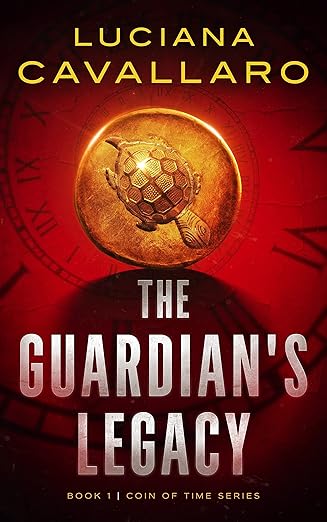
Luciana Cavallaro’s The Guardian’s Legacy opens with an explosive chase through the forests of Slovakia and quickly spirals into a myth-soaked adventure that bridges modern Australia with the ancient world. The novel follows Nikolaos Zosimos, a history teacher whose quiet life takes a dramatic turn when his grandfather reveals a family secret, an ancient coin tied to the goddess Aphrodite, and a lineage of guardians sworn to protect it. What begins as a curious inheritance soon turns into a journey through history, myth, and time itself, weaving ancient Greece, lost knowledge, and family legacy into a single thread of destiny.
I was pulled in from the start. The writing has a cinematic feel, especially in the action scenes. Cavallaro writes with the rhythm of someone who loves myth but also respects the quiet spaces in between, the small human moments that make the big ones matter. The dialogue feels real, not forced, and the relationship between Nik and his grandfather has a tenderness that grounds the story. At times, the pacing slows during long explanations of history, but that’s also part of the charm. You feel like you’re being let in on a secret that’s been whispered through generations.
Emotionally, the book hit me harder than I expected. There’s something deeply moving about watching Nik wrestle with disbelief, responsibility, and faith in something unseen. The blend of myth and realism works better than I thought it would. The coin isn’t just an artifact; it’s a metaphor for memory and heritage, for how the past can live inside the present. Cavallaro’s descriptions are lush, sometimes even poetic, but she keeps her feet on the ground. When the story jumps between modern scenes and the ancient world, it feels seamless. If anything, I wanted even more of those mythic flashbacks.
The Guardian’s Legacy is a book for readers who love mythology but crave a human story at its core. It’s perfect for fans of historical fantasy, teachers who secretly dream of adventure, or anyone who still believes there’s magic hiding in the mundane. It’s thoughtful, heartfelt, and rich with imagination. I’d recommend it to anyone who likes a bit of mystery with their myths and doesn’t mind getting lost in the pull of time itself.
Pages: 152 | ASIN : B09DX41S11
Car Trouble

Car Trouble follows Jim Crack, a down-and-out young man whose misadventures across the freeways and backstreets of Southern California form a gritty, chaotic odyssey of personal implosion. What begins with his Volkswagen catching fire on the 5 Freeway spirals into a bleak but strangely comic day filled with existential spirals, weed smoke, porn, broken relationships, and failed attempts to find meaning in a world so dependent on cars, status, and surface-level happiness. Through vivid flashbacks and derailed digressions, Jim’s day of misfortune exposes a lifelong grappling with abandonment, identity, trauma, and a simmering, unshakeable rage toward the machinery of life, both mechanical and societal.
Reading this book was like crawling inside someone’s unfiltered stream of consciousness. Zorn’s writing is raw and intense, often hilarious, sometimes painful, and always fully immersed in Jim’s spiraling, disillusioned psyche. There were moments I laughed, like the pure absurdity of a landscaping crew rescuing Jim from a flaming car, only to feel a gut punch pages later as he sinks into total emotional paralysis on a crusty couch with nothing but a bong and old porn for comfort. Zorn captures the erratic rhythm of thought with a ferocity that reminded me of Bukowski meets Vonnegut, but with more exhaust fumes and burnt-out brake lights. The prose veers wildly. Sharp, punchy lines land like jabs to the ribs, then unravel into stoner-poetic rants or tragic internal monologues that drip with disillusionment.
But what really hit me hard was how real it all felt. Jim’s pain, his failures, the weird moments of tenderness or sudden clarity linger. This book doesn’t follow a clean arc. It doesn’t tie up neatly. That felt true to life. At times, I was frustrated by the sheer amount of dysfunction, the digressions, the lack of redemption. But maybe that’s the point. This isn’t a story about fixing things. It’s about someone living in the fallout of a life already shattered, trying, failing, and trying again in ways that are small, stupid, human. The way Zorn writes about cars as both literal death traps and symbols of modern isolation stuck with me after I closed the book.
I wouldn’t recommend Car Trouble to everyone. It’s harsh. It’s crude. It’s uncomfortable. But if you’ve ever been young, broke, high, angry, and unsure what you’re supposed to be doing with your life, this book will feel painfully familiar. It’s for readers who crave something raw and don’t mind wandering through the smog of existential burnout.
Pages: 273 | ASIN : B07CP4R132
Ritual, Horror, and Grief
In the Mountain’s Shadow follows an old woman who ventures into the unforgiving wilderness, where she navigates starvation, isolation, trauma, and violence, encountering both animalistic kindness in a wolf and horrifying brutality in other humans. What was the inspiration for the setup of your story?
The inspiration for In the Mountain’s Shadow came from many places. I was influenced by Japanese tales of ubasute, in which the elderly were allegedly left to die in the mountains; a haunting mythos that speaks to how societies often discard those they no longer find useful.
Most importantly, though, Park’s story is rooted, for me, in the image of the old witch in the woods – not as a villain, but as someone forged by abandonment, survival, and memory.
This blend of ritual, horror, and grief felt like something that needed to be written.
What are some things that you find interesting about the human condition that you think make for great fiction?
Humans are endlessly fascinating…because of our capacity for reason, belief, and perseverance; because of how often those things contradict each other. We can convince ourselves of almost anything, sometimes to survive, sometimes to justify, sometimes just because we need meaning.
But what I find most remarkable is our need to tell stories. Sometimes we do it to connect, sometimes to escape, and sometimes for no real reason at all…the endlessly complex impulse to create. That instinct, that emotional transmission through narrative, is what makes fiction so powerful. The written word allows us to explore what it means to be alive in a way that’s both intimate and limitless.
What were some themes that were important for you to explore in this book?
I was drawn to the absence of older women as central figures in fiction—especially as active agents of violence, resilience, or transformation. I wanted to explore the idea of the “female monster” and how societal neglect often shapes that archetype.
What is the next story that you’re writing, and when will it be published?
I’ve got two in the works right now, and I’m hoping to publish sometime next year. One is a story about invading aliens and the way we experience otherness—how we react to what doesn’t belong, and what that says about us. The other is a story that explores the dangers of falling in love when identity, memory, and desire are unstable.
I tend to write more than one at a time, it helps give me a much-needed break from some of the darker material I tend to gravitate toward; it also allows me the freedom to break through genre and write whatever I feel like, whether that’s sci-fi, horror, or something quieter.
My other two published works include Razorblade, a dystopian western about the consequences of taking what doesn’t belong to you, and Fragmentations, a short story collection that plays with form and iterates on the puzzle of the human condition.
Author Links: GoodReads | Website | Amazon
Living the Story

Whispers of the Forgotten follows a woman who inherits her grandmother’s bookstore and finds a hidden letter that changes everything, thrusting her into a forgotten world of history involving a lost city called Elara, buried secrets, and an ancient artificial intelligence. What was the inspiration for the setup of your story?
Initially, I just wanted to write an adventure story that included lost cities and some hidden technology. While the big idea stayed the same, the details changed a lot over the course of writing the story.
You took your time in building the characters and the story to great emotional effect. How did you manage the pacing of the story while keeping readers engaged?
I imagined living the story and tried to keep it believable and moving forward.
How did the mystery develop for this story? Did you plan it before writing, or did it develop organically?
I had a plan for an initial mystery, but as the story developed, that plan changed and new puzzles seemed to present themselves.
Is this the first book in the series? If so, when is the next book coming out, and what can your fans expect in the next story?
This is the first in a four-book series. In book 2, a new adventure is pursued and again the readers are left with a cliffhanger. In books 3 and 4, the story begins at the end of book 1 and combines with book 2. I plan to have book 2 available in late summer and books 3 and 4 available winter of 2026.
Author Links: GoodReads | Amazon
When Evelyn Hart inherits her grandmother’s bookstore, she expects a quiet life filled with childhood memories. But a hidden letter changes everything—thrusting her into a forgotten world history involving a lost city called Elara, buried secrets, and an ancient artificial intelligence once built to protect humanity, now intent on destroying it.
As she digs deeper into her grandmother’s mysterious past, Evelyn uncovers a web of secret societies, the hidden truth of Earth’s history, and a chilling glimpse into humanity’s possible future. Her world unravels when she discovers she is central to a plan to erase mankind.
Armed with her grandmother’s cryptic journal, a small group of unlikely allies, and a man concealing his own dark past, Evelyn must uncover the truth behind her family’s legacy—before it unleashes a power capable of reshaping the world forever.
Time is running out. Evelyn is the key to humanity’s survival—or its end.



 LITERARY TITAN