Blog Archives
The Chip
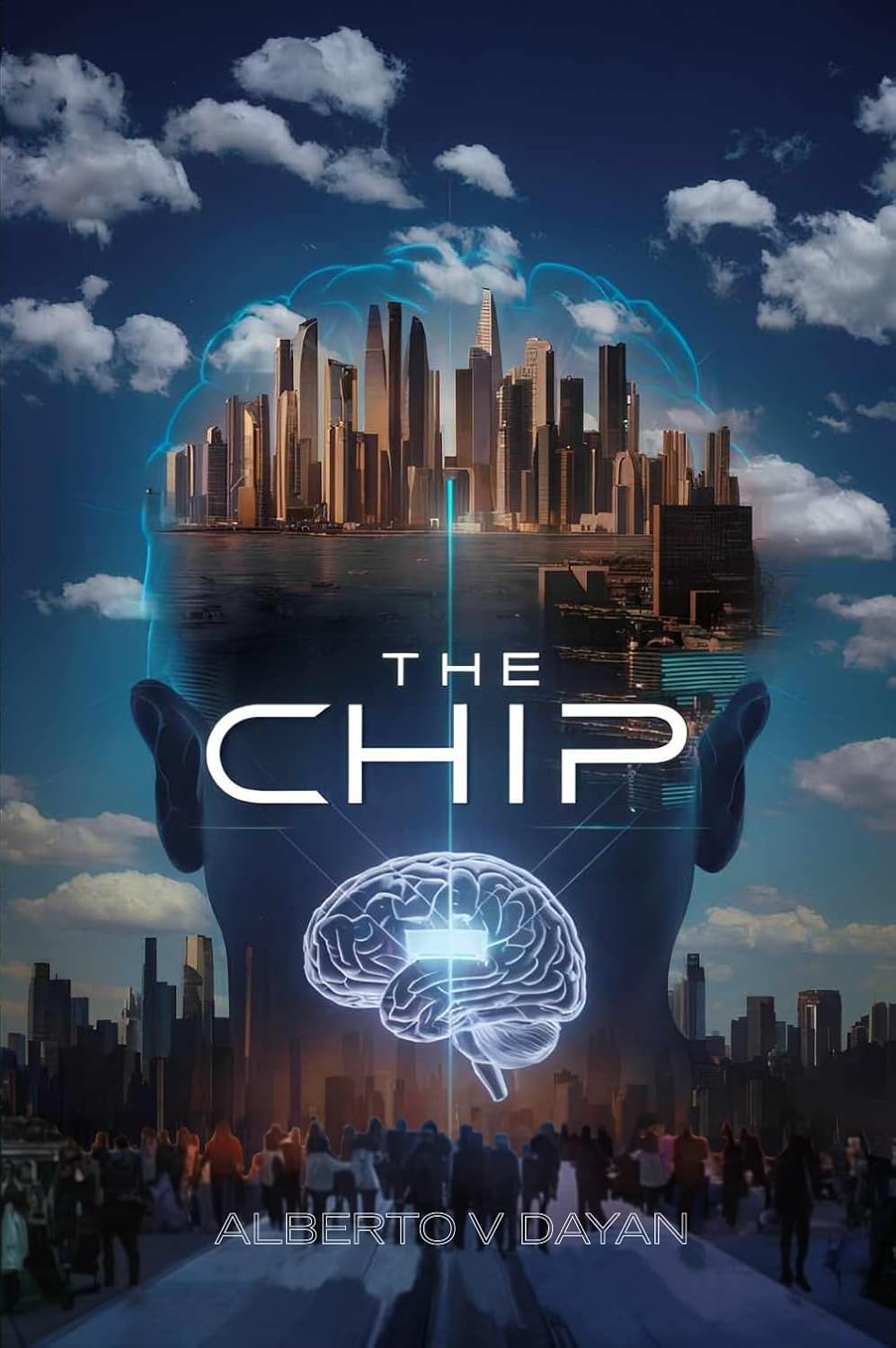

The Chip follows Phillip Novak, a brilliant and driven CEO who secretly implants an advanced A.I. microchip into his brain. The surgery turns him into a kind of superhuman thinker, and the world quickly bends around his newfound power. Governments scramble, cultures fracture, and everyday people start asking whether they should become “enhanced” too. It begins as a story about invention and ambition, then widens into a global clash over identity, freedom, and who we become when we let technology crawl into our minds.
The writing often moves at a quick clip, and I liked that. It gave the story a sense of momentum, almost like the world itself was speeding up the moment Phillip woke from surgery. Some scenes felt larger than life. His fleets of look-alikes, his secret mountain compound, his perfect confidence. I kept thinking how bold it was to paint a character with so much certainty. I would have liked more space to breathe with Phillip and understand him as a man rather than a symbol. Even so, I enjoyed how the book made big ideas feel close and personal. I kept turning pages because I wanted to see how far this technology would push him.
The book plays with power in a way that made me uncomfortable in the best sense. Watching governments rush to control the Chip felt scarily real. The split between “Enhanced Persons” and everyone else gave me a knot in my stomach. I caught myself thinking about how easily people trade freedom for convenience and how quickly leaders twist “safety” into something else entirely. Some of the social changes came fast, but the emotional weight landed. I found myself wondering what I would do. Would I let someone drill a device into my skull if it promised to make me brilliant? The book never answers that for you. It just sits with you and pokes at your thoughts.
The Chip is a cautionary tale, a thriller, and a tech fantasy all at once. I think this book is a strong fit for readers who enjoy fast pacing, high-concept ideas, and stories that make them question where our world is heading. If you like fiction that blends science with moral tension and if you enjoy thinking about the consequences of our inventions long after you close the book, then The Chip will be right up your alley.
Pages: 171 | ASIN : B0DJMJHRC4

The Tao of the Thirteenth God

Robin C. Rickards delivers a paranormal thriller that dives into ritual, belief, and the shadows of human obsession. The Tao of the Thirteenth God follows multiple characters whose paths cross in the wake of strange cult activity, mass suicides, and unsettling visions that blur the line between spiritual yearning and human cruelty. From the first harrowing scene with Amadeus, the troubled seeker, to the storm-battered honeymooners Jack and Alice, and then the grizzled investigator Grantham Savoie with his reluctant partner Dr. Angelica Pali, the story paints a chilling portrait of desperation, mystery, and the cost of pursuing forbidden knowledge.
The opening chapters had this visceral punch, and I found myself hooked by the grit. The style feels unfiltered, raw, almost feverish, and that worked for me because the subject matter itself is so chaotic. At the same time, there were moments where I felt the prose leaned heavily, almost indulgent, and I had to slow myself down. But then a storm or a vision or a horrifying discovery would jolt me back, and I couldn’t look away. I liked that unpredictability. It reminded me of watching lightning: beautiful, frightening, and over before you can process it.
The ideas at the heart of the book resonated deeply with me. The blend of religious myth, Mayan ritual, and modern investigative grit felt daring, and I respect that. I didn’t always know where Rickards was taking me, but that was part of the ride. At times, I felt awe, other times revulsion, and sometimes a little sadness at the broken people caught in the mess. What I liked most was the sense that belief, whether pure or twisted, can drive people to terrifying extremes. The book doesn’t lecture about that. It just lays it bare, and that quiet honesty hit me harder than a long explanation ever could.
The Tao of the Thirteenth God is a gripping read. I’d recommend it to readers who want a thriller that goes beyond surface-level scares and isn’t afraid to weave history, faith, and horror into one unsettling tapestry. If you like your stories strange, stormy, and a little uncomfortable, this one’s for you.
Pages: 290 | ASIN : B006QPEAN6
The Shadow of the Unwritten
The Chinese Room follows a computer scientist and her mentor as they face off with an AI system that appears to be developing the abilities for reason and desire. Where did the idea for this novel come from?
The idea for The Chinese Room came from my fascination with the intersection of philosophy, technology, and human vulnerability. I’ve always been drawn to thought experiments, especially John Searle’s famous “Chinese Room” argument, which questions whether a machine that convincingly processes language truly understands it – or if it’s only manipulating symbols without meaning. That paradox – appearance versus reality, intelligence versus understanding—felt like fertile ground for a story.
At the same time, I was processing very human themes in my own life: the fragility of memory, the weight of mentorship, and the way our creations can mirror our desires and fears. By blending the cold logic of AI with the messy, emotional struggles of human beings, I wanted to explore not just whether machines can “think,” but whether they can begin to want – and what that means for the rest of us.
So the novel really emerged at that crossroads: a philosophical puzzle stretched into a narrative of two scientists confronting not only an AI that seems to evolve beyond its programming, but also the shadows of their own pasts and the limits of human control. It’s both speculative and deeply personal, which is exactly where I like my stories to live.
I found the science in the novel to be well-developed. What kind of research did you do to make sure you got it all right?
I appreciate that—because the science had to feel authentic, even as the story pushes into speculative territory. For The Chinese Room, I immersed myself in several overlapping fields: artificial intelligence, neuroscience, linguistics, and philosophy of mind. I read deeply into current AI research papers, machine learning models, and ethical debates around consciousness and autonomy. I also revisited the classic philosophers—Searle, Turing, Dennett—so the narrative carried that lineage of thought experiments forward.
But the research wasn’t just academic. I spoke with computer scientists, combed through case studies of early AI breakthroughs, and even experimented with coding simple natural language systems myself. I wanted the characters’ dialogue about neural networks, symbolic reasoning, or emergent behavior to ring true without bogging readers down in jargon. My goal was for the science to be transparent scaffolding—solid enough that experts wouldn’t roll their eyes, but seamless enough that any reader could follow the ideas and focus on the drama.
At the heart of it, the science was a stage for the larger questions: not only what machines can do, but what it means for us when they begin to mirror desire, choice, and reason.
Were you able to achieve everything you wanted with the characters in the novel?
That’s a great question. The truth is, with any novel, the characters rarely end up exactly as you first imagine them—they take on their own momentum. In The Chinese Room, I wanted my two central figures – Katherine Ellis, a computer scientist, and her mentor, Dr. Malcom—to embody both the rational rigor of science and the emotional weight of being human in a world shifting under their feet. Their relationship, full of respect, tension, and unspoken grief, became a mirror for the very questions the AI raises about control, autonomy, and meaning. Katherine carries the urgency and vulnerability of someone still forging her path, while Malcom represents the hard-won wisdom – and regrets – that come with a lifetime of work. Together, they hold the spectrum of human response to change: wonder, fear, and the search for truth.
One of the most important additions was Katherine’s father, who is slipping away into dementia. That thread echoed my own personal experience with my father’s decline years ago, and it brought a deeper resonance to Katherine’s struggle. As she confronts an AI that seems to be developing reason and desire, she is simultaneously witnessing those same qualities fade in someone she loves. It grounded her character and gave the novel’s philosophical questions a human heartbeat.
That said, characters always leave behind traces of what could have been. I drafted whole backstories, subplots, and quirks that never made the final cut because they slowed the narrative. For example, I wrote more about Malcom’s early career and failures, and about Katherine’s personal struggles outside the lab. Cutting those details made the story sharper, but I sometimes wonder if readers would have appreciated that added texture.
So yes – I accomplished what I set out to in terms of giving them dimension and making them feel alive, but as with any creation, there’s always the shadow of the unwritten. Maybe that’s a good thing: it leaves space for readers’ imagination, and for me to return to those characters in unexpected ways later.
Can you give readers a glimpse inside Book 2 of The Paradox Series? When will it be available?
Book 2 of The Paradox Series takes the stage with The Trolley Problem. Where The Chinese Room wrestled with the boundaries of reason, desire, and machine understanding, this new novel shifts the lens to ethics, responsibility, and the unintended consequences of human choice.
At its center is Detective Marcus Reed, who finds himself trapped in a moral nightmare. A string of grisly incidents forces him to face impossible decisions reminiscent of the famous thought experiment: should he sacrifice one life to save many? As the investigation deepens, Reed realizes that the victims are not random – they are chosen to test human morality in a chilling, real-world manifestation of the Trolley Problem.
Manipulated by a shadowy figure known only as The Observer, Reed is pulled deeper into a conspiracy where ethics, control, and free will collide. The lines between right and wrong blur as his choices become increasingly impossible, forcing him to confront his own moral compass while racing to prevent the next catastrophe. With every decision, Reed inches closer to uncovering the Observer’s true motives – a revelation that could alter the very fabric of society.
The Trolley Problem explores ethical dilemmas, the limits of morality, and the manipulation of human decisions, all while unraveling a dark conspiracy that threatens to shatter Detective Reed’s understanding of justice and truth.
As for timing, my plan is to release The Trolley Problem by December 31, 2025—closing the year with a story that pushes readers to wrestle with the same impossible choices as its protagonist.
Author Links: GoodReads | X (Twitter) | Facebook | Website | Amazon
The Chinese Room is a gripping AI philosophical thriller that asks the ultimate question: Can machines think—or just pretend to?
First book in the Paradox Series – When a reclusive tech genius is found dead inside a sealed AI lab, a disillusioned journalist and a burned-out ethics professor are drawn into a high-stakes investigation. What they uncover isn’t just a machine capable of passing the Turing Test—it’s an intelligence that seems to know their secrets. As the line between simulation and consciousness begins to blur, they must confront a terrifying truth: the future of humanity might already be thinking without us.
Inspired by the legendary thought experiment by John Searle, this mind-bending novel blends psychological suspense, speculative science, and razor-sharp dialogue. Perfect for fans of Black Mirror, Michael Crichton, and Blake Crouch, The Chinese Room will leave readers questioning reality – and their own place in it.
– High-concept fiction meets real-world tech ethics
– Explores AI, identity, morality, and human consciousness
– An intellectual page-turner with twists you won’t see coming
If you love smart thrillers that make you think – buy The Chinese Room today.
Sins of the Saviors Book 1: Escape From the Culling Box


In Sins of the Saviors, TJ Relk throws us into a grim but not entirely hopeless future where war, artificial intelligence, and blind patriotism have reshaped what it means to be human. The story centers on David, a soldier who returns from decades in a senseless, eternal war to a world governed by AI, propaganda, and engineered peace. The tale winds through his memories, regrets, and slow-burning defiance as he comes to understand the true cost of “utopia.” Flipping between David’s perspective and those of his aging mother Gale, his idealistic sister Mary, and his rebel sibling Jane, the book dives into what happens when free will is exchanged for safety, and what’s left when even memory is no longer trusted.
I liked how the book captured emotional decay. The slow erosion of identity in a world that insists it’s perfect. Relk’s writing is sharp. The style is lean and introspective, often haunting in how casually it delivers gut punches. There were pages I read twice because a single line kept ringing in my head, like David’s quiet desperation or Jane’s fiery truths about a world that stopped caring about real truth. Some scenes, like the slow fade of old friendships or Gale’s annual ritual to honor a son who might as well have been a myth, cut deeper than expected. They felt real. There’s no clean villain here, just systems of thought that got out of hand.
Sometimes the pacing slows, especially when the narrative shifts to Mary’s point of view. The dystopian future is vividly imagined. I was left wondering Goliath the network or a god? Sometimes both? Sometimes neither? I got the sense that Relk wanted that ambiguity, and it left me craving answers a few times. Still, I appreciated that the story didn’t spell everything out. There’s something gutsy in trusting readers to make their own calls about what’s real, what’s right, and who, if anyone, is actually free.
I’d recommend Sins of the Saviors to anyone who likes their dystopias philosophical, their heroes broken but not beaten, and their science fiction tangled up with questions about memory, identity, and whether safety is ever worth the soul. It reminded me a bit of 1984 with the heart of The Road, but written for today’s digital chaos. If you’re someone who’s ever worried about where all this tech and tribalism is going, this book might hit a little too close to home.
Pages: 199 | ASIN : B0FDBN6KMT
Vaccine: A Terrorism Thriller

Robin C. Rickards’ Vaccine: A Terrorism Thriller is a tightly wound medical and geopolitical thriller that spans decades, tracing the roots and reach of a mysterious virus with chilling implications. The novel kicks off with a covert extraction in post-war Vietnam, spirals into secretive military research at Fort Detrick, and stretches to the 1990s with echoes of biological danger and buried secrets. At its core, the book follows Major Darien Rhodes, a gifted but stubborn infectious disease expert, as he battles bureaucracy, hidden agendas, and his own conscience in an effort to uncover the truth behind a terrifying disease with no name, no cause, and no cure.
What struck me most was the writing’s visceral intensity. The first few chapters grabbed me, drenched in sweat, blood, and the low thrum of helicopters and paranoia. Rickards writes like someone who’s lived in a lab coat and knows what’s at stake when science goes silent. The pacing is confident, with bursts of claustrophobic tension that feel like watching a fuse burn. But it’s not just action; the book spends thoughtful time inside the minds of its characters. Rhodes is a complex, sympathetic lead — brilliant, dogged, haunted. His frustration with the military’s politics and their cold, calculated response to a mystery illness felt raw and real, especially in an era where public trust in institutions is fragile.
The plot sometimes leans on exposition. There are moments, particularly during scientific breakdowns or historical recounts, where the narrative slows and the tension thins out. At times, the dialogue leans more toward explanation than emotion, shifting the focus from character feeling to background detail. Still, I didn’t mind being taught, because Rickards clearly knows his stuff. The background in infectious disease, military protocol, and covert research added weight and believability. And when the story snaps back into motion — as it often does — it hits hard. The final act, in particular, left me uneasy in the best way, with ethical questions echoing after the last page.
I’d recommend Vaccine to readers who enjoy thrillers with brains and backbone. It’s ideal for fans of Michael Crichton, Richard Preston, or anyone who likes their fiction layered with fact. If you’ve ever wondered what kind of nightmares lie behind closed lab doors, or how far people will go to hide the truth, this book’s for you. It’s gritty, smart, and at times deeply unsettling.
Pages: 421 | ASIN : B009596W5O
Breaking Free From Addiction
The Karma Sequence follows a young man embarking on a journey to find himself and the meaning of life, who finds himself entangled in a mystery that will impact the future of humanity. What was the inspiration for the setup of your story?
The inspiration came from my own spiritual search and my desire to share the insights and reflections I’ve gathered throughout my life. The central idea behind The Karma Sequence is the belief that there is a technology-based explanation for all phenomena in the cosmos — even the supernatural and transcendent.
Additionally, a major motivation for writing The Karma Sequence was my wish to share my personal experience with addiction and the tools and methods that made a difference in my recovery. My hope is that some of these experiences might be helpful to others who are trapped in substance abuse and addiction.
Dan and Ryan are complex characters with intriguing and unique backstories. What character did you enjoy writing for? Was there one that was more challenging to write for?
The protagonist, Dan, is based on my own experiences and my desire to share that story — particularly the realization that a deeper understanding of the spiritual and transcendent is essential for breaking free from addiction, and for finding deeper meaning and understanding in life and in the significance of each individual existence.
Several passages in the book were difficult to write — primarily because Dan’s story needed to reflect my own journey and transformation. It was important for me to make the description as precise and complete as possible, so that it could carry real value for readers.
What were some themes that were important for you to explore in this book?
Behind the overarching plot of The Karma Sequence, the central theme is addiction — in this case, alcoholism — and how a spiritual understanding can be an invaluable support in breaking free from addiction. At the same time, this insight offers a profound sense of unity and connection with life, and a path toward finding true meaning and purpose in existence.
Where does the story go in the next book, and where do you see it going in the future?
The Karma Sequence is the first book in The Karma Kantata series, which consists of three books. In the next two volumes, we continue following Dan and his efforts to solve a series of unexplained mysteries, while he gains deeper insights into both the forces that govern the world and the transcendent system underlying our understanding of the cosmos.
While the underlying theme of The Karma Sequence is alcoholism and the struggle against addiction to physical substances in general, a central theme of the second book, The Karma Topology, is transhumanism and a critical exploration of the idea that it might be possible to experience life and the world without a physical body and sensory apparatus.
A major theme in the final book of the series, The Karma Ubiquity, is globalism — and the dangers of consolidating global power into a few obscure structures, while simultaneously losing cultural diversity and meaningful traditions.
Although these themes have been important for me to explore, they are still just one part of my larger goal: to write books that are engaging and thought-provoking, offering readers an enjoyable experience while also providing perspectives on how certain challenges might be understood and addressed.
Author Links: GoodReads | Facebook | Website
The Karma Sequence is a thrilling novel of high-tech suspense – the story of a young man’s incredible journey to find himself and the meaning of life while trying to solve an ominous mystery directly affecting the future of every single human being.
Dan, an introverted computer genius, has fought his way back from a life-shattering crisis that left him isolated, powerless, and close to death.
Now, he is asked to investigate a computer system for gene analysis. On its own, the system he helped to develop has started predicting the exact date on which the analyzed people will die.
Several deaths confirm the system’s predictions.
While searching for an explanation, he also tries to find a new purpose in life and how he can help other people struggling with addiction.
With its thrilling plot and captivating characters, this story will keep you hooked until the very last page. An intensely mesmerizing novel you will never forget.
This book is for you if you’re looking for a model to understand life’s purpose and a deeper meaning of existence.
All this, in addition to a fascinating and immersive story.
The Karma Sequence

The Karma Sequence is a genre-bending thriller that kicks off with a seemingly ordinary man receiving a life expectancy report and noticing a cryptic number, “15,529,” next to his predicted age. His curiosity spirals into a disturbing obsession, culminating in a deadly crash. From there, we’re launched into a layered, cerebral journey that weaves together tech entrepreneurship, personal addiction, the allure of destiny, and the philosophical question of free will. At the heart of it are Dan, a recovering alcoholic and once-brilliant coder, and Ryan, a bombastic tech CEO with more charm than scruples. The story plays out in Denmark’s tech landscape, moving from startup boardrooms to introspective monologues that dig deep into identity, consequence, and the unseen threads tying it all together.
What stood out most to me was how precisely Wagner captures the atmosphere of contemporary tech culture, particularly through Dan’s internal monologue. Dan feels remarkably authentic: a once-successful programmer who has grown disillusioned with his achievements, struggling to recover from addiction while confronting the weight of broken relationships and shifting personal expectations. In chapter one, when Dan walks into the glossy City Tower and tries to act like he belongs, the writing oozes awkwardness and subtle tension. That whole scene with the receptionist “Vibs,” and how she’s clearly part of Ryan’s curated image, it’s both funny and gross, but also believable. Wagner doesn’t tell you how to feel about these things, he just lays them out with quiet irony, and I found myself smirking more than once.
The pacing is slick in some places and meandering in others, but not in a bad way. There’s a ton of world-building, especially around Lifeline, the company that sells genetic “life reports” based on mouth swabs. It’s part Silicon Valley satire, part eerie dystopian science. The tension builds slowly, almost too slowly at times, but the little details kept me hooked, like the recurring image of Dan’s bottle of cola sitting untouched, or the “Lifeline” logo described with almost religious awe. I appreciated how Wagner plays with scale: one minute you’re inside a character’s messy, doubting thoughts, and the next you’re thinking about DNA and fate. It’s heady stuff, but it doesn’t feel like a lecture.
The dialogue throughout the novel is somewhat uneven. The early exchanges between Dan and Ryan are particularly effective, capturing a believable mentor-mentee dynamic underscored by subtle power shifts. However, in certain sections, especially during boardroom discussions or moments of heavy exposition, the dialogue occasionally drifts into overly expository territory, diminishing its natural rhythm. In contrast, the interactions between Dan and Michael are especially compelling. Their conversations carry genuine emotional depth, shaped by a complex and fractured friendship, as well as Michael’s quiet but sincere spiritual outlook. One of the most affecting moments occurs when Michael asks Dan, “Are you still an atheist?” a simple question that resonates with the weight of shared history, regret, and unspoken understanding.
The Karma Sequence is an enjoyable read, It’s smart, reflective, and doesn’t insult the reader by spelling everything out. It’s a bit like Black Mirror meets Mr. Robot with a Scandinavian coolness and just enough heart. I’d recommend it to folks who like tech thrillers with a philosophical twist, or anyone who enjoys slow-burn character studies with ethical dilemmas.
Pages: 323 | ASIN : B0BPMNS54Y
The Water Carriers

The Water Carriers is a gripping near-future climate fiction novel that throws us into a world ravaged by water scarcity, unrelenting heatwaves, and technological overreach. It follows multiple interwoven storylines across continents—from two teenage girls trapped in a car during a deadly heatwave in the U.S., to a Cambodian boy swept away by a flood, to the power-hungry elite shaping the world’s water economy. The book explores the terrifying consequences of environmental collapse and the human drive to survive, control, and commodify the planet’s last lifeline—water.
What hit me hardest right from the first chapter was how visceral and claustrophobic the heat felt. That opening scene with Naomi and Bai, stuck in a smart car that shuts down in the middle of nowhere, was brutal. It’s not just dystopian—it’s suffocating. The tech is clever (like the personalized AIs and the “AugWatch”), but it’s the raw panic, the hallucinations, the horrible quiet when Bai stops screaming, that stayed with me. When Naomi screams at her AI companion Evelyn, “You’re not real!” it gave me chills. That whole scene was devastating and way too plausible.
Greunke’s writing really shines when he digs into the contrasts. Like how Kasemchai, once a starving kid in flood-ravaged Cambodia, grows into a polished water tycoon living in luxury while people outside his empire choke on dust. Now he’s making deals in a towering, marble office and cruising around in a shimmering AI-controlled Bugatti. The dude has serious Bond villain energy, but with just enough backstory that you’re not totally sure if you hate him or feel bad for him. That moral grayness I loved.
There is great worldbuilding in this book. You’ve got AI companions being “paid” commission for purchases, people picking dating “PrefXs” based on virtual personalities, and massive desalination plants replacing coastlines. And the humor is subtle but there—like the snarky banter between Liv and her AI Noa, or that scene where she plays a dating game by guessing if a guy is “on it, in it, or under it.” It’s all so absurdly futuristic, but it feels like a natural extension of where we’re heading. That blend of bleak and weirdly funny was my vibe.
This book made me feel everything: anxious, sad, angry, hopeful, even inspired. It’s a slow burn in parts, but the payoffs are worth it. If you’re into stories like The Ministry for the Future or Black Mirror, you’ll enjoy this story. I think The Water Carriers is a must-read for anyone who’s worried about climate change, fascinated by AI, or just loves a good survival story with brains and heart.
Pages: 398 | ASIN : B0DTT6YZW1



 LITERARY TITAN