Blog Archives
Tachyon Tunnel 3
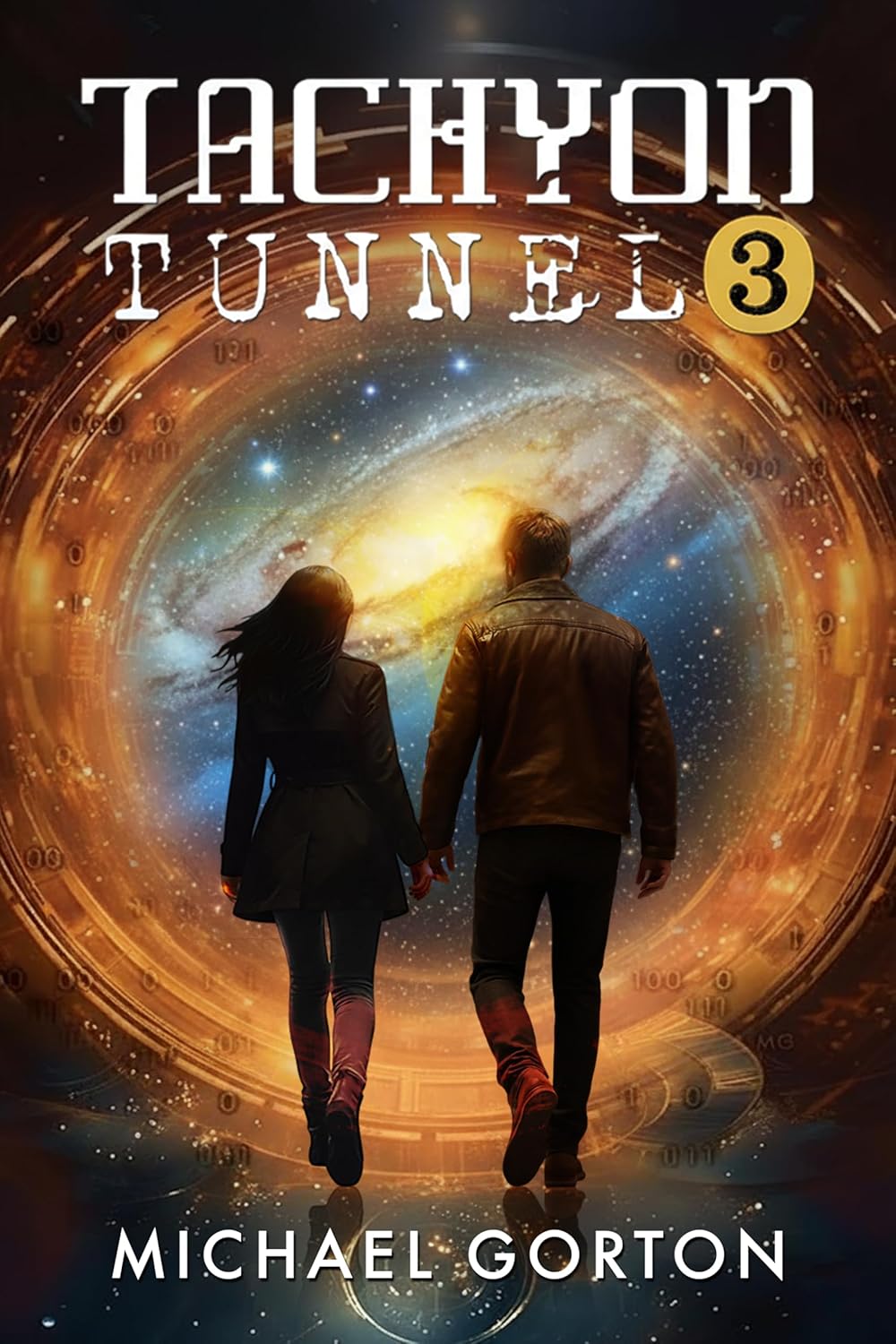

Tachyon Tunnel 3 continues the breathtaking saga of Alex Durant, Paula Campbell, and the evolving AI, Emily, as they face a galaxy on the brink. The story picks up where the last book left off: Earth barely spared from annihilation and the Daklin Empire’s grip tightening over the Milky Way. Author Michael Gorton plunges us into a universe brimming with complex technologies, alien politics, and impossible odds. We meet Fortak, a Daklin scientist stranded on Earth, and follow the growing resistance led by Alex and his allies. There are vast ships that hold cities within their hulls, civilizations millions of years old, and battles that unfold across the fabric of space and time. It’s part space opera, part philosophical exploration of humanity’s place in the cosmos.
Gorton’s writing crackles with energy. His descriptions of the Martian Empire and their cities made me feel the weight of their history, their pride, their downfall. The pacing runs hot, but it fits the chaos of a war that stretches between galaxies. I loved how science isn’t just a backdrop here. It’s part of the soul of the story. Tachyon tunnels, plasma consciousness, and sentient AI aren’t just gimmicks. They’re extensions of how we think about creation and survival. I wanted to sit longer with the characters, especially Fortak, who’s both villain and victim. His curiosity and isolation hit me harder than I expected.
Emotionally, this book is a roller coaster. It made me think about what it means to be human in a universe filled with beings far older and smarter. The scenes on Andromeda Prime, with its harmony and peace, contrasted beautifully with the Daklin Empire’s cruelty. There’s awe in the way Gorton writes about discovery. There’s sorrow in his portrayal of loss. And yet, there’s a spark of hope that keeps burning, even when the odds seem hopeless. I found myself rooting for Emily, the AI who feels more alive than most of the humans. Her growth and sharp wit gave the story its heart.
I’d recommend Tachyon Tunnel 3 to readers who love big ideas mixed with real emotion. If you enjoy science fiction that feels vast but still human, this one’s for you. It’s for those who want their space battles served with philosophy and heart. Gorton writes like someone who believes in both science and soul, and that combination makes his universe feel alive.
Pages: 519 | ASIN : B0DWKRQFJS

The Gift


The Gift follows Emery, a young woman pulled into a strange dimension where voices, shadows, and visions drag her into a fate she never asked for. The novel is about her journey to rescue her mother, uncover hidden truths about her powers, and navigate an ancient and perilous world that teeters between myth and science. There are black holes that bend time, creatures that lurk in slithering shadows, and tribes that live by instinct and survival. But underneath the cosmic spectacle, it is really about one woman’s fight to hold on to family, identity, and purpose in a reality that constantly shifts beneath her feet.
The writing surprised me. It has a dreamlike quality in places, flowing almost like waves, then suddenly crashing into moments of raw grit and pain. The descriptions of the void, of light turning into memory, of bodies disintegrating and reforming, made me pause and reread because they were so vivid. But then the author would drop Emery into the dirt, into hunger and thirst, into stumbling mistakes, and it grounded everything. That combination kept me engaged. Sometimes the prose was a little heavy, but the emotional weight pulled me through. I found myself caring about Emery’s stubbornness, her doubts, her messy humanity, even as she was tasked with saving more than just herself.
What really stayed with me was the emotional pull of Emery’s relationships, especially her bond with Visla. Their friendship felt tender and real, the kind of connection that lights up even the darkest setting. I loved how their language lessons became a bridge between two worlds. I felt warmth reading their moments together, and sadness knowing Emery’s destiny might tear them apart. Emery’s constant second-guessing sometimes slowed the story, and I wished she trusted herself more. But then again, maybe that’s what made her believable. She wasn’t some perfect heroine. She was clumsy, scared, and hopeful, and that made me root for her all the more.
I felt like I’d been on a strange and exhausting journey right alongside Emery. The Gift is not just for fans of science fiction or fantasy. It’s for readers who want to feel the clash of fear and hope, who enjoy sci-fi stories where survival is as important as destiny, and where the heart matters as much as the universe. I would recommend it to anyone who likes their adventure raw and relatable, layered with both cosmic wonder and everyday struggle.
Pages: 381 | ASIN : B0FM77FD39

The Impossible Choice
Time Lines follows a group of characters who move between the Nazca desert, space stations, collapsed civilizations, and alternate timelines, trying to find a timeline that saves humanity. What was the inspiration for the setup of your story?
Originally, this idea was supposed to be a Mayan prophecy story/idea that I had back around 2010. It mostly involved the main foundation of my ultimate story – with 2012 approaching, I thought it would be interesting to revolve a story around the memory of a cataclysmic event involving the moon that would be sent back in the time with the astronauts who then help send a message forward. That moment came and went, and I never committed to writing the story.
My brother Peter passed away in June of 2021, and that experience and feeling of loss is what drove me to finally start writing. My brother was always an inspiration – a person who always worked to better himself and never left anything on the table, so to speak. The grief I felt after losing him inspired me to get this story out of my head. It became my outlet.
I have always been fascinated by ancient cultures – the Nazcan lines and the Nazcan people in particular and thought I could weave some of their unexplained history into my story. I admit, the story became a whole other thing after that.
I know that the combining of philosophy, some hard sci-fi, and the palatable feelings of loss and grief create what is perhaps a unique story. I wrote the story and then put it all together in a purposeful nonlinear flow that I hope will resonate with future readers. Memory isn’t linear, and neither is my story.
I agree it can be frustrating to read at times. That is purposeful. I want you to feel that sense of frustration and feeling of living similar moments over and over again – but set in different timelines. I want the reader to feel the same sense of loss that one of our characters feels after losing their family to the past. Only in the end do I allow the reader to see the story for what it is – A story of sacrifice, loss, and the wish to spend one more day with those you love that are now gone.
This story was and is at its very soul a story written to allow me to grieve in my own way. Once I wrote it, I then decided I owed it to the memory of my brother and to myself to share it. I have been fully committed to that endeavor since the book was published.
What are some things that you find interesting about the human condition that you think make for great fiction?
The human condition truly is a beautifully flawed idea to me. We call it a condition, as if it has been diagnosed with some ailment or disease. We, the ones bestowed with this condition, are not perfect, not even close. We strive to be better through our own actions, and many times, thankfully, with the help of those around us. If we are lucky, this gift can allow us to be better – to help tender our fire and hopefully in time that fire will grow into something even more beautiful.
What were some themes that were important for you to explore in this book?
Time Lines isn’t just a story about time travel. It’s a story of love, of loss, and of the impossible choice to leave your family in the past… so the rest of us might have a future.
It is also a story of grief and trying to take something back from the thief that is time, so that we have the hopeful chance to get it right just once.
Where do you see your characters after the book ends?
I hope that wherever they are – lost in time or those who have made the final sacrifice so that the rest could have a future will know that they had purpose. I see Elly, Max, Sunita, Renée, Sam, and Peter as they are in my mind – people who have lived a thousand lifetimes and have always been the best of humanity.
Through fractured memories created from these many lifetimes, these characters never cracked. Others, trapped in their shattered lives, could never move forward.
Author Links: GoodReads | Facebook | Instagram | TikTok | Website | Amazon
Four suits. Four names. No astronauts missing. No mission logged.
The spacesuits had been there for 2000 years—how did they get there?
When archaeologists uncovered them beneath the Nazca desert, time itself began to fracture.
What followed wasn’t just discovery. It was memory—echoing across centuries. It was sacrifice, carried from the Moon to the ancient past. And it was the desperate search for the only timeline that worked.
Time Lines is a haunting, non-linear science fiction novel where the past collides with the future, and memory itself becomes the battlefield.
Perfect For Fans Of
- Neal Stephenson’s Seveneves
- Arrival and thought-provoking, idea-driven sci-fi
- Emily St. John Mandel’s Station Eleven
- Post-apocalyptic and time-travel thrillers
Why You’ll Love It
- Nonlinear storytelling that mirrors memory itself
- Ancient mysteries intertwined with futuristic science
- Emotional depth: love, sacrifice, and the cost of survival
- A pulse-pounding finale where not every astronaut makes it home
Time Lines isn’t just a story about time travel. It’s a story of love, of loss, and of the impossible choice to leave your family in the past… so the rest of us might have a future.
The past is buried in the desert. The future is written in the stars.
Discover Time Lines today.
Time Lines
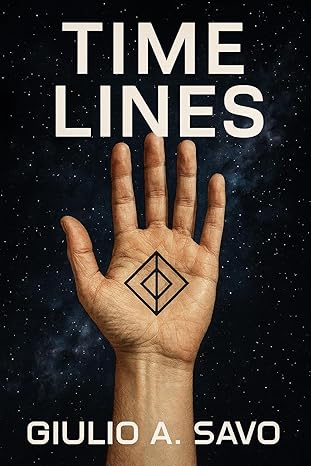
The book Time Lines by Giulio A. Savo is a sweeping and intricate story about memory, survival, and the fragile threads that connect our lives across timelines. It doesn’t just tell a straight tale. Instead, it bends and folds, presenting fractured futures, failed worlds, and the human struggle to get it right just once. Through characters like Samantha, Elly, Max, Sunita, Renée, and Andori, we move between the Nazca desert, space stations, collapsed civilizations, and alternate ages of humanity. At its core, it’s a meditation on memory, how it defines us, betrays us, and sometimes saves us. The science-fiction framework of neural resonance, timelines, and echoes is really just a way to explore grief, hope, and the longing for continuity in a fractured universe.
Reading this book felt like getting pulled into a dream. The writing is bold, lyrical at times, and not afraid to get messy. I loved how the narrative leaned into confusion rather than fighting it. Memory isn’t clean, and this story doesn’t pretend it is. I felt unsettled, even frustrated at points, but that seemed intentional. The voices of the characters lingered with me. Some chapters felt sharp and fast, almost brutal, while others slowed down into reflection, like drifting through echoes of lives I half-remembered myself. It reminded me of that strange sensation of déjà vu; familiar but haunting, like something just out of reach.
At the same time, I’ll admit there were moments where the complexity threatened to overwhelm me. The constant shifting between timelines and the weight of so many interlaced fates made it hard to follow at times. Yet, even in that chaos, I felt a strange intimacy with the story. The ideas about time as a thief and memory as both a curse and a gift hit me hard. There’s a raw humanity underneath all the science and cosmic scale, and that’s what kept me turning the pages. The book made me think about my own life, about the memories I cling to and the ones I’ve lost, and it left me feeling a little haunted in the best way.
Time Lines is a powerful and ambitious book that blends science fiction with philosophy and heart. It’s not for someone looking for a simple space adventure. It’s for readers who enjoy being challenged, who want a story that asks them to sit with uncertainty and lean into wonder. If you like novels that blur the line between speculative fiction and poetry, or if you’ve ever felt the pull of memory you can’t explain, this book will resonate deeply with you.
Pages: 399 | ASIN : B0FHHSYDDQ
Strength of Character

Jigsaw: The Face of the Joker follows a team of Temporal Guardians racing through time to save a single 1927 film whose failure could unravel a century of history, culture, and humanity itself. What inspired you to center the plot around The Man Who Laughs?
I have always, since the time my father introduced me to Abbott and Costello Meet Frankenstein, been a fan of Universal Horror Movies. What made me center on The Man Who Laughs is that the movie both set the cinematic scope for Universal classics like Dracula, Frankenstein, and The Mummy, but also provided, through Jack Pierce’s makeup for the Conrad Veidt character, the inspiration for Batman’s The Joker. When coming up with the story, I thought The Man Who Laughs would be a wonderful fork in the temporal roads to center on. I also wanted to pay homage to Paul Leni, an acclaimed director who died before his time and who may have directed Dracula with Veidt in the lead role had he not died prematurely from an infection.
The dynamic between Noah and Francesca feels particularly alive. Were any of their interactions drawn from real-life experiences or relationships?
Yes. I based it on some of the interactions between my wife, Gwyn, and myself.
Did you have a favorite scene to write, maybe one that brought together your love of film, history, and sci-fi in a satisfying way?
I like the scene where Francesca and later she and Noah dealt with Norman Kerry, the actor who tried to harass the women on set. It showed their strength of character and why they are indeed the heroes of the story. I also like the interplay between Paul Kohner and Noah and Josh, as well as the interactions between Mary Philbin and Francesca and Tori. It brought history alive.
The book has a sharp, cinematic style. Did you imagine it visually as you wrote, and has there been any interest in adapting it for the screen?
Yes, I did because I always thought back to scenes in Universal Horror classics for some of the chapters. There is also a subtle homage to Abbott and Costello Meet Frankenstein in the chapter with the custodians. There is also an interest in having it adapted for the screen.
Author Links: GoodReads | X (Twitter) | Facebook | Website | Amazon
Franesca and Noah are excited to start their new lives as newlyweds, but the fight for reality never ends! Catapulted back into yet another adventure, life is put back on pause.
Thrust into the battle to stop the vampire Lilith from helping Novus Ordo change history by stopping the production of the Universal silent movie The Man Who Laughs, Francesca, Noah, Tori, and Josh face off against the supernatural forces of evil in 1920s Hollywood — both in this universe and a parallel Neo-Fascist one.
Jigsaw: Shadow Ball

Jigsaw: Shadow Ball is a thrilling time-traveling adventure that mixes sci-fi action with powerful lessons from America’s racial past. Centered around a group of Temporal Guardians trying to preserve and repair the timeline, the story follows Noah and Francesca as they battle against shadowy forces like Global Harmony and the Grey Branch Foundation. Along the way, they cross paths with historical legends such as Larry Doby, Rube Foster, and Bill Veeck, learning how Black baseball helped kickstart civil rights movements. The book deftly interweaves speculative fiction with real history, taking readers on a rollercoaster from 1897 Texas to a dystopian 1980 Phoenix ruled by fascism and eugenics.
Reading this felt like binge-watching a high-stakes Netflix series. Gordon’s writing is snappy, visual, and deeply emotional when it needs to be. The characters are flawed but brave, and the dialogue flows like people talking in real life, not stiff, not overly clever. I loved how the story used baseball as a lens to view much bigger things: racism, resistance, and the price of progress. Rube Foster’s quote, “We are the ship. All else the sea,” really stuck with me. It gave the book a kind of heartbeat. But what hit me even harder was Cheryl’s descent. Her idealism turns to horror, and watching her realize how she accidentally created a nightmare world was genuinely heartbreaking.
At times the historical exposition gets a little dense. You might be deep in a firefight or an emotional reunion, and suddenly the story drops into a history lesson. It’s good stuff, important stuff, but it can slow the pace. Still, I’d rather have a story try something ambitious than play it safe the whole time. Gordon clearly cares deeply about this history, and it shows in every scene.
I really dug this book. It’s smart, bold, and weird in the best ways. If you’re into baseball, time travel, civil rights, or just want a wild story that respects its characters and its readers, this one’s for you. Shadow Ball would be perfect for high schoolers, history buffs, teachers, or anyone who believes that stories still have the power to change the future.
Pages: 160 | ASIN : B0DXMQXXZ8
Global History and Politics
Jigsaw: Sonora follows a group of ideological extremists who travel back in time to WWI to alter history, and a group of temporal guardians must stop them before their plan unfolds. What was the inspiration for the setup of your story?
Excellent question. Most of the attention given to World War I seems to center on what happened on the Western and Eastern Fronts in Europe. Outside of the Zimmerman Telegram, little attention is given to the efforts to keep the United States out of the war or keep many of their military assets occupied on the Southern Border. This book touches on that as well as the origins of the Influenza virus in that period and the attack on Wall Street, where a real one did take place in 1920.
What intrigues you about this time period enough to write such a thrilling novel in this era?
This time period influenced global history and politics for the next century, from World War II to the Cold War, to the growth of the United States’ influence, to the advance of the modern welfare state and labor movement, to the creation of modern nations and nationalist movements that are still with us today.
What was your favorite scene in this story?
The climax on the Zepplein Sonora. I do not want to spoil the climax for readers, so I will leave it there.
Can you tell us where the book goes and where we’ll see the characters in the next book?
Yes. The next book, Jigsaw: Shadow Ball is already out where our Time Traveling heroes have to save the creation of the Negro Leagues in the 1920’s and the integration of Major League Baseball in the 1940’s with Larry Doby and the Cleveland Indians. That adventure will be followed in 2026 with Jigsaw: Temporal Apocalypse, where our heroes have to stop the ultimate attempt to change reality in the post-World War I Era by disrupting events in Italy/Yugoslavia over Fiume and the Russian/Polish War.
Author Links: GoodReads | X (Twitter) | Facebook | Instagram | Website | Amazon
Renegade Novus Ordo operatives have formed Global Harmony and have launched Project Sonora, a plan to draw the United States out of World War One, start a continental war in the Americas, and unleash a genetically coded pathogen that would cause population segments to fall to the Influenza Virus.
The Temporal Guardians, led by Francesca and Noah must stop Global Harmony before the Forces of Evil can change history and destroy reality.
Jigsaw: Sonora

Jigsaw: Sonora is a time-hopping, genre-blending adventure that weaves historical fiction with science fiction, political thriller, and a touch of emotional family drama. The story centers around a network of time-traveling guardians from the Falcone Foundation who are thrust into a global conspiracy orchestrated by a rogue splinter group called Global Harmony. Set against the backdrop of the Mexican Revolution, World War I, and a future ravaged by ideological extremism, the novel features multiple timelines and perspectives, villistas spying near the U.S.-Mexico border, modern-day scientists, grieving families, and zealots seeking to rewrite history. The central object tying these narratives together is a mysterious zeppelin named Sonora, a vessel of both literal and symbolic weight.
This story was thrilling, jarring, and slightly disorienting at times. David Alyn Gordon’s writing is fearless. He throws you headfirst into rapid scene changes and complicated timelines without much handholding. The dialogue snaps and pops with sarcasm and humor, even when characters are in mortal danger. Some chapters feel cinematic and full of suspense, while others read like exposition dumps wrapped in tech-speak and geopolitical history.
That said, the emotional moments work beautifully. Scenes like Noah’s funeral, Francesca’s fierce interventions, and Tori and Cheryl’s strained romance really resonated with me. They ground the story in human stakes, which is needed when the plot starts spinning into viral warfare and shadowy authoritarian takeovers. I found myself rooting for the characters, even when I wasn’t always sure where (or when) they were. And the villains are chilling in their calm, calculated evil. I especially liked how the historical injustices, like the Bisbee Deportation or school segregation, were blended into the sci-fi narrative. It made the stakes feel real.
Jigsaw: Sonora is an inventive, passionate, and unorthodox book. It’s not always easy to follow, but it’s never boring. I’d recommend it to readers who enjoy time travel with a conscience, ensemble casts, and layered conspiracies. If you like shows like 12 Monkeys or Fringe, or books like Cloud Atlas, you’ll probably find something to love here.
Pages: 162 | ASIN : B0CZTWP2N5



 LITERARY TITAN