Blog Archives
Operation Archer 2nd Edition.


Operation Archer is a wartime time-travel thriller that follows Simon — a grieving engineer in 2027 — whose recurring nightmares and unresolved trauma lead him to seek hypnotherapy. What begins as an attempt to heal from the anguish caused by his wife Lorna’s preventable death develops into something far stranger, as Simon’s sessions unlock vivid recollections of flying RAF bombers in WWII. Soon, the boundaries between memory, imagination and reality vanish until he participates in a dangerous mission with life – changing consequences. The book blends historical fiction with speculative adventure, grounding its big swings in a character who feels painfully human.
Beyond the aerial action, hypnotherapy and intrigue, this is really a story about grief and the mind’s strange ways of restoring balance after it has been shattered. The early chapters are heavy with loss. Simon’s memories of Lorna feel tender and raw, and his anger toward the medical system is explored in a way that feels honest rather than melodramatic. When the book shifts into regression, past-life imagery, and eventually full time-travel, the transition works better than I expected because the emotional groundwork is so solid. I found myself believing the unbelievable simply because Simon did, and because the narrative lets his curiosity and vulnerability drive the plot rather than spectacle alone.
The author makes some bold choices, especially in how he describes the procedural details of hypnosis, RAF aviation, and wartime operations in great detail. Sometimes I caught myself wishing the pace would move a little quicker, but then I would hit a passage where the sensory detail pulled me right back in. The roar of Merlin engines. The searing heat of a burning bomber’s fuselage. The eerie quiet of a hypnotic induction. When these moments appear, they feel less like exposition and more like slipping into someone else’s skin. And I appreciated the book’s willingness to stretch genre boundaries. It is a mixture of historical and science fiction plus psychological drama, which gives it a strange charm.
Operation Archer is reflective, occasionally surprising, and anchored by a protagonist whose pain feels real even when the plot turns surreal. If you enjoy historical thrillers with a speculative twist, or character-driven stories that explore trauma and transformation, you’ll enjoy this book. Readers who love World War Two aviation fiction or time-travel adventures will feel especially at home here. For me, Operation Archer is a compelling blend of heart, history, and imagination.
Pages: 223 | ASIN : B0G52L2ZL3

Quantum Weirdness

Diverging Streams follows two young lovers who, after an accident, are separated and reunited twenty years later by another accident, leaving them with the ability to travel through time and dimensions. What was the inspiration for the setup of your story?
I began working on this book over 30 years ago, and I really don’t remember any particular inspiration for it. At one point, in 2008, I gave up on it and published Chapters 2 and 3 as a stand-alone short story, but about 2010, I took it up again and finished it in 2015.
Your novel has some interesting characters with their own flaws, yet they are still likable. How do you go about creating characters for your story?
I know it sounds corny, but I listen to my characters and allow them to develop their own personalities. I like to compare it to those old Max Fleischer cartoons in which Betty Boop or Koko the Clown climbs out of the ink bottle onto the paper. And once the characters are fully developed, I let them write the story for me. I feel more like an observer than the creator.
The science inserted in the fiction, I felt, was well balanced. How did you manage to keep it grounded while still providing the fantastic edge science fiction stories usually provide?
I have long believed that time, like space, is three-dimensional, which I maintain offers the best explanation for quantum weirdness. The world I have created—the constantly dividing and diverging time streams, each with its own unique reality, follows necessarily from multidimensional time. Although the afterlife, as I have described it, is more speculative, it is perhaps more a case of probable than merely possible.
Will this novel be the start of a series, or are you working on a different story?
I have no interest in further pursuing this story. I have finished two more novels: Conniption Creek, a dark comedy in the tradition of Catch 22, and The Swing Time Soda Emporium, a coming-of-age story set in small-town America during the 1940s, which I hope to publish by late this year or early next.
Author Links: GoodReads | Amazon
Consistent with the many worlds interpretation of quantum physics, time—like space—is three-dimensional, with a nearly infinite number of constantly dividing and diverging time streams, each stream containing its own unique reality.
I Know You


I Know You follows Eilidh, a Scottish teenager whose life flips from exam day nerves to heartbreak to something far stranger. What begins as a coming-of-age story full of friendship, grief, and young love suddenly veers into a haunting experience in an Ethiopian refugee camp, where suffering, compassion, and disorientation collide. The book jumps between timelines and perspectives in a way that keeps you leaning forward, trying to stitch the pieces together just as the characters try to make sense of their own fractured realities. It feels intimate at times and then shockingly vast, almost like two novels braided into one.
The opening stretch, set in Scotland, felt light on the surface, but it carried an ache that hit me harder as the chapters moved on. The writing holds a kind of gentle honesty. It stays close to Eilidh’s emotions without dressing them up, and it lets her teenage certainty sit right beside her unravelling doubts. When the story shifts into the chaos and brutality of the camp, the tone changes sharply. I felt the ground move under me just as she does. Those sections knocked the breath out of me. They were raw, unsettling, and written with a restraint that made everything feel even more real. I kept pausing, not because I needed a break from the book, but because the moments asked for you to think about them for a moment.
There were points where the transitions left me a little lost. Even so, the emotional core held everything together for me. The scenes of care, fear, and tiny human connections had me thinking about them and the story for a while afterwards. And the way the book treats memory and trauma felt honest. Messy. Human. I appreciated that it didn’t try to explain everything. It trusted me to sit with uncertainty, and that trust made the story hit deeper.
This is the kind of novel I’d hand to readers who like character-driven stories that wander into unexpected territory, people who don’t mind when a book lifts them up just to pull the rug and make them feel something sharper. If you enjoy coming-of-age stories that refuse to stay tidy or narratives that mix tenderness with real darkness, you’ll enjoy reading this book.
Pages: 328 | ASIN : B0C545LJDG
Diverging Streams

Diverging Streams is a work of literary science fiction that blends time travel, alternate realities, and deeply human moments. The novel follows Haskell Yngren across multiple timelines, weaving together pivotal events from adolescence, adulthood, and parallel versions of his life. What begins as a vivid, often humorous barroom incident expands into a meditation on chance, memory, desire, and the small decisions that quietly fracture a life into many possible paths.
Author Earl L Carlson writes with a confident, old-fashioned storyteller’s rhythm, the kind that is unafraid to linger. He pauses to philosophize, to explain, to wander off briefly and then return. The prose is rich but not showy. He trusts long scenes and detailed observation, especially when he is writing about adolescence, embarrassment, longing, and those fragile moments when everything feels charged and irreversible. Some passages are genuinely funny, others almost uncomfortably intimate, and that contrast feels intentional.
The story leans into digressions and omniscient commentary, sometimes stepping well outside the action to reflect on culture, sexuality, or human cruelty. Still, those same detours are also where the book’s personality lives. The speculative elements are never flashy. This is not a fast, gadget-driven science fiction novel. Instead, the genre functions as a framework for asking what might have happened if a single moment tilted another way. The alternate timelines feel less like puzzles to solve and more like emotional echoes.
I felt that Diverging Streams is best suited for readers who enjoy reflective, character-driven speculative fiction. If you like science fiction that behaves more like literary fiction, are curious about time but deeply invested in memory, desire, and consequence, this book will likely resonate. It rewards patience and a willingness to sit with discomfort, humor, and nostalgia all at once.
Pages: 172 | ASIN : B0FP5TSF7T

Wooden Dolls Game

Wooden Dolls Game, written by Ivonne Hoyos, follows Mary Jane Crowell through a life shaped by family tension, a volatile sister, and a strange set of wooden dolls that lets her rewind time. The story begins with two little girls picking paint colors for their new bedrooms and unfolds into a tale about resentment, trauma, fate, and the high cost of trying to fix what cannot stay fixed. What starts as a simple childhood conflict grows into a sweeping journey through teenhood and adulthood, where Mary Jane desperately tries to undo tragic events using the dolls, and where every attempt triggers new ripples of chaos. It is a story about family wounds that never quite heal and the limits of love when time itself becomes a battleground.
The writing is direct and emotional in a way that sneaks up on you, and I found myself caring a lot about what happened. Scenes between the sisters made my chest tighten. Some moments felt painfully real, like the time Antonia destroys Mary Jane’s room in a wild burst of envy or the school fight that spirals into tragedy. The author captures the feeling of walking on eggshells around someone you love yet fear. I felt myself bracing every time Antonia entered a scene. The pacing moves fast, and sometimes the dialogue feels raw, but honestly, that worked for me because the characters live in a constant state of imbalance. Their world is never calm.
As the story leaned more into the supernatural element of rewinding time, I felt a mix of fascination and frustration, which I think is exactly what the book wanted me to feel. Every attempt to rewrite the past leads Mary Jane deeper into emotional exhaustion. I kept rooting for her and kept dreading what might go wrong next. The idea that fixing one tragedy only opens the door to another stayed with me. It made me think about how people carry their pain and how trying to rearrange life into something perfect can end up breaking everything. Even when the plot went dark, I stayed hooked because the emotional truth behind the events felt honest.
Wooden Dolls Game is a story for readers who enjoy family drama with sharp edges and for anyone who can handle a bit of heartbreak mixed with hope. If you like stories about sisters, trauma, time loops, and choices that echo forever, you’ll enjoy this book. For readers who enjoy a tense and emotional journey, Wooden Dolls Game is more than worth your time.
Pages: 353 | ASIN : B0CDJ8T2NX
Blending Adventure With Science

Galileo’s Points of Light in the Night Sky follows a pair of curious siblings and Dr. K and her magical time portal, who travel back to Renaissance Italy to meet Galileo and experience firsthand the wonder of his telescope and discoveries. What was the inspiration for the setup of your story?
The inspiration came from my desire to make science and history feel alive for children. Galileo’s discoveries changed how we understand the universe, yet for many young readers, history can feel distant or abstract. By introducing a magical time portal and pairing the story with two inquisitive siblings, I wanted to create a bridge between today’s readers and the past. The setup allows children to see history not as dusty facts in a textbook but as living experiences full of curiosity, wonder, and adventure.
I enjoyed your characters, especially Dr. K. What was your favorite character to write for and why?
Dr. K was certainly the most rewarding character to write. She is both a guide and a fellow traveler, modeling how to ask questions, nurture curiosity, and balance seriousness with a sense of wonder.
Through her, I was able to weave together elements of science, history, and imagination.
She is not only a mentor to the children in the story but also a representation of my own lifelong passion for encouraging young minds to explore the world around them.
What were some educational aspects that were important for you to include in this children’s book?
I wanted to emphasize both Galileo’s scientific process and the cultural context of his discoveries.
Children learn not only that Galileo built a telescope and observed the moons of Jupiter, but also that these observations challenged established beliefs of the time.
The book highlights critical thinking, perseverance, and the courage to question accepted truths.
I also included a “Science Primer” at the back of the book to give readers and educators additional resources, ensuring that the story supports learning in both classrooms and homes.
Can you tell us more about what’s in store for Dr. K and the direction of the second book?
The second book, Marie Curie’s Radiant Quest, transports readers to Paris at the turn of the 20th century.
In this story, Dr. K and the siblings meet Marie Curie and learn about her groundbreaking work with radioactivity.
The narrative continues to blend adventure with science, showing not only Curie’s discoveries but also her perseverance in the face of challenges as a woman in science.
The series as a whole will continue to introduce children to great scientists across time, always with an emphasis on curiosity, resilience, and the wonder of discovery.
Author Links: GoodReads | X | Facebook | Website Books | Website Authors
In the awarding-winning Galileo’s Points of Light in the Night Sky, the first book of the captivating Dr. K’s Portal Through Time series, Jennifer, a vivacious 10-year-old, and her intellectually curious 8-year-old brother, Daniel, embark on an exceptional voyage through the annals of time. Guided by the enigmatic and brilliant scientist, Dr. K, they are transported to the heyday of Renaissance Italy, straight into the workshop of the iconic astronomer, Galileo Galilei.
As they traverse the time portal, Jennifer and Daniel experience firsthand Galileo’s groundbreaking observations of the celestial expanse through his innovative telescope. They are enlightened about the significance of questioning established norms and the audacity needed to defy the status quo. The siblings witness Galileo’s unveiling of the cosmos’s wonders and his revolutionary proposition that our Earth is not the center of the universe.
Throughout their journey, Jennifer and Daniel support Galileo in chronicling his pioneering discoveries. They confront challenges that enhance their problem-solving abilities and deepen their grasp of the scientific method. Their adventure cultivates an appreciation for the quest for knowledge and the potency of curiosity.
This enthralling tale seamlessly blends history, science, and adventure. It offers young readers a captivating, educational narrative, introducing them to the mesmerizing world of astronomy and the enduring contributions of one of history’s most illustrious scientists. The story of Jennifer and Daniel will inspire the readers to question, explore, and cherish the pursuit of knowledge, just like Galileo did. The book, while being a thrilling read, also helps foster a love for STEM disciplines in young, inquisitive minds, making it a perfect addition to any child’s reading list.
At the end of Book 1 is a QR code for the Science Primer, a comprehensive, free downloadable guide over 100 pages long, written specifically for parents and teachers. It also includes a complete Teacher’s Guide with detailed lesson plans, a glossary of terms, and an extensive list of resources such as books, videos, websites, and other online Resources for teaching about Galileo and his discoveries. The primer is designed to make science education engaging and accessible. Each of the books written for the series will feature its own tailored Science Primer. Book 1 itself also includes a glossary of terms and resources designed specifically for children ages 8-12, complementing the exciting adventures of Jennifer and Daniel.
The Friend from the Future: The Spark of Friendship

Luna is a curious girl stuck on a rainy day with homework and no help from her sick friend. Out of nowhere, a glowing robot named Nova lands in her backyard-from the future! Using his futuristic technology, he helps Luna with her tasks, while she teaches him about friendship, kindness, and feelings. Together, they help Luna’s friend Mia, discover the meaning of joy and gratitude, and share a sweet bond that crosses time. The story ends with Nova returning to his own time, leaving Luna hopeful for their next adventure.
I loved how simple yet meaningful the story felt. The rhyme flows smoothly, like a lullaby, and the rhythm keeps you turning pages without realizing it. It’s got that cozy mix of sci-fi and warmth that feels rare in children’s books. I liked Luna’s kindness most of all, she never hesitates to help. And Nova’s curiosity about emotions hit me in a soft spot. It’s sweet watching a robot learn that friendship can’t be programmed. The message about kindness and helping others felt real, not forced. It reminded me of how kids can be both logical and tender at the same time.
The writing is gentle and clear, perfect for young readers or parents reading aloud. It made me smile and feel that small spark of wonder that good children’s stories always give. The illustrations are beautifully rendered digital illustrations. The character designs are polished and appealing. The use of light and color is particularly masterful, with the warm, dreamlike palette working together to create magical and atmospheric scenes. It feels like a Disney or Pixar cartoon, which I’m sure children will love.
I’d recommend The Friend from the Future to kids around five to ten years old, or to anyone who loves stories about friendship and a touch of magic. It’s great for bedtime, classrooms, or quiet afternoons. It’s a story about kindness, learning feelings, and how even a robot can understand the power of love and helping others.
Pages: 38 | ASIN : B0F76TW1DC
My Twelve-Year-Old Wife
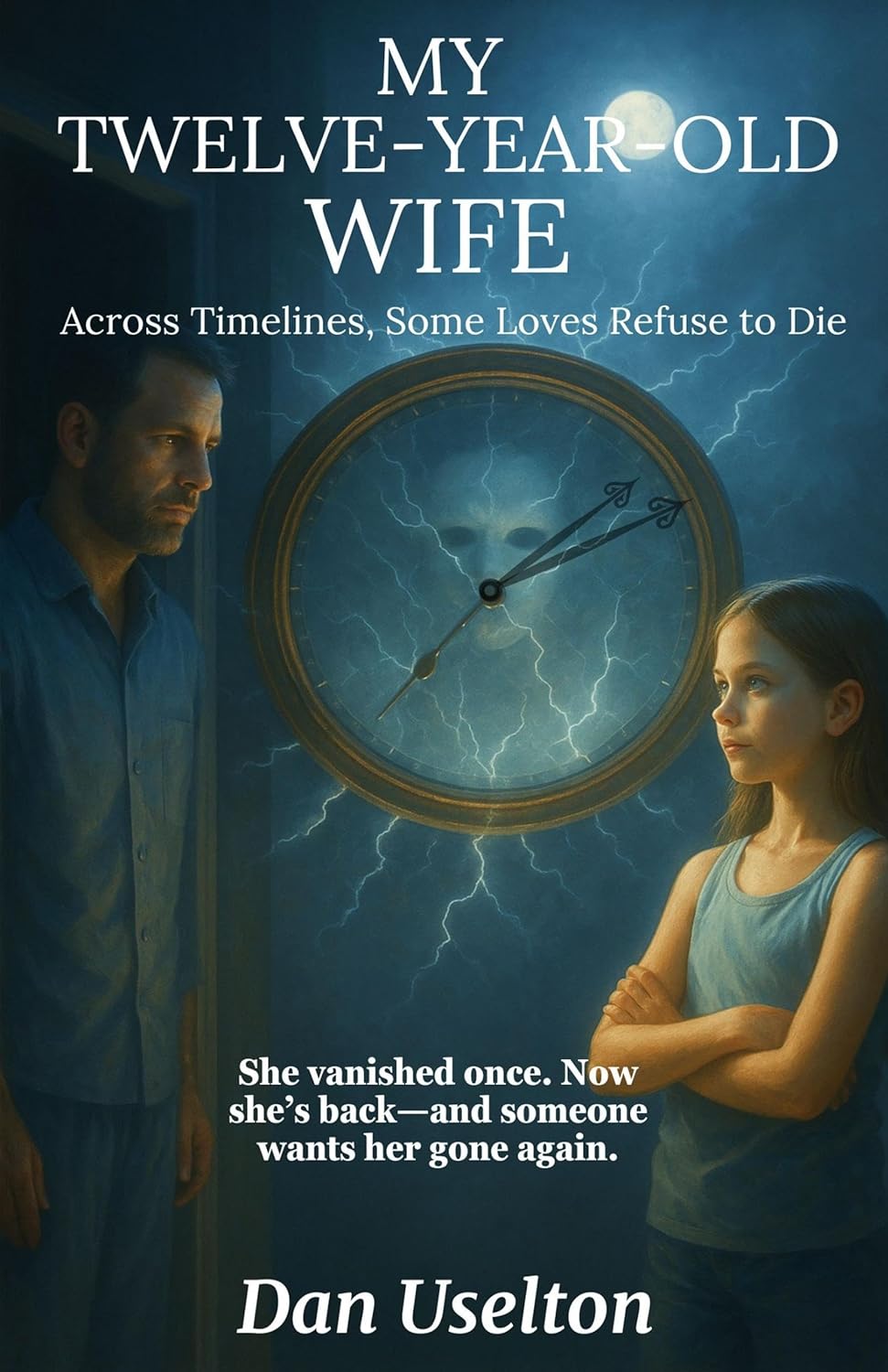
My Twelve-Year Old Wife is a dark, time-bending thriller about love, grief, and the unrelenting pull of fate. It follows Dan Fox, a husband desperate to find his missing wife, Celia, only to have a twelve-year-old girl appear at his door claiming to be her. What begins as a mystery about disappearance spirals into something stranger, a story that slips between timelines and emotions, showing how trauma, memory, and devotion can warp across the years. The book plays with horror and science fiction but stays grounded in its aching humanity. Each chapter peels back another layer of the impossible, until the reader is as disoriented and haunted as Dan himself.
The writing is cinematic and unnerving, full of tight, fast sentences and moments that hit like a punch. I could feel Dan’s confusion and fear, his disbelief when he’s confronted with a version of his wife that shouldn’t exist. The story toys with logic but never loses its emotional truth. The prose has this eerie stillness, a rhythm that feels like breathing in the dark, and the pacing moves between slow dread and heart-hammering tension. I caught myself whispering “what?” out loud more than once, which almost never happens when I read. The author’s control over mood and momentum is impressive. Even when scenes leaned into the surreal, the characters kept me anchored.
But what hit me hardest wasn’t the time travel or the mystery, it was the loneliness. Beneath the weirdness, this is a love story about guilt and obsession. Dan’s desperation feels raw and a little ugly, and Celia’s time-fractured existence is both tragic and strange. Their connection stretches and twists, but it never breaks. I could sense how much the author wanted to explore what happens when love is stronger than reality itself. At times, the dialogue can feel blunt, but it works here, it fits people who are terrified and grasping for sense in the middle of madness.
My Twelve-Year Old Wife is for readers who like their stories unsettling, who don’t mind questioning what’s real and what’s imagined. If you liked Dark, Arrival, or The Time Traveler’s Wife but wished they were more psychological and eerie, this book is for you. It’s weird, bold, and relatable.
Pages: 194 | ASIN : B0FD87Y85R


