Blog Archives
Family Moments Together
Jonty and the Giant Pike follows a father and son who build a fishing pond in their backyard, and things do not go as planned. What was the inspiration for your story?
This book has two sources of inspiration. The first is summer, which is a familiar Finnish summer to me. It includes many things about nature, such as lakes and forests. People may spend the summer in the countryside in summer cottages with their families. In Finland, the lakes and seashores are essential for summer holidays – and many people like fishing. When I write about summer, I get in close contact with my inner child, for whom summer is an incredible time of discovery.
This book has another even more concrete background. My children and I have encountered a similar adventure with a giant pike, as I have told in the book’s plot. We encountered such a large predatory fish, which accidentally got into our yard pond and ate the fish planted there during the summer. The king pike finally got into trouble when the pool had to be emptied in the fall. We would have lifted it back into the pond to eat its delicacies there, but the longing for freedom won. In my book, I changed the plot’s ending to make it better for the pike. Now, I will reveal to you what happened next in real life.
During our break from this pond cleaning work, the pike pushed itself out of the temporary storage box and bounced toward the open water. Unfortunately, its strength ran out, and it collapsed on the hot beach sand. That’s where I found it and mourned its fate. I buried the fish in a beautiful spot near the shore because I didn’t want to throw it into the water for other animals to eat. So this pike became soil, from which perhaps new plants sprouted.
When you first sat down to write this story, did you know where you were going, or did the twists come as you were writing?
As I revealed in my previous answer, this story is based on an exceptionally authentic series of events – except for the happy ending I created. For this reason, writing was, this time, more like retelling a relatively recent memory in a way suitable for a storybook.
Although my favorite kind of writing is the one where I am completely free, sometimes it’s nice to tell my own childhood memories a little tuned and twisted. As a mother and grandmother, I also have many fun topics about other children’s real lives.
When I write children’s books, the fairy tale’s topic and entire content take over my head as a ready-made package. It often causes such a strong feeling that I rush to write. The first version is created then as if driven by a storm wind. I’m just an aid to bring it into the world. When I write such stories, the whole story is already more or less complete and ready. Sometimes, a character might start making additional demands on me, for example, if I forget to write down something important related to him. I enjoy it when the story has its own will.
Do you enjoy fishing? If so what draws you to it?
As a child, I spent a lot of time by the lake. At first, I watched my father fishing, and gradually, I could participate in different ways. It started with simple angling, and soon, I could try other equipment as well. I’ve never been a keen fisherman, but the moments together at the lake have been significant. While fishing, it is possible to relax and chat with your partner.
Sometimes, the experience can also be exciting, like raising the nets with my father just as a thunderstorm rose over the bay. But we managed to get to a nearby island in time, where we sorted out the badly tangled nets by hanging them on the trunks of pine trees. It took some patience!
I spent much time at the beach while my children were learning to fish. Sometimes, the fish catch was so plentiful that I was in a hurry to pick up small fish from the sand and the dock before they got away. Helping the smallest fishermen was also quite a job, as I constantly had to place new baits on their hooks.
But the joy when the children succeeded in catching something rewarded all the effort. We have always made food from their catch, even if children had just one tiny fish. You learn to make a surprisingly tasty fish soup even from that!
Fishing often also involves being together and exchanging life experiences across generations. I still remember a summer evening twenty years ago when my little one was fishing with his grandfather. The little boy sincerely admired the older man’s ability to wait patiently and catch the fish at the right moment – a valuable lesson.
What do you hope is one thing readers take away from your book?
Writing summer books is fun because I have so many warm memories of my childhood summers. I often make children do things beyond their abilities. The most important thing is not a perfect success but a good attempt.
In this book, I want to write about a child’s enthusiastic summer plans, which the whole family participates in. Family moments together are important topics.
However, the most important message of this book is related to the relationship between the boy and the pike. A giant pike is something unique that accidentally gets into the boy’s garden pond. It’s exciting for him to follow, and the boy tries to control it like a pet.
I want readers to consider whether capturing a wild, free giant pike in a small pond is right. We must choose whether to hope for the boy’s success or the pike’s freedom.
In this book, the pike and nature win! Maybe I want to give exactly that message: nature cannot and must not be subjected to too much.
Author Links: GoodReads | Facebook | Website | Amazon
Jonty loves to fish, so he and his dad build a fishpond in their yard. The pond takes a lot of work and maintenance, but Jonty is thrilled to have the chance to fish for rainbow trout.The most exciting catch of the summer, however, is a giant pike, which Jonty catches from the dock on the lake. By accident, the hungry fish winds up in the fishpond! Even though there’s plenty of food available, the pike doesn’t like being imprisoned in a pond. Then one day it tries to escape!
Anxiety Produced by Sounds
Noise All Over follows a little boy with sensitive ears who runs away from loud sounds because they hurt him. What was the inspiration for your story?
I have noticed that, surprisingly, many people—children and adults—suffer from loud noises. After all, “primitively” thought, loud noises are often warnings or alarms about dangers threatening people, from which it is necessary to flee or wise to protect oneself.
This over-activation and exaggeration also apply to our other senses, but I decided to focus on hearing in this book. The change in the sound environment in modern times has been swift. In part, this is because technology has brought sounds everywhere. Different sound stimuli compete with each other for people’s attention in entertainment and marketing.
The loudest and most annoying sound – downright noise – often wins this competition for people’s attention. Its effect may actually harm its target but generate money in its creator’s wallet.
I’m a sensitive person who strongly feels the stimuli in the environment. On the other hand, I’m very social and eager to meet people, experience various situations, and go to different places. I have to find a suitable balance between these opposites for myself. A sound environment that suits you can be good, even if it is loud and intense. When the sounds of nature roar around or an orchestra plays my favorite music at full power, I’m in the same tune, even if the sounds are loud.
Adults have a special responsibility to observe sounds around children. We must protect them from noise that is harmful to them.
How did you decide on the title of this novel?
The title of this book—Noise All Over—is a natural consequence of how I personally experience disturbing noise. I thought about the environment around the exceptional, sensitive child in the story and the feeling of alarming elements around him. They attacked from all directions, and the boy felt helpless and threatened.
With the book’s title, I wanted to emphasize the comprehensiveness of the disturbance and anxiety produced by sounds. The oppressive feeling grows if we can’t escape the noise and can’t decide for ourselves what happens in our environment in terms of sounds.
What were some ideas that were important for you to share in this book?
Noise is an individual experience. It is one form of stimuli that can become overwhelming for an individual. So we are talking about a real problem, especially for sensitive people.
Various forms of disturbing noise exist—some more obvious and others more hidden. It can be a single loud, frightening, or even painful sound element or a sum of many smaller and weaker stimulants, which become an overwhelming experience when combined or followed without a reasonable break. One must be able to protect oneself from noise in a way that is characteristic and suitable for the individual.
The role of adults as guides and helpers of the child’s burdening experience is essential. The constant awareness of noise can be a secret burden in the child’s life. It can be difficult for a child to explain what bothers or scares him in different sound environments. This hidden experience can restrict or depress the entire life. The child can be reluctant to confess the problem as it might not be pleasant to differ from the others in this respect.
However, I want to show with my book that there are cures for this difficulty. It is essential to realize that no one has to be alone with problems caused by excessive sensitivity, and there is always someone who understands.
Of course, at the end of the story, I can’t resist mentioning nature and its power to level and “understand” human experiences. Nature is always a place where I can at least seek balance in various challenging situations.
Do you write novels for adults or only children’s books?
I must admit that I am also one of those writers with several adult novels under development and unfinished. I haven’t given them up yet, but writing for children has taken up most of my time – so far, I’ve published more than 60 books in English and even more in Finnish.
I have also written for adults—both nonfiction and fantasy. On the nonfiction side, I have written texts related to my legal scholar background and an extensive nonfiction book that deals with the life work and production of the most famous Finnish storyteller, Zacharias Topelius (1818–1898), from a legal perspective. Including a vast amount of law and justice in fairy tales and reflections on morality and justice, in general, is possible. This topic is close to my heart on all levels of writing.
I have also participated in a peace-themed writing competition, and my essay was included in an anthology of the prize-winners. That was very encouraging as I have written many children’s books about the themes of war and peace, too – in a delicate way.
I’m also constantly writing short stories for adults, and I’ve already published one book where I give a voice to people who don’t usually get one. My motto is that for ordinary people, shockingly big and unusual things often happen in their ordinary lives, even if others don’t always notice them. There seem to be enough stories ready for another book now, so maybe I will publish something for adults again shortly.
There should also be a way to get adults to read more instead of excessive, passive entertainment. There is a lot of talk about children’s reading, but the role of adults as role models is often overlooked. It would be a dream if I could find a way to write about topics touching many people and raising everyday problems to a level where you can see through them more clearly. I don’t mean any self-help books, but stories that make their readers notice new life nuances and possibilities. This became a big wish, but a writer must have such!
Author Links: GoodReads | Facebook | Website | Amazon
The Dinosaur Rock Band concert for children should be the highlight of the summer. Liam is going with his aunt and cousins.
However, there is an unpleasant surprise in store for Liam. The loud music is painful to his sensitive ears. The only solution is to escape!
Friends and Rivals
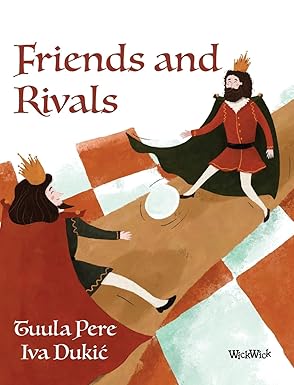

In Friends and Rivals, Tuula Pere delves into the complex dynamics of sibling rivalry through a captivating children’s narrative. Set in a kingdom where two princes, once inseparable friends, become adversaries in their quest for the throne, the story unfolds a poignant tale of lost familial bonds. The novel charts the journey of one brother’s ascendancy to power and the subsequent imprisonment of the other, culminating decades later in a heartwarming turn of events orchestrated by a young boy.
The book, embellished with the evocative illustrations of Iva Dukić, stands out for its compelling imagery and a distinct Old World allure. Dukić’s use of a limited color palette skillfully draws attention to the characters’ expressive faces and the setting’s unique charm. Otto, the prince confined to obscurity, emerges as a character that resonates deeply with readers. At the same time, Victor, his ruling brother, embodies the realization that wealth and power are no substitutes for happiness—a crucial message for young minds.
Pere and Dukić’s collaboration results in a book that is a delightful read and a source of valuable life lessons. Friends and Rivals transcends mere storytelling by weaving in a fundamental lesson about the power of forgiveness and reconciliation. Pere’s narrative, through the actions of a kind-hearted child, not only reunites the estranged brothers but also rekindles their lost friendship. This aspect of the tale, along with the gentle infusion of magical elements, makes the book particularly appealing to children. Meanwhile, educators and parents will find ample material within the story for meaningful discussions with young readers.
Pages: 42 | ISBN : 9528200133

Crookedness, Dishonesty, and Betrayal
The Fox’s Palace follows a fox that tricks his friends in order to get the land he wants to build his dream amusement park, he learns a hard lesson however when his tricks are discovered. What was the inspiration for your story?
Francis the Fox is the main character of one of my book series. Through his actions and adventures, I have revealed many forms of crookedness, dishonesty, and betrayal. My goal is to increase children’s understanding of society and help them see the motives of different actors. This is an essential skill as an adult!
I write social satire for children. I want to bring out the dark sides of human relationships, business life, and society that also occur in real life. But I want to do it lightly enough and use a lot of humor so it works for children and teaches an understandable lesson on the right and decent ways of doing things.
What is one thing that people point out after reading your book that surprises you?
One exciting feature regarding the Francis the Fox Series and people’s reactions is the readers’ opinions about the endings of the books. Let me explain.
Some readers are hoping for the worst possible ending for this “wretched hero.” They would like to avenge the fox’s evil deeds even more severely than I have done in the story. Some would like to make the evil hero entirely out of business and incapacitated for the rest of his life.
I have to explain to them that, unfortunately, I believe that the swindlers will continue to misbehave even in the future. Very few become completely clean and continue as perfectly decent citizens. My fox has such a mind that he does not stop pursuing his personal interests. He is very persistent and always continues to come up with new projects.
Another group of readers is those who enjoy the fox’s tricks and the fact that he always continues with new ideas in the next book. They see in the fox some human imperfections that can be hidden in all of us. We just value honesty more and control our selfish needs better.
I understand both of these opinions. I have an almost contradictory attitude towards this fox. First, I always let him try and go his own way, and then I make him fail in his actions, and some punishment follows. I don’t believe my villain, Francis, will ever become kind and honest, so there is still plenty to write about in the Fox Series.
Is there any moral or idea that you hope readers take away from the story?
“The Fox’s Palace” focuses on Francis’s dishonest actions and their consequences – as the entire Fox Series does. This time, the central conflict exists between the fox’s selfish goals and the townspeople’s common beach.
I want to draw attention to how cunning means the most power-hungry individuals are ready to use to achieve their goals. We must learn to recognize such characters in our immediate circle and at different levels of society. Otherwise, we cannot defend ourselves against dishonest activity and exploitation.
The story also has some side themes that I want to draw the reader’s attention to. I’ll pick a few here.
Building a false image of both events and himself is Francis’s specialty. He is good at recognizing the weaknesses of others and knows how to motivate his partners by feeding arguments, half-truths, and enticement accordingly. He does not hesitate to use even those closest to him – family or friends. It’s cruel how even his own mother is the target of his lies and manipulation.
Even though I feel significant irritation towards the actions of the fox I created, he also arouses pity in me. This poor thing has no one to be honest with. He has to be constantly careful that the web of lies and pretenses is not revealed.
I’m afraid Francis the Fox always tends to pursue things that will never make him happy. This is an essential message to my readers, too.
When thinking about some of your other books, Francis the Fox is drastically different than Colin the Crab in their personalities and approaches to life. Is it hard to get your mindset in the right place with so many diverse characters and personalities to write for, do you ever find characters from different series overlapping when trying to write?
What an interesting question! One of the attractions of writing children’s books is the possibility to vary different topics and approaches from one book and series to another. Also, the fact that some of the books are aimed at very young readers and some already contain more demanding subjects gives the author a lot of opportunities.
My way of writing is like diving into different realities in my fantasy.
I have different imaginary worlds ready for my different books. If I want, I can enter that world with my chosen characters at any given time. It’s all authentic to me. This also applies to the characters I created. They become real acquaintances for me, with their personalities and “existence.”
When my characters are “born,” their life cycle develops most naturally and almost self-directed forward. Some characters become so strong and close to me that they start demanding something and making suggestions as the story progresses.
They sometimes want to bring up more than I was going to say or take a more significant role, and I have to give in and trust their opinion. Each of my fairy tale characters has a unique personality and even a strong will. So, they don’t get confused in any way, at least not more than I would confuse people I know in real life.
Author Links: Facebook | Website
Finding Peace at Christmas
Christmas Switcheroo follows a family preparing for the holidays who get overwhelmed with preparations and cause a gift mix-up that could be disastrous. What was the inspiration for your story?
I have to admit right away that I am a Christmas person. So, it’s fun to write stories about the Christmas season. The inspiration for my ”Christmas Switcheroo” can naturally be found in the things related to Christmas in my home country. However, I left out many Finnish-related and religion-related issues and instead focused on the general rush associated with preparations for the festive season. Christmas provides a good background for how different people’s expectations and preparations for a big celebration differ.
People’s age is significant when we follow how they feel about the upcoming holiday season. In children’s minds, fun activities, happy excitement, and the “fairytale” elements of the holiday season are highlighted. The adults may be worried about schedules, financial issues, and various responsibilities. They think about who to buy gifts for, who to visit, who to invite… It is easy to conclude that for many adults, for example, Christmas time is not the same joyful thing as for carefree children.
What were some ideas that were important for you to share in this book?
In ”Christmas Switcheroo,” I also wanted to transform some typical roles into slightly new positions. I wrote about children who love peace and seek an authentic Christmas atmosphere. I tried to bring peaceful atmospheres and places where you can find genuine Christmas spirit into the story. It doesn’t happen in the hustle and bustle of a shopping center but can be found, for example, in a quiet library or a small cafe. Crafting paper snowflakes or drinking warm cocoa on a cold winter evening can give a much more incredible feeling than flashy neon advertisements and theme music blaring everywhere.
I also wanted to show that exhausted adults can even get help from children. Christmas comes for the whole family, even with less stress. Everything can be fun if the family’s Christmas preparations are done together and kept to a reasonable level. Of course, each family member may have particular wishes that must be considered and respected. One likes to bake, another puts up decorations and Christmas lights, and someone listens to music. There is a place for all of these when there is a good spirit of togetherness.
The most important message I wanted to convey is that families must also have a peaceful time together. The most valuable moment during the entire holiday season can be a quiet moment together, looking at Christmas stars and snow lanterns and singing a familiar Christmas carol together.
What is your favorite part of the Christmas season?
All parts of Christmas are dear to me and associated with many memories from different stages of my life. What is important is how the experiences of Christmas are made up of layers of all the years of my life.
My mind can take me back to situations from decades ago: To the Christmas atmosphere of the village church or visits and Christmas carol performances at a local nursing home for older people. They are dear memories to me, and I hope that as many children as possible today could experience the same.
The joy of having a good memory is that even the deceased relatives and all my departed loved ones are still present at my Christmases. I can light candles to burn on their graves and next to their photos. I can think of them as grateful for all the intangible gifts they have given to my life.
The most meaningful things in my Christmas are the children and their bright eyes as they admire the candles and the Christmas tree. Christmas time is the darkest time of the year in Finland. You can imagine how beautiful it is if there are lights outside in the dark and in the middle of the snow, even in the trees and bushes.
I had a somewhat tight childhood financially, but I felt nothing was missing in my Christmases. I collected Christmas pictures from the newspaper in a small box and admired them in the evenings. I also saved a small amount of Christmas money, which I used to buy tiny presents for my little sisters and my parents. The joy of giving was great, even though the package was insignificant.
Finally, I have to mention Christmas music and candles. What could be more beautiful than listening to music that you have chosen yourself by candlelight? – But remember to be careful with fire! As a child, I enthusiastically burned candles – and once accidentally almost a wooden table.
What story are you currently in the middle of writing?
I always have many books in various stages of the publishing process. And in our small family business, I am involved in all those stages. I’m about to send many stories to my editor in the USA just now. They include yet another sequel in The Fox Series, as well as stories for the new ”Lyrics of Life Series” and two beautiful stories set in India.
I would also like to mention the ongoing illustration projects where my new “Active Kids Series” will have the first two books illustrated by Dane D’Angeli from Brazil. They feature new kinds of adventures – even an exciting detective story about a museum robbery.
Another interesting illustration is the fourth book in my “I Did It!” series. This time, the story illustrated by Catty Flores takes place in icy winter landscapes.
For next Christmas, we will have another Christmas book, which takes place in Northern Finland. As a child, I experienced similar moods at the mercy of nature and in the middle of snowstorms in the landscapes of my mother’s childhood home. In that story, I could also include many memories of my late Grandpa, his old house and horse, and the big clock that now ticks on my living room wall.
Author Links: Facebook | Website
For Dad, the most important thing is to have the garden decorated with tons of Christmas lights to delight himself and the neighbors. But the fuses blow nearly every time he comes up with a new lights arrangement!
This year the Perksons get the last presents ready in the nick of time. But things don’t play out quite as they planned. Will Christmas still come despite this year’s less-than-perfect preparatio
A Pretty Strange Book
Stone Garden follows siblings who venture into a stone garden where one statue reminds them of a story of an unfortunate old man. What was the inspiration for the idea behind this story?
Stone Garden is a pretty strange book. It has both narrative and temporal levels that intertwine. The inspiration has been my own imaginary plays in old abandoned houses and between the statues and stones in cemeteries.
This interview question brought back many fond memories from my childhood. In my home village, there was an old cemetery behind the church, just opposite our house on the other side of the road. As a child, I often wandered around looking at the tombstones and wondered what kind of people they told about. At least in the daytime, sunshine, it was not scary at all!
It was a quiet and peaceful space to spend time immersed in one’s thoughts. There were plenty of trees growing around, with little birds building their nests and singing beautifully in the summer. I remember how I appreciated the history of grave sites, thought about varied human lives – in content and length – and listened to the birds singing above.
I’ve always liked rocks. I have collected small stones and broken them into pieces; I have climbed on top of large rocks and looked for caves in their shelter. Stone is a beautiful material, almost alive, depending on the temperature. A rock warmed by the sun is a comforting place to rest.
Thinking more closely, all those elements have been transferred in a way to this storybook, Stone Garden.
What were some artistic directions you wanted to take that were specific to this book?
The illustrator of Stone Garden, Andrea Alemanno, had quite a free hand when it came to the illustration. He has already illustrated many of my books in the past, so we have a mutual relationship of trust in building the book. This time, he hoped for the opportunity to try a new kind of illustration and suggested a relatively calm and minimal artwork.
When I saw the plan, I fell in love with its atmosphere. The chosen approach allowed the illustrator to bring out both the historical level and the present day of the plot in a sensitive way. From the harmonious and plain color scheme emerge colors and things that draw our attention. At the same time, they are essential details for telling the story.
When we collaborate with Andrea Alemanno, my story is in good hands. He has already illustrated my books for many years. I have tried to give his strong vision as an illustrator as much space as possible. With a skilled and experienced illustrator, there is no need to interfere with small things as long as the general artistic line is agreed upon. Stand-alone stories like Stone Garden allow the illustrator to experiment with a new style and approach. It’s always interesting to watch how it develops.
Now, I’m getting a little sidetracked, but I can’t help but bring up our long-term joint project, “The Fox Series.” It has been enjoyable to watch how it has developed. Andrea Alemanno is currently working on the fourth part of the series. Social satire for children is a demanding genre in terms of text and illustrations. Our cooperation will work very well in that.
What were some themes that were important for you to explore in this book?
In my Stone Garden, I wanted to bring out the layered nature of the life I described earlier. It is good that a person realizes how life is linked with things in this moment and the past. I used this to my advantage in describing my characteristic way of thinking.
The story’s main themes include the gradual isolation of the main character from the past. When greed and selfishness grow too big, a person is left alone. Money can’t buy genuine affection.
The children in the story’s present moment represent me as a curious child. In my time, I used to be a keen explorer, too! Here, the children go on an adventure to the dark stone garden and, at the same time, dive into the depths of an old story in their imagination.
As a little extra spice, I wanted to bring in the mystery of nature. Finally, the reader must ponder the little songbird’s connection with the stone garden’s history and past owner. I like the moment where a tear seems to roll out of the corner of the statue man’s eye, and the little birds rest in the folds of the stony man’s clothes.
What is the next book that you are working on and when will it be available?
Last fall was exceptional – in many respects – at our small publishing company, Wickwick.
The most extensive effort, my non-fiction book for adults in Finnish, with 250 pages, is now in printing, and I will have more time for children’s literature. This study, “May You Kill The Evil Troll? – Law and Justice in Topelius’ Fairy Tales” (freely translated), combines my background as a Ph.D. in Law and children’s author in a unique way. After the book is launched in a week, we can entirely focus on children’s picture books – my absolute favorite!
Waiting for its turn is The Bird Prison, which has lovely hand-drawn watercolor illustrations by Sofia Panchyschyn from Ukraine. Dane Angeli from Brazil created a fascinating visual world for two of my stories with adventurous kids: A Museum Robbery and Luke’s Sailing Adventure.
A colorful fairytale adventure, Friends and Rivals – illustrated by Iva Dukić from Croatia – has a severe topic dressed up in a fairytale kingdom. It depicts, in fact, the pursuit of power and the spiral of revenge.
The book series – Axel and Ava Books and Do You See Me? Series – aimed at my youngest readers, will also get sequels. My illustrator, Nyamdorj Lkhaasuren, from Mongolia, has made fun and colorful illustrations for the new books about Axel’s baking day and Ava’s adventure as a market seller. Another Mongolian illustrator, Majigsuren Enkhbat, has drawn funny pictures for the new story in the Do You See Me? series. It tells about the challenges of the little ones in sports activities – not everything is always fun!
As you can see, much interesting literary work is underway with the new illustrator partners just now. – And only the books closest to printing are described here. This spring is going to be very busy!
Author Links: Facebook | Website
I Write the Difficult Children’s Stories
The Owl and the Shepherd Boy follows a young boy who is left to care for the family’s goats up on a mountain when a storm destroys their home. He must now find a way down the mountain alone. What was the inspiration for your story?
My Survival Stories Series, including The Owl and the Shepherd Boy, were written in response to the devastating 2015 earthquake that struck Nepal. This tragic event brought immense challenges for the nation, resulting in emotional and material losses. The rebuilding and repairing efforts continued for years.
By writing my survival stories, I aimed to provide hope and inspiration to readers facing these difficult circumstances – or better understand and help those who struggle.
Various shepherd topics are close to my heart because I still remember many childhood experiences my father told me about. It’s not easy for a little boy to be responsible for guarding the neighbor’s cattle in the pasture all alone.
I also like to write about the power of nature and how it constantly surprises us. Often it’s about pleasant surprises, but sometimes the destructive forces of nature make us feel small and helpless.
In every situation, people should understand their place as a part of nature and not as its master. The surrounding environment deserves all our respect and care. We should learn this from childhood.
What were some goals you set for yourself as a writer in this book?
I want to answer this question by describing the experience mainly from the point of view of writing stories on complex topics.
I also write about things many avoid in children’s books – such as poverty, fears, illness, and social crises. I consider it important that I can describe children’s experiences of how it feels to live in the middle of these situations.
As a writer, it would certainly be easier for me to avoid such demanding topics, but I think they are perhaps the most important ones. Writing about them requires the courage to stand beside the children and support them – at least with words – even when it is the most difficult.
In these more problematic stories, depending on the case, I also use various fantasy elements. They can help us to look at the situation a little “above” the everyday perspective. The main thing is that the result is understandable and comforting for the child. When the book cover closes, the readers should be left with the feeling that they have survived together with the main character.
What were some educational aspects that were important for you to include in this children’s book?
By telling the story of this shepherd boy, I wanted to emphasize the power of natural forces, which I already referred to earlier.
Another essential theme in this book is related to social differences between countries and regions. The young protagonist lives in a culture where children’s responsibility for work is more significant than in countries where livelihoods are more secure. In such an environment, children must take responsibility early on, often much too early. They carry tasks that are heavy, scary, or otherwise oversized.
Of course, there are various kinds of societies in which to live. For those children whose lives include safe schooling, play, and adequate food, it is good to realize that not everyone is equally lucky. Understanding this makes them more sympathetic toward others and increases their desire to support and help.
Also, I wanted to encourage children with this story. When they read about the difficulties and fears of the shepherd boy, they realize that it is possible to survive even in such a situation. It is important not to stop trying – which is pretty universal and encouraging advice.
What story are you currently in the middle of writing?
For the past few weeks, I have been writing two unique stories connected to India. They were “donated” to me by a friend, originally from India, who shared some of his own experiences with lots of human wisdom. Writing such stories has been a challenging and gratifying task.
Of course, the most important thing is to do justice to the actual events in the background of the books. I try to pass on the materials I receive from events, people, the environment, and culture. I’m melting these elements into my story version.
When the original ingredients and foreshadows of stories are light and fun, it’s easier to write without fear of hurting anyone’s feelings. But the events I heard also have such characteristics that they raise deep emotions in my mind as a writer, even sadness.
I want to emphasize that these two stories are products of the imagination detached from their models, but I still feel responsible. I also try to write the stories to fit a believable cultural and geographical setting.
I believe this credibility requires that I, as the author, have my own background knowledge and check the details, too. What bread are people buying at the market in the place in my mind? Which fruit trees can bloom in the garden? When is the rainy season, and how long is it? Finding suitable names is particularly interesting, as they have their cultural meanings. I hope I hit the right ones!
Overall, I took some time to ponder how to deliver my friend’s experiences and the wisdom in them to the little ones, too. – But as a children’s author, you always find a way.
Author Links: Facebook | Website
In the darkness of night, Nicky spots a big owl. Can the mysterious creature help Nicky find his way home?
Hope, Faith, and the Power of Love
Stella and the Magic Stone follows a young girl visiting her grandfather who wants to find a magic stone to help him heal after an accident. What was the inspiration for your story?
Stella and the Magic Stone is primarily inspired by my childhood. Stella’s world is familiar to me in many ways. When you have had the opportunity to live in a scenic village in the Finnish lake district, it touches you for the rest of your life.
In the Stella books, I wanted to describe the safe experience that Finnish children have traditionally been able to experience in their environment. The possibility to move around alone and make your own decisions is perhaps more comprehensive than in many other countries or cultures. I understand that not all of Stella’s activities are suitable elsewhere, so she is not meant as a role model. I just tell readers about Stella’s life and environment as it might be inspirational.
Various experiences related to nature have always been important to me and have also inspired this book. There is summer with thunder, berry-picking, and playing in the middle of the forest – everyday activities for most Finnish children.
Another inspiration for this book comes from the relationships between children and grandparents. I think they can play a significant role in each other’s lives. That’s why I wanted to focus on an extraordinary period of the accident and its effects on the girl and her grandfather.
Was there anything from your own life that you put into the characters in your story?
Stella and the Magic Stone is an important book for me, with many personal experiences behind the story.
As mentioned earlier, Stella’s activities and the surroundings of the events have a solid connection to my own childhood.
I must also admit that the book’s main character carries two versions of myself with her. The first one is the independent little girl riding the little red bike in the home village and the roads around it, and the other one is the adult worried about her seriously ill father.
I was surprised by the power with which the story, my childhood memories, and my worries as an adult intertwined in this fairy tale. In writing the story, I went back to my childhood activities with my father – even though he turned into the main character’s grandfather in the fairy tale.
The situation related to the creation of this book, where I finished the manuscript and put the last point at the end of the text, was a special moment in another sense as well. At that particular second, in real life, I received a call from a doctor from the hospital where my father had just survived a major operation and was transferred to the recovery room.
Is there any moral or idea that you hope readers take away from the story?
A child’s relationship with nature and trust in its power is a central theme in this book, although the main theme is the deep connection between the girl and her grandfather.
When my book came out, some adults pointed out that miracles seem to play a significant role in the story. I think that’s precisely what fairy tales are often about – miracles that lift our experiences above everyday life and encourage us to trust ourselves even when we face difficulties.
For me, the miracles of the fairy tale represent hope and faith in the extraordinary power of love. I like to bring in nature experiences because, at least for me, nature has often offered help in many ways in difficulties. It can sometimes provide a refuge or a friend and support. The magical details nature offers – like the magic stone the girl found in this book – can become a symbol of life forces and give us faith in survival.
However, the most important message of this book is that affection and love between two people – the girl and her grandfather – are patient. From that, the girl in the story gets the strength to visit her unconscious grandfather’s hospital bed again and again.
Even in a fairy tale, I don’t want to claim that the stone healed the grandfather. But I want to show how important it was that Grandpa could feel and sense the girl’s visits on some level. It certainly helped him to regain consciousness and recover.
Where does the next book in the Stella stories go, and what adventures will she have?
I have already written two other books about Stella – Stella and the Berry Bay and Stella and Her Spiky Friend. And more stories about this active girl’s adventures are ready in my head!
In the second one, Stella and the Berry Bay, her life takes a surprising turn when the family moves to another town. Moving away from their old home takes place in a difficult moment because Stella has imagined going to a familiar school with her friends. Now everything has changed: a new home, a new school, and new friends. But together, we can get through this, too!
In the third book, Stella and Her Spiky Friend, the girl meets interesting people in a new environment. In addition to her hedgehog friend, she gets to know the strange pharmacist whom the other children are afraid of.
My Stella books continue along the same line of encouraging children. In these stories, children have much freedom to act independently in a safe environment. I also describe cooperation between different people and people of different ages.
In real life, I learned a lot about this kind of interaction in my childhood. Seeing how different people could cooperate and work together was useful for my upbringing. The community also included those whose actions could not be accepted or who harmed others. Mostly, though, problems were solved together. Small towns and country villages are good teachers!
Author Links: Facebook | Website
No one is quite sure how to help Grandpa until Stella gets a wonderful idea. She will go back to the quarry and locate a magic stone!



 LITERARY TITAN