Blog Archives
Resilience of a Nation

In Sheltered, you share experiences following the sudden death of your husband and a trip to Israel that turned into a dangerous and transformative journey. What inspired you to share your story with readers?
I was so grief-stricken when I left for Israel and didn’t believe it was possible to recover from so much loss. The loss of my husband, my home, my community, my caretaker, my friends, and our church, which had welcomed John and me with love and joy. The resilience of a nation healing from the October 7, 2023 nightmare, together with the love of family and strangers I encountered, demonstrated that healing is possible. I want readers to know that if healing can begin in a war zone, healing is possible anytime, anywhere.
Some of the memoir’s most moving moments are its quietest, particularly the scenes surrounding John’s final days. How difficult were those chapters to write?
As a writer, the only way I could process John’s passing and all the subsequent losses was to write about them. I wrote about John’s death in a gentle, perhaps detached way that conveys the deep shock I was in. In The Year of Magical Thinking, Joan Didion writes about her husband’s death using a similar detached style that conveyed her shock and inability to absorb her new reality. The voice and tone Didion employed in The Year of Magical Thinking resonated strongly with me. Someone in grief needs to feel less alone, and Didion’s book accomplished that for me. I hope Sheltered will do the same.
How did you decide when to include historical and political context without losing sight of the personal story?
My superb editor, Melanie Martin, was indispensable in determining how much background was needed and where it would be most effective.
What do you hope someone who is grieving will find in your memoir?
Recovery and purpose. Recovery came gently in whispered moments of grace. The message to find purpose was repeated and reinforced so many times that even my thick-headed noggin finally got the message!
Author Links: GoodReads | Facebook | Website | Amazon
Five months after losing her husband to a sudden heart attack, Elisa Hertzan Schetrompf boarded a plane on an unexpected healing journey. She was a widow still numb with her loss, in danger of losing her eyesight, and utterly unsure of what came next, definitely not expecting to find herself stranded in the middle of war.
In this raw, vivid memoir, you will find:An unflinching portrait of grief: The isolation, the shock, and the slow, nonlinear work of healing
A firsthand account of modern war: Sirens at 3 am, the Iron Dome overhead, and the remarkable calm of a people who have learned to live inside uncertainty
The healing power of unexpected community: Strangers turned friends and distant relatives demonstrating what family really means
If you have lost someone and are wondering whether you will ever feel hopeful and happy again, Sheltered is an achingly honest account of what healing actually looks like, where grief and joy work together, and resilience and grace show up when you least expect them.
Sheltered


Sheltered, by Elisa Hertzan Schetrompf, is a memoir of grief, faith, family, and unexpected resilience, following the author after the sudden death of her husband, John, and into a trip to Israel that becomes something far more dangerous and transformative than the pilgrimage she imagined. What begins in Tennessee, with boat races, church, late-life love, and the raw shock of widowhood, opens into a journey through wartime Israel, where Schetrompf finds herself stranded amid sirens, shelters, cancelled flights, medical uncertainty, and the startling tenderness of relatives she barely knows. The book moves from loss to dislocation to a hard-won sense of purpose, tracing how grief can be held, not erased, by faith, memory, and human kindness.
I was moved by the way the memoir lets love remain ordinary and immense at the same time. John isn’t presented as an abstract saint, but as a vivid man of engines, boats, teasing confidence, and rough working hands. The scene of him racing on the Tennessee River gives the book its first pulse of danger and joy, while the later hospital scene, when Schetrompf kisses his cold hands and smooths his hair, lands with quiet devastation. I also appreciated how honestly she writes about spiritual identity. Her Jewish roots, her Christian church community, the breaking of the glass at her wedding, her prayers, and her complicated attachment to Israel all sit together in a way that feels lived rather than neatly resolved. The book’s strongest idea, to me, is that healing doesn’t always arrive gently. Sometimes it comes through exhaustion, sirens at 2 a.m., a crowded shelter, a stranger’s cookies on a plane, or a cousin saying, in effect, you belong to us now.
The writing is at its best when it trusts small, concrete moments. Uncle Isaac’s disciplined routines, the bus full of soldiers headed toward Eilat, Shorayna filling a kitchen with music and food, the musty bomb shelter with children’s toys, the beach glowing beneath the Red Mountains while war presses in from elsewhere, all of these details give the memoir its emotional texture. I did occasionally feel that the narration became more explanatory than evocative, especially when historical and political reflections somewhat overtook the intimacy of the personal story. Schetrompf writes as someone trying to make meaning while still shaken, and that urgency gives the memoir its particular human grain.
By the end, when the author returns through Rome and New York, rests on the Kavanah, and begins to speak of being “whole and healing,” the memoir has earned its title in a way I found unexpectedly affecting. Sheltered is not only about physical refuge from missiles, but about the shelters made by memory, kinship, prayer, and the stubborn will to keep living after love has been torn away. I would recommend it to readers who appreciate reflective memoirs about grief, interfaith identity, Israel, family inheritance, and the strange ways crisis can reveal both vulnerability and strength.
Pages: 189 | ASIN : B0H42WQ5CC

Vashti’s Daughter

Vashti’s Daughter by Raven West weaves a captivating narrative inspired by ancient legend and the Book of Esther. The story introduces Anna Steine, a 29-year-old book publisher who stumbles upon a mysterious manuscript. Plagued by recurring dreams of a past life in 366 BC, Anna seeks answers from a diverse group of experts, including archaeologists, reincarnation specialists, and a kabbalah astronomer. Her journey reveals her identity as Adarna, the reincarnated daughter of Queen Vashti, destined to break a familial curse and fulfill a centuries-old vow to transform societal perceptions of her mother.
West’s narrative is enriched with a descriptive style that vividly brings to life the settings and emotions of the characters. The plot deftly combines elements of historical intrigue with supernatural adventure, making it particularly engaging. The inclusion of time travel, romance, mysticism, and religious themes adds layers of complexity to the story, appealing to readers with varied interests. The character of Adarna is portrayed as a beacon of inspiration, demonstrating resilience and determination. This aspect may resonate deeply with young women, presenting a model of empowerment and agency. The historical connections and biblical references are likely to attract readers who appreciate religious and historical fiction, offering a fresh perspective on familiar stories.
Raven West’s skillful blend of history and fiction in Vashti’s Daughter offers a unique take on an ancient tale, positioning it as a notable addition to its genre. The book is not only a journey through time but also an exploration of personal destiny and historical reinterpretation.
Pages: 331 | ASIN : B0CD4XXRWN
Finding Poetry, Finding Me
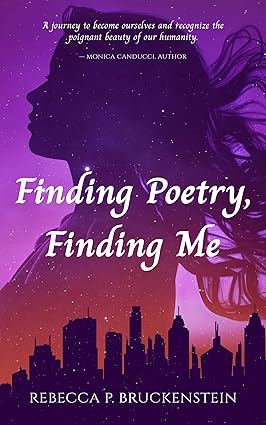
In Finding Poetry, Finding Me, Rebecca P. Bruckenstein offers readers an intimate glimpse into her world through a debut collection of poetry that bridges personal experiences with universal themes. Bruckenstein’s verse navigates the complex terrain of life, linking the personal with the communal across past, present, and future. Her poems, characterized by emotional transparency and vulnerability, delve into a spectrum of human experiences, ranging from love and loss to the nuances of self-discovery and resilience.
The collection is adorned with simple yet evocative sketches that complement the poems, enhancing the reader’s immersion into the emotional landscape Bruckenstein crafts with her words. This visual element adds an extra layer of depth to the reading experience, offering a visual echo of the themes explored in the text.
Organized into four distinct sections, the collection begins with reflections on writing and the author’s journey as a poet, offering insights into the inspiration and connective power of words. The second section revisits the past, evoking a sense of nostalgia through vivid recollections of childhood experiences and relationships. The third part delves into a journey of self-discovery, touching on Bruckenstein’s connection to nature, culture, and her Jewish heritage. The final section, “Community and Me,” focuses on home and family, concluding the book on a note of emotional resonance and hope, even in the aftermath of global upheaval.
This poetry collection is particularly accessible to those new to the genre, though its depth and relatability will resonate with a diverse audience. Bruckenstein’s ability to articulate complex emotions in a relatable way makes each poem a conduit for introspection and connection. Her work is not just a reflection of her inner world but also an invitation to readers to explore their own emotional landscapes.
Pages: 167 | ASIN : B0CQ14R6BS


