Blog Archives
Awareness Changes Things

Unfollow the Leader makes the case that the performance-at-all-costs model of leadership is burning people out, and that success can cost you your health, your relationships, and yourself. What did you most want readers to “unlearn” about leadership?
I think one of the biggest things I wanted people to unlearn is the idea that leadership is primarily about image, status, certainty, control, or constant performance.
So often, we are conditioned to believe leadership means pushing harder, sacrificing ourselves, always appearing strong, always knowing the answers, and tying our worth to outcomes and achievement. For a while, that behaviour is often rewarded. Until eventually the cracks begin to show in our health, our relationships, our nervous system, and our sense of self.
A lot of this happens at a subconscious level.
Intellectually, most people already understand that balance matters, that relationships matter, that health matters, that presence matters. But understanding something consciously and embodying it behaviourally are two very different things. Many of these patterns are built deeply into the psyche over decades through family systems, workplaces, society, fear, survival, conditioning, and identity.
People often do not realise how much of their leadership is being driven by unconscious fear. Fear of failure. Fear of not being enough. Fear of losing control. Fear of being judged. Fear of slowing down.
Somewhere along the way, people disconnect from themselves while trying to become who they think they need to be. They become productive, but not present. Accomplished, but exhausted. Surrounded by people, but emotionally disconnected.
I wanted readers to question the idea that success at any cost is actually success.
For me, leadership is not about becoming somebody important. It is about becoming more conscious, more honest, more grounded, and more responsible for the impact we have on other human beings.
I also wanted people to unlearn the belief that humanity weakens leadership. Some of the strongest leaders I have ever met are deeply self-aware people who can regulate themselves under pressure, hold difficult conversations with care, stay open to feedback, admit mistakes, and create environments where people feel psychologically safe enough to think, contribute, and grow.
That takes far more strength than simply dominating a room.
Health, Head, and Heart is a deceptively simple structure. What took you the longest to understand about the relationship between those three, and what do most leaders get wrong about the order?
What took me the longest to understand is that they are not separate parts of leadership. They constantly affect each other, whether we acknowledge it or not.
You cannot think clearly when your body is exhausted. You cannot lead people well when your nervous system is constantly operating in stress or survival mode. You cannot consistently make values-based decisions when your identity is tied entirely to achievement, approval, or external
validation.
For years, leadership development focused heavily on the “Head.” Strategy, intellect, execution, KPIs, performance. Those things matter. Of course they do. But without Health and Heart, eventually the entire system becomes unstable.
What many of us get wrong is the order.
We sacrifice Health first while chasing success, disconnect from Heart while trying to maintain performance, and eventually even the Head begins to suffer. Decision-making becomes reactive. Relationships deteriorate. Clarity disappears. We begin operating from pressure rather than presence.
And much of this happens unconsciously.
At an intellectual level, most people already know they should rest more, slow down sometimes, prioritise relationships, regulate stress, and take care of themselves. But behaviour is often driven by much deeper subconscious conditioning around productivity, worth, identity, survival, and fear.
A lot of us inherit patterns we never consciously chose.
Health is not just fitness or diet. It is energy, emotional regulation, capacity, sleep, wellbeing, and the overall state of your nervous system.
Heart is not weakness or sentimentality. It is values, courage, emotional intelligence, humility, empathy, connection, and the ability to remain human under pressure.
And the Head functions best when supported by both.
That understanding did not come from theory for me. It came from life. From burnout. From grief. From leadership. From watching incredibly intelligent and capable people slowly disconnect from themselves while trying to hold everything together.
The framework became less about perfect balance and more about awareness. Learning to recognise the subconscious patterns driving our behaviour before the consequences become impossible to ignore.
The S.T.O.P. tool is one of the book’s practical anchors. How did you arrive at that particular intervention, and what does it do that other pause-and-reflect tools don’t?
The S.T.O.P. framework came from years of coaching leaders, teams, and individuals who intellectually knew what to do, but struggled to access that wisdom in real moments of pressure.
That gap fascinated me for years.
I realised most people do not fail because they lack information. The struggle is often that subconscious emotional patterns and conditioned responses take over before conscious awareness has a chance to enter the room.
Intellectually, we often know how we want to behave. We know we should listen more, react less, communicate better, stay calm, lead with empathy, or have more patience. But in moments of stress, fear, exhaustion, ego, or threat, human beings tend to default to deeply wired survival patterns that exist beneath conscious thought.
S.T.O.P. was designed to interrupt that automatic cycle.
It was designed to be simple because in moments of pressure, people rarely access complicated frameworks effectively. There is an art to taking complexity, overwhelm, and moving parts and turning them into practical simplicity that people can actually execute consistently in real life.
What makes it different is that it is not just a mindset tool or a reflective exercise. It is a practical blueprint that helps bring strategy, behaviour, culture, communication, accountability, and execution together in a way that people can actually operationalise day to day.
It breaks things down to the lowest common denominator so people and organisations can implement change step by step rather than becoming overwhelmed by theory.
The framework brings together Health, Head, and Heart through the right operating rhythm, practical templates, behaviours, meeting structures, communication rhythms, accountability processes, and ways of working from beginning to end.
It starts with purpose, goals, values, and culture. It moves into flow, emotional regulation, engagement, clarity, accountability, and execution.
More than anything, it is designed to align the human side of leadership with the operational side of business so they are no longer working against each other.
For me, S.T.O.P. became the blueprint that underpins it all.
The intention was never to create another leadership concept that sounds good intellectually but becomes difficult to apply practically once real pressure enters the room. It was designed to help people turn awareness into behaviour, and behaviour into culture, rhythm, and execution.
Whether it is a one-person business, a family, a small team, or a large global matrix organisation, the human dynamics underneath remain remarkably similar. People still need clarity, trust, emotional awareness, consistency, communication, ownership, and alignment.
S.T.O.P. helps reconnect the body, thoughts, emotions, awareness, behaviour, and organisational rhythm together in a practical way.
It helps create enough space between stimulus and response for a conscious choice to emerge instead of an automatic reaction.
Sometimes that pause lasts five seconds. Sometimes it lasts longer. But within that space, people often reconnect to their values, their intentions, and the version of themselves they actually want to lead from.
I have seen it shift difficult conversations, workplace conflict, parenting moments, leadership decisions, and even the way people speak to themselves internally.
It is important to recognise that most damage in leadership does not happen because people are intentionally harmful. It happens because under pressure, awareness narrows and old protective patterns take over before we even realise it.
S.T.O.P. helps bring awareness back online, while also giving people a practical structure to consistently turn that awareness into behaviour, culture, and execution.
The reflective prompts invite pause and self-examination. What do you hope happens in the reader between the reading and the answering, and what would you say to a reader who skips them?
For me, the space between the reading and the answering is probably where the real work begins.
It is easy to consume ideas intellectually. It is much harder to sit honestly with ourselves.
The prompts were never designed as homework. They were designed as interruptions. Small invitations to slow down long enough to notice patterns, beliefs, fears, behaviours, contradictions, and the ways people may have drifted away from themselves without even realising it.
A lot of what drives human behaviour lives beneath conscious awareness.
We can intellectually understand ourselves far more than we emotionally, behaviourally, or subconsciously embody that understanding. Someone can explain emotional intelligence beautifully while still reacting defensively in relationships or leadership. A person can deeply value presence while living in a constant state of internal urgency.
Awareness changes things, and because there is no limit to awareness, it does not happen instantly or perfectly. But once something is seen clearly, it becomes very difficult to completely unsee it.
I hope readers become curious rather than judgmental of themselves. So many people are carrying pressure, grief, burnout, fear, responsibility, and expectations they have never fully stopped to examine. Sometimes, even one honest question can begin bringing hidden patterns into awareness.
And if someone skips the prompts, that is okay, too. Not everybody is ready to pause immediately. Sometimes people read a book intellectually first and only later realise certain parts stayed with them long after they finished reading.
I think timing matters in growth. But I would gently say this. The book is not really meant to be consumed as information alone. It is meant to be experienced, and the value is not in agreeing with the ideas. It is in noticing where those ideas meet your actual life.
Author Links: GoodReads | Amazon
Drawing on over 25 years across corporate, government, and grassroots sectors, Reem Borrows shows how real leaders align Health, Head, and Heart to create trust, accountability, and sustainable results. With honesty and insight, she invites you to redefine success—not by doing more, but by leading with clarity, courage, and integrity.
This book shows how to align strategy, behaviour, and culture so organisations perform and people thrive. It also includes three practical downloadable resources designed for immediate implementation.
Inside, you will discover how to:
Replace outdated leadership habits with values that inspire genuine trust
Lead with emotional intelligence and empathy, without losing authority
Align personal well-being with professional performance
Build cultures of accountability and psychological safety
Develop self-leadership as the foundation for leading others
Benefits of reading this book:
Authentic Leadership: Lead with integrity, clarity, and confidence
Sustainable Success: Balance well-being and performance for lasting impact
Cultural Transformation: Create teams grounded in trust, safety, and purpose
This is more than a leadership book. It’s a call to rethink how we lead, connect, and create change in the modern world.
Cognitive Kin: How to Work, Win, and Make Meaning with Agentic AI


Cognitive Kin paints a big picture of how AI is shifting from a clever autocomplete helper to something closer to a digital coworker with its own goals. The authors walk through what they call “agentic AI” and show how these systems plan, act, and coordinate with people across work, infrastructure, and even questions of consciousness and identity. The book moves from technical basics to leadership playbooks, then out to the social, economic, and ethical stakes, so it feels like a tour of the whole landscape rather than a narrow tech manual.
The book’s tone feels confident, and I enjoyed it. I could hear a human voice behind the arguments, not a white paper. I liked how they open with the Renaissance image and keep returning to art, history, and philosophy. It gave me a sense of scale and made the topic feel less like a product launch and more like a cultural shift. The short sections, clear headings, and the “Leader’s Playbook” at the end of each chapter kept me moving. The book is long, and the parade of new terms and patterns sometimes felt like drinking from a fire hose. Still, even in the heavier chapters, the metaphors helped me stay grounded, like the Roomba comparison for an agent moving around a messy digital world or the Borges library image for intelligence without action.
I found the core message both exciting and unnerving. The claim that execution is cheap and imagination is scarce really resonated with me, because it flips the usual story about productivity and hard work. I liked how the authors frame agents as a new kind of labor and talk about software as staff instead of only tools. That felt honest about what is really changing in companies. The book discusses governance, kill-switch illusions, and trust, and those chapters helped balance the hype.
I would recommend Cognitive Kin to senior leaders, product people, and technical managers who need a big-picture frame for agentic AI and also want concrete prompts to use with their teams. It also suits curious general readers who are comfortable with long, idea-heavy books and who enjoy references to philosophy and science mixed with business talk. If you want help thinking about how humans and AI might actually live and work together over the next decade, this book is for you.
Pages: 690 | ASIN : B0GKPX9B8M

Sustained Courage

The Price of Nice lays out a sharp argument that our cultural obsession with being “nice” keeps us stuck in cycles of false comfort and stalled progress that preserves the status quo at home, in workplaces, and across society. What is the Think–Feel–Do–Revisit framework, and how does it help people break the cycle of niceness?
The Think–Feel–Do–Revisit framework was born out of my work in behavioral communications, not theory for theory’s sake, but years of studying how people actually change.
In my professional work, we borrow heavily from sociology, psychology, and behavioral science to answer very practical questions: What do people believe? What do they feel? Who do they trust? And how does that shape what they will do, and keep doing? We know that behavior doesn’t change just because information is correct or presented. It changes when beliefs and emotions are addressed first.
What clicked for me is that those same tools apply individually, especially when it comes to niceness.
When people stay “nice” in moments that require courage, it’s rarely because they don’t know better. It’s because of what they’re thinking, often unconscious stories about risk or belonging, and what they’re feeling, fear, obligation, loyalty, or discomfort. Those two things quietly determine what they do, usually nothing, and then the cycle repeats.
This framework helps interrupt that pattern. It gives people a way to name what’s happening internally before defaulting to silence. By revisiting the outcome, they build awareness and agency over time. That’s how mindset shifts stick. Not through one brave moment, but through understanding and practicing behavior change on purpose.
What were some ideas that were important for you to share in this book?
One of the most important ideas I wanted to name is that niceness is not neutral.
Growing up and throughout my career, I was praised for being “easy,” “gracious,” and “not difficult.” But I realized those compliments often came up just as I was quietly absorbing harm. Niceness became a way for the system to stay comfortable while I paid the price.
I also wanted to challenge the idea that courage has to look loud or reckless. In the book, I introduce the idea of nerve as sustained courage. Not the big speech once, but the daily practice of choosing yourself, again and again, even when there’s pushback.
And finally, I wanted to make it clear that this isn’t about becoming harsh or cruel. It’s about replacing performative niceness with intentional kindness, the kind that takes action, tells the truth, and is willing to disrupt.
What is one thing you hope readers take away from The Price of Nice?
I hope readers walk away knowing that the discomfort they feel isn’t a personal failing. It’s often a signal that they’re outgrowing the rules they were given.
So many people, especially women and people of color, think they’re broken because being “nice” isn’t working anymore. What I want them to see is that their instincts are intact. They’re just bumping up against systems that rely on their silence.
If readers take away one thing, I hope it’s this: You’re not required to be palatable to be powerful. And choosing nerve doesn’t make you dangerous. It makes you daring.
Author Links: GoodReads | Website | LinkedIn | YouTube | Instagram | TikTok | Bluesky | Amazon
“What’s wrong with nice?!” A simple and powerful question. It demands we interrogate the unspoken rules that shape our lives, often without our realizing it.
“It costs nothing to be nice!” What a travesty of logic. Niceness is not free—it comes at a steep price. It’s a velvet glove over an iron fist, stifling dissent, prioritizing comfort over progress, and conditioning us to accept the status quo. Niceness is one of the most insidious social constructs, keeping us compliant, silent, and complicit in inequity. If we don’t question it, we stay exactly where power wants us—agreeable, easy to manage, and stuck.
The Price of Nice is about breaking free. Amira Barger deconstructs our cultural obsession with niceness, exposes its hidden costs, and offers a practical framework for real change. With sharp analysis and personal insight, she helps readers disrupt the narratives that keep them stuck and reclaim their power.
Guided by four dimensions rooted in social psychology—think, feel, do, revisit—this book offers immediate, adaptable practices for creating change. Because breaking free isn’t only what you know—it’s what you do next.
If you’re tired of “good enough,” this book will challenge you, change you, and call you to more.
CULTURE RE-WIRED: Unleash Your Inner AI CEO

Culture Re-wired is part wake-up call, part playbook, and part pep talk. Author Ida Byrd-Hill dives straight into the heart of how artificial intelligence is reshaping business and insists that culture, not tech alone, determines who wins in this race. She draws on case studies, industry data, and real-life examples to demonstrate that both frontline workers and CEOs need to view AI as a partner, not a replacement. The book argues that human creativity, emotional intelligence, and culture are what turn AI into a genuine growth engine.
The writing style took me by surprise. It’s bold, loud, and packed with metaphors that sometimes felt like a pep rally. But the energy worked for me because the subject is urgent. The author doesn’t whitewash the fears people have about losing their jobs to AI, and she doesn’t dismiss those fears either. Instead, she shows how fear can kill innovation if it’s ignored. I found myself nodding along when she described middle managers as bottlenecks. I’ve seen that happen, and her advice on rewiring leadership training to focus on people skills resonated with me.
At the same time, I caught myself smiling at her bluntness. She doesn’t dance around her points, and that made the book fly by. The mix of statistics and case studies kept things grounded, but what I really liked were the stories of companies like Ford and Bank of America that had to push past cultural resistance to make AI stick. It’s one thing to say “culture matters,” but it’s another to show how culture literally makes or breaks billion-dollar rollouts. Reading those sections made me feel hopeful that AI doesn’t have to be a cold or scary thing. It can make work better if leaders get it right.
I’d recommend this book to managers, executives, and anyone who feels anxious about AI creeping into their job. It isn’t a technical manual. It’s about mindset. If you want to understand how culture drives technology instead of the other way around, I highly recommend this book. It’s equal parts practical advice and rallying cry, and it left me energized.
Pages: 128 | ASIN : B0FMYH3RQ1
Purposeful Collaboration

In EVERYTHING IS PERSONAL, you explore the difference between effective leadership skills and straightforward management tactics. What inspired you to write this book?
After being a leadership program designer, facilitator, and avid student of the art of leadership for decades, the premise of foundational leadership success became vividly clear. When leaders, or anyone, embraced the idea of “stewardship of others” and made positive and enriching relationships purposeful, it completely switched up how we view our interactions with others inside and outside of work. I wanted to collect these ideas in a simple but thought-provoking way via my first leadership book!
Can you share with us a little about the research behind your book?
Working on five continents with teams and leaders of various experiences, education, and interests was the best research I could have hoped for and yielded such valuable information. Whether leaders were in Brazil or Thailand…Azerbaijan or Thailand…China or UAE…the common query of leadership ran throughout. How do we retain talent? How do we drive success across our enterprise? How do we create an environment where people desire to succeed? The answer was always enlightened leadership, not based in authority, but resident in relationships.
What is one misconception you find most people have about business leadership?
That it’s “lonely at the top.” That leadership is a solitary place to live practically and emotionally. Nonsense. Beyond the stereotypical staff meeting, the most successful leadership environment is a place rich with healthy debate, challenging viewpoints, and purposeful collaboration.
What is one thing you hope readers take away from EVERYTHING IS PERSONAL?
I hope they never hide behind the “it’s just business” premise again. Yes, we need to make tough decisions in business all the time…just like we do throughout every facet of our lives…why deny the personal elements? In fact, embrace them – even when it’s deeply difficult. As a result, your credibility, transparency, and authenticity will only grow.
Author Links: GoodReads | LinkedIn | Facebook | Website | InspireLSC | Amazon
Through storytelling and practical guidance, Louis Roden empowers readers to cultivate excellence and empowerment in their organizations and beyond by exploring the essence of transformational leadership and delving into the heart of stewardship.
Drawing from a wealth of global industry experiences, Everything is Personal serves as a roadmap for navigating the complexities of leadership with confidence and clarity. By embracing the principles outlined in this book, readers will discover how to forge genuine connections, inspire trust, and drive sustainable success in every facet of their lives. Join us on a journey of self-discovery, as we challenge conventional notions of leadership and empower individuals to lead with authenticity and purpose. Together we can unlock the transformative power of stewardship and make every interaction, every decision, and every moment truly personal.
EVERYTHING IS PERSONAL: Embracing Stewardship in The Workplace and Everyplace
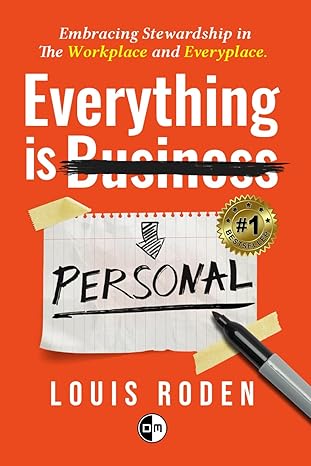
“There is a stark difference between organizations that are led and those that are merely managed.” This assertion is at the heart of Everything is Personal, a compelling guide to understanding the intricacies of true leadership. Louis Roden’s work highlights the significant distinction between textbook management and leadership infused with a personal touch. Challenging the conventional separation of personal and professional life, the book argues convincingly that every decision in business is profoundly individual. Through a series of insightful essays and reflections, Roden dismantles the notion that business decisions can or should be devoid of personal impact.
The book makes a powerful start with a critique of the phrase “it’s not personal, it’s business,” which Roden dismisses as nonsense and a cowardly evasion of responsibility. He argues that leaders must acknowledge the implications of their decisions, as these decisions shape the lives and well-being of their teams. This critical perspective will force readers to reconsider every instance they have used the phrase, ultimately agreeing that it indeed represents an evasion of responsibility. Roden’s writing is marked by its candid and often provocative tone, challenging readers to rethink their approach to leadership and workplace relationships. He emphasizes the significant amount of time individuals spend at work, arguing that workplaces must be more than impersonal environments focused solely on productivity. Roden’s unique perspectives challenge the notion that coworkers are not friends, urging readers to reconsider their relationships both at work and beyond. For instance, his reinterpretation of the golden rule—treating others as you would like to be treated—reveals it to be presumptuous and advocates for a more individualized approach to empathy and understanding.
Everything is Personal is strongly anchored in Roden’s personal experiences, following his own advice to let the personal reign. By drawing on his experiences, he illustrates his points effectively, making his suggestions practical and relevant to the real world. He calls for greater responsibility in shaping workplace culture, recognizing that empathy can transform soulless transactional engagements into meaningful, mutually beneficial relationships with coworkers and subordinates.
Everything is Personal is a thought-provoking read, especially in a world where the nature of work is rapidly changing. It advocates for a shift from workplaces that function merely as money-minting operations to fulfilling environments that employees look forward to each day. Roden’s passionate advocacy for personal accountability and genuine leadership makes Everything is Personal an essential read for anyone looking to transform their workplace culture into one that promotes trust, engagement, and long-term success.
Pages: 110 | ASIN : B0D55LW8VX
The DAP Strategy

Author Raj Sundarason offers readers solid advice on how to run a business or organization; especially in the digital age. The author comprehensively covers various aspects of business, that include marketing, making profits, dealing with losses, branding, leaving a digital footprint, and overcoming challenges while in the industry. The DAP Strategy: A New Way of Working to De-Risk & Accelerate Your Digital Transformation is primarily about Digital Adoption Platform (DAP), and how one can capitalize on the digitization of everything. The author is thorough in the topics that he covers and also engaging. Reading Raj Sundarason’s book will motivate you to think about your business on a global scale. The author gives crucial tips on the management of enterprises and how one can build an empire.
One thing every reader will appreciate about Raj Sundarason is how he personifies almost everything. Raj Sundarason makes his discussions relatable by personifying his experiences and business situations. When he talks about his milestones, one can feel how passionate he is about the work he has done. I love this about the author as it gives one the incentive to keep pushing. The DAP Strategy was an easy read thanks to the author’s moving tone and friendly language.
There are tons of lessons that one will draw from the book. Some of the chapters that were my favorite touched on topics like marketing, networking, digital branding, entrepreneurship, and strategizing. Raj Sundarason discussed relevant topics that would help one climb the career ladder or grow their business. His modest way of highlighting his wins and gracious tone he applies when sharing the knowledge he has acquired was impressive.
In The DAP Strategy, you do not just learn about Digital Adoption Platform. You learn about taking risks, preparing for incoming risks, and solving business issues in a professional manner. The objectivity displayed by the author even when he is talking about personal experiences is commendable. The content in this book is relevant today and can be used as reference material for professionals in different industries. I appreciate the author for his modesty when talking about business and for discussing both his highs and lows while working.
The DAP Strategy: A New Way of Working to De-Risk & Accelerate Your Digital Transformation is a refreshing look at the technology industry and how it impacts and interacts with the business world. This eye-opening book will have readers reevaluating how they run their organizations and will better prepare them for the future of technology.
Pages: 191 | ASIN: B09G3KRVWN


