Blog Archives
Backstories

And the Walls Came Tumbling Down follows American and German families across two world wars as their children inherit dreams, prejudices, loyalties, and choices that eventually place them on opposite sides of an altered World War II. What was the inspiration for the setup of your story?
Several.
First, not all Germans were Nazis, just as not all Japanese Americans were loyal to Japan. (See my novel The Two Terrors of Tulelake)
Second, I wanted to explore the backstories, the local stories, of those who fought on both sides of that conflict.
Third, how would the war have changed if certain key historical events had failed?
What interested you about exploring not simply whether history could have happened differently, but what those changes might have cost?
I wanted to examine what those changes might have cost, both physically and mentally, to individuals, groups of people, and nations. My own family had several veterans of World War II, and they were not comfortable in sharing their stories. The History Channel‘s World War II with Tom Hanks had two interesting questions from survivors and participants alike: “Who could do such a thing?” “How can one people do this to another people?” I wanted to share with a younger generation the horrors of concentration camps. Also, the 1846 translation of Eugène Sue’s novel Memoirs of Matilda included a famous quote — “Revenge is a dish best served cold.” This quote served as a connection to the second book in the trilogy, The Spies From Camp X.
What did you want to explore about humanity’s relationship with increasingly powerful weapons?
Someone can always create a bigger gun, a faster bullet, or a higher platform from which to destroy mankind. J. Robert Oppenheimer once said, “Now I am become Death, the destroyer of worlds.”
Albert Einstein once said, “I know not with what weapons World War III will be fought, but World War IV will be fought with sticks and stones.”
T.S. Elliott wrote, “This is the way the world ends / Not with a bang but a whimper.” I ask, “Where will it end?”
Author Links: GoodReads | Facebook | Website | Amazon
Two families, one American and one German, collide across World War I, the Great Depression, and a radically altered World War II, shaped by hatred, sacrifice, and forces that feel uncomfortably divine. As twin brothers choose opposing paths within Nazi Germany and a Texas farm boy takes to the skies, history veers off course. D-Day collapses in disaster. Britain faces annihilation. Volunteer pilots launch desperate missions, and a single flight toward Berlin carries the weight of ending the war at an unimaginable cost. Biblical echoes of Jericho haunt every turning point, raising unsettling questions about destiny, justice, and intervention.
Blending military history, family saga, and psychological tension, this gripping alternative history challenges readers to ask what if history changed, and what the cost of that change would be.
And the Walls Came Tumbling Down


And the Walls Came Tumbling Down by WM Gunn is a sprawling historical thriller that mixes twentieth-century warfare, alternate history, family drama, espionage, and a strong supernatural thread. It opens during World War I, where reports of impossible apparitions and a mysterious force saving British troops at Mons immediately establish that history in this novel has another presence moving behind it. From there, Gunn moves through the aftermath of the Great War, the rise of Nazi Germany, the Holocaust, Pearl Harbor, D-Day, the Manhattan Project, and the final stages of World War II. The book’s scale is one of its defining features. Real historical figures such as Manfred von Richthofen, Hermann Göring, Franklin Roosevelt, Jimmy Doolittle, Dwight Eisenhower, Robert Oppenheimer, and Adolf Hitler share the story with fictional families whose lives keep colliding with major events. The result feels like history being taken apart, rearranged, and then put back together along a more ominous path.
The novel’s emotional center comes from the families caught inside that history. Jürgen Kretz begins as a German pilot whose grief, pride, prejudice, and anger pull him toward extremism, while his twin sons, Manfred and Wolfgang, eventually represent radically different responses to the ideology they inherit. Gunn pairs their story with the Maxwell family in Texas, especially Allen Maxwell, whose childhood fascination with flight eventually places him at the center of enormous military decisions. That generational approach gives the novel a sense that beliefs don’t simply appear in wartime. They’re handed down, challenged, strengthened, or rejected. Manfred embraces the Nazi world his father helped support, while Wolfgang gradually chooses resistance, even helping prepare the bomb marked “Shofar” that will eventually be used against Berlin. His final realization ties his own Jewish ancestry to the novel’s biblical imagery, bringing a long-running family conflict into the book’s larger argument about responsibility, inherited hatred, and moral choice.
Gunn’s approach reminds me most of Ken Follett’s Century Trilogy. Like Follett, he enjoys putting fictional characters close enough to famous people and historical turning points that personal lives and world events begin to overlap. Gunn also has a similar appetite for military technology, politics, geography, and the mechanics of how history happens. His style can become almost documentary in its level of detail, especially when describing aircraft, weapons, operations, and military organizations. That density slows some scenes, but it also gives the alternate-history sections a strangely convincing texture. Gunn adds something much more speculative than Follett usually does, though: the destruction of Jericho becomes a template for later acts of destruction, with the image of a massive fist, the sound of the shofar, and the collapsing walls recurring across thousands of years. That biblical thread turns the novel from a conventional wartime epic into a story about civilizations repeatedly reaching moments of judgment.
The final stretch brings all of those elements together in a bleak and memorable way. In Gunn’s altered version of 1945, the Normandy invasion has failed, Nazi Germany remains powerful, and Hitler believes Germany is approaching an ultimate victory. The Allied response culminates in the atomic destruction of Berlin, killing Hitler, Manfred Kretz, and hundreds of thousands of others, while Wolfgang dies after witnessing the devastation and recognizing the connection between the bomb’s name and the shofar of his childhood. Germany subsequently surrenders, but Gunn closes on consequences: Maxwell and Akira face court-martial, the Atomic Age has begun, unresolved secrets remain, and an OSS officer receives a final message suggesting the danger isn’t finished. And the Walls Came Tumbling Down is ultimately a big, ambitious novel about war, hatred, faith, technology, and the decisions people make when history gives them the power to act. Its most interesting idea is also its simplest: walls can protect evil for a long time, but eventually someone has to decide whether bringing them down will save the world or simply create another kind of destruction.
Pages: 349 | ASIN : B0GY9HBXMV

Jigsaw: Temporal Apocalypse

Jigsaw: Temporal Apocalypse is a sprawling time-travel adventure that combines historical fiction, supernatural fantasy, science fiction, political intrigue, and a generous amount of pulpy action. It’s the tenth Jigsaw novel and the fifteenth book in the larger Jigsaw Universe, and the author recommends reading the earlier installments first. The story follows the Guardians as they try to stop Lilith, Ahriman, Pilo, and their allies from reshaping history and triggering a Temporal Apocalypse. The plot moves across centuries, from Roman-occupied Judea and medieval trade routes to postwar Europe, 1910s Arizona, the Russo-Polish War, and the strange political experiment in Fiume. That scale gives the book the energy of a season finale in which nearly every character, artifact, rivalry, and historical thread has returned for one enormous confrontation.
David Alyn Gordon’s greatest strength here is his enthusiasm for overlooked history. The novel doesn’t treat the past as scenery. Labor struggles, racial violence, extremist movements, wartime upheaval, political opportunism, and religious traditions all become active parts of the story. The shifting missions in Arizona, Poland, and Fiume gradually connect through the fragments of a powerful amulet, while the Nazi Bell and other temporal devices add a science-fiction framework to the supernatural conflict. There’s a lot happening, but the structure creates the feeling that separate pieces of history are clicking into place. Gordon also has a knack for choosing settings that are dramatic on their own, then finding ways to raise the stakes with demons, immortals, vampires, zombies, and time travelers.
For all its apocalyptic danger, the book is often funny and affectionate. Noah, Francesca, Tori, Mueller, Mariah, and the rest of the Guardians speak to one another like people who’ve survived far too many bizarre missions together. Their teasing, arguments, romantic bonds, and family connections give the story warmth between battles. The dialogue can be blunt and deliberately theatrical, especially when the villains explain their plans or heroes trade jokes during a crisis, but that style fits the book’s larger-than-life personality. The emotional farewell scenes near the end are particularly effective because they draw on relationships built across the series. Even after the central conflict is settled, the final chapters leave room for births, reunions, new beginnings, and the amusing realization that retirement may be harder for these characters than saving history.
I’d recommend Temporal Apocalypse most strongly to established Jigsaw Universe readers, especially those who enjoy seeing long-running character arcs and earlier plot elements brought together. It’ll also appeal to readers who like alternate-history adventures packed with real historical figures, supernatural mythology, political commentary, and fast-moving ensemble action. Someone fascinated by lesser-known episodes from the aftermath of World War I or early Arizona history will find plenty to explore. Because the story assumes familiarity with a large cast and extensive backstory, its biggest rewards will go to readers who’ve already traveled through the earlier books and are ready for a crowded, energetic culmination.
Pages: 258 | ASIN : B0H28LCRTT
The Phoenix CODEX: 138 Palindromic Mirror Edition Complete Phoenix Chronicles: Complete Phoenix Chronicles: A Trilogy of Trilogies

The Phoenix Codex: 138 Palindromic Mirror Edition is a speculative science-fiction thriller with strong elements of conspiracy fiction, metaphysical fantasy, horror, and mythic adventure. At its center is Dr. Natori Saira Evren, a synesthetic researcher drawn into a hidden pattern of Phoenix cycles, ancient Egyptian consciousness technology, alien hunters, simulation theory, and recurring resets every 138 years. The book presents itself not just as a story, but as a codex, a puzzle box, and a ritual object, with its mirrored structure, sacred numbers, and recurring symbols shaping the reading experience as much as the plot itself.
The book is committed to its own mythology. It doesn’t ease the reader in gently. It opens with pain, blood, classified files, impossible geometry, and a heroine who is already half legend before we really know her. That choice gives the novel a charged, feverish energy. Sometimes it works beautifully. The world feels huge, dangerous, and strangely magnetic, like every room has a hidden door and every number is whispering. The book wants to explain its patterns, prove them, dramatize them, and make the reader feel implicated in them all at once. That’s ambitious, but it can also be overwhelming at times.
The writing is at its best when it trusts atmosphere and image. Copper, burnt cinnamon, cold concrete, humming frequencies, jungle silence, blood on leaves: those details make the strange ideas feel physical. I could feel the book trying to turn paranoia into texture. The author’s biggest choice, though, is structural. The palindromic design, the 138-year cycle, the ascending and descending arcs, and the central mirror are not decorative. They’re the book’s engine. Even when I questioned some of the repeated exposition, I could see the purpose behind it. This is genre fiction that wants the form to become part of the spell. It’s a story about recursion.
I would recommend The Phoenix Codex most to readers who enjoy big, strange, high-concept speculative fiction, especially people drawn to ancient mysteries, secret histories, simulation ideas, cosmic horror, and books that blur the line between novel, artifact, and prophecy. Readers who like genre fiction that swings hard, builds its own symbolic language, and treats conspiracy, myth, and science fiction as parts of the same burning machine, this book has a fierce pull.
Pages: 501 | ASIN : B0GBVLRVXP

The Phoenix CODEX: 138 Palindromic Mirror Edition Complete Phoenix Chronicles: Complete Phoenix Chronicles: A Trilogy of Trilogies
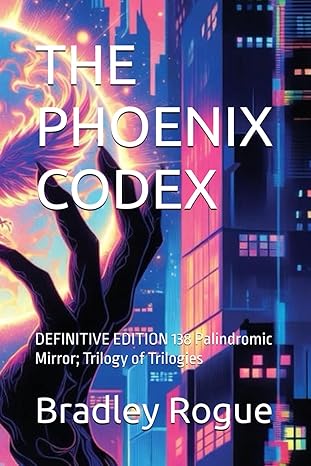
The Phoenix Codex is a theatrical metaphysical thriller that treats structure as part of the story, not just a container for it. Bradley Rogue builds the book as a “palindromic mirror” with ascending and descending arcs wrapped around a central point, and that design gives the whole thing a ritualized, incantatory feel rather than a straightforward adventure-novel rhythm. The opening makes its intentions clear right away: “It’s also a novel. Also a seed. Also a key.” That line captures the book’s whole personality. It wants to be read as fiction, transmission, puzzle box, and initiation text all at once.
At the center of it all is Dr. Natori Saira Evren, who isn’t just a protagonist so much as the book’s tuning fork. Her synesthesia, her academic outsider status, and her role as a traveler through patterns of recurrence make her the ideal guide for a world built on hidden frequencies, ancient architectures, and repeating catastrophes. The book follows her through interrogations, prequels, secret histories, temporal jumps, and revelations about the Phoenix cycle, and it does so with total conviction. Rogue writes like someone fully committed to the reality of his invented cosmology, and that commitment gives the novel its distinctive heat.
The book wants myth, conspiracy, sacred geometry, speculative archaeology, simulation theory, apocalypse, and spiritual transformation all in the same breath. Sometimes that makes the prose feel deliberately overwhelming, but that excess is also part of the reading experience. This is a book that likes pressure, repetition, symbols, and declarations. It keeps returning to numbers, mirrors, cycles, names, and encoded meanings until the language starts to feel ceremonial. Even the narrative instructions invite readers to treat the novel as an object with multiple valid pathways, which is a pretty revealing choice. The Phoenix Codex isn’t shy about asking the reader to participate in its pattern-making.
The most interesting thing about the novel is how openly it explains its own method. In the author’s note, Rogue says, “The Phoenix Chronicles make no claims to historical accuracy. They are mythology—but mythology that is aware of its own mythological status.” That self-description is useful because it points to what the book is really doing. It isn’t just telling a story about a hidden truth. It’s dramatizing the human urge to arrange history, fear, destiny, and transcendence into one giant meaningful design. That gives the novel a strange double quality. It’s earnest and self-conscious at the same time, immersive but also always nudging readers to notice the architecture holding it together.
The Phoenix Codex is less a conventional novel than a designed experience, and that’s what makes it memorable. It reads like a fusion of esoteric manifesto, sci-fi myth cycle, and visionary character saga, all organized around symmetry and recurrence. Readers who click with its wavelength will probably admire the sheer audacity of the construction and the intensity of its voice. Even when it gets wild, it knows exactly what it’s trying to summon: a story where reading becomes a form of initiation, and where narrative structure itself becomes part of the spell.
Pages: 550 | ASIN : B0GF7YTNQ8
The Collective

A Symbol of Time follows a dying alien civilization as it flees its poisoned homeworld and undertakes a perilous generational voyage to Earth, where survival may demand remaking an entire planet. What was the inspiration for the setup of your story?
I’ve always been uneasy with neat explanations for events that occurred before recorded human history. The idea that dinosaurs vanished because of a single catastrophic event is a tidy answer to a question that can only ever be fully answered in the deep past. It is a narrative we impose on incomplete evidence. Pairing that unease with my fascination with the possibility of an intelligent past on Mars became the foundation for A Symbol of Time.
The book follows an entire society as it wrestles with extinction. What interested you about telling a collective story rather than focusing on one protagonist?
Extinction is never experienced by a single person. I wanted to show how responsibility gets diluted when it’s shared, and how even well-intentioned individuals can participate in outcomes but the their contributions die with them. It’s the collective that has the greatest impact.
The novel raises difficult questions about survival at any cost. Was there a moment where you personally struggled with the choices your characters made?
Yes, especially when the choices stopped feeling dramatic and started feeling practical. The hardest moments might, on one hand, have seemed like acts of cruelty and indefensible, but on the other, were decisions that seemed reasonable in the circumstances. Those are the ones that bothered me, because they’re the kinds of choices people actually make under pressure.
What question from the book still lingers with you personally?
Whether a civilisation has the right to preserve itself if doing so fundamentally alters or harms another world. Whilst this is probably a question the human race will never get to answer, it was interesting to ponder. Who gets to decide what “necessary” means, and who lives with the consequences decades later. I don’t think the novel answers that question, and I don’t think it should.
Author Links: GoodReads | Website | Amazon
Their home is cold and dying, choked by the toxins of their own progress. Now, an advanced alien species looks toward the Third Planet—Earth—with hope and fear. They see a fertile paradise, but one that is hostile, hot, and dominated by massive, predatory reptiles.
The choice is stark: die in the heat, or remake this new world in their own image.
As they descend to alter the climate and purge the planet of its prehistoric masters, they set in motion a chain of events that will echo through geological time. A Symbol of Time weaves palaeontology and astronomy into a chilling tale of survival. As the new masters of Earth terraform the planet, the question remains: does high intelligence inevitably carry the seeds of its own destruction?
A Symbol of Time

A Symbol of Time is a sweeping work of science fiction that follows a dying species as it flees its collapsing Homeworld and sets course for the “Third World,” a dangerous and vibrant planet filled with prehistoric monsters, hostile climates, and uncertain hope. The story opens with the political struggle of leaders like Elthyris, who pushes her people toward escape, and then expands into a tense generational mission through deep space where fear, mutiny, and loss threaten the survival of everyone aboard. By the time the colonists finally approach their new world, the book has painted an entire civilisation wrestling with extinction, guilt, and the fragile possibility of beginning again.
The story moves with a clarity and earnestness that makes the stakes feel heavy without bogging the story down. Author John Turnbull spends time on sensory details: the grit in the air of the dying planet, the hum of the ship’s systems, the sharp dread in a crowded briefing room as monstrous creatures appear on a screen. These moments gave me the sense of being there, not as a distant observer but as someone tucked into those cramped ship corridors, overhearing worries and watching loyalties shift. Sometimes I wanted certain conversations to go deeper, especially when characters brushed up against big ethical questions. But the writing carries a steady confidence, and it kept me curious about what each character would choose next.
The story blends large-scale worldbuilding with interpersonal tension, letting us watch society shrink down and then stretch again under pressure. I liked the way the book raises questions about responsibility and survival without forcing neat answers. The mission logs, political debates, and emotional undercurrents between characters all layer together until you feel how messy a desperate exodus would really be. Some plot beats arrive suddenly, especially the catastrophic loss of Ark Hope, but that abruptness made sense to me. Space is indifferent. Disaster doesn’t wait for pacing. That raw edge worked.
I felt the book speaking to anyone who enjoys science fiction that leans into survival, moral tension, and the rebuilding of society. It will especially appeal to readers who like their sci-fi grounded more in people than in technology, even when dinosaurs and starships share the page. If you’re drawn to stories about second chances and the uncomfortable truths that come with them, A Symbol of Time is one you’ll want to pick up.
Pages: 234 | ASIN : B0G2CP49WX
Operation Archer 2nd Edition.

Operation Archer is a wartime time-travel thriller that follows Simon — a grieving engineer in 2027 — whose recurring nightmares and unresolved trauma lead him to seek hypnotherapy. What begins as an attempt to heal from the anguish caused by his wife Lorna’s preventable death develops into something far stranger, as Simon’s sessions unlock vivid recollections of flying RAF bombers in WWII. Soon, the boundaries between memory, imagination and reality vanish until he participates in a dangerous mission with life – changing consequences. The book blends historical fiction with speculative adventure, grounding its big swings in a character who feels painfully human.
Beyond the aerial action, hypnotherapy and intrigue, this is really a story about grief and the mind’s strange ways of restoring balance after it has been shattered. The early chapters are heavy with loss. Simon’s memories of Lorna feel tender and raw, and his anger toward the medical system is explored in a way that feels honest rather than melodramatic. When the book shifts into regression, past-life imagery, and eventually full time-travel, the transition works better than I expected because the emotional groundwork is so solid. I found myself believing the unbelievable simply because Simon did, and because the narrative lets his curiosity and vulnerability drive the plot rather than spectacle alone.
The author makes some bold choices, especially in how he describes the procedural details of hypnosis, RAF aviation, and wartime operations in great detail. Sometimes I caught myself wishing the pace would move a little quicker, but then I would hit a passage where the sensory detail pulled me right back in. The roar of Merlin engines. The searing heat of a burning bomber’s fuselage. The eerie quiet of a hypnotic induction. When these moments appear, they feel less like exposition and more like slipping into someone else’s skin. And I appreciated the book’s willingness to stretch genre boundaries. It is a mixture of historical and science fiction plus psychological drama, which gives it a strange charm.
Operation Archer is reflective, occasionally surprising, and anchored by a protagonist whose pain feels real even when the plot turns surreal. If you enjoy historical thrillers with a speculative twist, or character-driven stories that explore trauma and transformation, you’ll enjoy this book. Readers who love World War Two aviation fiction or time-travel adventures will feel especially at home here. For me, Operation Archer is a compelling blend of heart, history, and imagination.
Pages: 223 | ASIN : B0G52L2ZL3


