The Pebble in the Pond


The Pebble in the Pond is a work of fiction, and it reads to me like Southern women’s fiction with a strong small-town family drama at its core. It follows Miriam Llewelyn, who arrives in Stuarts Landing, Virginia, after bankruptcy and grief have knocked her life off balance, only to find herself pulled into old local loyalties, class tensions, women’s power struggles, and the long shadow of her grandfather’s past. What begins as a story about starting over gradually opens into something larger: a novel about reputation, memory, belonging, and the way one person’s arrival can unsettle an entire community.
What stayed with me most was the book’s steady interest in women as they actually are, not as symbols. Author Suzanne Groves gives us Miriam, Louise, Emma, Bitsy, Pearl, and the Webster sisters with enough room to be difficult, wounded, funny, controlling, generous, petty, and surprisingly tender. I appreciated that. The writing has an easy, readable flow, and it often feels as if you are being quietly let into the social life of Stuarts Landing rather than formally introduced to it. I also liked how Groves builds tension through everyday moments: a church luncheon, a grocery store encounter, a tense conversation in a parlor. The drama comes from pride, history, and the thousand little ways people test one another. That felt true.
I was especially interested in the author’s choice to center class, status, and female friendship without sanding off the rough edges. Louise, in particular, is written with enough sharpness that she could have become a caricature, but she never quite does. That is one of the book’s strengths. Even when I found her maddening, I could still see the fear and conditioning underneath the polish. Miriam, on the other hand, gives the novel its moral warmth, though I think what makes her work is that she is not naive in a flimsy way. She absorbs a lot, she missteps, she keeps going. The title ends up feeling earned too. The book is interested in ripples, in the way old secrets and fresh acts of courage move outward through a town that pretends it cannot change.
By the end, I felt I had spent time somewhere real, with people I could argue about on the drive home. That is usually a good sign. I would recommend The Pebble in the Pond most strongly to readers who enjoy character-driven fiction, Southern-set novels, and stories about women navigating family history, social pressure, and reinvention. Anyone who likes novels where the emotional stakes matter more than speed, and where a town can feel almost as alive as the cast, will probably find a lot to appreciate here.
Pages: 420 | ASIN : B0GQCNB5VW

A Police Action


AA Freda’s A Police Action follows James Coppi, an Italian-born draftee from the Bronx, who is sent to Vietnam just as he thinks he is nearly clear of combat. Before deployment, he falls into an intense, improvised relationship with Samantha Powers in Colorado Springs; then the novel splits its attention between that fragile bond and the brutal, grinding logic of the war, as Coppi moves through training, field operations, letters from home, and finally the longed-for flight out of Vietnam. The book is part war novel, part love story, and part character study of a man whose cynicism functions like armor until it starts to crack.
What stayed with me most was Coppi’s voice. He is sharp, profane, funny, opportunistic, and often morally slippery, yet he never feels airbrushed into likability. I liked that the novel lets him be contradictory: he loans money at punishing rates, sizes everybody up like a card player reading a table, and still turns unexpectedly tender when Sam’s crisis lands in front of him. That tension kept the book alive for me. Freda is especially good at showing how swagger, lust, fear, and decency can inhabit the same man without canceling one another out. I also admired how the book keeps returning to letters, promises, and half-made commitments; the emotional life here is not decorative, it’s part of the war’s pressure system.
Even the book’s excesses have a strange pulp vitality. The prose can be blunt, and some scenes lean into masculine bravado or sensual description that will divide readers. But even when the writing gets overheated, the book has a stubborn sincerity that kept pulling me back. The combat material, especially once Coppi is operating in the field and the novel widens into mud, artillery, exhaustion, and the eerie bureaucracy of survival, has a granular, unvarnished charge. What affected me most was the book’s refusal to hand out a neat emotional reward: after all the letters and longing, Coppi goes home without stopping for Sam, and the novel leaves behind an ache rather than a tidy embrace. That choice felt harsher than sentiment, and truer.
I’d recommend A Police Action to readers of Vietnam War fiction, military fiction, historical fiction, literary war drama, and relationship-driven coming-of-age novels, especially those who prefer stories with rough edges over polished heroics. It will likely appeal more to readers who admire the bruised candor of Tim O’Brien than to those looking for the cleaner momentum of a conventional combat thriller, though Coppi’s sardonic hustle also gave me flashes of a darker, more streetwise James Jones. This is a war novel that understands survival costs more than blood; it costs the life you thought would be waiting for you.
Pages: 471 | ASIN : B0GV1ZSCZJ
Destiny Is Forced on Them

The Soul-Sung centers around a village boy who becomes the unwilling bearer of a world-shaping force called the Song. What was the inspiration for the setup of your story?
The inspiration for this story came from a short story I wrote late one night while on third Shift. The idea wasn’t really about one boy bearing responsibility, but about the Idea of change as a whole and how it affects everyone and everything. Denny is just one aspect of that. The one whose destiny is forced on them. The song represents the force of change in the world.
How did you approach writing a character who carries something so large while still feeling small in the world?
I approached it the same way you would approach a boy who has a weight dropped on him in the real world. I was raised early on in very troubling times and circumstances. This was not my fault or my family’s. But I had a weight, a burden pressed onto me. I was the last male heir to my family’s name and line. I know what it’s like to carry a burden and have to find a way to swim against the current while also having undiagnosed ADHD.
The novel suggests that remembering can be both necessary and painful. How do you navigate that tension?
Memory, good or bad, is a forge. It creates who we are. Looking back on who we were and what we have done is painful, but it gives us a chance to continue. To learn and to grow. I am the person I am today because I never once forgot where I came from. I never once looked back and saw only pain. I saw purpose. I saw love. I saw all the tools that would push me to be all that I could be. Remembering is pain. In the novel, I lean on this. Everybody carries a part of their past, and that past drives their actions.
Can you give us a peek inside the second book in The Vaeritas Saga? Where will it take readers?
The Second Book will expand the world. The theme of change becomes a pressure cooker. Characters that we thought we knew become lost in their own ideology. There are a few surprises in store. It’s important to note that no one in the world of Vaeritas is safe from their own choices. Every Character we have met thus far who has lived will return. And we will even see the arrival of a Draken that makes Albion seem kind. His own son.
Author Links: GoodReads | Facebook | Website | Instagram
After witnessing the destruction of his home, a reluctant bearer becomes bound to an ancient living legacy that predates law, power, and ownership. As political ambition, cultural fracture, and rigid tradition collide, the fate of the world hinges not on victory, but on restraint.
The narrative examines the tension between preservation and progress, asking whether change can be guided without erasing what gives a world meaning. Crossing borders and confronting forgotten rites becomes essential as every decision alters the fabric of existence itself.
This novel blends mythic worldbuilding with philosophical depth, appealing to readers of epic fantasy who value thematic richness, moral complexity, and emotionally grounded storytelling.
Finalist, Writers’ League of Texas Manuscript Contest.
Supplicant

Supplicant is a science fiction novel with a strong dystopian streak, and its core idea is sharp right from the start: in Kip Cassino’s future, prayer has been measured, weaponized, and folded into the machinery of power itself. A researcher named Mason Pratt proves that directed prayer can preserve life, and centuries later that discovery has helped create a brutal world ruled by the long-lived elite, sustained by engineered “supplicants” who exist to pray for them without end. From there, the novel follows violence, political maneuvering, and the fate of KAX, one of the surviving supplicants, as the story turns that big speculative premise into something much more intimate and disturbing.
What I enjoyed most was the book’s willingness to go all in on its premise. Cassino does not treat the idea of prayer as a soft symbol or a vague spiritual backdrop. He treats it like infrastructure, like currency, like oil in the pipes of civilization. I found that fascinating. There is a real chill in the way the novel imagines faith being absorbed into systems of ownership, biotech, and hierarchy. At its best, the writing has that old-school speculative fiction energy where one bold idea keeps radiating outward and changing everything it touches. You can feel the author thinking through consequences, and I respected that. Even when the book gets blunt, it’s rarely lazy. It wants to ask what happens when something sacred gets processed by institutions until it becomes another tool for control.
The novel is vivid, sometimes almost brutally so, and it doesn’t flinch from cruelty. KAX’s storyline, especially, is hard to read at times. There were stretches where I admired the conviction behind the storytelling, and other stretches where the book leaned so hard into horror that it was shocking. I kept coming back to the fact that Cassino gives KAX an inner life, not just a role in the machinery of the plot. The book is full of excess, but underneath it I could feel a serious concern with dignity, survival, and the damage done when people are reduced to functions. That gave the novel weight. It kept it from feeling empty.
I’d recommend Supplicant most to readers who like speculative fiction that is idea-driven, dark, and unapologetically severe. If someone enjoys dystopian science fiction that wrestles with religion, power, bioengineering, and the moral cost of building a society on human dependence, this book will give them a lot to chew on. For people who appreciate ambitious genre fiction that is willing to be unsettling, provocative, and sometimes messy in pursuit of a big thought, I think it will leave a mark.
Pages: 326 | ASIN : B0GMK71BX2
Houdini Saves the Farm
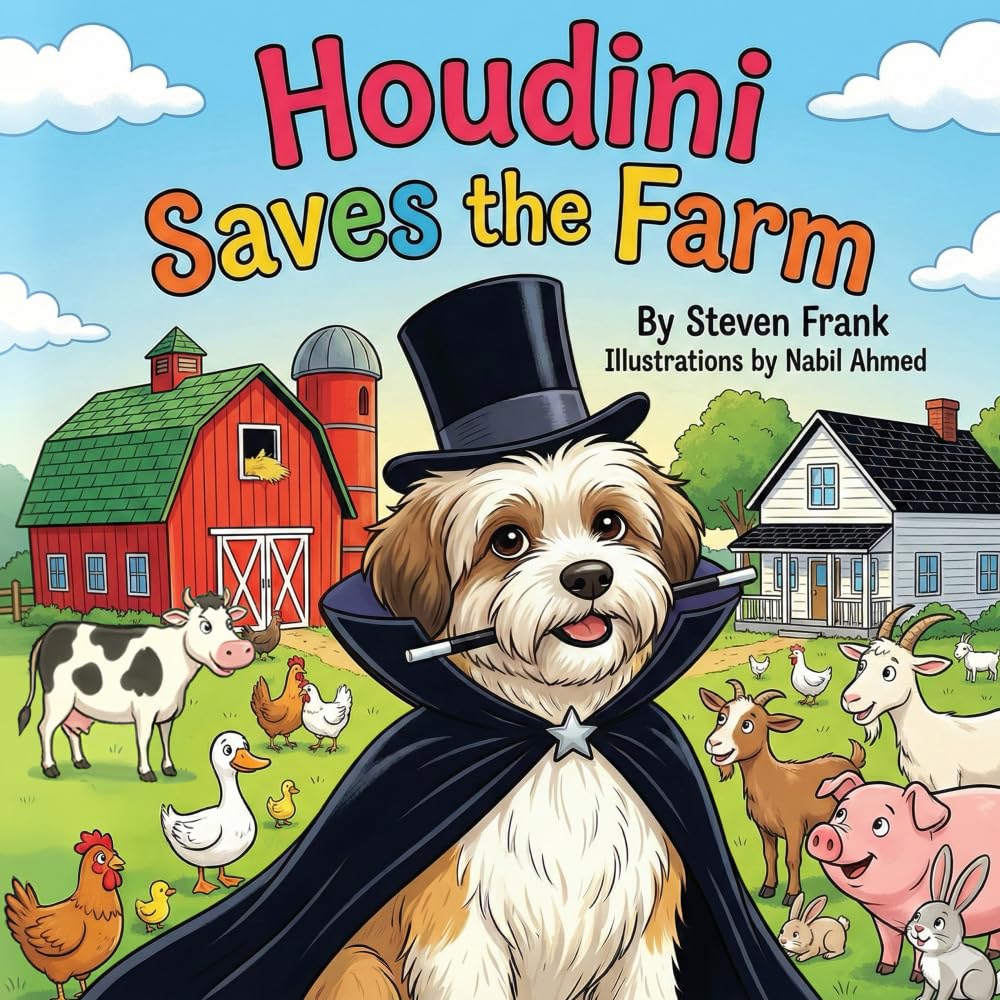
Houdini Saves the Farm is a children’s picture book with a gentle farm setting, a playful mystery, and a clear heroic arc. It follows a pup named Houdini, adopted by a farmer because of his knack for disappearing into his surroundings, as he grows into the farm’s watchful little guardian. After the farmer is injured and the farm animals begin vanishing one by one, Houdini pieces together what is happening, tracks the theft, and helps bring everyone safely home. As a work of children’s picture book fiction, it blends animal adventure, light suspense, and a simple lesson about loyalty and courage.
What I liked most was how direct the writing is. It does not try too hard, and for this age range, that feels like the right call. The story moves with real purpose. Each page gives young readers one clear beat to hold onto, and that steady pattern of animals disappearing one after another builds suspense in a way that is easy to follow without becoming too intense. I also thought the author made a smart choice in giving Houdini a special trait early on, then paying it off later in the plot. His talent for hiding is not just cute; it’s also practical. It becomes part of the mystery and part of the solution, which makes the story feel more thoughtfully built than some picture books that simply move from scene to scene.
The illustrations on every page are wonderful. They are sharp, vivid, and full of color. They give the book its warmth and energy, making the farm feel lively and inviting while giving young readers plenty to look at and enjoy. The rural farm world feels warm and familiar, and the beautiful illustrations give the story a soft golden-hour feeling even when the plot turns tense. The missing animals, the nighttime theft, the injured farmer, all of that give the book a stronger dramatic spine than many very young picture books. It gives the story shape and makes Houdini feel genuinely brave, not just adorable. Still, what keeps it grounded is that the emotional center stays simple: a dog looking after his person, a farm thrown off balance, and a small act of loyalty growing into something big. That part landed for me.
I’d recommend Houdini Saves the Farm to families looking for a children’s picture book that offers more than sweetness alone. It would especially appeal to kids who love animals, farm settings, and mysteries with a clear payoff, as well as adults who want a read-aloud with enough story to keep things interesting. It’s earnest, easy to follow, and built around a hero young readers can root for right away. For children who enjoy brave-animal tales with a touch of suspense, this one should fit nicely.
Pages 33 | ASIN : B0GQBL7QMK
It Started as a Pun

EscapePeas follows an advanced race of space exploring peas who, after having ship troubles, wind up on Earth on a pea farm where they set out on a quest to find a way home. What inspired the idea of peas traveling through space?
J.L. McCreedy: Actually, the idea simply started when some peas rolled out of our freezer one evening. Sam said, “Escape peas! That would make a great story!” And then we set about the framework. We wanted the peas to be escaping (obviously!) but wanted to keep it quirky and funny. Peas escaping from prison? Too dark. But interstellar-traveling peas escaping a black hole and avoiding the fate of “Mushy Peas”? Now we’re on to something interesting! But then what?
Well, it just so happens that we live near a village in Italy called Lumignano, and this place really is known as the “Kingdom of Peas,” and they really do have a Pea Festival every year. And at this annual festival, they actually have a King and Queen of Peas! With that in mind, we had this idea drawn loosely from The Wizard of Oz: this concept of a quest to find a greater power that will resolve one’s problems, only to discover that no such greater power actually exists, and that the only one who holds the ability to address the situation is you. Except there are no magical ruby slippers. The answer is entirely within yourself, and sometimes—maybe usually—that answer is a lot more practical than the solution you thought the magical, “greater power” could grant.
So that idea shaped our story. And we thought the idea of the king and queen “just dressing up like this” was funny!
Dr. Sam: Yes, as Jesse mentioned, it originally was just a spur of the moment play on words pun of saying “Escape Peas” in place of “Escapees” and then we just sort of ran with it from there.
How did you come up with the personalities for each of the peas?
Some, like GrumPea and GramPea and SweetPea were just obvious choices. Others came to us as our story progressed. The word play was a lot of fun, and so the personalities really came from finding “pea” words that were fun or silly or endearing. The hats helped show their individuality. We loved the idea of these brilliant, space-traveling-pea-scientists who also share a penchant for kooky hats and dancing and acrobatics. They’re so well-rounded. (Pun intended!)
How do you balance fun storytelling with educational content?
J.L. McCreedy: Stories are inherently informative anyway—even silly ones. There is almost always something thoughtful that can be gleaned from a story, regardless of genre or audience. Since Sam and I both enjoyed the rhyming and imaginative stories like those by Dr. Seuss as children, that aim of entertaining in a quirky and imaginative way is always the goal when we write together. And since children are naturally inquisitive, the idea of adding educational content at the end just seemed like a natural conclusion. Information is always more interesting when there is a story tied to it! We did this same story-and-educational-pages format for Theodore, The Sloth Who Wants to Race, and the kids really got into that back matter during school visits. They loved the sloth facts in particular.
Dr. Sam: Yes, and it was fun and sort of nostalgic digging into old high school biology memories related to Gregor Mendel, the role of Legumes, etc.
What is one message from EscapePeas that you hope young readers take away from your story?
J.L. McCreedy: There are so many things! Be strange! Be adventurous! Be kind and brave! But I guess if I had to pick just one message, it would be: Don’t let obstacles keep you down. It’s so easy to think that, just because you fail at something or if people criticize/make fun of your efforts, or that you find something extremely difficult, it means you can’t achieve the thing for which you are striving. That you’re not good enough. But failure or difficulty or disappointment usually just means that you need to get back up and try again. Think about what you’ve done so far, and then think of what you can do differently that might work this time. I feel this message is extremely important because kids very often internalize criticism, obstacles and failure in really self-defeating ways. It’s normal to face setbacks. When things don’t go as hoped or planned, use your creativity and intelligence to find a way forward. It might not be the solution you want, but there is usually something you can do to move toward your goal. You’ll have to adapt. Sometimes, it will take much longer to reach your goal than you had hoped for. Sometimes, your goal will change. But if you pay attention, that journey of sticking it out when things get tough will show you new things about yourself. Don’t give up!
Dr. Sam: To me, the John Lennon (I think it was him anyway) quote of “Life is what happens when you’re making other plans” is sort of embodied in this story. Being able to roll with the punches and carry on, regardless of what surprises and obstacles life throws at you is an important skill to develop.
Author Links: GoodReads | Facebook | Instagram – J.L.McCreedy | Instagram – Dr. Sam | Website

Blast off on a rhyming adventure with a crew of space peas who aim for Pea Planet but end up on Earth. Oops.
Now these plucky peas must face a big, unfamiliar world full of surprises, setbacks, and bumpy detours. Will they panic? Give up? Split apart? Not a chance. With teamwork, courage, creativity, and a little trial and error, they just might find their way home.
EscapePeas is a playful picture book celebrating resilience, friendship, problem-solving, and belonging. Perfect for read-aloud time, it delivers humor, heart, and an uplifting message about what to do when life doesn’t go according to plan.
At the end of the story, young readers can enjoy bonus educational features, including Dr. Sam’s Pea Facts and a Glossary of Super Words.
Lexile® Framework for Reading, Lexile® text measure 550L
40 pages, Paperback
Expected publication May 5, 2026
Capturing the Experience

In Encounter, you share with readers your incredible experiences coping with culture shock, natural disaster, and classroom struggles while teaching at Leulumoega Fou College in Samoa in 1990. What did you most want to preserve about your time in Samoa?
I most wanted to capture the experience, what it taught me, and how it impacted my life following the experience. In capturing the experience, I sought to make the story as immersive as possible for the reader. I want them to feel what I felt when they step on a cockroach in bare feet first thing in the morning, the sweat on their face, tears in their eyes, and how the constant confusion and uncertainty of cultural collision drags us down emotionally. I want my readers to be as confused and uncertain as I was. I want them to face the hard moral choices I faced, and leave them to make their own decisions – what would they do in that time and place? What would they do now? Most of all, I want to preserve the search for wisdom, understanding, meaning and purpose to all the hardship and suffering. The reflective passages are there to help the reader reflect on the bigger picture, but with humility, acknowledging just how limited our knowledge and experience actually are or can be. To make the book immersive, I re-read and studied authors who I thought had done that well – like Steinbeck, Dickens, Hemingway, Frank McCourt, and contemporary thriller writers John Le Carre, John Grisham, and Lee Child. To help make scenes vivid, I returned to poets Shakespeare, TS Eliot, Keats, Shelley, Wordsworth, and Tolkien. For reflection, I turned to the way CS Lewis and Jennifer Worth (Call the Midwife) wrote their reflective pieces.
How did you decide what to include versus what to leave out, especially in more vulnerable or unflattering moments?
My guiding principle was to be honest with whatever I put in, but the need to keep the word count to under 100,000 meant I had to cut a lot out. I approached judgment of others by honestly sharing what they said and what they did so the reader could make their own judgment. Unflattering moments and vulnerability are a necessary part of learning, but also necessary to show contrast. The climb out of the valley of “badness” is only meaningful if we first know how bad that valley was for us.
In the case where I did provide judgement (characters Helen, Tammy, and some others) I did so because it was necessary to show my changing understanding of them – how my initial judgement changed from unflattering to gaining wisdom. This is most important, and most difficult for me to write about, in the case of my relationship with Helen, where my initial assessment slowly changes from someone I’m wary of, to someone I loved and cared for deeply. (The “real” Helen passed away from breast cancer in 2007 as a young mother with two young boys; Tammy passed away in 2021 after a life of overseas service as a teacher and nurse.) However, for many people working overseas as volunteers, aid workers or missionaries, it’s often our fellow workers and those we live with that are the most difficult, not those we go to serve. I wanted to share that experience in the hope that it would help others going through a similar struggle when thrown together with colleagues and co-workers they may not like. I want them to know that even if your negative assessments of difficult people turn out to be true, in true community, you still need to care for them, love them, and recognize you will need to depend on them.
How did your Christian faith shape the way you interpreted your experiences at the time?
We would not have gone to Samoa if we did not at least hold a Christian worldview. And we would probably not have persevered without having the challenge of Jesus words, and the example of both his life, and the lives of many Christians since that time. I mention St Francis and Mother Teresa, but there are many others. This is why each chapter starts with a quote from the words of Jesus, because it was those actual words that challenged me personally each step of the way.
In going to Samoa in 1990, the risk of death was very real since the previous year a field worker had died of Dengue fever, and there were other threats to safety and security we could not control. We believed then, as we do now, that if we died our death would not be an accident – that God would work this for good, for His purpose, and God’s purpose is what gave us purpose in whatever we did. I don’t think we would have willingly engaged in suffering and risked our security, peace, happiness, or life for something that we do not believe to be true. I have looked at atheism, and it is a selfish, meaningless, and purposeless wasteland.
What is one thing you hope readers take away from Encounter?
I hope they gain a window into what a life lived with purpose can look like, that such a life can be found following Jesus on the narrow road, that such a life may be hard, and involve suffering, but it will at least be very rich and will lead to an abundant life.
Author links: GoodReads | X | Facebook | Website
When Ian and Heather leave Australia to teach in Samoa they expect hardship. They don’t expect a devastating cyclone followed by the slow dismantling of everything they thought they understood about the world.
Why are they being laughed at? Why is introducing someone offensive? What does respect look like? Navigating traditional Polynesian culture amid disaster, poverty and political tension, exposes their own cultural blind spots, assumptions and questions their deeply held beliefs. Good intentions are not enough. Join with them as they seek purpose and explore what justice, identity, faith and community mean in a radically different culture.
Raw, honest and unexpectedly funny, Encounter immerses you in the lived reality of being an outsider — the exhaustion, the mistakes, the fear, the beauty and resilience of Pacific Island life and community. Moving with the pace of a thriller, Encounter’s true story also wrestles with uncomfortable questions immigrants, travellers, and truth seekers know well: Where do I belong? Why am I here? Who am I when everything familiar is stripped away?
Perfect for readers who love biographies and memoirs that transport you into another world, want to be challenged or need a page turner they can’t put down.
A Floresta Encantada / The Enchanted Forest

The Enchanted Forest, by Isabel Ricardo and translated from Portuguese by José Manuel Godinho, feels like a gentle introduction to longer fantasy stories for middle-grade readers. It’s the kind of book that slowly pulls you in, with just enough magic and emotion to keep you turning the pages.
The story follows a young girl, Rita, who finds herself stepping into a hidden, magical world during what begins as a normal day by the lake. What unfolds is a full-fledged adventure. She meets Bella, the fairy who protects the forest, and is introduced to a world where animals speak, underwater kingdoms shimmer, and every part of nature feels alive. As Rita spends more time in this enchanted space, she meets different animals, each with their own personality, and begins to understand how closely their world is tied to human actions.
What I loved about this children’s book is how it balances wonder with something more meaningful, grounded in our reality. There is magic everywhere, from crystal palaces beneath the lake to quiet forest paths filled with talking creatures, but there is also a clear message running through it. Rita learns that the same world that feels so beautiful is also fragile. Through her journey, she sees the effects of carelessness, pollution, and harm caused by humans. One of the most striking parts of the story is when she helps break a spell on a boy who has been turned into a swan, showing how kindness and second chances matter. Later, when hunters enter the forest, the tone shifts, reminding readers that this magical world is not untouched by danger.
The book also works beautifully for bilingual readers. With both Portuguese and English text, it becomes a great way for children or families to engage with a new language without feeling overwhelmed. I absolutely loved the illustrations as well. They are soft, magical, and detailed enough to draw younger readers into the story, making the forest feel vivid and real.
The Enchanted Forest is a lovely read for children who are ready to move into slightly longer, more immersive stories. It carries a quiet but important lesson about caring for nature, while still feeling like an adventure.
Pages: 135 | ISBN : 1962185761


