Joshua Creed: Keeper of Worlds


Joshua Creed: Keeper of Worlds is a middle-grade portal fantasy with a strong coming-of-age thread, and at its core, it follows twelve-year-old Joshua as his already-shaky life cracks open even further. His parents are divorcing, school feels like a minefield, and then his strange blue eye starts pulling him into another world, where prophecy, dangerous magic, and creatures like Wormly, Selia, and Gonthragon force him into the role of a keeper between worlds. What makes the book more than a simple quest story is that Joshua is not just trying to save a fantasy realm. He’s also trying to understand his family, his anger, and the fear that he ruins everything he touches.
I liked how directly the author, Dawnette Brenner, writes Joshua’s inner life. The fantasy setup is big, but the emotional entry point is small and human: a tetherball game, a suspension, a kitchen table conversation, a kid trying not to cry. I think that choice works great. It gives the book real footing before the world-hopping begins, and it keeps the stakes personal even when the plot expands into prophecy and interdimensional danger. I also liked that the magic has rules and consequences. The idea that crossing between worlds costs Joshua something, even time from his own life, gives the story weight and keeps it from feeling too easy.
I felt the book was at its best when it slowed down and let character and emotion breathe. Joshua’s bond with Jonah, his guilt over his mother being hurt, and the way fantasy becomes tangled up with family pain all land well. Those parts felt honest. The novel throws a lot at the reader: prophecy, magical tools, multiple creatures, vision lore, world rules, and escalating threats. Some readers will enjoy that rush. I respected the author’s instinct to make this adventure about responsibility instead of simple wish fulfillment. The book keeps asking a solid question: what does it actually cost a kid to become “chosen”? That question gives the story its backbone.
I’d recommend this most to readers who like middle-grade fantasy that blends portals, prophecy, and magical objects with family strain and emotional growth. Kids who enjoy stories in the lane of classic quest fantasy, but want something more grounded in school, home, and identity, will probably connect with it. I think adults who read middle grade closely will also notice the heart behind it. This is a fantasy novel, but it is really about carrying too much too young and learning that bravery is not the same thing as pretending you are fine.
Pages: 281 | ASIN : B0GPP1XLTD

SANJIVANI SCROLLS


Sanjivani Scrolls is a mythic fantasy manuscript that blends court intrigue, divine politics, martial action, and botanical mystery into one sweeping story. At its center is the search for Sanjivani, an elixir tied to healing, power, memory, and the right to shape life itself. The book moves through kingdoms, forests, palaces, laboratories, and battlefields, but it keeps returning to the same core tension: who should hold sacred knowledge, and what kind of responsibility comes with it? From the prologue onward, it treats that question seriously, and that gives the whole narrative a sense of purpose.
What stood out to me most is how fully the book commits to its world. It doesn’t just decorate the story with gods, Asuras, legendary herbs, and ancient owls. It builds a whole moral atmosphere around them. The manuscript is interested in memory, inheritance, loyalty, and balance between science and the living world. Raven and Devan embody that tension especially well, with Raven reaching toward discovery and Devan pushing for stewardship. When Raven says, “Nature does not forget, she waits,” the line feels like a thesis for the book’s worldview, not just a nice piece of dialogue.
The storytelling style is big, dramatic, and unapologetically romantic. Battles arrive with a lot of force, and the emotional beats are written with the same intensity as the action scenes. Prince Dron, Raven, Devan, Westfin, and the Wise One all belong to a world where heroism is meant to feel luminous. That heightened approach works best when the manuscript slows down long enough to let character, myth, and setting reinforce one another. A line like “what legend calls myth, I call memory” captures the book’s tone perfectly. It wants legend to feel lived-in, and a lot of the time it does.
What I found engaging is that the book isn’t just chasing spectacle. It’s also trying to braid together several kinds of story at once: fantasy quest, dynastic saga, war chronicle, love story, and near-mystical science fiction about healing and life extension. Owlwood becomes the place where all of that gathers, and the manuscript gives it real symbolic weight. The owls, the hidden lore, the royal alliances, and the scientific hunt for Sanjivani all make the setting feel charged with meaning. Even when the plot branches outward, the world itself remains the anchor.
This reads like the opening movement of an epic fantasy that wants scale, feeling, and mythology all on the same page. Its strengths are its conviction, its imaginative worldbuilding, and its sense that knowledge is never neutral. It’s a book about sacred medicine, contested power, and people trying to decide whether love, duty, and wisdom can survive the pull of ambition. Most of all, it knows what kind of story it wants to be, and that confidence gives it momentum.
Page: 137
Stairwell To Silence
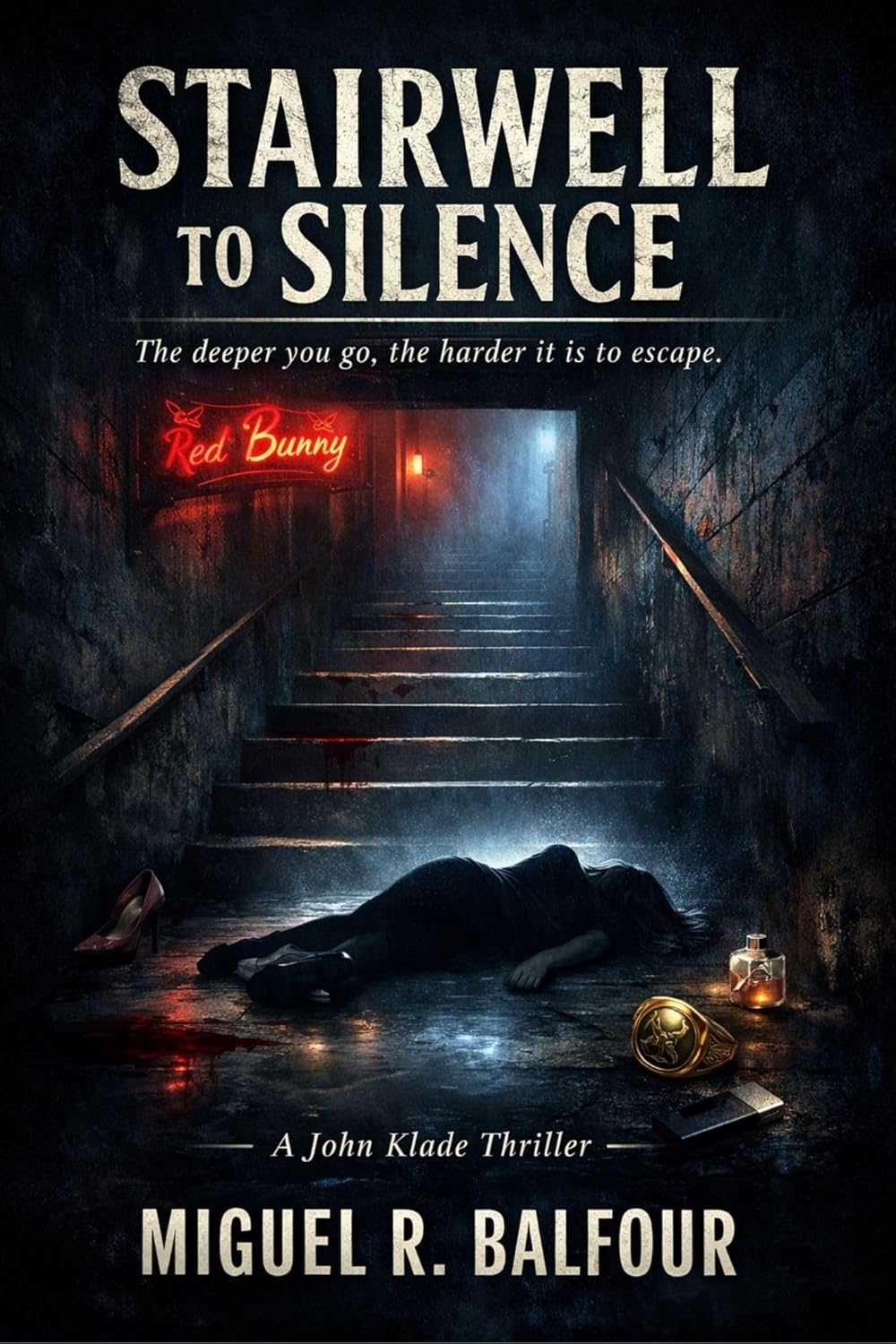
Stairwell to Silence opens with private investigator John Klade being warned away from a case he is destined to take anyway: the suspicious stairwell death of Bella Gaines, a brilliant law student whose “accident” quickly widens into a web of compromised police work, elite vice, military-adjacent secrecy, and family deception. What begins as a murder inquiry hardens into a conspiracy thriller, with Klade following bruises, burner phones, club back rooms, and buried wartime history toward a truth that keeps changing shape even after it seems cornered.
I liked this book most when it trusted its atmosphere, because atmosphere is one of its genuine strengths. Klade’s world is all controlled light, hard angles, quiet threat, expensive perfume, cheap coffee, and the procedural tenderness of someone who notices everything because he has learned what happens when he does not. The prose often leans deliberately hard-boiled, but it is not merely imitating noir; it has a chilly, polished texture of its own. I kept reading not just to know who killed Bella, but to remain inside that vigilant, airless mood the novel builds so well around surveillance, class, and private grief.
What I really reveled in, though, was the book’s interest in masks. Bella is not just a victim but a pressure point between institutions and identities; Marjorie arrives as bereaved mother and slowly reveals a more complicated moral silhouette; Ortiz never settles into a single readable role; and Klade himself is compelling because competence is both his armor and his damage. I did think the novel prefers momentum to stillness, so some emotional turns land more as sharpened revelations than as deep excavations. Even so, the book has real propulsion, and its later reversals give the story an undertow of melancholy instead of mere cleverness. By the end, the investigation has expanded far beyond one death, yet the narrative keeps returning to the intimate cost of using people as instruments.
I’d recommend this to readers of crime thrillers, conspiracy thrillers, detective fiction, noir suspense, and procedural mysteries, especially people who like capable, solitary investigators moving through corrupt systems with equal parts caution and stubbornness. It reminded me a little of Michael Connelly’s cleaner investigative drive crossed with the colder, more shadow-lacquered sensibility of David Baldacci at his most conspiratorial. This is a sleek, bitter-edged thriller that knows how to turn a staircase into a whole architecture of menace.
Pages: 391 | ASIN : B0GFCXT3WF
The Pebble in the Pond

The Pebble in the Pond is a work of fiction, and it reads to me like Southern women’s fiction with a strong small-town family drama at its core. It follows Miriam Llewelyn, who arrives in Stuarts Landing, Virginia, after bankruptcy and grief have knocked her life off balance, only to find herself pulled into old local loyalties, class tensions, women’s power struggles, and the long shadow of her grandfather’s past. What begins as a story about starting over gradually opens into something larger: a novel about reputation, memory, belonging, and the way one person’s arrival can unsettle an entire community.
What stayed with me most was the book’s steady interest in women as they actually are, not as symbols. Author Suzanne Groves gives us Miriam, Louise, Emma, Bitsy, Pearl, and the Webster sisters with enough room to be difficult, wounded, funny, controlling, generous, petty, and surprisingly tender. I appreciated that. The writing has an easy, readable flow, and it often feels as if you are being quietly let into the social life of Stuarts Landing rather than formally introduced to it. I also liked how Groves builds tension through everyday moments: a church luncheon, a grocery store encounter, a tense conversation in a parlor. The drama comes from pride, history, and the thousand little ways people test one another. That felt true.
I was especially interested in the author’s choice to center class, status, and female friendship without sanding off the rough edges. Louise, in particular, is written with enough sharpness that she could have become a caricature, but she never quite does. That is one of the book’s strengths. Even when I found her maddening, I could still see the fear and conditioning underneath the polish. Miriam, on the other hand, gives the novel its moral warmth, though I think what makes her work is that she is not naive in a flimsy way. She absorbs a lot, she missteps, she keeps going. The title ends up feeling earned too. The book is interested in ripples, in the way old secrets and fresh acts of courage move outward through a town that pretends it cannot change.
By the end, I felt I had spent time somewhere real, with people I could argue about on the drive home. That is usually a good sign. I would recommend The Pebble in the Pond most strongly to readers who enjoy character-driven fiction, Southern-set novels, and stories about women navigating family history, social pressure, and reinvention. Anyone who likes novels where the emotional stakes matter more than speed, and where a town can feel almost as alive as the cast, will probably find a lot to appreciate here.
Pages: 420 | ASIN : B0GQCNB5VW
A Police Action


AA Freda’s A Police Action follows James Coppi, an Italian-born draftee from the Bronx, who is sent to Vietnam just as he thinks he is nearly clear of combat. Before deployment, he falls into an intense, improvised relationship with Samantha Powers in Colorado Springs; then the novel splits its attention between that fragile bond and the brutal, grinding logic of the war, as Coppi moves through training, field operations, letters from home, and finally the longed-for flight out of Vietnam. The book is part war novel, part love story, and part character study of a man whose cynicism functions like armor until it starts to crack.
What stayed with me most was Coppi’s voice. He is sharp, profane, funny, opportunistic, and often morally slippery, yet he never feels airbrushed into likability. I liked that the novel lets him be contradictory: he loans money at punishing rates, sizes everybody up like a card player reading a table, and still turns unexpectedly tender when Sam’s crisis lands in front of him. That tension kept the book alive for me. Freda is especially good at showing how swagger, lust, fear, and decency can inhabit the same man without canceling one another out. I also admired how the book keeps returning to letters, promises, and half-made commitments; the emotional life here is not decorative, it’s part of the war’s pressure system.
Even the book’s excesses have a strange pulp vitality. The prose can be blunt, and some scenes lean into masculine bravado or sensual description that will divide readers. But even when the writing gets overheated, the book has a stubborn sincerity that kept pulling me back. The combat material, especially once Coppi is operating in the field and the novel widens into mud, artillery, exhaustion, and the eerie bureaucracy of survival, has a granular, unvarnished charge. What affected me most was the book’s refusal to hand out a neat emotional reward: after all the letters and longing, Coppi goes home without stopping for Sam, and the novel leaves behind an ache rather than a tidy embrace. That choice felt harsher than sentiment, and truer.
I’d recommend A Police Action to readers of Vietnam War fiction, military fiction, historical fiction, literary war drama, and relationship-driven coming-of-age novels, especially those who prefer stories with rough edges over polished heroics. It will likely appeal more to readers who admire the bruised candor of Tim O’Brien than to those looking for the cleaner momentum of a conventional combat thriller, though Coppi’s sardonic hustle also gave me flashes of a darker, more streetwise James Jones. This is a war novel that understands survival costs more than blood; it costs the life you thought would be waiting for you.
Pages: 471 | ASIN : B0GV1ZSCZJ
Destiny Is Forced on Them

The Soul-Sung centers around a village boy who becomes the unwilling bearer of a world-shaping force called the Song. What was the inspiration for the setup of your story?
The inspiration for this story came from a short story I wrote late one night while on third Shift. The idea wasn’t really about one boy bearing responsibility, but about the Idea of change as a whole and how it affects everyone and everything. Denny is just one aspect of that. The one whose destiny is forced on them. The song represents the force of change in the world.
How did you approach writing a character who carries something so large while still feeling small in the world?
I approached it the same way you would approach a boy who has a weight dropped on him in the real world. I was raised early on in very troubling times and circumstances. This was not my fault or my family’s. But I had a weight, a burden pressed onto me. I was the last male heir to my family’s name and line. I know what it’s like to carry a burden and have to find a way to swim against the current while also having undiagnosed ADHD.
The novel suggests that remembering can be both necessary and painful. How do you navigate that tension?
Memory, good or bad, is a forge. It creates who we are. Looking back on who we were and what we have done is painful, but it gives us a chance to continue. To learn and to grow. I am the person I am today because I never once forgot where I came from. I never once looked back and saw only pain. I saw purpose. I saw love. I saw all the tools that would push me to be all that I could be. Remembering is pain. In the novel, I lean on this. Everybody carries a part of their past, and that past drives their actions.
Can you give us a peek inside the second book in The Vaeritas Saga? Where will it take readers?
The Second Book will expand the world. The theme of change becomes a pressure cooker. Characters that we thought we knew become lost in their own ideology. There are a few surprises in store. It’s important to note that no one in the world of Vaeritas is safe from their own choices. Every Character we have met thus far who has lived will return. And we will even see the arrival of a Draken that makes Albion seem kind. His own son.
Author Links: GoodReads | Facebook | Website | Instagram
After witnessing the destruction of his home, a reluctant bearer becomes bound to an ancient living legacy that predates law, power, and ownership. As political ambition, cultural fracture, and rigid tradition collide, the fate of the world hinges not on victory, but on restraint.
The narrative examines the tension between preservation and progress, asking whether change can be guided without erasing what gives a world meaning. Crossing borders and confronting forgotten rites becomes essential as every decision alters the fabric of existence itself.
This novel blends mythic worldbuilding with philosophical depth, appealing to readers of epic fantasy who value thematic richness, moral complexity, and emotionally grounded storytelling.
Finalist, Writers’ League of Texas Manuscript Contest.
Supplicant

Supplicant is a science fiction novel with a strong dystopian streak, and its core idea is sharp right from the start: in Kip Cassino’s future, prayer has been measured, weaponized, and folded into the machinery of power itself. A researcher named Mason Pratt proves that directed prayer can preserve life, and centuries later that discovery has helped create a brutal world ruled by the long-lived elite, sustained by engineered “supplicants” who exist to pray for them without end. From there, the novel follows violence, political maneuvering, and the fate of KAX, one of the surviving supplicants, as the story turns that big speculative premise into something much more intimate and disturbing.
What I enjoyed most was the book’s willingness to go all in on its premise. Cassino does not treat the idea of prayer as a soft symbol or a vague spiritual backdrop. He treats it like infrastructure, like currency, like oil in the pipes of civilization. I found that fascinating. There is a real chill in the way the novel imagines faith being absorbed into systems of ownership, biotech, and hierarchy. At its best, the writing has that old-school speculative fiction energy where one bold idea keeps radiating outward and changing everything it touches. You can feel the author thinking through consequences, and I respected that. Even when the book gets blunt, it’s rarely lazy. It wants to ask what happens when something sacred gets processed by institutions until it becomes another tool for control.
The novel is vivid, sometimes almost brutally so, and it doesn’t flinch from cruelty. KAX’s storyline, especially, is hard to read at times. There were stretches where I admired the conviction behind the storytelling, and other stretches where the book leaned so hard into horror that it was shocking. I kept coming back to the fact that Cassino gives KAX an inner life, not just a role in the machinery of the plot. The book is full of excess, but underneath it I could feel a serious concern with dignity, survival, and the damage done when people are reduced to functions. That gave the novel weight. It kept it from feeling empty.
I’d recommend Supplicant most to readers who like speculative fiction that is idea-driven, dark, and unapologetically severe. If someone enjoys dystopian science fiction that wrestles with religion, power, bioengineering, and the moral cost of building a society on human dependence, this book will give them a lot to chew on. For people who appreciate ambitious genre fiction that is willing to be unsettling, provocative, and sometimes messy in pursuit of a big thought, I think it will leave a mark.
Pages: 326 | ASIN : B0GMK71BX2
Houdini Saves the Farm
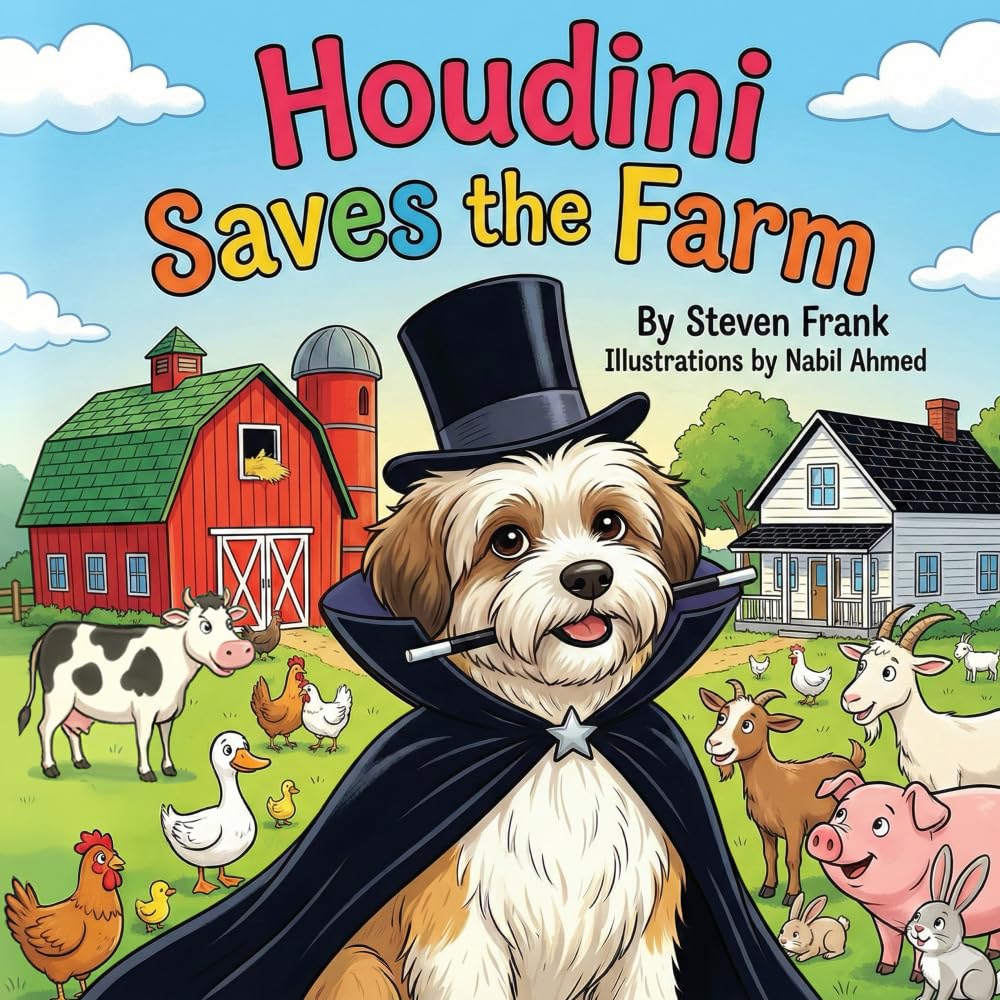
Houdini Saves the Farm is a children’s picture book with a gentle farm setting, a playful mystery, and a clear heroic arc. It follows a pup named Houdini, adopted by a farmer because of his knack for disappearing into his surroundings, as he grows into the farm’s watchful little guardian. After the farmer is injured and the farm animals begin vanishing one by one, Houdini pieces together what is happening, tracks the theft, and helps bring everyone safely home. As a work of children’s picture book fiction, it blends animal adventure, light suspense, and a simple lesson about loyalty and courage.
What I liked most was how direct the writing is. It does not try too hard, and for this age range, that feels like the right call. The story moves with real purpose. Each page gives young readers one clear beat to hold onto, and that steady pattern of animals disappearing one after another builds suspense in a way that is easy to follow without becoming too intense. I also thought the author made a smart choice in giving Houdini a special trait early on, then paying it off later in the plot. His talent for hiding is not just cute; it’s also practical. It becomes part of the mystery and part of the solution, which makes the story feel more thoughtfully built than some picture books that simply move from scene to scene.
The illustrations on every page are wonderful. They are sharp, vivid, and full of color. They give the book its warmth and energy, making the farm feel lively and inviting while giving young readers plenty to look at and enjoy. The rural farm world feels warm and familiar, and the beautiful illustrations give the story a soft golden-hour feeling even when the plot turns tense. The missing animals, the nighttime theft, the injured farmer, all of that give the book a stronger dramatic spine than many very young picture books. It gives the story shape and makes Houdini feel genuinely brave, not just adorable. Still, what keeps it grounded is that the emotional center stays simple: a dog looking after his person, a farm thrown off balance, and a small act of loyalty growing into something big. That part landed for me.
I’d recommend Houdini Saves the Farm to families looking for a children’s picture book that offers more than sweetness alone. It would especially appeal to kids who love animals, farm settings, and mysteries with a clear payoff, as well as adults who want a read-aloud with enough story to keep things interesting. It’s earnest, easy to follow, and built around a hero young readers can root for right away. For children who enjoy brave-animal tales with a touch of suspense, this one should fit nicely.
Pages 33 | ASIN : B0GQBL7QMK


