Blog Archives
THE LAST BATTLE AT STALANGER FJORD: The finale of the Silver Helmet Trilogy


At its heart, The Silver Helmet: The Last Battle, by George Lyttle, is a dramatic tale of Viking resilience, leadership struggles, and the delicate balance between war and peace. The story follows Magnus, a wise and conflicted advisor, as he attempts to steer a defeated Viking clan toward a peaceful future, only to face opposition from the ambitious and violent Ragnold. With the mystical seeds gifted by a former enemy offering hope for prosperity, the story unravels in a clash of ideals, as Ragnold stokes the embers of war to reignite Viking glory, all while supernatural elements linger ominously over their fate.
The imagery of the defeated Viking flotilla returning to Stalanger Fjord is both vivid and poignant. The community’s mix of exhaustion, hope, and uncertainty set the tone beautifully. Magnus, a man burdened by past mistakes yet hopeful for redemption, is a character you want to root for. His interactions with Aasta, who herself is recovering from years of abuse under her late husband Stenfeld, are tender but never overdone. The symbolism of the golden box of seeds, a weapon turned into a tool for peace, is powerful, though I feel occasionally heavy-handed. At times, I wished the pacing matched the emotional intensity of these moments, as the first few chapters brimmed with potential.
The book shines in its characterization, though Ragnold’s arc felt a bit too archetypal for my taste. His rise to power, complete with loyal warriors and intimidation tactics, follows a predictable trajectory of youthful arrogance and unchecked ambition. His moments with the god Tyr and the supernatural elements lent an eerie weight to his character. While Magnus wrestles with inner demons and the fallout of his advice to Stenfeld, Ragnold comes across more as a caricature of brute force. His intentions are clear, but I found myself craving a more nuanced exploration of his motivations.
The tension in the final chapters escalates masterfully. The ritualistic scenes are atmospheric and gripping. The use of Tyr as a divine figure looming over their actions was an effective touch, though the god’s somewhat enigmatic instructions sometimes felt repetitive. I appreciated how the book questions the cyclical nature of violence and revenge, but I found the dialogue occasionally overly expository. Ragnold’s dramatic speeches, while fitting for his character, lacked the subtlety that made Magnus’s quiet resilience so compelling. Still, the broader themes of legacy, leadership, and community resilience were thought-provoking.
The Silver Helmet: The Last Battle leaves you both satisfied and unsettled. It’s a story of a community caught between past and future, war and peace, and leaders who represent both hope and destruction. The book’s themes resonate deeply. If you enjoy tales of Viking lore, moral dilemmas, and a touch of Norse mythology, this is worth a read. It’s a gripping story for fans of historical fantasy, though its deliberate pacing and weighty prose may not be for everyone. I came away feeling reflective and slightly haunted by the choices these characters made, which is always the mark of a good book.
Pages: 197 | ASIN : B0DTHGGS37

Myths and Legends of Antiquity

The Tale of Sir Valiant and Earl Vladimoor follows a brave knight who meets a beautiful maiden, leading them on a dangerous collision course with the Dark Earl and a battle between good and evil. What was the inspiration for the setup of your story?
The first and only true inspiration was my partner Cathy, at the time of the original writing. I had always wanted to write a story of this nature, of a steadfast knight who braves all obstacles, evil villains and dragons alike, to rescue the fair maiden, whisking her safely away to his castle far, far away. Cathy had always been touched by my writing, and asked me to put this whole story into words, after seeing the first few paragraphs. Though our relationship did not endure, the desire to finish this story always remained.
I find the world you created in this novel brimming with possibilities. Where did the inspiration for the setting come from, and how did it change as you were writing?
Apart from Cathy, much of this inspiration comes from my own classical and historical education. I have always been fascinated by both the myths and legends of antiquity, the Greeks and the Romans, the underworld, fantastical tales of knights, dragons and the chivalry of the medieval period. Further inspiration came about through the writing and rewriting of the story, the determination to create a better and more engaging tale over the years, enhanced even more by the many thoughtful and helpful suggestions of my editor through the editing processes.
What were some of the emotional and moral guidelines you followed when developing your characters?
In developing these characters, first and foremost, I strove to imbue them with both admirable, but most importantly believable moral, or in the case of the villain, immoral qualities.
Those characters in the former category, while moral and virtuous to the extent that they could be in their present circumstances, honest, caring, dependable and trustworthy, were also infused to some degree with certain character flaws and shortcomings, self-doubt and self-worth as examples, that at times created an internal struggle for them in their own development.
Those characters in the latter category were likewise imbued with wholly despicable characteristics, of cruelty, selfishness, arrogance and greed, and a complete disregard for the safety or well-being of others, those who in the end held no hope of salvation. These would be such character traits that would create and almost immediate dislike amongst readers, while simultaneously necessitating the need for an ultimate triumph of good over evil.
These characters too, the good ones, at least are in part based on real life people, Cathy and myself.
Is this the first book in the series? If so, when is the next book coming out, and what can your fans expect in the next story?
Interestingly enough I had never intended to write any sort of sequel for this story, but as luck and good fortune, and inspiration would have it, I found myself very quickly through the editing process of this book sitting down and writing a follow up to this original text. Looking at the story ever closely I could see many new potential directions in which this tale could continue. At present, the draft for the next book is well underway, but with no clear definitive ending yet in sight. Depending how I choose to complete this new text, I may be able to set this up for a potential third installment.
I anticipate a second publication by the end of next year, as I do have another manuscript in the works, ready to go for later this year. I started writing it at about the same time I began this original text.
At this point all I can really say is that the fight between these two main characters is not over. The evil Vladimoor is far from remaining confined, restless in the depths of the murky underworld.
Author Links: GoodReads | Facebook | Website
Vladimoor, obsessed with this young maiden, will stop at nothing to possess the beautiful Catherine. Thwarted time and again, Sir Valiant and Earl Vladimoor face each other once more in a final epic battle.
Only one will walk away.
The Missing Children of Blackwood
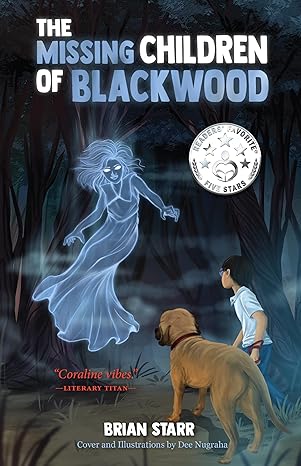

Brian Starr’s The Missing Children of Blackwood is the kind of book that grips you from the first sentence and refuses to let go. It follows twelve-year-old Daphne Elloise Planter (Daph for short), a sharp, quirky, and self-assured protagonist with a knack for storytelling, as she gets swept into the eerie legend of Blackwood, a town haunted by its dark past and the mysterious disappearances of children. As Daph, her writer-parents, and her massive dog Sparrow set off on a so-called “legend-hunting” adventure, they soon realize that some legends aren’t just stories. Strange warnings, supernatural occurrences, and an ever-thickening fog lead Daph to one terrifying realization: she may not make it out of Blackwood alive.
The book’s greatest strength is Daph herself. She’s witty, defiant, and full of personality, cracking jokes even when she’s in the middle of a terrifying situation. Her opening lines, where she nonchalantly talks about her inevitable death, set the tone for a darkly humorous and adventurous ride. She’s also a wonderfully unreliable narrator in the best way possible. She claims to believe in logic over myths, but her fascination with the unknown pulls her deeper into the town’s secrets. When she first sees the ghostly girl near Blackwood’s entrance, her reaction isn’t just fear; it’s excitement, curiosity, and just the right amount of sass. The mix of humor and horror is balanced so well that even the scariest moments never feel overdone.
The moment Daph and her parents arrive at the ominous fork in the road (with a literal blood-red sign pointing toward death), the tension ratchets up. The slow build-up, the weird trucker lady who bolts at the mere mention of Blackwood, and the way Daph describes the gnarled trees as an “express lane into Terrorville” all add up to a setting that feels alive, like the town is waiting, watching. The scene where the family enters the foggy tunnel, and suddenly, Daphne’s parents start floating, completely unaware, completely silent, had me chilled to the bone. The writing doesn’t just describe fear; it pulls you into it.
The book takes its time setting up the legend of Blackwood, making sure you know the gruesome backstory before the real horror begins. Some might find the first few chapters a little slow, but I actually loved the way it lured me in. It gave me a chance to really get to know Daph and her parents, to appreciate their banter, and to feel that false sense of security before things started unraveling. However, once the mystery kicks into high gear, the pages fly by. The moment Daph is separated from her parents and realizes that she’s truly alone, you feel the shift. The writing gets sharper, the danger more real, and the question of what’s really lurking in Blackwood becomes an obsession.
The Missing Children of Blackwood is perfect for those who love spooky mysteries, snarky narrators, and stories that feel like a campfire tale come to life. It’s got Coraline vibes but with more humor, a splash of horror, and a protagonist who refuses to be just another missing child. If you spook easily, don’t read this one at night, but if you’re up for an eerie, funny, and surprisingly heartfelt adventure, this book is for you.
Pages: 218 | ASIN : B0DNYQ34RT
Mathsmagica: Tapestry of Shadows

From the first page, Mathsmagica: Tapestry of Shadows pulls you into a world where magic isn’t just a tool; it’s a language, a science, and a force that binds the very fabric of reality. The novel introduces us to a divided world where Luminari’s light clashes with Nocturna’s darkness and where power is both a gift and a curse. We follow Sova and Nilah, siblings with a deep connection to Black Magic, as they navigate the complex and often dangerous city of Mathsmagica, a place where magic and mathematics merge in spectacular ways. As they struggle to survive in an academy that both fears and needs them, their fates become tangled with political intrigue, ancient legacies, and a battle between forces far greater than themselves.
The worldbuilding is, without a doubt, the novel’s greatest strength. Georgiev has crafted an intricate setting that blends arcane magic with a sense of scholarly depth. The city of Mathsmagica pulses with life, from its floating lantern-lit streets to the ominous corridors of The Academy. The details of magic, how it’s cast, and how it interacts with the laws of nature feel well thought out and almost scientific. The book captures the thrill of learning and discovery, much like Harry Potter but with a darker, more methodical edge. The scene where Sova and Nilah are running through the rooftops, dodging disapproving glares, makes the world feel dynamic and alive.
Sova is an engaging protagonist, brooding, brilliant, and always on the verge of losing himself to the magic he wields. His relationship with Nilah feels authentic, full of sibling banter, but also tinged with a mutual understanding that they are outsiders in this world. Evie, a noble and a student of Illumination Magic, provides an interesting contrast to them, challenging the rigid divisions between light and dark. One of the most emotionally gripping moments is when Sova unleashes Level Four Black Magic to save Arthus, a moment that not only showcases his power but also the consequences of wielding forbidden sorcery. That said, Arthus himself, along with some of the antagonists, could have used more complexity. He starts off as a typical arrogant noble, but his deeper motivations are only hinted at, rather than fully explored.
There are moments of sheer beauty, such as the description of the festival, where dragons of fire and ice dance across the sky, turning magic into an art form. But then there are moments where the narrative gets bogged down in too much detail, especially when discussing magic theory. The book is strongest when it lets the action unfold naturally, such as the tense confrontation between Sova and the Revenant, rather than explaining too much about how the magic functions. The dialogue is generally strong, with Nilah’s liveliness balancing Sova’s intensity, but occasionally, characters deliver lines that feel more like exposition dumps than natural conversation.
Mathsmagica: Tapestry of Shadows is a fascinating blend of dark fantasy and academic magic, perfect for readers who enjoy deeply constructed worlds and morally complex characters. If you’re a fan of The Name of the Wind or Mistborn, you’ll likely appreciate the depth of the magic system and the intellectual intrigue. If you prefer fast-paced storytelling with minimal exposition, you might find certain sections a bit slow. Regardless, it’s an ambitious and compelling read that leaves you eager to see what happens next in Sova’s journey.
Pages: 318 | ASIN : B0DBSN8RC4
The Tale Of Sir Valiant and Earl Vladimoor
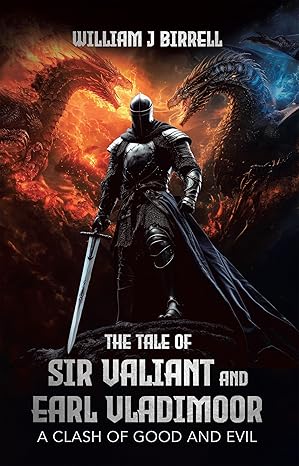
William J. Birrell’s The Tale of Sir Valiant and Earl Vladimoor is an epic clash of good versus evil wrapped in a sweeping medieval fantasy. The novel follows Sir Valiant, a noble knight devoted to protecting his kingdom and his beloved Catherine from the cruel and ruthless Earl Vladimoor. Throughout the story, Sir Valiant faces not only external threats, ferocious dragons, treacherous landscapes, and relentless enemies but also his own inner struggles of duty, love, and sacrifice. The story is steeped in the grandeur of classic heroism, with vividly detailed battles, a strong romantic undercurrent, and a rich medieval setting that pulls the reader into its world.
From the first page, the book grabs hold with its intense, immersive descriptions. The opening battle between Sir Valiant and the dragon Prometheus is cinematic, filled with scorching fire, clashing steel, and a knight’s sheer determination to survive. The way Birrell describes the oppressive heat, the putrid stench of the dragon’s breath, and the weight of the knight’s armor make it feel like you’re right there in the thick of it. The prose is energetic and dramatic, sometimes bordering on overindulgent, but that’s part of its charm. It reads like a legend passed down through generations, with every detail heightened for effect. Some passages can be a bit lengthy, especially when describing settings or Sir Valiant’s thoughts, but if you love rich world-building, it’s a treat.
One of the most engaging aspects of the book is the emotional depth of Sir Valiant’s character. His devotion to Catherine is unwavering, and the way he treasures the embroidered cloth she gave him adds a touching personal stake to his battles. A particularly moving scene is when he recalls watching Catherine dance for the first time in the village square, her silver-white gown flowing with the music. This moment, alongside his vow to protect her at any cost, gives weight to his every decision. However, while the romance is beautifully woven into the plot, I occasionally wished Catherine had more agency in the story rather than being primarily a symbol of Valiant’s honor and purpose. Still, their connection is heartfelt and powerful, making his quest feel all the more urgent.
The villain, Earl Vladimoor, is a formidable and thoroughly despicable antagonist. He is the embodiment of darkness, cruelty, and revenge, always lurking in the shadows, waiting to strike. His siege on Summerton and the kidnapping of Catherine and other young women adds a harrowing level of stakes to the story. The devastation he leaves in his wake is palpable burning villages, terrorized people, and a looming sense of dread. While he’s a classic evil-for-the-sake-of-evil villain, it works well within the grand, mythical tone of the novel.
The Tale of Sir Valiant and Earl Vladimoor is a gripping, old-school adventure with heart, high-stakes battles, and a noble hero worth rooting for. If you love medieval epics, knights in shining armor, and grand quests filled with danger and romance, this book is for you. Fans of The Lord of the Rings or The Once and Future King will likely appreciate its classic, mythic tone. While it occasionally leans into overly elaborate descriptions and predictable heroism, that’s also part of its appeal—it’s a story that revels in its own legend. A thrilling, heartfelt read that will leave you eager for more of Sir Valiant’s adventures.
Pages: 224 | ASIN : B0DR5S1CCG
Human Tendency to Wage Wars

Galloper’s Quests follows a military scientist whose groundbreaking propulsion system allows him to journey the cosmos in defiance of his superiors. What was the inspiration for the setup of your story?
I had written a short story about an astronaut who had become alienated from the rigid ways of life on Earth and also the human tendency to wage wars. He decided to escape by blasting off into the unknown. I decided to expand the story, have him invent the wormhole propulsion system, and encounter civilizations that mirrored in exaggeration what he saw on Earth.
The science inserted in the fiction, I felt, was well-balanced. How did you manage to keep it grounded while still providing the fantastic edge science fiction stories usually provide?
I guess I tried to show individuals, even if they were alien, grappling with the human problems that we struggle with in everyday life.
Did you plan the tone and direction of the novel before writing, or did it come out organically as you were writing?
I composed numerous notes about the themes and the plot to deliver those themes beforehand. The details about what characters were feeling, the funny android, and the romantic interest emerged as I began writing.
What is the next book that you are working on, and when will it be available?
I spend a lot of time writing analyses of films in my blog, My Meaningful Movies, which is quite successful. I think my next project will be a play.
Author Links: GoodReads | Facebook | Website | Amazon
Galloper’s Quests
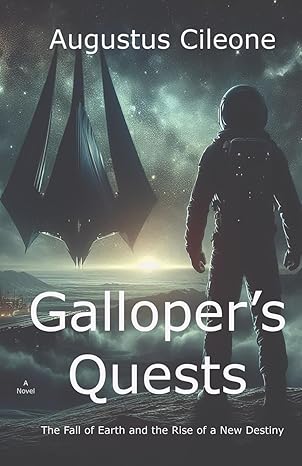
Galloper’s Quests is an ambitious sci-fi adventure that follows Captain Samuel Galloper, a military scientist who dares to defy his superiors in the pursuit of knowledge and freedom. Using his groundbreaking propulsion system, he escapes Earth’s grasp and journeys across the cosmos, encountering strange worlds, authoritarian societies, and existential dilemmas. His story, smuggled to the reader under mysterious circumstances, reads like a personal journal, a mix of raw emotion, philosophical musings, and gripping narrative. From the military’s relentless pursuit of power to the mind-numbing routines of an alien civilization, the novel explores what it means to think freely in a world determined to control you.
Galloper’s inner conflict is as compelling as the dangers he faces. He’s a man torn between duty and conscience, trapped between the structured obedience of military life and the terrifying unknown of free thought. His encounters with Admiral Rutlaw, a hardened military leader obsessed with weaponizing his discoveries, highlight this tension brilliantly. Rutlaw’s interrogation is chilling because it reveals the military’s single-minded goal: control and dominance. Galloper, however, isn’t willing to be a cog in that machine. His escape isn’t just physical; it’s a moral stand, and that’s what makes his journey so captivating.
Then there’s the planet Burc, a place that at first seems promising but quickly reveals itself as another kind of prison. The Burcs live in a rigid, cyclical society where work is endless, thinking is discouraged, and individuality is stifled. Their robotic sentries enforce order, while their Procs, like the conflicted Lask, bear the mental burden of decision-making so others don’t have to. It’s a fascinating concept, one that feels eerily familiar. When Galloper’s carefully constructed picnic table is destroyed by a robot, it’s a perfect metaphor for the futility of creativity in a society that fears change. Burc’s motto, “More work, less thought,” echoes throughout the book, a warning about the dangers of blind obedience.
But Galloper’s Quests isn’t all grim. There’s an undeniable thrill in its interstellar exploration, and Cileone has a knack for making space travel feel both wondrous and dangerous. The HOPS propulsion system, with its ability to fold space and create wormholes, is fascinating, yet terrifying in its unpredictability. The descriptions of travel bodies stretching, consciousness flickering, reality bending are some of the novel’s most immersive moments. When Galloper arrives on a new world, the awe is palpable, reminding us why we dream of the stars in the first place.
Galloper’s Quests is perfect for fans of thought-provoking sci-fi, especially those who enjoy books that question authority, challenge societal norms, and explore the weight of human choices. If you like stories that mix The Forever War’s military critique with 1984’s oppressive regimes and Star Trek’s exploratory wonder, you’ll find a lot to love here. It’s not a light read, it makes you think, it makes you uncomfortable, and at times, it makes you angry. But that’s the point. It’s a journey worth taking, even if the destination isn’t what you expect.
Pages: 235 | ASIN : B0DRTBVDM6



 LITERARY TITAN