Blog Archives
Joy in Sorrow, Hope for Tomorrow: Homecoming


In Joy in Sorrow, Hope for Tomorrow, Vonnetta Mayo tenderly reveals the brutal reality of slavery in America. With a sensitive yet compelling approach, Mayo crafts a narrative that highlights the innate human desire for freedom and the pivotal role of religion as a beacon of hope for those enduring desperate circumstances. The book is concise and accessible, aiming to shed light on the inhuman treatment faced by slaves. Central to the story is Betsy, a cheerful young girl who shares her days with her three brothers, her mother, and her mother’s three friends. Despite the harsh realities of their existence, the children find solace and distraction in each other’s company, while the adults toil under oppressive and abusive conditions on a plantation. Through unwavering faith and constant prayer, they cling to hope, trusting in God’s plan and longing for the day they will be free.
Mayo’s straightforward and easy-to-read prose draws readers into the daily lives of the plantation’s inhabitants. Each chapter lays bare the grueling labor and the systemic oppression they endure. As the narrative unfolds, readers are gripped by a sense of foreboding about the future of these individuals, yet the innocence and resilience of the children provide a glimmer of hope. This hope is sustained by the recurring theme of prayer, imbuing the story with a sense of faith that persists even in the bleakest of situations. The structure of the book reinforces the monotony and inescapability of the slaves’ routine, characterized by scarce resources and distant dreams of freedom. Despite these harsh conditions, what unites and sustains this small community is their unwavering faith in God. The narrative invites readers to ponder whether their fervent prayers will ever be answered, and whether they will finally attain the freedom they so ardently seek.
Joy in Sorrow, Hope for Tomorrow stands as a moving short story that humanizes the experiences of those subjected to the atrocities of slavery, while simultaneously celebrating the resilience and spirit of Black communities. Mayo brings to light the harsh truths of American history, while also revealing the profound beauty found in family, hope, faith, and religion. This book not only illuminates the past but also underscores the enduring power of faith and the unbreakable spirit of those who, despite facing unimaginable hardships, continued to dream of a better tomorrow.
Pages: 32 | ASIN : B09VWR3S4K

White Lies Matter Too

In White Lies Matter Too, author John A. O’Connor presents a compelling exploration of American history, interweaving conceptual art with well-researched narratives. Each section of the book is structured around a series of plates that delve into varied aspects of American historical narratives, illuminating marginalized perspectives and critiquing entrenched national myths. Through his analysis of presidential legacies and the global ramifications of recent events, O’Connor challenges readers to reassess their grasp of historical realities.
Utilizing a combination of visual symbolism, engaging storytelling, and academic thoroughness, O’Connor crafts a narrative that scrutinizes accepted truths and advocates for a deeper, more layered understanding of history. His critical approach to sources and distrust of official narratives enhances the book’s identity as both an art piece and a scholarly work. O’Connor reflects on the transformative power of art and history, encouraging readers to question dominant narratives and adopt a more critical view of past events.
White Lies Matter Too asserts itself as a notable addition to both contemporary art and historical analysis, posing a compelling challenge to the oversimplifications prevalent in mainstream historical portrayals. O’Connor’s methodical research and analytical perspective utilize visual and narrative elements to provoke thought and broaden the reader’s historical insight. The book’s detailed citations underscore its scholarly merit, inviting readers to critically evaluate the information presented by traditional sources.
This work serves as a vital catalyst for reflection and discussion, enriching readers’ understanding of American history and prompting them to scrutinize the stories that shape their views of the world. White Lies Matter Too is indispensable for those intrigued by the convergence of culture, politics, and history.
Pages: 158 | ASIN : B0D25DK59C
Entertaining Fact-Filled Journey

Delaware from Railways to Freeways explores the little-known history of this small state from the period of 1800-1907 and the emergence of freeways. Why was this an important time period to cover?
This was the birth of the Industrial Revolution, and it impacted both Delaware and the nation enormously. Several ‘firsts’ originated in the state during this period. Early in the 19th century, the Delaware Breakwater, completed in 1835, was the Western Hemisphere’s first such structure. The bay’s barrier protection has been pivotal in facilitating safe maritime passage and trade, bolstering Delaware’s economy as well as Pennsylvania’s and New Jersey’s. Its strategic location also rendered the Delaware Bay more secure for naval operations, particularly during times of conflict like World War II. By mid-19th century there’s the ‘first’ from Betts, Pusey, and Harlan of Wilmington, who stand as pioneers in American industrial history for their role as the first iron shipbuilders in the country. Their groundbreaking work laid the basis for the broader American shipbuilding industry, contributing to the nation’s economic growth and naval capabilities. And finally, heralding the freeways era, Delaware’s DuPont Highway introduced the concept of separated lanes, enhancing road safety and efficiency. Funded by T. Coleman du Pont, this seminal model set a precedent for the U.S. highway system.
With so many interesting facts included in this book about Delaware, like Return Day, how did you narrow down what information to include and what to save or discard?
That’s a challenge for all three of the books I’ve worked on or am working on in this series. On the one hand, I look to academic history book models to get an idea of broad topics that should be tackled: Historical Context, Key Figures and Personalities, Major Events and Turning Points, and so on. On the other hand, I personally love to include quirky anecdotes and folklore items that add local color. One of my favorites from this particular book is about an innkeeper who trained a goose to keep an eye on his bar while he was out back plowing the field. If a customer entered the bar, the goose knew to go out to signal the innkeeper in the field with a honk! It’s a delicate balance to maintain gravitas without getting dull and to entertain the reader without being trivial. Writing a nonfiction book takes a lot of time and research, as well as talent, to take it from the level of a textbook to an entertaining fact-filled journey.
What would you say is your strength as a writer?
I was trained as a journalist. Reporters are drilled with a who-what-when-where approach to writing that always keeps an eye on the word count. And so, I’m always crosschecking my writing to make sure that the pace is brisk, that I’m getting to the point, not losing my reader through mountains of dull verbiage. I was fortunate to have writing professors who in addition to instilling bullshit monitors into me, also insisted that good journalism is about good storytelling. I think I spin an ok yarn.
What can readers expect in the third installment of this series about Delaware? What time period will it cover? When will it be available?
The third book is tentatively titled Delaware from Freeways to e-Ways, covering the 20th century. I’d like to have it in the public’s hands by Christmas 2024. The term “e-Ways” is a made-up word that refers to digital avenues of transportation, drawing from the 1990s trend of using “e-” as a prefix for things related to the nascent e-commerce industry. Digital technology has modernized traditional transportation methods, enabling, for example, self-driving cars, and rendering unnecessary outdated tools like sextants for ships and cabooses for trains. And while Delaware may not be a tech hub like Silicon Valley, the University of Delaware has offered up pure research and patents that have aided in the development and commercialization of the Internet’s physical infrastructure. In between freeways and e-ways, of course, there’s lots more to talk about. Stay tuned!
Author Links: Goodreads | Twitter | Facebook | Website | Amazon
Delaware from Railways to Freeways: First State, Second Phase


Delaware from Railways to Freeways by Dave Tabler is a captivating exploration of the state’s history, focusing on the period from 1800 to 1907. It’s the second installment in a three-part series that sheds light on the lesser-known aspects of Delaware’s past. This book is a treasure trove of intriguing facts about the people, places, and ideas that have shaped Delaware. The skillful pairing of these facts with illustrations and fascinating photographs makes it a delightful read for anyone residing in Delaware. History enthusiasts, in particular, will revel in the abundance of unusual facts associated with the state.
Tabler introduces readers to a wealth of information, from the development of railways to the emergence of freeways, unveiling lesser-known facets of Delaware’s history. Notably, he delves into the unique Delaware tradition of Return Day, providing insights into its origins. Additionally, he explores valuable resources found in Delaware, such as the versatile Bald Cypress Tree, which played a pivotal role in various aspects of daily life. One captivating highlight in the book is the development of Duck decoys during the early 19th century and its intriguing connection to steamboats and punt guns in Delaware. Such revelations add depth and intrigue to the state’s historical tapestry. While the book brims with captivating facts, images, and illustrations, I would’ve liked a more explicit connection between these fascinating tidbits and their unique significance within Delaware’s history. Such contextualization could have elevated the book from feeling like a trivia collection to a more engaging historical exploration.
Delaware from Railways to Freeways offers readers a captivating journey through Delaware’s lesser-known history. It is an excellent choice for those who relish reading about unusual facts and harbor a passion for history, even if it occasionally leans toward trivia. This book provides a valuable contribution to understanding Delaware’s rich heritage.
Pages: 110 | ASIN : B0C9NKB828
Delaware’s Wonderful Cultural Contributions
Delaware Before the Railroads: A Diamond Among the States shares the rich and fascinating history of the little state of Delaware. What made you write a book about this topic? Anything pulled from your life experiences?
Because of Delaware’s diminutive size, a lot of non-Delawareans either have a very limited view of the state or draw a blank altogether. Some think of us first for tax-free shopping. Others for our fabulous beaches. Still, others think of Delaware as the place where corporations incorporate. All of which are true. And all of which are only a sliver of the whole picture. I wanted to tell a fuller story about Delaware. I think of the First State as the mustard seed in the eponymous Biblical parable. Though in the geographic scheme of things we are tiny, from our wee 3 counties have sprung a host of influential people (a president, actors, musicians, scientists, etc), inventions (nylon, ATMs), and influences on Americana (log cabins as we know them originated here, not in the Land of Lincoln). From my own experience: I worked in NYC for a number of years and was always startled by how uninformed New Yorkers often were about Delaware heritage. It was at such odds with what I knew about the place. So this book is an attempt to give the reader an “Oh! I didn’t realize that!” moment about Delaware’s wonderful cultural contributions.
History texts sometimes will overwhelm readers with too many facts, or they are told in a sterile manner. You have managed to create an entertaining and educational book. What were some goals you set for yourself as a writer in this book?
I love that you see in my book both entertainment and educational value. It’s tricky to balance the two audiences. On the one hand, I research my topics deeply, aiming to use primary sources and come up with fresh historic interpretations of those topics. My book’s been accepted into the permanent collections of both the Delaware Public Archives and the Delaware Historical Society. So I’ve succeeded with that demanding group of historians. On the other hand, I don’t want to get bogged down in endless footnotes and citations. I want to offer up a page-turner. Many of my readers are vacationers from other places who come to the beaches in the summer. They want to be entertained on their vacation.
What experience in your life has had the biggest impact on your writing?
My 8th-grade geography teacher, Mr. Jarboe. He intuitively knew that history would be a grinding chore to middle school students if it wasn’t presented in a funny, energetic, surprising way. He was one of those storytellers whose eyes lit up the room as he unfolded his tales. Being in his presence was magical. If I can capture a fraction of his essence in my books, I’ll have honored his memory.
What is one thing you hope readers take away from your book?
That history is full of surprises!
Author Links: GoodReads | Twitter | Facebook | Website
Lost To Time

Rebel Correspondent tells the story of Arba F. Shaw and his time in the Civil war through a combination of research and Shaw’s own writings for a newspaper.Why was this an important book for you to write?
Shaw wrote his memories about his time as young Confederate private in the 4th Georgia Cavalry over about a six week period from late December 1901 to February 1902. You can imagine him writing it by lantern light in his farmstead located in the shadow of Lookout mountain. It would have been one continuous manuscript. Then it was serialized into 55 articles in the Walker County Messenger, where he was a correspondent, through early 1903. It was pretty much lost to time until I stumbled across the mention of his writings and was able to piece together all of the articles so they read as a continuous manuscript once again. I felt it was an important piece of history to see the light of day again, and I was intrigued by all of the facts he wrote about and wanted to find out how accurate his memory was, more than 35 years after the war ended.
What were some ideas that were important for you to share in this book?
It is important for readers to understand the difficulties of soldiers trying to survive on either side. Most were young like Shaw (He had just turned 18 when he enlisted) and were leaving home for the first time. They had to deal with the communal illnesses caused by having hundreds of men living together through all kinds of weather while also not understanding the cause of most diseases. Shaw himself became very sick, likely with Typhoid in the first year. More men were killed by illness, like rubella than died in battle.
Soldiers on both sides were just trying to survive the experience.
Did you find anything in your research of this story that surprised you?
Shaw witnessed events that had not been reported in detail. Like the death of soldiers in his regiment or others who his regiment encountered that died when they attacked the regiment. Families knew their some of their loved ones went off to war and died, but didn’t know how or where. Shaw remembered these events in very accurate detail years later providing context to lives lost.
Shaw was also wounded twice. The second time he recounts a battle in Campbellsville, TN in September 1864 and mentions the face to face encounter with a Union soldier wearing a red sash. I was able to research in detail the events of that day, and the “red sash” was an important clue to identifying the soldier that wounded Arba Shaw. A Union sergeant. Shaw himself fired on the man and he sustained a mortal wound to the lungs. In Shaw’s lifetime, he never knew who the man was that left him with a damaged right arm that he never regained full use of. Now we know who that was. It’s that kind of sleuthing that I really enjoy. Researching something that discovers an answer to a mystery. Rebel Correspondent had many instances like this.
What do you What is one thing readers take away from your book?
I hope they enjoy learning what it was like for the average soldier in the American Civil War. A young private who went to war, was wounded twice, and came home alive. He was on the losing side, and had to take a loyalty oath to become an American citizen again. I am sure that the political side of why the Civil War was fought was not important to Arba after the war ended. He was proud of doing what he considered service he was required to do. He participated in the veteran groups after the war, but ultimately was a patriotic American the rest of his life. Happy to have survived and happy to return to a normal life on the family farmstead and to get married and have his own family. I think he treasured and discovered the value of a productive life.
Author Links: GoodReads | Twitter | Facebook | Website | YouTube
Rebel Correspondent is the true story of a young man who joined the Confederate Army days after his eighteenth birthday and served bravely until the war ended. Wounded twice, he emerged a changed person. But he wasn’t just a returning veteran; he was also a writer.
At the beginning of the twentieth century, Arba F. Shaw was a fifty-seven-year-old farmer. On a chilly December day in 1901, he put pen to paper to write his memories of being a Rebel Private in the 4th Georgia Cavalry (Avery), C.S.A. He completed writing his account in February 1902. His local newspaper, the Walker County Messenger, in Lafayette, Georgia, published his account in more than fifty articles from 1901 to 1903.
Then it was all but forgotten. Until Now.
THOMAS JEFFERSON FAMILY SECRETS
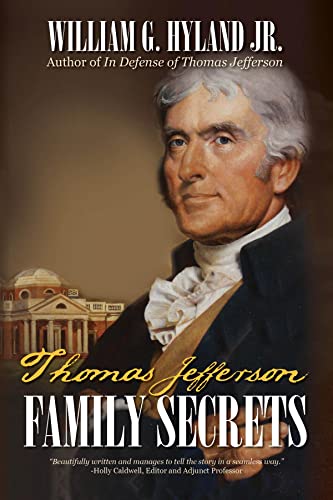
Most people know Thomas Jefferson only as the third President of the United States of America. The name would mean nothing more to them than a fun fact heard in a tourist spot in other parts of the world. The truth is, Thomas Jefferson was a human being just as complicated and worthy of empathy as all of us. This is what author and Jefferson expert William G. Hyland Jr. sought and accomplished to convey in his book Thomas Jefferson: Family Secrets.
Written in prose that is accessible without sacrificing the scholarly gravity, this book would be ideal reading for any student of history. Not only does it shed light on this enigmatic figure’s life post-presidency, but it also inspires curiosity. This biography could be enjoyed by almost any reader who loves US history and wants to know more about their lives outside of their public deeds.
Each chapter covers a specific milestone of Jefferson’s twilight years with tidbits from personal letters, commentary from other scholars, and other references. This gives the biography an intimacy and depth no textbook can rival, giving Jefferson humanity that is easy to relate with. Because of that, the experience of reading this almost feels like reading a novel. Beyond the scandals and the history of slavery, you can’t help but empathize with him. However, before you write this off as a full-length fluff piece, it’s important to note that Hyland does not shy away from the less savory events of Jefferson’s storied life. Instead, he focuses on facts, not the modern emotions elicited from these facts.
Different readers will have varying opinions, and luckily Hyland Jr. understands that very well. As a result, the book doesn’t hammer us in the head with sugar-coated anecdotes in order to convert Jefferson’s detractors. Instead, it simply presents the facts and lets the reader decide on their own.
Thomas Jefferson: Family Secrets is a stimulating historical biography on the life of President Jefferson after he left office. History lovers that want to expand their knowledge will enjoy this unique look at his life.
Pages: 542 | ASIN : B09SD6ZD9B
A Battle for Her Nation’s Freedom

Wild Colts Make the Best Horses– The Intrepid Life of Abigail Adams is a biography on the former First Lady and her life before and after her husband’s role as President. Why was this an important book for you to write?
All my life, I have admired Abigail Adams’ accomplishments and have felt that the Adams family has been overlooked. Even in my college history courses, the only woman mentioned as a contributor to the American Revolution was the seamstress, Betsy Ross. My own life mirrors Abigail’s, therefore I easily identified with her and hoped to transfer this empathy to readers. She was one hundred years ahead of her time on many issues, such as the abolition of slavery and equal education for women. My hope is that students will become more interested in learning our history, that they encounter teachers who make it come alive, and that our history is presented fairly, including its strengths and weaknesses. At this divisive time in our nation, all citizens need to grasp and understand the initial ideals of this nation so that freedom will survive! Lastly, I wished to leave my five grandchildren a legacy that includes a love of history, their nation, and the written word.
When researching the life of Abigail Adams, what was one thing that surprised you from her life?
Abigail’s incredible loyalty and devotion to both John and the country she helped to birth. Abigail not only molded bullets in her kitchen, but she also produced saltpeter using urine and rainwater to be used as gunpowder. Despite being aware that both her femininity and fertility would be questioned, Abigail drove a modest horse and carriage to attend many sessions of Congress while serving as the Vice-President’s wife. Due to John’s ten-year absence serving as a delegate in Philadelphia and as a diplomat in France, Abigail independently managed their farm, supervised the homestead, created homespun clothing to support the boycott of English goods, and educated their four young children. Her knowledgeable and charismatic influence in the White House reinforced John’s relationship with Congressmen and Justices. In an age when women’s opinions were neither elicited nor accepted, I was also surprised to learn about John’s pride in Abigail as his trusted advisor.
What do you hope is one thing readers take away from Abigail Adam’s story?
An appreciation for the imminent dangers the Founding Fathers and Mothers, particularly Abigail Adams, faced during our Revolution, a crucial turning point in history. Abigail was John’s confidante and most trusted advisor, who despite the criticism she received as First Lady, she continued to staunchly battle for the advancement of America and the survival of her nation’s freedom.
What is the next book that you are working on and when will it be available?
There are so many fascinating figures in history that deserve recognition. I am undecided about which of these I would passionately devote my time to researching and bringing to life.
Author Links: GoodReads | Amazon


