Blog Archives
Encouraging Emotional Openness

Anxious Amy: Calming the Worries Within follows an anxious young teen who appears cheerful but feels overwhelmed inside, and how her mom and counselor help her learn to manage these feelings.
The book emphasizes that asking for help is a sign of strength. Why do you think that message is especially important for young readers today?
Strength is especially important for young readers today because many children struggle with self-doubt and a lack of confidence when it comes to expressing their thoughts and feelings. Young people often feel pressure to handle challenges on their own or worry about being judged if they speak up. By emphasizing communication and the importance of asking for help, the book encourages emotional openness, builds confidence, and helps children develop healthy coping skills that will benefit them throughout their lives. By reinforcing this idea early on in youth, the book aims to strengthen a quality in them that may have been lost along the way—the understanding that vulnerability and communication can be powerful, not weaknesses.
The use of color plays a powerful role in Amy’s emotional journey. How did that concept develop?
Color is used to visually reflect Amy’s emotional journey and make her feelings easy for young readers to understand. Amy’s character begins in black and white to represent confusion, isolation, and the heaviness of anxiety. As Amy learns to understand her feelings, communicate, and receive support to manage her anxiety, color gradually fills the pages as Amy becomes more visible, symbolizing growing confidence, healing, and hope. This shift shows children that progress takes time and doesn’t happen all at once and that brighter moments are possible, even after feeling overwhelmed.
How can adults use this story as a conversation starter with children or teens?
This story offers a gentle, non-threatening way for adults to start meaningful conversations with children or teens about emotions. Its short, visually inviting format makes it easy to read together at home, in classrooms, or in therapeutic settings. By discussing the character’s feelings first, adults can ask open-ended questions that encourage children to reflect without feeling pressured or singled out.
Focusing on the story helps normalize conversations about anxiety, emotions, and asking for help. This indirect approach encourages open meaningful dialogue amongst young readers, at their own pace while fostering understanding, emotional awareness, and connection.
Author links: GoodReads | Twitter | Facebook | Instagram | Website
Anxious Amy: Calming the Worries Within
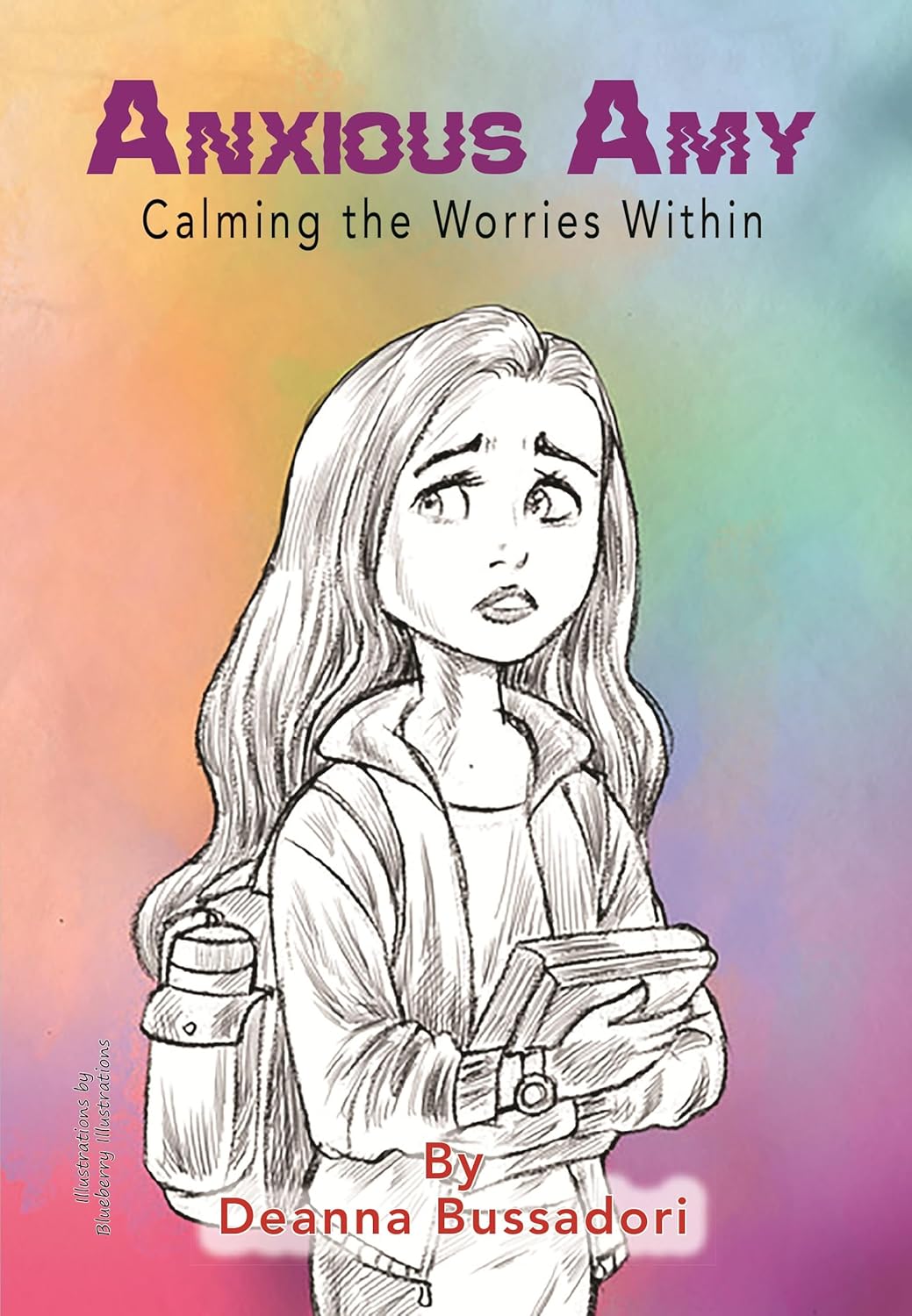

Anxious Amy: Calming the Worries Within by Deanna Bussadori is a warm, sincere story that speaks to readers of all ages. Centered on Amy, a young girl living with persistent anxious thoughts, the narrative explores the quiet effort of appearing cheerful while feeling overwhelmed inside. Through gentle rhyme, the book captures how ordinary moments can feel unmanageable when anxiety takes hold. With steady support from her mother, Amy begins working with a counselor and learns to talk honestly about her feelings. That encouragement leads her to an important realization: anxiety can be managed, and asking for help is not weakness but growth.
One of the book’s greatest strengths lies in its rhythmic structure. The cadence mirrors Amy’s inner world while remaining accessible to young readers. Difficult emotions are presented with care, never feeling heavy or intimidating. Instead, the language invites empathy and understanding. Equally impactful is the portrayal of supportive adults. Amy’s mother and counselor are patient, attentive, and nonjudgmental. Their presence reinforces the idea that anxiety should not be faced alone and that a strong support system can ease stress, build confidence, and improve overall well-being.
The illustrations deserve special recognition, particularly the thoughtful use of color. Visual storytelling plays a central role in reflecting Amy’s emotional journey. At the beginning, she appears entirely in white, a clear symbol of uncertainty and self-doubt. As she begins to open up, color slowly emerges. Each new shade represents growth, self-expression, and acceptance. By the final pages, the richness of color underscores a powerful message: confronting anxiety allows Amy to feel whole, present, and authentically herself.
Anxious Amy: Calming the Worries Within is thoughtful, reassuring, and visually compelling, this book is an excellent resource for children and teens experiencing anxiety, as well as for the adults who support them. Its gentle message encourages open dialogue about mental health and offers a comforting reminder that no one has to navigate their worries alone.
Pages: 36 | ASIN : B0FQ5Z58NF

Meaningful Work

Emetophobia & Me follows your transformation from a childhood shaped by fear to an adulthood grounded in courage, compassion, and the radical act of choosing to live fully even when anxiety whispers otherwise. Why was this an important book for you to write?
What a great question. It brought up quite a lot for me. I will try to summarise it. Having battled crippling anxiety throughout most of my childhood and adult life, I wanted nothing more than to help others who were suffering too. When I saw someone suffering with anxiety and/or emetophobia and heard them speak of their experience in ways I deeply resonated with, my heart would literally hurt. For many years, I would just listen and try to offer any understanding and …. well, just love really. It felt like a lifeline for me to have someone who would just listen and remind me that I was not alone. So when I decided to write this little book, it was really to create a lifeline for those who feel lost and to remind them that they were safe. There is hope, and they are deeply loved.
What feels important to me is that, even when I am gone, my books might still bring comfort to others. That feels like meaningful work to me.
What was the hardest memory to revisit while writing Emetophobia & Me, and how did you care for yourself during that process?
Writing the book really did bring up some old feelings and fears, but it was therapeutic in a way too. I think the hardest part to revisit was those times, as a child, where I felt so unsafe. I had the phobia, anxiety, and panic ( I had no idea they had names then), there was violence at home, and my sister was diagnosed with cancer.
I felt so sad for that frightened little girl, who tried tirelessly to control what was never in her control. I guess that is why I turned inward more and more, to try and control myself. To try and keep myself safe with rituals, behaviour, and fear.
Was there a specific moment when your relationship with fear shifted from something to avoid to something you could coexist with?
You know, I wish there was a light bulb moment when it all changed. We are all looking for the magical quick fix, right? But, actually, it was a slow process. A process of seeing, then not seeing, then seeing more. The real change came from being open to being wrong …. about who I thought I was, my beliefs, and my misunderstanding about fear.
Being open. Being prepared to change your mind. Being aware that there is a lot you don’t know yet, is huge.
What do you hope readers who don’t struggle with phobias take away about empathy and the lived experience of anxiety?
It has always been important to me that loved ones and family members have some understanding about anxiety and Phobias. The one thing a sufferer needs is understanding. Followed by time and love. Just listen, not always to fix, but just to hear. Often, we sufferers of anxiety feel unheard, and that increases fear and insecurity.
The answer to everything always is love.
Author Links: GoodReads | Facebook | Instagram | Finding Peace | Website | Books.By | Amazon
She could control everything—
except her own fear.
From the outside, Jess Smith looked fine. A wife, a mother, a woman doing her best to hold it all together. But behind every smile hid a secret terror—an obsessive fear of vomiting so intense it ruled her every decision. Every meal was measured. Every outing calculated. Every day, a battle with her own mind.
Until the fear began to consume her life completely.
In this raw and beautifully written memoir about emetophobia, anxiety and panic attacks, Jess takes readers inside the hidden world of a phobia few dare to talk about. Her story unfolds like a psychological thriller—every symptom, every panic episode, every desperate attempt to stay “safe” pulling her further from the life she longed to live.
But when she finally hit breaking point, something miraculous happened.
She stopped running.
She turned inward.
And she began the journey home—to herself.
Part memoir, part self-help guide for anxiety and recovery, Emetophobia and Me will make you feel every heartbeat of fear—and every breath of freedom that follows.
If you’ve ever lived your life controlled by fear—whether of panic, sickness, or simply losing control—this story will hold your hand through the darkness and show you that healing isn’t about fixing yourself.
It’s about finally allowing yourself to be free.
A powerful, honest, and inspiring read for anyone navigating anxiety, emetophobia, panic disorder, or trauma recovery.
You are not afraid of what you think you are.
It’s time to see the truth — and take your life back.
Digital Stressors

Anxiety Reset 30 Days to Find Calm is a structured 30-day guide to understanding and managing anxiety based on science-backed strategies to assist readers in identifying patterns and mastering self-regulation techniques. Why was this an important book for you to write?
The city that I live in has the youngest average population age in Canada. Also, the highest suicide rate. This comes along with depression and anxiety. Initially, I wanted to help children, but I realized that children learn by mirroring their parents. Thus, I needed to write an anxiety book for adults, not in a lazy way, and also doing something that other books in the genre are not doing.
How much research did you undertake for this book, and how much time did it take to put it all together?
Great question, it took many months of research and around 23 updates leading to the current version available on Amazon. It has been a second full-time job on top of my regular day job. My 3-week vacation this year was almost entirely spent on the book in some component of its updating/advertising, etc.
What were some ideas that were important for you to share in this book?
The idea that we have not evolved to deal with all the modern-day digital stressors and combined inputs that the world demands our attention/focus. Even when grieving, there are so many triggers that our ancestors never faced. Digital Pictures, radio music, connected yet disconnected friends.
What is one thing that you hope readers take away from Anxiety Reset 30 Days to Find Calm?
Any tool that they find beneficial. I realize that most people may not have the energy or time to complete the full 30 days; however, using the summaries at the back and emergency regulation sheets, the chances are high that someone finds a tool that improves their life or someone in their circle’s life. That is a win for me and for humanity.
Author Links: GoodReads | X (Twitter) | Facebook | Website | Amazon
Anxiety overwhelms body and mind, impacting millions of adults in today’s chaos. Anxiety Reset: 30 Days to Find Calm delivers a science-backed, 30-day program tailored for busy adults—a 463-page workbook with narrated pages, relaxing videos via scannable QR codes, and emergency relief cards for instant support.
Inside: • 4-part system to build skills daily • Practical exercises for adult life • Emergency relief techniques and cards • Flexible, schedule-friendly practices • Advanced resilience strategies
What Sets It Apart: Combat workplace stress and digital overload with neuroscience and psychology, enriched by color illustrations, tracking sheets, and multimedia—every page narrated, with day-specific video QR codes.
Your 30-Day Journey: • Days 1-5: Unravel Your Anxiety Triggers • Days 6-10: Master Emergency Techniques • Days 11-20: Cultivate Daily Calm • Days 21-30: Achieve Lasting Mastery • Bonus: Quick-reference guides
Ideal for professionals, parents, or anyone seeking clear, comprehensive tools. Launch your reset today and take control of your emotional well-being!
Unbreakable You: Create, Revise, Repair Your Life
In Unbreakable You, Dr. Jon Deam presents a refreshingly direct and deeply humane take on personal transformation. Structured around six themes—life as iteration, letting go, self-worth, connection, urgency, and resilience—the book uses storytelling, personal insight, and a counselor’s wisdom to deliver bite-sized guidance on how to reframe struggles and begin again, again and again. Each chapter opens with a truism, a short, sometimes humorous saying, and then unpacks it through anecdotes from his practice, cultural metaphors, and practical coaching. The message is clear and simple: your life is not a fixed story. You can shape, reshape, and strengthen it—if you’re brave enough to begin.
What hit me hardest as a counselor—and frankly as a human—was the book’s repeated reminder that perfection is a myth. Deam kicks things off with a powerful metaphor: “You don’t start with the statue; you start with the marble”. So often, clients sit in my office paralyzed by the idea of needing to get life right on the first try. Deam tears that down gently but firmly. He illustrates that we’re all rough stone, being chipped away over time, with grace, frustration, and sometimes a lot of mess. The story of Clark, a man stuck in obsessive fear about his heartbeat, was especially poignant. Deam walks him back from anxiety not with a lecture, but with a practical, almost poetic recalibration—counting the sheer number of times Clark’s heart has beaten without fail. That’s powerful. That’s therapy without jargon.
Another chapter that lingers is “Don’t Be a Spectator in Your Own Life.” In it, Deam shares the story of Barry, a 50-year-old veteran who had never been kissed, never been on a date. The courage it took for Barry to speak that truth and the way that story unfolds with compassion and zero judgment nearly brought me to tears. Deam doesn’t overanalyze Barry’s behavior. He doesn’t offer quick-fix advice. He simply names the pain, the loneliness, and the monster on the hill we all sometimes imagine. He empowers Barry to step onto the field and fumble if he must—but at least play. That message is so needed. I’ve seen too many people frozen by fear of “starting too late” or of not being perfect. This chapter gave me new language I can now use with clients. And that’s the kind of value that sticks.
Chapter 17, “Resilience Isn’t Showing Up When It’s All Green Lights; It’s Showing Up Despite a Lot of Red Ones,” really hit home for me. I spend so much time encouraging others to push through setbacks that I sometimes forget how exhausting it can be to do that myself. This chapter reminded me that resilience isn’t about waiting for perfect conditions—because, honestly, those rarely come. What stuck with me was Deam’s reminder that showing up on the tough days, when everything feels heavy or uncertain, is actually the bravest kind of progress.
This book is honest. Raw in moments, encouraging in others, and filled with metaphors that sneak into your thoughts days later. It isn’t preachy or polished like some self-help bestsellers. It doesn’t rely on flashy neuroscience or overdone motivational speech. What it offers is more human: grounded truths. Short chapters. Real voices. I recommend Unbreakable You to anyone who feels stuck, especially high-functioning professionals, caretakers, or adults in transition who think they “should have figured it out by now.” This book is for the burned out, the overwhelmed, and the quietly hurting. It’s for people who need permission to start over. Or just start. It’s not magic. But it is good medicine.
Pages: 126 | ASIN : B0DYX3SH15

We Simply Are

Good Boy Bad Boy is a heartfelt exploration of self-acceptance and the battle within ourselves between societal expectations and personal authenticity. Why was this an important book for you to write?
Thank you for your kind words!
The last time I wrote a book, I was so burnt out that I vowed never to write again. Yet, less than a year later, I found myself back at the keyboard at 5:30 AM, eager to write again.
Writing can be a cathartic experience, and I had been contemplating “Good Boy Bad Boy” for quite some time. I had also written numerous blog posts centered around its themes. The turning point came when I discovered we were expecting our third daughter. This news motivated me to properly explore my struggles with self-worth as a man and my feelings of inadequacy as a father. I hoped that by sharing my journey, I could help my children navigate their own inner critics and, selfishly, one day understand where I had fallen short.
I appreciated the candid nature with which you told your story. What was the hardest thing for you to write about?
The hardest part for me to write about was my relationship and healing journey with my mother. It was challenging not only because it was deeply personal, but also because I was concerned about portraying her in a negative light (which would not have been representative of what I was attempting to convey). She graciously supported my efforts to share our journey, which I believe will resonate with many parents and their children.
What were some ideas that were important for you to share in this book?
In this book, I aimed to convey a few key ideas that I found particularly important. First and foremost, we are neither inherently good nor bad; we simply are. While are the moral standards of right and wrong, to often we give meaning to experiences that result in unneeded and unwarranted feelings of guilt and shame. By embracing our shadow selves—the parts of ourselves that we often deem “not good enough”—we can liberate ourselves to live more fully and purposefully.
I also wanted to highlight the destructive impact that the structures and influences of modern society can have on us, both intentionally and unintentionally. These influences play a significant role in shaping our actions and our perceptions of what is good and bad within ourselves. I hope that by raising awareness of these often harmful influences, we can find greater freedom from them.
What do you hope is one thing readers take away from Good Boy Bad Boy?
What I hope readers take away from “Good Boy, Bad Boy” is that the forgiveness of our feelings of guilt and shame stemming from past experiences is a gift we can give ourselves. This gift is available to us at any moment.
Author Links: GoodReads | YouTube | Website | Instagram | Substack
Author Joel Primus grew up believing he needed to “do good” and “be good” to earn his parents’ love and society’s acceptance, but no matter what he accomplished, he never felt good enough. This underlying feeling of “badness,” which he tried desperately to ignore, permeated much of his life.
Psychiatrist Carl Jung calls the unsavory aspect of our personality the “shadow self,” and the more we distance ourselves from it, the more anxiety, shame, and unworthiness grows. From the media, society, religion, our parents, and other external voices, we learn to condemn the bad in others and push it away in ourselves. But what if good and bad aren’t actually opposites?
That’s what author Joel Primus explores in this book. Combining research and parables with his
own experiences as a long-distance runner, entrepreneur, traveler, and father, Primus asks us to challenge our perception of good and bad. When we embrace the idea that our shadow is not the antithesis of our light, but rather a vital piece of our whole, we free ourselves from self-imposed constraints and give our children permission to do the same. By healing ourselves he believes we can “heal the line” and redefine what it means to live a good life.
Good Boy Bad Boy

Joel Primus’s Good Boy Bad Boy is a heartfelt exploration of self-acceptance and the battle within ourselves between societal expectations and personal authenticity. Drawing on his own experiences and blending them with psychological insights, Primus dissects the binary notion of “good” and “bad” that often traps us in cycles of guilt and shame. Through personal anecdotes, philosophical musings, and practical advice, he invites readers to confront their “shadow self,” embrace their complexities, and ultimately, find harmony. The book is both reflective and actionable, moving from the roots of our struggles to solutions for overcoming them.
From the first chapter, when Primus shares his teenage feelings of inadequacy in front of a mirror, you can feel his pain and relate to it deeply. His journey is woven with relatable examples, like the dichotomy of being a “good kid” who follows the rules but internally feels hollow. The chapter on duality, with its Cherokee wolf parable, offers a powerful metaphor for the internal struggle between our better and darker selves. It’s not just abstract philosophy; the examples, like balancing societal expectations with personal truth, felt refreshingly real.
The book’s strongest moments come when it challenges the idea of external validation. For instance, Primus describes a poignant moment when his coach urged him to race for the love of the sport rather than for others’ approval. That conversation resonated with me, as I’ve struggled with the same perfectionist tendencies. His ability to balance personal anecdotes with universal lessons—such as recognizing and integrating your shadow self—made the book incredibly thought-provoking.
Good Boy Bad Boy is a book for anyone seeking personal growth and self-acceptance. Its candid tone and relatable stories make it accessible to readers who feel weighed down by the need to be perfect. Whether you’re grappling with feelings of inadequacy or simply looking to better understand yourself, this book offers a compassionate guide to navigating the messy, beautiful middle ground of being human. I’d recommend it to anyone who wants a blend of introspection and practical advice wrapped in genuine emotion. It left me inspired to look in the mirror with more kindness and curiosity.
Pages: 166 | ASIN : B0DL8H6HVC
Stoic Solutions. Simple Steps to Tranquility. A Handbook of Stoic Principles to Overcome Mental Distress.
Stoic Solutions, by Ross Taosaka, offers a thoughtful and practical dive into the enduring wisdom of Stoic philosophy. The book explores how timeless teachings from ancient Stoics like Marcus Aurelius, Seneca, and Epictetus can help modern readers tackle stress, anxiety, and uncertainty. Through clear explanations and actionable advice, Taosaka connects the principles of Stoicism to everyday challenges, encouraging readers to build mental resilience, gain clarity, and find peace amid life’s chaos.
What stood out to me most was the way Taosaka distilled complex ideas into bite-sized and relatable lessons. He writes with a conversational tone that feels like talking to a wise friend, and the examples he uses, both historical and modern, help ground these ancient teachings in the real world. The chapters feel like they’re designed to be referenced again and again, each one filled with practical steps to shift your mindset and take control of your emotions.
The integration of history adds depth and credibility to Taosaka’s advice. I found his summaries of Zeno’s stoic founding and Marcus Aurelius’ reflections fascinating and easy to grasp. Often, philosophy books feel bogged down with theory, but Taosaka strikes a perfect balance. His personal anecdotes and real-world strategies, like reframing adversity and focusing on what you can control, make the book relatable and actionable. He even tackles misconceptions about Stoicism, like the idea that it’s all about suppressing emotions, showing instead how it fosters strength, balance, and purpose.
Chapter 7: Temperance – Managing Desires and Emotions really hit home for me, especially the section on living with intention. The idea of starting each day with a clear purpose felt like a breath of fresh air in my often chaotic mornings. The advice to ask, “What virtues do I want to embody today?” or “How can I practice moderation in my actions and thoughts?” was such a simple yet profound shift. I tried it, and it was amazing how setting that mental roadmap calmed my mind and gave me direction. Instead of being pulled in a hundred different directions, I felt grounded and focused. The phrase, “It’s like giving your mind a calming mantra to follow, keeping you grounded and centered,” perfectly captured how this practice helped me let go of stress and approach my day with clarity. It’s such a small change, but it made a huge difference in how I navigate both my emotions and my to-do list.
One of my favorite aspects of the book overall was its structure. The chapters build on one another, creating a sense of progress as you read. And Geoffrey Adams Clark’s illustrations add a creative vibe to the experience.
I highly recommend Stoic Solutions to anyone looking to improve their mental well-being and find a clearer path through life’s challenges. Whether you’re new to Stoicism or already familiar with its teachings, this book has something to offer. It’s perfect for those feeling overwhelmed by modern stress or for anyone curious about philosophy’s practical side.
Pages: 199 | ASIN : B0DLV9Z99N



 LITERARY TITAN