Blog Archives
Revisiting the Depths: Overcoming Fear and Finding Peace – A Journey of Transformation


Revisiting the Depths by Amy Tan pulls you into a captivating journey. Thirty years away from diving, and now she returns, diving deep into both the ocean and her own soul. Set on the picturesque Tioman Island, this memoir unfolds against a mesmerizing underwater backdrop. Healing, self-discovery, and transformation pulse through each page. Tan captures the serene beauty of the ocean, allowing readers to feel its tranquility. At the same time, she delves into the growth that arises from facing one’s deepest fears.
The writing doesn’t just tell—it immerses. Tan paints the underwater world with words, drawing vivid pictures of coral reefs, vibrant sea life, and the ocean’s eerie stillness. These scenes are not just visual treats but emotional contrasts. The narrative layers internal conflict over the serene scenes, elevating this from a simple diving memoir to a thoughtful meditation on life. Resilience and self-reflection emerge as key themes. For instance, when Tan describes the coral reefs, once vibrant but now dulled by climate change, the imagery doubles as a metaphor for her own struggles.
Tan’s personal history intertwines seamlessly with her diving experiences. Flashbacks to her early dives—darkened by the sternness of her instructor, Rick—add authenticity and vulnerability. These memories don’t just sit in the background; they resurface, haunt, and challenge her as she returns to diving. The book becomes less about the physical act of diving and more about reclaiming herself, proving that the fear and self-doubt of the past no longer define her. Tan’s raw honesty and her willingness to expose her vulnerabilities add depth and authenticity.
Revisiting the Depths is a work of art. It speaks to anyone who has ever grappled with fear, sought healing, or found peace in nature. Tan’s prose is eloquent, and her insights are profound. This memoir resonates, especially with those who appreciate narratives rich in emotion and reflection. It’s an especially compelling read for those drawn to personal growth, environmental concerns, and the spiritual connection with nature.
Pages: 76 | ASIN: B0DHL2Q6FX

The Hate Game: Screaming in the Silence – A Memoir

The Hate Game: Screaming in the Silence is an evocative memoir by Gary Trew that delves into the harrowing experiences of his youth at Knoll School for Boys in Hove, Sussex. Set in the 1970s, the book captures the brutal reality of a boyhood overshadowed by relentless bullying, a toxic school environment, and the enduring trauma that came with it. Trew narrates his story with a raw honesty that draws the reader into the bleak halls of “Knollditz,” a nickname derived from the Nazi prison camp, revealing a world where survival often came at the cost of one’s spirit.
The memoir’s strength lies in Trew’s ability to convey the sheer terror and helplessness of his formative years while maintaining a sense of dark humor and resilience. His writing is candid and unflinching, offering a vivid portrayal of a school culture that normalized violence and dehumanization. The chapter titled “Playground Holocaust,” for instance, stands out for its disturbing recount of a ritualistic game where younger boys were subjected to mock concentration camp scenarios by their older peers. This chapter, among others, exemplifies the memoir’s disturbing yet necessary exploration of the long-term effects of unchecked aggression and the failure of adults to protect the vulnerable. While Trew’s recounting of events is gripping, his writing includes richly detailed passages that enhance the vividness of his memories, adding depth to the narrative. These moments offer readers a more immersive experience, allowing them to fully engage with the story. His comparison of Knoll School to infamous historical sites like Auschwitz might seem jarring at first, but it effectively communicates the intensity of the fear and oppression he felt as a child. One of the most compelling aspects of the memoir is Trew’s reflection on the psychological impact of his experiences. He does not merely recount his past but also delves into the lasting scars it left on his psyche, demonstrating a deep understanding of trauma and its complexities. His ability to articulate the silent suffering of his youth, while also finding moments of hope and resistance, makes this memoir not just a story of survival but also a testament to the resilience of the human spirit.
The Hate Game: Screaming in the Silence is a powerful and disturbing memoir that will resonate with anyone who has faced adversity or struggled to overcome the demons of their past. It’s a must-read for those interested in understanding the darker side of school life and the enduring impact of childhood trauma. Gary Trew’s story is a stark reminder of the importance of empathy, intervention, and the need to confront bullying in all its forms. This book is particularly recommended for educators, mental health professionals, and anyone interested in memoirs that explore personal resilience in the face of overwhelming odds.
Pages: 290 | ASIN : B0D9J21WGD
Immortal Wounds

Immortal Wounds emerges as Angie Barton’s masterful confluence of historical fiction, fantasy, and gothic mystery. She captivates with a narrative where history and magic converge with haunting results, smudging the boundaries between epochs. The novel plunges into a gripping ordeal as Isobel confronts the gruesome murders of her mother and husband. A startling revelation follows when a vampire, claiming to be her father, confesses to the crimes. Driven by desperation and the magic at her disposal, Isobel flees through time to unearth her origins, only to land in an era not her own.
Navigating through this alien century, Isobel peels back layers of her history, finding herself woven into a dire prophecy that has shaped destinies for ages. Angie Barton’s narrative prowess shines as she transports readers to a time rife with witch burnings and supernatural schemes. Every element of the setting contributes to an ambiance filled with suspense and enigma, turning each shadow into a repository of secrets. Barton’s fusion of immediate danger with timeless conflict ensnares readers, propelled by twists that keep them perched on the brink of revelation.
Character development is rich; every figure is imbued with intricate motives and emotions, rendering them both authentic and engaging. The historical backdrop not only enriches the tale’s fantastical elements but also reflects the grim realities of past persecutions, mirroring modern themes of injustice and societal fears. Witch burnings become a grim metaphor for the perils of ignorance, while the seamlessly woven supernatural facets like time travel and prophecy amplify the narrative’s resonance.
Approaching its finale, Barton skillfully resolves crucial conflicts yet hints at more to come, hinting at a sequel that many will await with keen interest. Immortal Wounds transcends the typical vampire story, offering a deep exploration of human endurance, the tangled skein of fate, and the ceaseless potency of familial bonds and love. It stands as a compelling recommendation for readers of historical fantasy and those seeking a narrative that reverberates beyond the last page.
Pages: 317 | ASIN : B0D9XTF25K
We’ve Got This: Unlocking the Beauty of Belonging
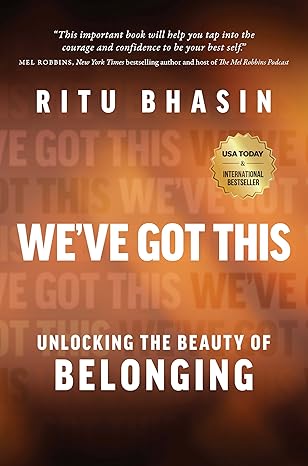
We’ve Got This by Ritu Bhasin is a call to embrace the often-challenging journey toward authentic belonging. Drawing from her personal experiences as a child of immigrant parents and her professional expertise in Diversity, Equity, and Inclusion (DEI), Bhasin crafts a narrative that is both a memoir and a manual. Her stories of battling racism, understanding cultural identity, and ultimately finding her place in the world resonate deeply, offering readers of diverse backgrounds a mirror and a map.
Bhasin’s writing style mixes vulnerability with vigor. She does not shy away from discussing the pain and confusion of her early years. Moments of racism, cultural dissonance, and personal doubt are laid bare with a raw honesty that is as compelling as it is educational. Her transition from a successful lawyer to a DEI leader is not just inspiring but also instructive, providing practical advice for anyone looking to make a significant life change or to find deeper meaning in their work and relationships, empowering the reader and equipping them for personal and professional growth.
The book shines brightest when Bhasin discusses the concept of “Performing Self,” the facade we often present to fit in or feel accepted. Her insights into how this performance can drain one’s sense of self and belonging are poignant. The personal anecdotes she shares, such as her reflective moments in an ashram or interactions with her parents, are not just relatable but are also used effectively to illustrate broader truths about human nature and societal expectations.
We’ve Got This is a compelling guide to living authentically. Bhasin’s book is a powerful testament to the beauty and complexity of forming a true sense of belonging. This self-improvement book is highly recommended for anyone feeling adrift in their cultural, professional, or personal identity, but it particularly resonates with activists and advocates of DEI, validating their work and inspiring them to continue their efforts.
Pages: 192 | ASIN : B0CZFVNSN5
Whispers of the Heart


Whispers of the Heart by Barbara Woster is a romantic thriller that intertwines love and danger in a compelling narrative. The story follows Dalian and Kat, two individuals who have both endured the heart-wrenching loss of their spouses due to different tragedies. Their worlds shattered, and neither expected to find love again. However, when Kat takes a much-needed vacation at Dalian’s dude ranch, they unexpectedly discover a deep connection with each other. Yet, their budding romance is quickly overshadowed by danger as they face two life-threatening attempts. The question that looms is whether Dalian can protect Kat and preserve their newfound love.
The relationship between Dalian and Kat is beautifully portrayed, showcasing how love can blossom even after profound loss. Kat’s grief is particularly well-explored, offering readers a deep understanding of how her past shapes her present. Dalian’s experience of loss is portrayed with a subtle touch, which may resonate uniquely with different readers based on their perspectives. While the novel focuses on the emotional journey of its characters, there is an opportunity to enrich the narrative with more vivid descriptions. The romance between Dalian and Kat is central to the story, and while their connection is clear, adding more physical descriptions could further enhance the reader’s immersion in their love story. The setting, an essential element of any story, offers moments of beauty, such as the charming depiction of the picnic scene. Expanding this level of detail throughout the novel, particularly during key moments like the barn dance, could provide readers with a more vivid and tangible experience, especially for those less familiar with ranch life. The narrative remains engaging and easy to read, making it a delightful experience for a wide range of readers. Barbara Woster’s ability to weave a captivating story ensures that Whispers of the Heart is both accessible and enjoyable.
While Whispers of the Heart succeeds in delivering a thrilling mystery and a touching romance, the novel would have been stronger with more detailed descriptions of both the characters and their environment. Despite these shortcomings, it remains an enjoyable and easy read, especially for those who appreciate a blend of romance and suspense.
Pages: 284 | ASIN : B00DEWS4S6
The Secret Multiverse Academy (Magic Mystery and the Multiverse Book 2)
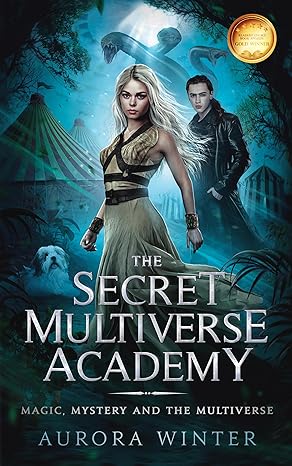
Prepare to be swept into a realm where magic and mystery intertwine in Aurora Winter’s enchanting fantasy, The Secret Multiverse Academy, the second installment in her series, Magic, Mystery, and the Multiverse. This book invites readers to expand their imaginations, dive into a world brimming with intriguing characters, and explore a uniquely crafted magical system. Ana is an ordinary girl from Earth until a fateful accident thrusts her and her brother Zackary onto an unfamiliar planet, where danger lurks at every turn. Zackary is captured, and Ana narrowly escapes execution. Now, her mission is clear: rescue her brother at any cost. To do so, she must navigate strange new worlds, and with the help of unexpected allies, she infiltrates the Secret Multiverse Academy as a spy. Within the academy’s walls, Ana not only discovers a magical world filled with new friends and hidden powers but also prepares to face dark forces that threaten her brother’s life.
Aurora Winter masterfully crafts an atmosphere that captivates from the first page. Her narration style, perfectly suited for a younger audience, makes the book both fun and engaging. The richness in detail offers young readers a story with the potential to become a cherished favorite. As we follow a cast of intriguing and diverse characters through a world full of surprises, the fantastical elements woven into the narrative keep the sense of wonder alive, creating an immersive experience that is difficult to resist. The unpredictability of the plot is one of the book’s greatest strengths. Winter keeps readers on their toes with unexpected twists and turns. Characters are brought to life with natural quirks, the world is cloaked in mystery, and the unfolding intrigue makes it nearly impossible to put the book down. Each page invites readers deeper into the adventure, where the magic of the multiverse is gradually revealed. The characters quickly become endearing, their vibrant personalities drawing readers in, creating emotional connections that enhance the tension and excitement of their journey. Winter strikes a perfect balance between the intricate world-building and light-hearted humor, using witty references to bring levity to the story’s more intense moments. The narrative ebbs and flows between light and darkness, keeping readers engrossed until the very end and leaving them yearning for more.
The Secret Multiverse Academy by Aurora Winter is a series that will linger in the hearts of readers long after the final page is turned. It promises an immersive adventure for those ready to explore a world of fantasy and magic. Embark on this journey and uncover a prophecy that could alter the destiny of the beloved characters we grow to cherish.
Pages: 456 | ASIN : B0CBNKZYLP
“You Got Me All Wrong”

The Magnificence of the 3 is an intriguing exploration of the intersections between science and faith, with a particular focus on the concept of the atom as a divine creation. Why was this an important book for you to write?
The original plan was to find ten scientific facts that were easier for the average person to analyze and come to conclude that there was a Creator and that Creator was the God the Hebrews brought to us.
The idea came to me while stuck in prison serving a life sentence. I was housed in Level IVs for twenty-one years but I was not afraid of prisoners housed there even though the majority were convicted of murders and violent crimes. But when I landed in the lower-level institutions where the majority of inmates were not killers yet but just gang members, I became very fearful for society. I overheard their conversations, and the majority of plans were rooted in violence. I couldn’t imagine a society living in constant fear where one member has to keep guard while the family rests.
I decided then that to secure society, we needed to confirm as fact that there was a Creator and scholars might have missed something. Furthermore, evolution had been planting the idea in all our brains that man came from monkeys. These children, the Christians and religious people in general including myself, have all succumbed in one form or another to this theory, by behaving like animals. We are witnessing a genocide today committed in the name of God by the Hebrews and Christians where children are indiscriminately murdered as an example.
As children can easily separate hypocrisy from facts, I decided to look to science for that evidence. It was also for my benefit as even though I grew up in the church, I had a lot of questions that leaders could not answer. I was very confident however that if God the Hebrews brought to us was real, He planted the evidence somewhere in the record. With the nature of the environment itself on its own, I concluded even as a child that God had to be a Scientist first and foremost. In that case, the truth about God had to be hidden somewhere in science and not in the church.
Furthermore, since children look to science as factual, it will be much easier for them to come to God compared to the Church which promotes God as loving, forgiving, and merciful while encouraging the murder of babies as we are currently witnessing with the genocide of Palestinians. Kids aren’t stupid or evil why they discard God when they grow up. The Christians had been accepting violence as a Biblical standard and children had also been watching from the sideline. Some of these children may be the future of the church and will continue upholding this standard while calling themselves Christians.
Research indicates more churches close every year than open and I am not surprised considering the ongoing violent wars of the last twenty years between the Zionists and Christians against the Muslims. These three groups follow the same God, unfortunately.
The only counter for our children’s future and to secure world peace hopefully is for us today to find proof that there was a God and with the pieces of scientific evidence provided by this book, I can now confirm that it was the One the Hebrews brought to us. We need to find some rest from anxieties of religious wars and violence. This was the original plan and its roots began inside a prison.
What were some ideas that were important for you to share in this book?
I am thankful to the Christians who reviewed the book and honored it with awards. I appreciate it much more as I am fully aware of habits by common Christians of calling anyone names for any observation of the scriptures outside what they had been taught. The majority of my claims have not been presented before and the awards indicate that the Christian reviewers accepted them. Here are a few examples.
The most important claim is that the Torah and Bible were parabolic stories about brain development while living on earth. This is why the Tree of Knowledge, Tree of Life, and Garden of Eden with its rivers were all recorded in the second chapter of Genesis.
The second most important claim is that the interpretation of the incident in the Garden of Eden when Eve chose to go for knowledge as the “Fall-of-Man”, was bad. To claim that man was created perfect, and then followed the devil immediately after creation and on their first challenge, meant that there was a flaw in God’s design. It amounted to calling God’s name in vain. God’s design was perfect.
It was during this incident that God revealed the elements of brain development. That of the Tree of Knowledge (brain neuron that looks like a tree), the Garden of Eden (brain full of neuron trees), and the Tree of Life (Ten Commandments representing societal laws).
The conversation between Eve and the snake revealed what our scientists recently confirmed: that knowledge is rooted in the development of emotions. I came to this conclusion when God planted the very first emotion during this conversation. This emotion was “desire” (I found that this word had been removed from some Bibles). Since every human behavior is motivated by an emotion according to our scientists, then the presence of “desire” in the conversation was the first incident where emotion and human behavior came together. This was what God meant to convey in the conversation between the Mother of mankind and the snake.
God designed the brain neuron to look like a tree and called it the Tree of Knowledge. As it turns out, it is the neuron that looks like a tree of earth that stores our memories and it is these memories that help us survive in our daily struggles by choosing what we tried and worked in the past while discarding what didn’t.
A biblical legend turned out to be a scientific fact. This was the kind of fact I suspected was hidden in parables. The Tree of Knowledge is no longer a myth to make fun of but a scientific fact.
The third most important one confronts claims by evolution that emotions were learned from the environment. It is my claim that emotions were fundamental elements of the design. In that case, they had to be in a relationship of THREE as fundamental elements of creation were designed after the Atom’s blueprint.
Since emotions have only been divided into classes of positive and negative, it is incomplete. If emotions were designed after the Atom (it has three particles), it has to have its own version of a neutron.
It is my claim that God included “desire” in the conversation between Eve and the snake to preserve the record of the identity of the neutron God designed for Emotions, or as I refer to it, the Mother of Emotions. God linked together the mother of mankind (Eve) to the mother of Emotion (desire) in deciding whether mankind was going to remain a beast or evolve into the Image and Likeness of God.
Since emotions were designed after the Atom, they were therefore fundamental elements of the design. In that case, they were hardwired into the human body in contradiction to claims by evolution that emotions were learned from the environment.
The so-called Fall-of-Man incident was therefore a scientific parable about the design of the brain involving the Tree of Knowledge (neuron) and Emotions. The design had been confirmed by science as a fact.
The fourth important claim involves the identity of the Tree of Life. It is my claim that God presented the Ten Commandments as this tree and left clues of where to find it and I did.
The Atom has many laws for its operation, and the most fascinating one is the Electron Capture. It is fascinating because of its spiritual and religious parallels. The Atom’s laws define the relationship of its particles that enable the Atom to survive immortally. If man was created in the Image and Likeness of the Atom, man had to have laws similar to the Atom’s to maintain human survival.
This was why God referred to the Ten Commandments as the Tree of Life. Man would need laws for the brain to be developed. I hear people accusing government laws as a means to control. But by understanding how man separated himself from beasts of the field through brain expansion, I now understand why God referred to the Ten Commandments as the Tree of Life.
The Commandments appear simple, but they were meant to be as they were not meant for entering heaven but for social living on earth. They were meant as tools for social interaction and developing a society. According to the social brain hypothesis, our ancestors separated themselves neurologically from animals when tribes began expanding and getting bigger. The bigger the tribe got, the more complicated social conditions became, requiring the human brain to adjust. In this process, the human brain expanded and we slowly separated ourselves from beasts of the field. The bigger the tribe, the bigger the brain.
Would you prefer to be part of a tribe that treats you with love or a tribe that condones stealing and murdering each other? If you prefer the former, then you understand what God meant to do with the “loving-thy-neighbor-like-loving-oneself” command. The bigger the tribe, the bigger the brain and the Tree of Life provided an example of tools designed for this purpose.
I’ll end this with my claim regarding my unsolved question as to the Image and Likeness of God. The discovery of the Atom in the record is crucial today. It not only confirms the truth about God of the Torah and Bible since the Atom was a recent discovery by science, but it solves my question as to the meaning of the Image and Likeness of a God who knew “good and evil”.
The Atom as I claim was God’s firstborn. It is my claim that the “Image and Likenesses” that God said He was going to use in creating Adam as recorded in Genesis 1: 26, was a reference to the Atom. God designed the Atom in His Image and Likeness and then used the Atom in designing mankind.
The snake came later and revealed this image and likeness parabolically, and this image was of a God who knew “good and evil”. The “good and evil” characteristics of God coincidentally, are the same classification our experts gave to the particles of the Atom. In modern language, “good” by word association means “positive”, whereas “evil” by word association means “negative”.
But when God created Adam, however, He had to redesign the atom’s particles Adam. The “good and evil” reference was the classification God gave these specially designed human particles. Our experts came later and identified these human particles as Emotions, but coincidentally, our experts assigned them into two groups: positive and negative emotions. Their purposes according to our experts including evolutionists, were to assist us in our survival pursuits. The atom’s immortal survival by the way, depends on the interactions between its own positive (good) and negative (evil) particles.
All I needed to find was a piece of evidence to prove that the “neutral neutron” of the Atom represented God. There are a lot of pieces of evidence submitted in book but one fell out of the Bible and landed here on Earth. This one is easy to understand through my claim that the Ark of the Covenant was also designed after the Atom.
When God walked with Israel in the desert carrying the Ark of the Testimony/Covenant in the Old Testament, He appeared as a magnificence of the three: cloud during the day, fire, and light at night.
When the Jews created the atomic bomb for the Americans, they used the Atom’s “neutral neutron” particle. When these bombs exploded on the Japanese, witnesses saw three things: a mushroom cloud, fire, and a bright light. These were the manifestations of God while walking with Israel carrying the Ark in the Old Testament. These manifestations provided us with a direct piece of evidence supporting the claim that God presented the neutral neutron as His particle.
Since all ordinary matters in the universe are made of Atoms including our bodies, and the “neutron” of the Atom is God’s particle, it clarifies two parables for us: (1) the meaning of God’s Omnipresence since He is the “neutron”, and (2), the meaning of Jesus’s declaration that the kingdom of God is in you. Luke 17: 20-21. God lives in us because He is the “neutron”.
Since all ordinary matters in the universe are made of the Atom, including the human mind and heart, this is why God has Omnipresence and lives in you. You were created from His Image and Likeness, and this Image and Likeness was first planted in the Atom.
These are some claims but there are plenty more including the meaning of Eve as the helper, why Eve was created in the Second Chapter of Genesis and not the first, why Cain was more than a murderer, why kicking Israel off the land did not violate the covenant between God and Abraham, why the Son Jesus was the opposite of the Father, the indisputable scientific evidence of the crucifixion, and the scientific meaning of many parables in the Torah and Bible including the one below.
With the looming election, it is time for our intellectuals to review one claim that the land once promised to Abraham, was replaced with a land of gentiles with God’s blessings. This land came to be known as the American lands. The evidence is overwhelming.
How much research did you undertake for this book, and how much time did it take to put it all together?
It took me ten years to get the project done once I was released in 2013. I planned on focusing on the project in full but then my family kept asking me questions like “still no job?” LoL. I spent all these years in prison and by appearance, it might have looked like I did not plan on getting a job. Writing a book was a bit foreign to them and not a job for sure. LoL.
So I had to get a job, and it slowed the project down. I didn’t know where to start either as I didn’t want to read books about God and science as they might influence my thoughts. I can say this however, thank God for the internet as without it, this project would have been impossible as I needed to understand scientific discoveries and theories to include as supporting evidence.
It was a lot of research as science was and still is foreign to me. For example, I was aware of the Atom, but not of anything else, not even the name of the particles. I had to study the basics of the Big Bang, evolution, social brain hypothesis, the triune brain theory, the biological and neurological structure of the human anatomy, including the latest discoveries such as the field of epigenetics and the wood wide web amongst other scientific matters.
I was five years into the project when the Atom hopped along on my screen. I immediately saw the similarity of its design to the Image and Likeness of God, once I renamed the “positive proton” as “good” and “negative electron” as “evil”.
The challenge then was to find proof in the scriptures that the “neutral neutron” was God’s representative in the Atom as it completed the image of God the snake revealed, that of One who knew good (positive) and evil (negative). Our experts inadvertently provided the evidence to substantiate this claim with the Atomic bomb.
It took another five years to finish the current published version. It took over a year for the first edit as God started dropping information on my lap and I pretty much almost changed the whole draft that I submitted to the publisher. So many additions to the draft that I ended up paying the Publisher more money to get the book published. I did not like this but I needed to get the information out to the community. LoL.
It took ten years to get it out as I had to work full-time and write. God revealed a lot to me and I originally thought of doing two or three books. But then I became fearful of what would happen to the information if I walked out of the house and got run over. So I decided to compact the information into one book and let better people come in and expand on them down the line.
What is one thing that people point out after reading your book that surprises you?
So far, I have not received any reviews yet. The people who are reading it are friends and they are shocked. Their comments are all supportive but shocked however with the claims. The comment I liked the most however was how simple I presented the claims for the average person to understand.
This was the goal initially. As science is foreign to a lot of people, I had to make it easier for the average person to understand as a result of my fear of the youths in prison. I wanted the average high school child to hopefully understand the biblical parables related to the design of the human anatomy that may influence behavior as grown adults.
I now feel bad however as I assumed unjustifiably that uneducated gang members pose the most serious menace to society. But then the October 7 incident involving the Zionists and Palestinians came about. Then grown Christians and Zionists with Bachelor’s and Master’s Degrees appeared on the news including a Christian Congressman promoting the idea that murdering Palestinians and their babies would bring them blessings from God.
I am unsure where these people found such an idea in the Ten Commandments or the Sermon on the Mount! Best-selling Author Neale Donald Walsch said God once told him, “You got me all wrong”. I owe our young thugs an apology.
Author Links: Facebook | Instagram | Website | LinkTr
There are three main characters in book:
God, the invisible Designer
God’s First-born, the invisible Atom
God’s Helpers, the invisible Emotions.
I ran across God’s treasures accidentally while following the tracts of the ATOM that God left in the biblical record parabolically. God was fully aware of the atom when He declared in Genesis 1: 1 that “He created the heavens and earth.”
The “THE MAGNIFICENCE OF THE 3” title was deducted from a quote attributed to Nikola Tesla, a mechanical and electrical genius of an engineer who said:
“If you only knew the magnificence of the 3, 6, and 9, then you would have the key to the universe”.
I am claiming that I found Tesla’s magnificence of the 3, and it was a reference to the ATOM and its three particles: (1) positive proton (Good), (2) negative electron (Evil), and (3), neutral neutron (God).
When I began researching for project, I was not looking for these biblical icons. Then one day, the ATOM popped up on my news feed and while admiring its mechanics, I immediately saw the parallel of its scientific structure, to the spiritual structure of the relationship God urged us to have with Him.
Then I searched for the Atom in Biblical record and found it. This was unexpected but the claims are presented for your review. Once I saw the parallel, God’s parabolic stories opened up for me. For example, how could Eve talk to a reptile? How could the devil turn the perfect humans against their Master on the first try? Why are innocent children born in sin if man was created perfect? Why were Abraham’s descendants designated to be enslaved before Abraham had a son? If man was born to be immortal in the flesh, why was there a Tree of Life in the Garden? Who was Cain’s wife and what was the mark God gave him? Was there a scientific meaning to the changes in diet after the flood? What were the meanings of the curse and blessing given by Noah to his three sons? Why would a loving, forgiving, and merciful God punish up to three and four generations of innocent children for the sins of the fathers? Who were the sons of gods and daughters of men? If the crucifixion was the truth, why isn’t there any record of it except the New Testament?
These are my personal questions that are dealt with in this book and many others. Book is compact with foundational information that better people will come along and expand upon for your benefit. Examples of scientific subjects involved are the atom, emotions, the Big Bang theory, the social brain hypothesis, the triune brain, neurons, evolution, and new scientific subjects such as the wood wide web, and epigenetics.
In case you wonder about God’s Omnipresence. Wonder no more as the secret is in the ATOM. Equip yourself properly as a Priest beginning with this book.
I Had to Look Harder and Deeper

Until I Have No More to Give follows a Union Civil War survivor who joins a group of workers trying to fix the issue of millions of displaced Southern whites and freed slaves who have no place to go and no means to support themselves. What inspired you to write this story?
When all this began, I had preconceived notions of what the Civil War was all about and discovered that my grandfather’s half-brother played his minor role and my father and his siblings knew little to nothing about him, even who he was. So, I had to look harder and deeper. Using the internet and established historical venues, I had tremendous advantages over my immediate ancestors. They had a picture of a group of Civil War officers and they had Hiram’s Appointment Certificate into the Veteran Reserves Corps, signed of course, by President Abraham Lincoln and the Secretary of War; but they had no idea what they had.
As I began looking on sites, I kept finding more and more. Military records, retirement pensions, etc. It took several years to realize that I needed to share this information and by this time, my dad and his siblings were all gone. I had to find someone who would be interested, so, at the urgings of my sisters, I decided to write a book. The approach I took was to take all of the historical facts I had discovered and put them in a time sequence. I took A and B and tried to figure how would Hiram have got from one point to the other. Using a lot of history and and an untested imagination, a story somehow began to take form.
My biggest and most pleasant discovery was how Hiram was historically right in the middle of major efforts that actually helped to shape who we are and perhaps even what we still stand for. I hope so.
So, ‘Chauncey’s Blood A Hiram Robinett Story of the Civil War‘ was published. However, my discoveries continued. I found new data and facts. I found answers that I did not have when writing book 1. Being the novice that I still am, I asked my editor/publisher if it was feasible to edit and update the story as a new edition. She suggested properly a second book, a story that expanded on the first book. So, that is what I decided to do.
I offered no apologies for changes that I found that modified the original story line somewhat. Such is life and why not reflect it accurately as fiction can be. I did that. The second book is a continuation of the story line from book 1 but reflects the accuracy discovered since the first writing. I additionally believe that I developed my interpretation of who Hiram was to be more accurate. He is definitely more human, with emotions that hopefully serve to make him more real. I love the guy and hope that who I described is who he was, an American average male who appreciated what life had handed him and felt a patriotic duty to give back when he could. His actions seem to dictate that to be true.
What are some things that you find interesting about the human condition that you think makes for great fiction?
I should strive to say something really profound, but I’m not capable. At my age and in my condition, I have virtually every emotion under the sun. I can still be serious, I am quite feeble, I still love heartily and can only talk and sometimes dream with my new reality. So, I can soar with the eagles one day and have a difficult time getting out of my bed the next. I am getting a new rescue dog on Friday and expect to be all better by Monday. Life is good, sometimes hard, but always good. I should write about it.
What were some themes that were important for you to explore in this book?
The role that the President of the United States of America plays in history.
History is far more favorable to the Reconstruction Era than is warranted.
Historically, The Bureau of Refugees, Freedmen and Abandoned Lands was deemed a huge failure. I disputed that before the book and I continue to believe that an organization of 1,000 employees took on ‘fixing’ America’s 36 million ‘broke’ people. Their successes to support a million people is truly a highlight of a very dismal time in our country’s history.
Will there be a follow-up novel to this story? If so, what aspects of the story will the next book cover?
I would love to make it a trilogy, however, the remainder of the story doesn’t have Hiram in the picture. There is a good story remaining, so I will just have to explore a bit more before making a decision. The other big question I still have is of 4.2 million freed slaves, approximately 1 million made use of the Freedmen’s Bureau. There has to be an amazing story as to how the additional 3 million survived. By 1870 Census, the black population had grown to more than 6 million, so something worked for them. Someone deserves credit.
Author Links: GoodReads | Second GoodReads
Award-Winning Author of “Chauncey’s Blood: A Hiram Robinette Story of the Civil War”



 LITERARY TITAN