Blog Archives
Leaders of Influence


Leaders of Influence is a multi-author leadership anthology that examines influence as a daily practice grounded in conduct, judgment, and responsibility. Its central proposition, “Leadership is influence with responsibility,” gives the collection a clear ethical foundation. Rather than treating influence as visibility or personal magnetism, the contributors explore how leaders shape expectations, decisions, culture, and performance through repeated actions. The result is a professionally focused book for executives, business owners, advisors, and emerging leaders who want to understand how their behaviour affects the systems around them.
The book’s strongest quality is the range of perspectives gathered around that central idea. Pollyanna Lenkic considers self-awareness, accountability, emotional maturity, and the ways leaders can unintentionally create dependency. W Daniel Cox III connects influence with board-level data governance, showing that credible leadership depends on trustworthy information and clearly assigned ownership. Kala Philip explores leadership as communication at scale, Luke Moroney presents influence as something built through consistent presence over time, and Anton Guinea brings the collection together through five dimensions that connect intention with integrity. Lauren Clemett examines visible credibility, professional positioning, and the courage required to become known for meaningful expertise. Les Moir’s discussion of the wolf adds a memorable framework for composure, standards, protection, and capability-building.
Although the contributors use different experiences and models, the essays remain connected by an emphasis on consistency. One of the book’s most useful observations is that “Influence is not only what we say. It is what our repeated behaviour teaches others to expect.” Case studies, personal accounts, diagnostic questions, and short exercises help translate that principle into workplace practice. Readers are repeatedly asked to consider what their teams do in their absence, how they behave under pressure, whether their stated values appear in their decisions, and whether their leadership develops ownership or dependence. These questions give the book substance and make it suitable for individual reflection, coaching conversations, and leadership-development programs.
The collection’s direct, accessible style supports its practical purpose. Its strongest chapters combine personal vulnerability with a disciplined explanation of how behaviour becomes culture, while its visual quotations and concise prompts make important ideas easy to revisit. Some themes recur across the contributors, particularly authenticity, self-awareness, credibility, and intentional action, but that repetition also reinforces the book’s argument that influence is cumulative. Leaders of Influence is a thoughtful and application-oriented examination of how people earn trust, communicate standards, strengthen capability, and create an impact that continues long after they’ve left the room.
Pages: 230 | ASIN : B0GX2WN4D4

Resilience and Authenticity

Wake-Up Calls follows your journey from grieving daughter to funeral home owner, mentor, and advocate as you transform loss and leadership lessons into a call for humane and compassionate deathcare. Why was this an important book for you to write?
Wake-Up Calls is about much more than my own story. It’s about the moments in life that challenge us, change us, and ultimately call us to become better leaders and better people. When I unexpectedly lost my father, I was suddenly faced with leading our family funeral, cremation, and cemetery business before I felt ready. That experience, along with the many personal and professional challenges that followed, taught me lessons that I couldn’t have learned any other way.
After more than 40 years in funeral service, I realized those experiences could help others, particularly women entering a profession that’s evolving rapidly. Today, women make up a growing majority of funeral and deathcare professionals, yet many still face obstacles in acceptance, mentorship, and long-term career growth. I wanted to offer the kind of guidance I wish I’d had early in my career through honest storytelling, practical leadership lessons, and encouragement.
I’m especially proud that every dollar of proceeds from Wake-Up Calls supports non-profit organizations dedicated to advancing leadership education for both men and women in the profession. That’s an extension of the book’s purpose: investing in the future of our profession and the compassionate leaders who will shape it.
What was the most difficult personal memory to revisit while writing Wake-Up Calls?
That’s not a question I answer lightly, because writing it meant living it all over again.
The most difficult memory was the day my dad died. He died suddenly and at a young age of 53, without warning, and I was eight years into my career at Baue’s when the call came.
But the moment that truly undid me was when I stood alone in his office afterward. The room still smelled like him, pipe tobacco, and his cologne. I found the letter in his desk drawer, the one addressed to my brothers and me that said, “Open if your mother and I are gone.”
And I looked at his chair. I thought, do I dare sit in it? I sat down. And I fell apart.
Through my tears, I actually asked out loud, “Dad, what am I supposed to do now? I don’t know how to run a business. Who will help me now that you are gone?”
Writing that scene meant going back to the girl I was in that moment. A young woman, a new mother, a funeral director who could help other families navigate grief, but had no idea how to navigate her own. I had been raised to be tough. Baues didn’t cry; we plowed through, no matter what.
And there I was, crying in my father’s chair, talking to a man who could no longer answer me.
That was the hardest page of the book to write. And it’s the one I’m most grateful I didn’t skip.
What do you hope young women entering the deathcare profession take away from your story?
More than anything, I hope they see that they belong here and that their voices matter. This profession needs leaders who bring empathy, innovation, resilience and authenticity.
I hope they learn to trust their instincts and embrace opportunities even when they feel unprepared. Some of the most important growth in my own career came from difficult experiences.
I also want them to know they don’t have to do it alone. That’s a big reason I founded the Funeral Women Lead Foundation: to help women “unleash their greatness” and create opportunities for mentorship, leadership development and long-term support for them across every stage of their careers. When we invest in each other, everyone benefits.
Looking back, what leadership lesson did grief teach you that success alone never could?
Grief taught me that leadership begins with compassion. Success often focuses on achievements and outcomes, but grief reminds you that every decision ultimately affects people. Experiencing profound personal loss gave me a much deeper understanding of what the families we serve go through, and it changed how I led my team as well.
It also taught me resilience. Leadership isn’t about avoiding hardship; it’s about learning how to move through it with integrity, courage and grace.
I hope readers come away understanding that our greatest challenges often become our greatest teachers and that compassionate leadership can transform not only businesses but also the lives of others.
Author Links: GoodReads | Amazon
In Wake-Up Calls, Lisa Baue shares the pivotal moments that shaped her into one of the most influential voices in the funeral and deathcare profession. She invites you into the heart of her leadership journey by sharing deeply personal stories and hard-won business lessons, helping you expand your knowledge, develop your grit, and embrace your heart for serving others.
Wake-Up Calls is both a rallying cry and a road map. While women are the future of the profession, they continue to face challenges that cause them to leave in large numbers. Lisa’s mission is to change that. Blending memoir with mentorship, she guides women to become the confident, compassionate leaders the industry needs.
From unexpected challenges to defining breakthroughs, Lisa reveals how each “wake-up call” became a catalyst for growth. Her story is a powerful reminder that women can not only succeed but also transform the profession from the inside out.
Teachers, Teams & Tugboats

Teachers, Teams & Tugboats is a reflective career memoir about leadership, mentorship, and the complicated machinery of global logistics, told through Rich Higgins’s more than forty years in the field. Using tugboats as his central metaphor, Higgins looks back at the people who steadied him, pushed him, protected him, and taught him how to lead. The book moves from noisy trucking docks and deregulation to retail bankruptcies, mergers, Asian port visits, union conflicts, public speaking, health struggles, and late-career reinvention. What holds it together isn’t just supply chain expertise, though there’s plenty of that. It’s gratitude. Again and again, Higgins returns to the idea that a career is rarely built alone, and that the best leaders are the ones powerful enough to guide without needing the spotlight.
I appreciated the book’s emotional honesty. Higgins doesn’t polish himself into some flawless executive hero, and that gives the memoir its warmth. The scene where Tom drives him to work every day after his DUI is one of the book’s most affecting moments because it’s both painful and generous. Higgins lets us feel the shame of that mistake, but he also lets us feel the astonishing grace of a friend who simply shows up. I found that more memorable than many of the larger corporate victories because it captures the book’s real subject: character under pressure. The same is true when he writes about relocating his family and watching his daughters struggle, or turning down the dream job in St. Louis so he could be near his dying father. Those passages carry a quiet ache. They remind us that every career decision has a private cost, and Higgins is at his best when he lets that human truth sit beside the business lesson.
The writing is plainspoken and sincere. Higgins writes like a man talking across a table, and that directness suits the material. The book uses a lot of quotations, acronyms, and operational detail, especially when it gets deep into detention, demurrage, ocean rates, UPS contracts, and best-practice checklists. I did occasionally want a little less instruction and a little more scene. But even the technical passages have an authentic authority. When Higgins describes eliminating rail detention by teaching the distribution center team how the clock worked, creating a Container Priority Report, and getting everyone aligned around FIFO, the lesson lands because it’s concrete. The ideas are strongest when they’re embodied in action: Charlie trying to turn C players into B players, Dave bringing in positive reinforcement training, Greg keeping a position open until Higgins found his way back, Jimmy valuing expertise over age. The book’s moral universe is clear, maybe even stubbornly so, but I liked that about it. Tugboats, captains, crew members, pirates. It’s simple language for complicated workplaces, and it sticks.
Teachers, Teams & Tugboats feels less like a conventional business book and more like a thank-you letter written after a long and meaningful voyage. Its best moments are tender, funny, and grounded in hard-earned perspective, especially when Higgins admits what he didn’t know, who helped him survive, and which values still matter after the titles and relocations fade. I closed the book feeling that its deepest argument isn’t about logistics at all, but about remembering who carried us when we couldn’t quite steer ourselves. I’d recommend it to readers in supply chain, retail, transportation, or operations, but also to managers, mentors, and late-career professionals who want a candid reminder that leadership is built through patience, integrity, gratitude, and the grace to help someone else reach safe harbor.
Pages: 78 | ISBN : 978-1970751505
This Car Sux!: Tales and Tips From a Life of Wheeling and Dealing


This Car Sux! is part memoir, part how-to guide, and part history lesson on the American car business. Author Randy Pressgrove walks through his forty-plus years in dealerships and corporate roles, from the showroom floor to the inner world of factory finance, while explaining how cars move from assembly line to dealer lot to driveway. Along the way, he breaks down sales tactics, add-on products, financing tricks, the role of banks and in-house lenders, the impact of recessions and oil shocks, and even the chaos of Covid, all threaded with road stories and character sketches from a lifetime on the road.
I felt pulled in by the voice right away. The writing has a straight-ahead, front-porch style that fits the subject. Pressgrove sounds like the seasoned rep who has seen every stunt in the book, and he is not shy about calling people bastards, bandits, and bozos when they earn it. The stories about “protection packages,” disappearing trade-in keys, and finance managers squeezing every last dollar out of a deal had me half laughing and half wincing, because they feel very human and very plausible. At the same time, he steps back often enough to explain the mechanics in plain English, so even when he gets into loan terms, floor planning, or leasing, I never felt buried in numbers. The pacing does sag a bit in spots, especially when he follows the history of interest rates and factory politics in detail, but the next colorful anecdote usually arrives just in time to wake the reader back up.
Pressgrove is tough on dealers who prey on unprepared buyers, yet he is just as blunt about customers who walk in with no research, no budget, and no plan, then complain later that “this car sucks.” That balance resonated with me. I liked how he connects personal horror stories to bigger themes, like how easy credit traps both buyers and dealers, or how manufacturer incentive programs change behavior on the ground. There are moments where the book leans on nostalgia for the old days. Older readers will relate, while younger readers will still be able to appreciate it.
I came away feeling both entertained and better armed. I would recommend this book to anyone who is about to buy or lease a car and wants to walk into the showroom with eyes wide open, and to people thinking about working in sales or management at a dealership who want a candid look at the culture they are entering. It will also land well with readers who enjoy behind-the-scenes business stories told by someone who lived the job, not by a consultant from the outside. If you want a technical finance text or a dry academic history, this is not it. If you want a sharp, funny, occasionally grumpy tour of the modern car circus from someone who clearly cares about the trade, This Car Sux! is worth your time.
Pages: 328 | ASIN : B0FVB8W9SM
Messy and Imperfect is Still Meaningful

In Rainbow Gold, you share your losses, lessons learned, and the long-term effects of making meaningful choices as you transitioned from struggling restaurant owner to building a thriving aviation insurance group. Why was this an important book for you to write?
Rainbow Gold was important for me to write because it captures the philosophy that has shaped every stage of my life, that you can build something valuable and meaningful at the same time. During my early struggles owning a restaurant and retail business in South Africa, I made many missteps and got some hard lessons in business and leadership, and success seemed elusive and distant. Over time, I realized the real reward isn’t at the end of the road; it’s woven into the journey; the relationships, resilience, impact, and identity you build along the way.
When my teams surprised me one holiday season with deeply personal notes about why they loved working at our company, it crystallized what I now call Rainbow Gold: the belief that fulfillment doesn’t need to be deferred. You can build it into your business and your life right now.
I wrote this book to show entrepreneurs and leaders that the process of building something, or learning how to build something, even in its messy, imperfect stages, can be just as meaningful as the outcome.
I appreciated the candid nature with which you told your story. What was the hardest thing for you to write about?
The hardest parts to write were the chapters where I had to revisit failures, missteps, and emotionally heavy moments, both from my early ventures in South Africa and later, from navigating sensitive family partnership dynamics in our current business. Those years were formative, but they also involved painful mistakes and setbacks that I hadn’t revisited in a long time.
As a leader who values responsibility and clarity, admitting where I fell short required vulnerability. But leaving those moments out would have made the lessons less authentic. Readers don’t benefit from a polished highlight reel; they benefit from the full picture, including the chapters where the stakes were high and things didn’t go right.
Those candid moments ended up being some of the most resonant for readers, which affirmed why they needed to be in the book.
Did you learn anything about yourself as you wrote this book?
Absolutely. Writing Rainbow Gold reaffirmed that resilience is built in the small, daily choices you make when no one is watching, those “butterfly effect” moments, not in dramatic turning points. As I revisited years of experiences, I saw that it wasn’t one brilliant strategy or one lucky break that moved me forward; it was consistency, perseverance, and staying anchored to my values even in uncertainty.
I also learned that people, my teams, clients, mentors, and family, have always been my true driving force. I learned from my father and I’ve said for years that relationships matter more than anything in business, but writing the book helped me understand how deeply this principle has shaped my identity and my approach to leadership.
What is one thing you hope readers take away from Rainbow Gold?
If readers take only one idea away, I hope it’s this: You don’t have to choose between building a successful business and building a meaningful life.
When you invest in people, relationships, and values-driven decisions, financial success will follow organically and it will be financial success that is sustainable and legacy building.
Rainbow Gold is about rejecting the idea that fulfillment comes only at the end of the journey. Instead, it shows that the “pot of gold” is much broader than profit alone. Making money and being financially successful is certainly an important part of it, but equally important is the legacy you create, the people you grow, the impact you make, and the pride you can take in the work you do every day. When you get your business to the point where you can both fill your wallet and fill your soul, you’ve struck Rainbow Gold!
If this book encourages someone to build a business with purpose instead of pressure, with sustainability instead of scale, and to enjoy the journey instead of waiting for one perfect moment, then it will have been a success from my perspective.
Author Website
“David Hampson has written the antidote to startup culture’s obsession with quick exits and venture capital. Rainbow Gold presents a compelling case for building businesses that become life’s work-sustainable, profitable enterprises that provide both financial rewards and deep personal fulfillment. Through his journey from restaurant owner in South Africa to aviation insurance entrepreneur, Hampson demonstrates that the real treasure isn’t reaching the end of the rainbow, but enjoying every step of the journey while building something lasting for your family and community.”-J.J. Hebert, Founder & CEO, MindStir Media; USA Today, WSJ, and #1 Amazon Bestselling Author
In Rainbow Gold, David Hampsonshares his journey from a college student immersed in science courses—with no formal business education—to becoming a successful acquisition entrepreneur and recognized industry thought leader. This book is for aspiring and seasoned entrepreneurs alike, offering a candid look at the challenges, triumphs, and transformative lessons of finding and building a business that is not just a stepping stone but the ultimate destination. Central to the narrative is the “butterfly effect”; the idea that small, decisive actions can create monumental shifts in your life and business. Through David’s story, readers will learn how embracing opportunities and acting decisively can lead to extraordinary outcomes, often in unexpected ways. Rainbow Gold shows what the real “end game” looks like: not an exit strategy, but a deeply fulfilling business that doesn’t need to be sold because its value goes far beyond dollars. It’s about creating a business that represents the pot of gold at the end of your rainbow, one that provides both tangible and intangible rewards. And once obtained, rainbow gold doesn’t trade in fiat currency! With humor, honesty, and practical advice, Rainbow Gold inspires readers to see entrepreneurship not just as a career path, but as a calling that can transform their lives and the lives of those around them.
Rainbow Gold: Building a Business That’s Both the Journey and the Destination
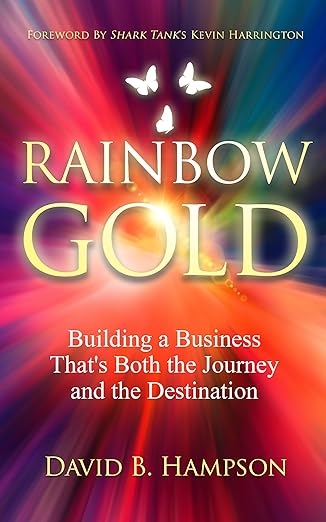
Rainbow Gold tells the story of an entrepreneur who learns, often the hard way, that business is really about people and purpose. The book follows David Hampson from his early struggles owning a restaurant in Cape Town to building a flourishing aviation insurance group in New England. The narrative blends personal loss, gritty lessons, and the slow shaping of a philosophy centered on long-term thinking, responsibility, and the butterfly effect of small but meaningful choices. It reads like a roadmap for building a business that gives back and grows people rather than one designed for quick exits and flashy valuations.
As I read, I found myself pulled into the raw honesty of Hampson’s voice. He doesn’t puff out his chest or pretend every move was a stroke of genius. He shares the messy parts. The moments he panicked. The moments he learned the hard way that trusting the wrong person can empty your stockroom or sink your cash flow. The chapters about the tragic accident involving his restaurant staff hit me hard. I could feel the weight he carried as he tried to care for his team while holding a broken business together. Those scenes made me pause more than once. They also made me appreciate how sincerely he views business as a human endeavor, not a numbers game. His focus on relationships, service, and showing up for people comes through clearly.
I also found myself energized by the parts where he reflects on decisive choices. His take on the fear that keeps people frozen felt familiar to me. The book urges readers to pick a road and walk it with conviction, even if it bends or darkens. That theme threads through his years in South Africa and later through his aviation career. I enjoyed how he mixes practical stories like fighting with VAT filings or chasing down a credit card machine with larger ideas about passion, equity, mentorship, and building a legacy. The writing feels close and direct, like sitting across from someone who has lived a lot and is finally ready to tell you the truth about what it cost. I appreciated that.
I walked away feeling inspired. Hampson writes with humility, and that makes the book accessible even when the subject matter gets heavy. I would recommend Rainbow Gold to new entrepreneurs who feel overwhelmed, small business owners who want to build something that lasts, and anyone who is tired of the startup world’s obsession with speed and exits. The book speaks to people who want a business with a heart. It’s a good read for those who want to build something slow, steady, and worthwhile.
Pages: 317 | ASIN : B0FWSZTMHP
The Cathedral of Quiet Power

Evan Yoh’s The Cathedral of Quiet Power is a poetic manifesto about surviving modern life without losing your soul. It’s part memoir, part philosophy, part self-destruction manual. Yoh takes us through his journey from sleeping in a leaking car to becoming a successful consultant, then tearing it all down to find what freedom actually means. The book moves like a confession and a sermon at once. It’s written in sharp, metallic prose that cuts through the noise of self-help clichés. Instead of offering comfort, Yoh offers confrontation. He argues that the world isn’t broken but rigged, that systems of power feed on our noise and dependence, and that real strength lives in quiet rebellion.
Yoh doesn’t sugarcoat a thing, and I admired that. His stories about corruption, burnout, and the “golden handcuffs” of success hit hard because they’re not abstract ideas; they’re lived pain. The writing is raw and unfiltered, full of short sentences that land like punches. And yet, underneath all the anger, there’s an aching tenderness. He’s not trying to burn the world down; he’s trying to build a new one inside himself. Some parts veer close to nihilism, but his insistence that silence, integrity, and sovereignty can coexist feels strangely hopeful. It’s messy hope, the kind that comes after losing everything.
What struck me most was Yoh’s honesty about ego and self-delusion. He admits to weaponizing ambition, mistaking control for love, and building a life that looked perfect but felt hollow. Those chapters were hard to read. They felt like someone holding up a mirror. The prose switches between poetic intensity and quiet introspection. But that’s also the beauty of it. This isn’t a book you breeze through. It’s one you wrestle with. Yoh doesn’t want followers. He wants witnesses–people willing to see the architecture of their own cages. His “doctrines” at the end of each chapter make the ideas stick; they’re like little grenades of wisdom you carry long after closing the book.
The Cathedral of Quiet Power isn’t a guide. It’s a reckoning. I’d recommend it to readers who are disillusioned by hustle culture, who’ve burned out and need a new kind of strength, not louder, but steadier. It’s for anyone ready to stop performing and start rebuilding from the quiet ruins of who they really are.
Pages: 166 | ASIN : B0FX8MG5C3
People Are Complex

Maximizing Organizational Performance is a practical guide that delves deeply into the power of performance coaching within organizations, outlining a clear, real-world approach to building coaching systems that help individuals grow and perform at their best. Why was this an important book for you to write?
The driving force behind Maximizing Organizational Performance: A Guide to Effective Performance Coaching was a need to reframe how we see and use coaching. I don’t view it as a profession in itself. I see it as a tool, one of many that come under the wider discipline of organizational development. As an OD practitioner first and a coach second, I am primarily interested in the system, that is, in how structure, process, leadership behaviors, culture, and other factors interplay and serve to facilitate—or sometimes constrain—performance.
Coaching is a means to that end. It’s a way of helping people and teams work more effectively. I wrote this book because I saw a need for more context in the way that coaching is being applied. It’s too often used as a tactical intervention, deployed against individuals without consideration of the broader system they inhabit. But individual performance can’t be elevated in a vacuum. If we want to build real, lasting performance, it has to be intentional and systemic. It has to connect to strategy, talent, culture, and other levers of organizational transformation.
That’s what this book is about. In it, I try to offer a different perspective on how coaching can be used. I try to give leaders and HR professionals a roadmap for weaving it into the DNA of their organizations so it can become a central part of how performance is created and sustained, not a niche service available to a select few.
What were some ideas that were important for you to share in this book?
I think one of the important ideas I wanted to convey is that performance coaching is not this ethereal thing that only happens at the C-suite level or during major life-or-death situations. It’s an everyday practice — a way of thinking, a way of leading, a way of showing up for and supporting one another at all levels of an organization. In my experience, coaching has the most impact when it becomes part of a manager’s normal leadership routine rather than an event that takes place quarterly, behind closed doors, with an external coach.
Another key idea for me was personalization. We often fall into the trap of thinking that performance can be optimized through standardized processes alone. How many organizations today still have standardized KPIs, standardized quarterly reviews, and serve only generic training programs? The hard truth is, people are complex. They bring unique strengths, challenges, motivations, and life experiences to work every day. Coaching works best when it’s attuned to that complexity, when it’s tailored and human. And it is only through that level of personalization that coaching can do more than keep people compliant. It’s only then that coaching can foster true growth and commitment.
And, I guess, if I have to pick the most foundational idea, it is that organizations aiming to sustain their competitive advantage can no longer afford to treat coaching as a discretionary add-on. If you’re serious about adaptability, that is, if you’re serious about building a resilient, high-performing team that can thrive in the conditions we all face today, then coaching is not a frill. It is a strategic infrastructure.
What is one piece of advice you wish someone had given you when you were younger?
If I could send a letter to my younger self, one message would be clear and resounding: “Lead with curiosity, not control.” In the early stages of my leadership journey, I equated being a good manager with knowing all the answers, moving fast, and pushing hard. Hyperfocused on outcomes, I regularly burned out and missed breakthroughs. I didn’t realize, as I do now, that sustainable leadership isn’t about being the best person in the room; it’s about setting the stage for others to be their best selves.
Curiosity makes all the difference. It starts conversations that would otherwise be shut down. It builds trust. It signals safety to experiment and learn. It lets people know that you see them not just as performers but as professionals with potential still to be realized. Shifting my stance from directing to inquiring has been one of the most liberating lessons of my career, one I wish I had learned much earlier.
What is one thing that you hope readers take away from Maximizing Organizational Performance?
If there is one thing I hope readers take away from this book, it is that coaching is a multiplier — not only for everything we do to strengthen and support individual performance, but also for culture, engagement, innovation, and sustainable success. Coaching is not fixing. Coaching is about unlocking what’s already inside and connecting that to the purpose, values, and direction of the business.
The real beauty of coaching is that it moves us away from the reactionary leadership models that lead so many of our organizations to scramble after performance problems, react to disengagement, and attempt to fill talent gaps at the eleventh hour. Coaching allows us to think and act more proactively, to have an intentional framework to develop people in a way that is both strategic and radically human.
I hope that when readers finish this book, they have more than new tools at their disposal. I hope that they will look at coaching and development as fundamental leadership practices and leave this book even more inspired to create work cultures where development is not limited to the chosen few who receive development, but where it is part of the way we talk to one another every day, the way we measure success, and the very DNA of our culture.
Author Links: GoodReads | X (Twitter) | Facebook | Website | Amazon
Dr. Patrick Behar-Courtois, with over two decades of international consulting experience, offers a fresh approach to performance coaching that transcends traditional methods. This practical guide tackles pressing issues such as remote work, diversity, employee retention, and technological integration, equipping leaders, HR professionals, and coaches with strategies to measure coaching effectiveness and build high-performing teams. Packed with immediately applicable tools and real-world case studies, Maximizing Organizational Performance bridges theory and practice, offering insights that resonate in today’s complex business environment.
So don’t let your organization fall behind. Unlock its full potential and prepare for the future with this essential resource!


