Blog Archives
Nothing So Broken
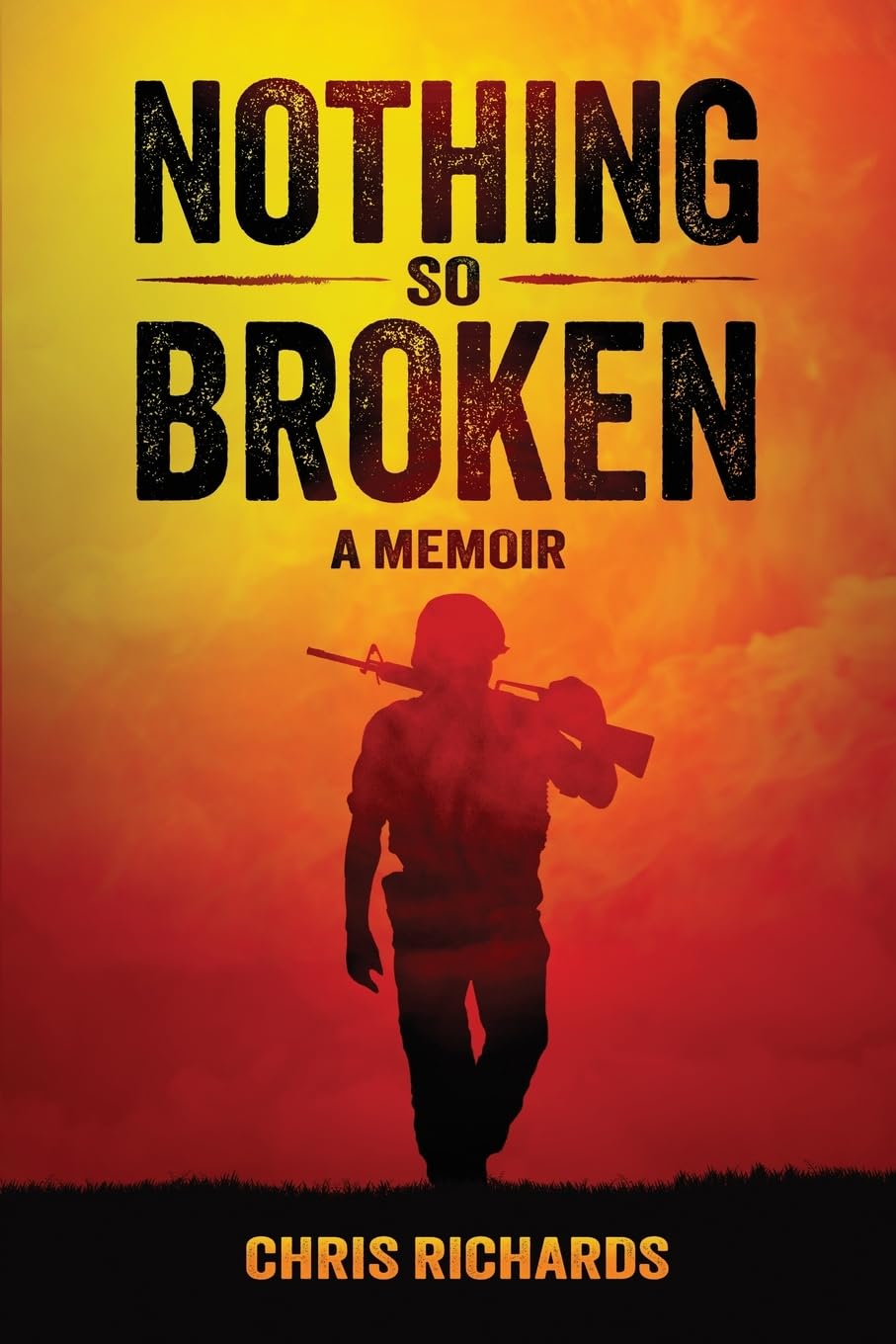

Chris Richards’s Nothing So Broken is a heartfelt memoir that weaves together family, friendship, and the long shadows cast by war. It’s told through a lens that shifts between generations, the Vietnam experiences of Richards’s father, and the tangled, messy journey of growing up in small-town America. The book captures what it means to inherit pain without ever being in the war yourself. It’s not just a story about Vietnam or divorce or youth; it’s about how those things mix together to shape who we become. Richards writes with a storyteller’s rhythm, turning memory into something vivid and cinematic, but also deeply personal.
The writing feels alive, sharp and tender at once. The way Richards talks about fathers and sons, love and loss, is both funny and painful. Some scenes had me smiling because they reminded me of my own childhood, while others just sat heavy in my chest for hours afterward. The tone is conversational, like he’s sitting across from you with a beer, just telling you how it all went down. The shifts between boyhood memories and reflections on his father’s war experiences work beautifully. They pull you into the idea that trauma doesn’t stop at the person who lived it. It seeps into the next life, quiet and steady. His language is simple, but it hits deep, no fluff, just truth.
The family stuff, especially the divorce and the father’s illness, his a deep emotional chord. But I loved that honesty. Richards doesn’t clean up the mess or try to make anyone a hero. Everyone is human, flawed, and trying their best. That’s what makes the book work. The emotional range, grief, humor, confusion, hope, feels real because life feels like that. He captures that strange middle ground between heartbreak and gratitude, and it made me feel like I knew these people, like I’d grown up right next door.
If you’ve ever wondered what it’s like to live with the echo of someone else’s war or if you just like stories about complicated families and growing up, this one’s for you. I’d recommend Nothing So Broken to anyone who appreciates honest, character-driven stories that don’t sugarcoat real life.
Pages: 201 | ASIN : B0FCSHMDMW

Conversations With My Mother, a Novel of Dementia on the Maine Coast

Conversations with My Mother tells the tender and heartbreaking story of a son watching his mother fade into dementia. Set on the coast of Maine, the book unfolds through small, vivid vignettes that capture the everyday beauty and sorrow of a family coping with loss long before death arrives. Through these fragments, each like a brief conversation or memory, the narrator shows his mother’s slow descent into confusion and fragility, while also revealing flashes of her wit, compassion, and stubborn humor. It’s as much about remembering as it is about forgetting, about holding on when life insists on letting go. The setting, with its shifting skies and sea winds, mirrors the mother’s mind, sometimes calm and lucid, sometimes clouded and unpredictable.
Reading this book felt like sitting in a quiet room, listening to two people who love each other deeply but know time is running out. The writing is simple yet piercing, with a kind of understated poetry that sneaks up on you. I found myself laughing at the mother’s dry remarks one moment and then, without warning, feeling my throat tighten the next. Gilbert doesn’t dramatize dementia; instead, he honors it with honesty. The story never begs for pity. It just shows life as it is, messy, unfair, beautiful. I admired how the author used humor to cut through the sadness. It’s the kind of humor that comes from people who’ve lived long enough to know that grief and laughter are two sides of the same coin.
What struck me most was the way Gilbert made the ordinary feel sacred. A drive to a hair salon, a walk to the beach, a chat about blueberries, these moments hold whole worlds of memory and meaning. The mother’s voice lingers long after you finish, a mix of sharp wit, old-world grace, and quiet resignation. There were times I wanted to reach into the page and hold her hand. The author’s restraint, his refusal to sugarcoat or sensationalize, gives the book its power. It’s a love letter wrapped in loss.
I’d recommend Conversations with My Mother to anyone who has cared for an aging parent or watched a loved one slip away piece by piece. It’s not a light read, but it’s a comforting one, full of truth and tenderness. This book is for readers who value quiet stories that move slowly and hit hard. It left me sad but grateful, reflective but strangely uplifted. Gilbert reminds us that even as memory fades, love stays, steady, stubborn, and shining through the fog.
Pages: 315 | ASIN : B0DHW9B73V
The Grass May Not Be Greener

This sweet little picture book tells the story of a bunny who’s fed up with being himself. He complains to a fairy that life as a bunny is dull and tough, so she grants his wish to become different animals for a day. He becomes a bee, an elephant, a snake, and a fish. Each adventure starts with excitement and ends in disappointment as the bunny learns that every creature has its own problems. By the end, he realizes he’s happiest being himself. The book wraps up with a moral about self-acceptance and a fun page of bunny facts for curious young readers.
I have to say, I loved the rhythm and rhyme of the writing. It’s bouncy and easy to read aloud, which makes it perfect for bedtime or storytime. The bunny’s personality really comes through. He’s grumpy, curious, and kind of dramatic in a funny way. Each transformation feels like its own little mini-story, and I found myself smiling at how relatable it all was. The fairy’s gentle patience balances Bunny’s constant complaining nicely, and the message about gratitude feels earned rather than preachy.
The illustrations are just gorgeous. Bright, warm, and full of life. The charming illustrations are delightful and perfectly convey the story’s humor. The warm colors and endearing art style create a rich, engaging world that invites young readers to pore over the details and discover a new, funny antic with every look. It’s a story that doesn’t just entertain kids but nudges adults too, reminding us all to stop comparing our lives to others. It hits that sweet spot of being simple enough for children and thoughtful enough for grown-ups to appreciate.
I’d recommend The Grass May Not Be Greener to parents, teachers, and anyone looking for a cheerful yet meaningful story to share with children. It’s especially good for kids who might struggle with confidence or envy. The writing is playful, the pictures are wonderful, and the lesson lands softly. It’s one of those books that makes you smile and think.
Pages: 40 | ASIN : B0D32GYDJ6
Inspired By the Void

Rise of the Phantom follows two divine feline protectors who, while visiting the mortal world, discover a supernatural force wreaking havoc on the towns and causing mass destruction. What was the inspiration for the setup of your story?
The idea first came from bedtime stories my dad used to tell me. I loved the idea of a world filled with magical creatures and guardians who protect it. As an avid reader, I also wanted to read books like the stories I had been told, but I couldn’t find any like them. Inspired by the void, I decided to create the world I wanted to visit. My mother was a huge part of helping me brainstorm this world and its depth over the last three years.
Rise of the Phantom features some very interesting characters who have their flaws but are still likable. How do you go about creating characters for your story?
I had general personality ideas for each character, but I quickly discovered that at some point, they begin to write their own story. They take on a life of their own, and as an author, you merely reflect how those characters react and go about their world more than creating it yourself. Some characters, such as Birch, suddenly come into the story and don’t leave like you thought they would.
What were some themes that were important for you to explore in this book?
Humor as armor, friendship, courage, and forgiveness were all really important to me. The story has serious moments, but I wanted to show that laughter and kindness can still exist even in dark times. The characters use humor and connection to get through pain, which I think makes them stronger and more human (even though most of them aren’t technically human). Tierra’s character really developed the humor as armor trope, and I feel it’s an aspect that isn’t always explored for its depth as much as it could be. I’ve found that there’s equal depth for characters who use this trope as an emotional safeguard as characters who are blatantly unhappy and miserable, or quiet and keep to themselves.
Is this the first book in the series? If so, when is the next book coming out, and what can your fans expect in the next story?
Yes, this is book one in a series of six books. Book 2, titled Guardians of Felina: The Lost Lair, is set to launch in December 2026, with each new book coming out every December. The Lost Lair goes deeper into the Guardians’ world and shows how the Phantom’s influence is spreading. Readers can expect bigger adventures, new characters, and more discoveries about the Guardians’ pasts—and how they’ll have to work together to face what’s coming next. And yes – readers are finally introduced to the Phantom.
Author Links: Facebook | Website
Before they can deliver their warning, the fire encircles the village, and glitching Beasts emerge, wreaking havoc. The Beasts vanish as mysteriously as they appeared, leaving behind injuries and a cryptic message: “You are now under the command of the Phantom.” Determined to act, Alada and Tierra set off to warn other villages, accompanied by Birch, an unassuming mortal unaware of their divine nature.
The journey takes them through the perilous Lost Labyrinth, where Birch becomes separated and must confront illusions and deceptive voices. With the help of an unlikely ally, and the bitter tree Gnarla, Birch learns the labyrinth’s secret: stop wishing and find strength within. Reunited with Alada and Tierra, they press on to Birch’s hometown, Stone Creek. There, Birch reveals the village’s tragic secret-its residents, including his family, are spirits in denial of their deaths. Despite the eerie setting, Birch reconnects with his father, rekindling lost bonds.
Next, the trio hurries to TierraTown, a village devoted entirely to celebrating Tierra. While Tierra revels in the attention, Alada uncovers a brewing rebellion among the villagers. Chaos erupts as traitors unleash a trap and glitching Beasts attack once more, setting the forest ablaze. Alada saves the town in her full goddess form, but the experience leaves Tierra shaken. Tierra resolves to stay and help rebuild, renaming the village to symbolize her newfound sense of responsibility.
Alada and Birch continue to the Pyrite Peaks, using Levi Lifts to traverse the mountainous terrain. In her domain’s technologically advanced Nya Network, Alada meets with the Nya council to discuss the growing threat of the Phantom. Tierra arrives to support the urgency of their warnings. After rallying the Nyas, the trio sets off again, this time toward Lotus Bay, home of Guardian Coral.
Passing over the Moto Desert, they encounter a group of fleeing Aras, Guardian Ember’s subjects, who reveal that he has abandoned them. Beasts now roam the desert unchecked. The Aras seek refuge in Coral’s domain while the trio head off to find Coral herself. Upon arrival at the bay, the trio finds it eerily deserted-until a mysterious voice calls out, “Don’t ask her, ask me!”
Birch stands out as a fervent advocate for justice, initially a mere citizen who refuses to accept divine complacency. His persistent moral outrage and readiness to act lend the story immediacy; readers will cheer as he challenges immortals to live up to their titles.
Alada’s journey is more contemplative-an immortal Guardian who realizes that omniscience is not the same as omnipresence. She grapples with the limits of her power and influence, growing humbler and more accessible as she dares to admit that she needs allies and cannot save everyone alone.
Tierra’s arc may be the most poignant: from a carefree lover of festivals to a guilt-stricken protector desperate to atone for past negligence, her transformation is a testament to how catastrophic events and honest self-reflection can stir even the most self-indulgent soul into greater purpose.
Finding Happiness

Ocean’s Creatures – Wellness Teachers follows a spirited boy whose bad day turns into a journey of discovery and lessons in mindfulness and emotional balance when his grandfather takes him for a walk by the sea. What was the inspiration for the setup of your story?
As the mother of an anxious child, I was inspired to write this story to help children learn healthy ways to manage strong emotions and navigate life’s challenges.
What were some educational aspects that were important for you to include in this children’s book?
I wanted to teach wellness concepts while fostering an appreciation for animals and the natural world. I hope children can take away lessons in mindfulness and finding happiness in everyday life.
What scene in the book did you have the most fun writing?
I really enjoyed writing the scene showing the cooperation between the clown and sea anemone because it beautifully illustrates how two very different creatures can rely on each other for survival and support.
Do you have more books planned for the Animal Teachers series? If so, where will they take young readers next?
I am considering a picture book about the valuable lessons we can learn from insects for the third installment of this series, tentatively titled Smallest Creatures – Wellness Teachers.
Author Links: GoodReads | Facebook | Website
Reclaiming Their Time, Sanity, and Profits

The Magnet, The Method, and The Machine provides readers with a clear roadmap for custom homebuilders who are ready to scale their company while gaining back their time, sanity, and freedom. How did you come up with the concept and then develop your system of “3 Laws and 9 Levers?”
After coaching hundreds of custom home builders, I started to see repeating patterns — not just in the problems they faced, but in the way high-performing companies overcame them. I realized that every successful builder had three things working in harmony: their marketing and positioning (The Magnet), their team and structure (The Machine), and their systems and execution (The Method). Those became the “3 Laws.” From there, I broke each law down into three actionable “Levers” — the tools a builder can actually pull to create measurable change. It evolved organically from years of real-world experience, not theory. My goal was to give builders a clear, repeatable framework to scale past $20M while reclaiming their time, sanity, and profits.
What were some ideas that were important for you to share in this book?
One of the most important ideas is that scaling a business isn’t just about more revenue — it’s about more freedom. Builders don’t need another spreadsheet or tactic; they need clarity, leadership, and alignment. I wanted to show that the chaos most owners experience isn’t personal failure — it’s structural. When you understand the 3 Laws, you stop reacting to problems and start engineering results. I also wanted to weave in the human side — the burnout, the family sacrifice, the loneliness of leadership — and remind readers that the real goal is to build a business that serves your life, not consumes it.
What is one thing that you hope readers take away from The Magnet, The Method, and The Machine?
That scaling doesn’t have to cost you everything. You can build what you want, where you want, with who you want — if you’re willing to slow down long enough to build it on purpose. My hope is that every reader walks away not just with a playbook for growth, but with permission to lead differently — to lead from clarity instead of chaos.
Author Links: Amazon | GoodReads
They hustle for leads, drown in details, and spend every day putting out fires.
They run an adult daycare instead of a business.
On paper, they look successful — trucks on the road, projects underway, revenue hitting $3M, $6M, even $10M+. But peel back the curtain, and you’ll see the reality:
They haven’t built a business. They’ve built an expensive prison with a fancy logo.
They’re the first one in, the last one out, and the bottleneck in every single decision.
Sound familiar?
It doesn’t have to stay that way.
In The Magnet, The Method, and The Machine, bestselling author and ICF Certified builder’s coach Rodric Lenhart pulls back the curtain on what it really takes to scale a custom homebuilding company to $20M+ while gaining back your time, sanity, and freedom.
This isn’t about hacks, spreadsheets, or another piece of software that sits unused on your team’s laptops.
It’s about building a company that works without you — by applying the 3 Laws and 9 Levers that have transformed builders from Vancouver to Miami.
Inside you’ll learn how to:
Attract premium clients on demand so you never waste time on tire-kickers again.
Build a team you trust to run projects without you so you can finally step out of the day-to-day chaos.
Install systems that drive profit and predictability so growth feels controlled, not overwhelming.
Position yourself as the authority in your market so clients chase you instead of the other way around.
Scale revenue while gaining freedom so your business supports your life – what you wanted when you started this thing in the first place…
These frameworks aren’t theory. They’re battle-tested with real builders who’ve scaled beyond what they thought possible.
Reach Out with Acts of Kindness: A Guide to Helping Others in Crisis

Letitia E. Hart’s Reach Out with Acts of Kindness is a heartfelt and practical guide born from personal loss and the deep desire to help others in pain. The book begins with Hart’s devastating story of her husband John’s brain cancer diagnosis and the emotional, physical, and spiritual toll that followed. From there, she expands outward, offering compassionate and straightforward advice on how to support people facing illness, grief, or crisis. Divided into clear, accessible sections, the book mixes personal storytelling with tangible suggestions, from cooking a meal and writing cards to simply showing up when someone is hurting. It reads like a friend pulling up a chair to tell you what to do when you don’t know how to help.
Reading this book felt like sitting across from someone who has lived through the storm and wants to help you keep your footing when it’s your turn. Hart’s writing isn’t fancy or polished for effect, but that’s what makes it so honest and moving. She doesn’t hide behind flowery words or abstract theories. She writes straight from the gut, with empathy, humor, and a kind of raw clarity that only comes from living through the unimaginable. I found myself touched by her humility and her insistence that kindness doesn’t need to be grand. She shows how simple gestures like a note, a meal, or a quiet presence can hold people together when everything else is falling apart. Some sections broke my heart, others made me pause and think about how often I’ve stayed silent out of fear of saying the wrong thing.
What stood out most was the emotional honesty. Hart admits when she struggled, when she was angry, when she didn’t know what to do. She gives readers permission to be human while encouraging them to act anyway. The advice is practical without ever feeling clinical. The way she weaves her story into the guidance makes it feel real and attainable. You can sense her grief, but also her purpose. The tone stays steady and compassionate, not preachy or sentimental. There’s an undercurrent of resilience that made me feel both sad and hopeful. I could feel her love for John in every line, and that love radiates outward, asking readers to keep it going through their own acts of kindness.
I’d recommend Reach Out with Acts of Kindness to anyone who’s ever felt helpless watching someone they care about suffer. It’s also for those learning to rebuild after loss. This isn’t just a book about grief, it’s about community, empathy, and what it means to be there for one another. It’s comforting without sugarcoating reality. For me, it was a reminder that kindness doesn’t always need words, only intention and heart.
Pages: 239 | ASIN : B0CZWGJLHR
Empowering Teens

Money Skills For Teens lays out a clear and practical roadmap for teenagers, beginning with the basics and then moving into lessons on budgeting, saving, and spending wisely. Why was this an important book for you to write?
This book was deeply personal for me because it began as something I wanted to give my son when he turned thirteen this year—a guide that would help him grow into a confident, capable young adult. I realized that so many essential life skills, like managing money, building confidence, or handling emotions, aren’t taught in school. That’s when I decided Money Skills for Teens would be just the beginning. It’s the first book in my nine-book Teen Life Skills Mastery Series, which I’m creating to help teens develop the practical, emotional, and real-world skills they need to thrive. Each book in the series builds on the same goal: empowering teens to step into adulthood with confidence, independence, and a strong sense of self.
I appreciated that your book covers topics like peer pressure and emotional spending. How did you decide which topics related to teens were essential for you to share in this book?
I wanted this book to reflect what teens are truly experiencing today. It’s not just about earning or saving—it’s about the emotions, social pressures, and digital influences that shape their choices every day. I included topics like peer pressure and emotional spending because those are the areas where many teens struggle the most but rarely talk about. They’re learning to find their own identity in a world full of social media trends and constant comparison. I wanted to create a space where teens feel understood and supported, not judged. Future books in the series will explore other life challenges—like communication, home skills, mindset, and emotional wellness—so teens can grow stronger in every area, not just financially.
What is one piece of advice you wish someone had given you when you were younger and learning how to manage money?
I wish someone had told me that money is more about confidence than calculation. Managing it wisely isn’t just about numbers—it’s about how you think and feel about your choices. I used to believe financial knowledge was something adults figured out later, but the truth is, starting young gives you power and freedom. Every small step, like saving a few dollars or setting a goal, builds the foundation for independence. That’s the message I want teens to hear early—that learning to manage money isn’t just about having cash, it’s about building courage, discipline, and control over your future.
What is one thing that you hope readers take away from Money Skills For Teens?
I hope every teen who finishes this book feels capable and proud of themselves. I want them to realize that money confidence is something they can build, no matter where they start. My biggest wish is that they walk away understanding that financial freedom begins with small, smart choices—and that every mistake is simply a lesson, not a failure. And beyond that, I hope this book inspires them to explore the rest of the Teen Life Skills Mastery Series—because money skills are just the first step toward mastering all the skills they’ll need to live independently, make good choices, and believe in their own potential.
Author Links: Amazon | GoodReads
Give your teen the one skill school rarely teaches—how to handle money with confidence.
Money Skills for Teensisn’t just another financial guide; it’s a heartfelt gift that prepares your teen for real-world success. With warmth, encouragement, and practical wisdom, it helps teens build independence, responsibility, and lasting confidence with money.
Money Mistakes Are Expensive—Confidence Is Free.
Does your teen run out of money too quickly?
Are they struggling to save for the things they want?
Do you wish someone could finally explain budgeting in a way that actually makes sense?
Money Skills for Teensis the go-to personal finance guide for teenagers who want to earn, save, and spend wisely. Written in a friendly, relatable voice, it turns confusing financial topics into real-world lessons that teens can actually enjoy learning.
Inside, your teen will discover how to:
✅ Budget, save, and spend without giving up the fun things they love
✅ Avoid scams and online shopping traps—protect their money in the digital world
✅ Tell the difference between wants and needs—and handle peer pressure around spending
✅ Start investing early—understand compound interest and lifelong wealth habits
✅ Find safe side hustles and jobs—even before they can drive
✅ Build healthy money habits that lead to lifelong confidence and freedom
Packed with simple lessons, real-life stories, and interactive exercises, this empowering guide helps teens practice smart habits and make informed choices—skills that will serve them for life.
Perfect for parents, teachers, homeschoolers, and mentors, Money Skills for Teensmakes the perfect graduation, holiday, or “just because” gift for any teen ready to take their first step toward independence.
Give the gift of financial confidence today—click “Buy Now” and help your teen start building a smarter, stronger future.



 LITERARY TITAN