Blog Archives
The Sage and the General
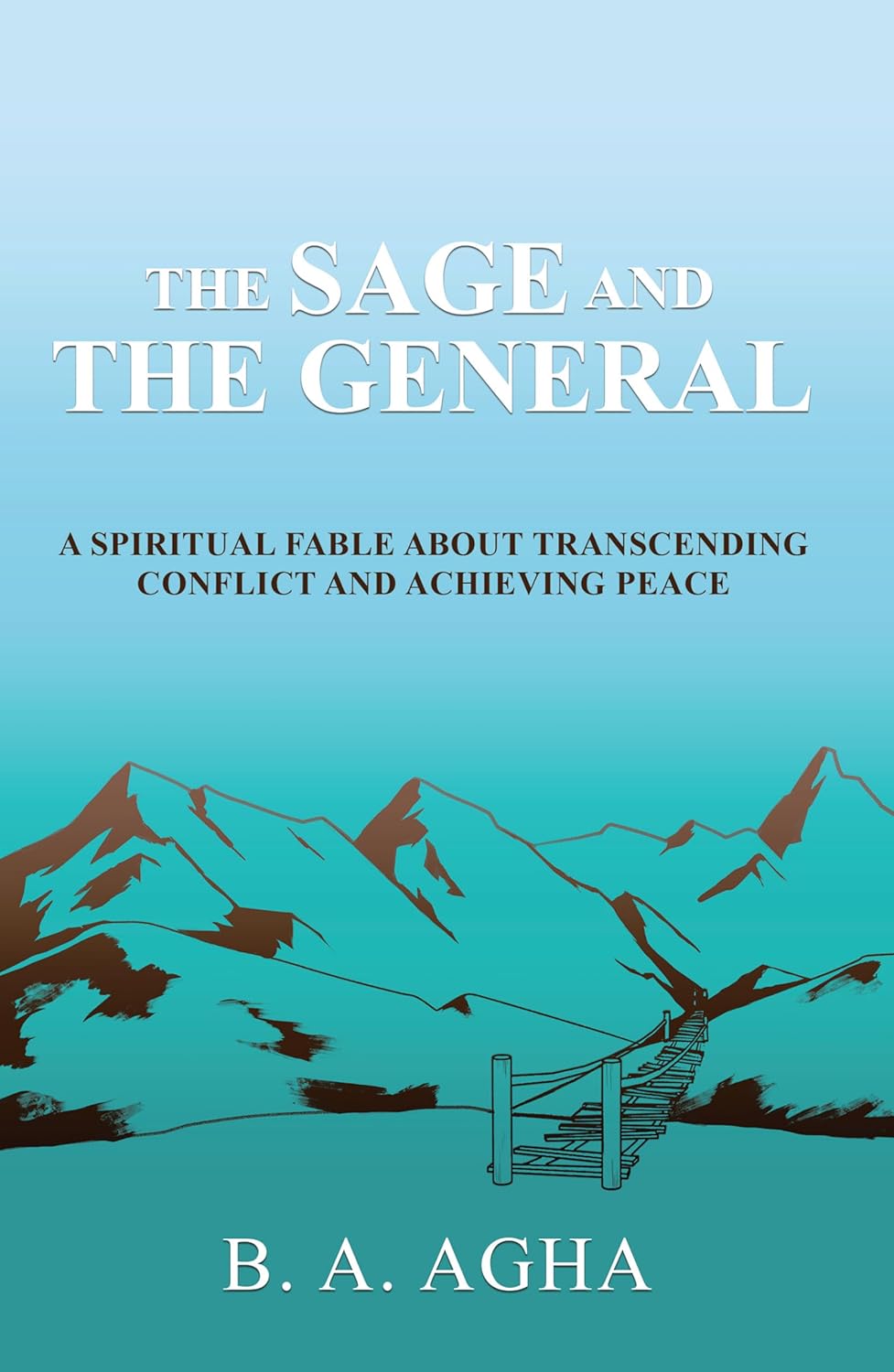

The Sage and the General is a thought-provoking spiritual fable. Author B. A. Agha builds the book around a Himalayan village torn apart by violent swarms of bees, then uses that conflict to tell a larger story about fear, power, revenge, and the hard work of choosing peace. At the center are two opposing figures: the Sage, who believes compassion and understanding can break cycles of harm, and the General, who answers danger with force and control. What follows is less a literal battle story than a moral and philosophical one, where the village becomes a testing ground for how communities think, panic, divide, and either harden or heal.
I enjoyed how direct the writing is. Agha doesn’t hide the book’s intentions behind irony or fancy prose. The story is clean, simple, and deliberate, which fits the fable form. I felt that clearly in the way the bees, the village, and the two leaders are set up, almost like living ideas, but still given enough human tension to keep the book moving. The dialogue can feel more symbolic. This book is not really chasing realism in the ordinary novelistic sense. It’s trying to make moral conflict visible. It wants the reader to stop and consider how quickly self-defense turns into identity, and how easily leadership can start feeding on fear.
I was especially interested in the author’s decision to make the General more than a simple villain. The book could have settled for an easy contrast between wisdom and aggression, but it pushes further and shows how conflict can become its own system, with followers, rewards, habits, and a logic that keeps reproducing itself. The sections where force only creates a tougher enemy felt pointed and uncomfortably familiar, and the later movement toward transformation gives the novel its real weight. When the villagers begin to see that victory might mean something other than domination, the book opens up. It stops feeling like an argument and starts feeling like an invitation. That shift worked for me. It stopped feeling so rigid and gave the story more room for reflection and possibility, and it made the ending feel earned rather than merely hopeful.
I would recommend The Sage and the General most strongly to readers who enjoy spiritual fiction, allegorical novels, and reflective moral tales that are more interested in ideas than plot twists. It will speak most to people who like books about peacebuilding, inner change, and the psychology of conflict, especially if they appreciate fiction that reads almost like a parable. For readers open to a clear-eyed, sincere, and thoughtful spiritual fable, this book has something real to offer. It feels like a conversation about how people lose themselves in conflict, and how they might still find a way back.
Pages: 146 | ASIN : B0CW19TSDM

Adventure Into the Unknown

The 6th Heaven centers around a plastic surgeon whose life is turned upside down when mysterious tattoos begin to cover his body, and he sets out on a journey to the Amazon jungle to find the key to his curse. Where did the idea for this novel come from?
The idea for the novel grew naturally from the first two books in the 21 Tattoos Series. As Derek’s journey of self-discovery reaches both emotional highs and lows, he becomes increasingly driven to find answers—how the tattoos appeared, what they signify, and whether he can ever be free of them.
Did The 6th Heaven begin as a spiritual story, a psychological one, or an adventure into the unknown?
It started more as an adventure into the unknown. I didn’t know what would happen next to Derek until he made the decision to enter the jungle—then the story began to unfold on its own. As I continued writing, I realized that his struggle in the jungle mirrored the conflict within his own mind, and I expanded on that connection.
Where did you find the inspiration for Derek’s traits and dialogue?
It developed over time. I started writing about a man waking up with tattoos, and he just started to develop in my mind, and as I researched the meaning of tattoos I got to know him. Most of the material relates to experiences in my life.
Can we look forward to another installment in The 21 Tattoos Series soon? Where will it take readers?
My 4th book will be out in September 2026. Already with the publisher.
My 5th book will be out in September 2027. 50% finished.
My 6th and final book of The 21 Tattoos Series will be out in September 2028.
Each book follows Derek and Kendal as their relationship deepens, facing life’s challenges and evolving into the people they’re meant to become.
Author Links: GoodReads | X (Twitter) | Facebook | Website | Amazon
Derek Hollinger has walked a long, hard road since a fateful encounter with an Indigenous shaman woman turned his life upside down. Now married to Kendal, his angel and savior, Derek desperately wants to be the man she deserves. But his obsession with his tattoos-what they mean and how to get rid of them-is tearing down everything they’ve built together.
Paralyzed by depression and self-loathing, Derek is convinced that only one person can help him now: the granddaughter of the shaman whose power inked him from head to toe. Enlisting the aid of his loyal friend and spiritual advisor, Father Mike, Derek treks deep into the heart of the Amazon jungle, where a final reckoning between good and evil awaits.
But God’s plan for Derek isn’t what he expects. And coming back alive-whole in mind, heart, and spirit-will require every ounce of his fortitude and faith.
The 6th Heaven is Book 3 in The 21 Tattoos Series, by Monica Broussard. Read Book 1 (21 Tattoos) and Book 2 (The 7th Dimension) to jump into this saga filled with heart, passion, faith, and fear. Discover how Derek Hollinger’s journey for answers begins.
The 6th Heaven

The 6th Heaven by Monica Broussard follows Dr. Derek Hollinger, a plastic surgeon whose life is derailed when intricate tattoos suddenly appear all over his body. Struggling with depression and a past full of trauma, he leaves his wife, Kendal, and their Los Angeles home to trek into the Amazon jungle. He travels with a priest named Father Mike to find a shaman’s granddaughter who might hold the key to his curse. The journey is brutal. Derek faces venomous spiders and near-death experiences while Father Mike battles a jaguar. Eventually, through a mix of tribal rituals and a spiritual encounter with God, Derek undergoes a deep internal transformation that forces him to face his past and find true emotional freedom.
The writing feels deliberate and vivid. I like how the author uses the jungle as a mirror for Derek’s own mind. The descriptions of the rainforest are dense and humid. You can almost feel the dampness and the sting of the mosquitoes on every page. One of the author’s boldest choices is shifting the perspective between Derek’s physical struggle in the mud and Kendal’s emotional isolation back in California. It creates a tension that keeps you moving. I found myself curious about the tattoos and what they really meant. The way the ink is treated as both a physical burden and a spiritual map is a fascinating concept. The pacing is patient. It takes its time to let the characters sit with their thoughts, which makes the action scenes, like the jaguar attack, feel sudden and earned.
I spent a lot of time thinking about the ideas of identity and healing in this story. Derek is a man who builds physical beauty for a living, yet he feels hideous because of something he can’t control. The book explores the gap between how the world sees us and how we see ourselves. I liked the candid look at trauma. It doesn’t offer easy fixes. Even after the spiritual revelations, the characters still carry physical and emotional scars. The intersection of Christian faith and Indigenous shamanic traditions is an interesting choice. It makes for a unique spiritual landscape. It made me wonder about the nature of mercy and whether we can ever truly outrun our past. The idea that our life story is written on our skin is a heavy one, but it feels grounded here.
This is a stirring Christian fiction novel that uses magical realism elements in an interesting way, along with some supernatural elements. It’s a reflective story about redemption and the hard work of coming home to yourself. I would recommend this to anyone who enjoys stories about spiritual journeys or readers who like fiction that wrestles with deep psychological themes. It’s a solid choice for someone looking for a grounded adventure that is not afraid to get a little bit dark before finding the light.
Pages: 265 | ASIN : B0FHBZWMRS

A Christian Perspective

Blue Jeans and Lavender Gowns follows two teenagers growing up in different circumstances who, over the years, struggle with faith, failure, broken marriages, and small-town judgment, for a chance and at love. Where did the image of “blue jeans” and “lavender gowns” come from?
The inspiration for this story came from a combination of personal experience, observation, and imagination. Some of the events in the book are based on real-life experiences, particularly things like the study hall scenes. I have become increasingly aware of young girls who were physically abused by their fathers, and later, by their husbands. Some of them were close friends, and their stories were tragic. That gave the basis of the story and, to a certain extent, a what-if scenario of how I might have responded to them had I been aware of their circumstances.
How important was the 1970s Midwest setting to the heart of the story?
Having grown up in the 1970s, it was easier to place things in that time setting. The window dressing of 8 tracks, school dances, small town attitudes, etc., helped shape a story that is quite relevant to any time and place, but gives it a ring of authenticity.
The story includes abuse, infidelity, and divorce. Why was it important not to shy away from these?
I wrote to emphasize these issues. Far too often, they are swept under the rug or ignored. The goal was to address these issues from a Christian perspective without being preachy. How should a Christian address these issues in real life, not from some lofty theological perspective? That was the goal. I hope that, at least to some extent, I achieved it.
What do you hope readers take away about faithfulness in ordinary life?
Real life is filled with people who are hurting, sometimes in private and unseen. Christians should open their eyes and recognize those who are hiding their scars and bruises with blue jeans or whatever else they might find. Responding compassionately and with God’s love can transform that hurting person into the beautiful person in the lavender gown, reflecting the glory of Christ.
Author Links: GoodReads | Facebook | Website | Amazon
Terry Deitz is fascinated with her the moment she walks into his life. She has dark-brown hair, and eyes—a beautiful smile and fair complexion. There is an artless grace about her. There’s only one problem; he has no idea who she is.
Debbie Douglas is bright, funny, and has a kind, quiet nature. But something is wrong, something Terry can’t quite put his finger on.
Debbie doesn’t understand Terry. Why is he determined to go to college to get a degree in history? Why does he insist on going to church four times a week? Does he look down on people like her?
Blue Jeans and Lavender Gowns promises laughter, tears and joy as it explores the relationship between two people who’ve grown up in different worlds. One world filled with love and happiness, the other with pain and suffering. Can their worlds ever come together?
Blue Jeans and Lavender Gowns


A. W. Anthony’s Blue Jeans and Lavender Gowns follows Terry Deitz as he grows up in small–town Illinois during the 70s and 80s. The story tracks his friendships, his awkward steps toward romance, and his slow discovery of who he wants to be. The heart of the book sits in his connection with Debbie Douglas, a quiet farm girl who surprises him again and again. Much of the book lives inside everyday moments. School hallways. Study hall banter. Football games. Long drives on dark country roads. It all builds a picture of simple places where small choices shape a whole life.
I felt myself leaning in as I read because the writing has this easy, steady flow that feels honest. Sometimes it rambles the way teenagers talk, and sometimes it snaps into sharp little moments that hit harder than expected. The author keeps the language simple, but the emotions run deep. I appreciated how Anthony lets Terry speak for himself without polishing his thoughts. He admits fear. He overthinks things. He wants to do the right thing, then stumbles. That made him feel real to me. Debbie felt real, too. She works hard. She hides her nerves. She wants kindness more than anything. Watching them circle closer together gave me a warm, hopeful feeling.
The book looks at family pressure, faith, and the everyday pain that people try to hide. Some of the scenes surprised me with how tense or tender they got. I liked how the author handles faith with a light touch. The characters lean on God without turning the story into a sermon. It shows how young people try to make sense of love, fear, failure, and forgiveness. The dialogue sometimes made me laugh, and the charm of the book carried me through.
By the time I finished, I felt like I had spent time with people I might actually know. That is what made the story work for me. I would recommend Blue Jeans and Lavender Gowns to readers who enjoy wholesome romance, small–town nostalgia, and stories that unfold gently. Teens and adults who like clean Christian fiction would enjoy it most. If you want a book that feels warm and sincere, with characters that you’ll keep thinking about, this one is worth reading.
Pages: 271 | ASIN : B0FZ2V62J7
The Final Shelter

The Final Shelter is a haunting dystopian novel that follows Phoebe, a young scientist and teacher, as she navigates a fractured world where survival is reserved for the wealthy and compassion has become a rarity. Through her eyes, we see a society collapsing under the weight of greed, fear, and inequality. Underground bunkers are built for the privileged while the majority struggle with hunger, violence, and despair. Phoebe, torn between her ideals and the harshness of reality, stumbles upon an invitation to a secret shelter that promises safety, forcing her to confront impossible choices about trust, survival, and who deserves a place in the future.
I felt an immediate connection with Phoebe because her frustrations, her quiet resilience, and her moments of doubt felt raw and relatable. The writing is vivid, with unflinching descriptions of a decaying society. I caught myself pausing to breathe, especially during the riot scenes, because they were written in such a way that I could feel the dread in my chest. The mix of tenderness, like Phoebe talking to plants or comforting a student, and the sheer brutality of the crumbling world gave the book a strange rhythm that pulled me in deeper than I expected.
At times, the dialogue leaned toward being a little more polished than everyday speech, almost like the characters were speaking with extra clarity and purpose. But the ideas within those conversations were sharp and thought-provoking. The story often felt like a mirror reflecting our own society, raising questions about fairness, wealth, and the meaning of kindness. Even in the moments that read more like lessons than story, the impact remained strong, and I couldn’t ignore the weight behind the words. The book made me angry, it made me sad, and it even gave me flickers of hope.
I was left thinking less about the plot twists and more about the questions it forced me to wrestle with. Who do we choose to save when resources are limited? What happens when morality collides with survival? I’d recommend The Final Shelter to readers who love dystopian fiction but crave stories that lean hard into emotional weight rather than just action. If you like books that shake you up and make you reconsider the world around you, this one is worth your time.
Pages: 215 | ASIN : B0FHG57QXP
Joint Salvation

Judging Athena follows a humble and kindhearted research assistant who meets a curator at an art gallery, and what begins as a chance encounter over a necklace for a young girl’s birthday unfurls into a deep and poetic romance. What was the inspiration for the setup of your story?
The idea came to me while I was walking one evening last October. There is a real art gallery gift shop in a charming New England town. Many years ago, I purchased some custom nickel jewelry from the shop manager, a lovely woman with an accent (the nationality of which I cannot recall). On my walk, I suddenly suspected a story was lurking in the memory. As I strolled along, it all began to coalesce in my mind, blending with a few other ideas. I decided to go home, start typing, and see how far it went. Three and a half weeks later, I had a rough draft.
I enjoyed the romantic relationship between Josh and Athena. How did their relationship develop while you were writing it? Did you have an idea of where you wanted to take it or was it organic?
I’m glad you enjoyed it! I had a notion about both characters and their interaction. While they eventually presented themselves well in the first draft, initially, both were somewhat difficult for me to conceptualize. Josh was a challenge because of his humility and piety, and because I wasn’t sure how he would relate to Athena. She was very challenging due to her rarified nature and utterly unique circumstances. And her essence changed quickly in my mind, from a mere legend into something higher and in keeping with her arc of redemption. Fortunately, all my quandaries were resolved as I wrote. Once I was used to the sincerity and kindness in both characters, writing them became a nearly effortless pleasure.
Because of my marital deliverance theme, and partly in defiance of postmodern trends, I knew I wanted the relationship to progress from meeting to matrimony as quickly as possible. Yet in getting there, I decided to dwell on the details of dates, thoughts, emotions, and so forth. And many, many roses! That is why the betrothal period, less than two months long, essentially occupies half the book. I felt the emphasis on clean and honest dating and development, along with genuine understanding behind the marriage, was that important. As an aside, part of me almost wishes I could have dedicated the same level of attention to the rest of the story. However, that would have resulted in a book of 95,000 pages, not words, and I was pleased with the second half anyway.
I did have an idea of where I wanted Athena and Josh to go, though the idea evolved a bit. Most unusual for me, the ideas pretty much landed in the word processor in an organic fashion. Ordinarily, I erratically plot, fill in via scattershot, overthink, and stall manuscript development for months or even years. I practically wrote Judging Athena straight through from page one to “The End.”
What were some themes that were important for you to explore in this book?
Perhaps the most important element is the Christian concept of joint salvation, manifested through the three primary reasons for marriage, as explained by Father Josias in Chapter Four. This is a core tenant of the Church, however, too much of its veracity has been lost or diluted in our era. The tale I tell is, sadly, not my own. Rather, it is an idealistic expression of the ideal romance. My plot device or hook regarding Athena’s true nature is an admittedly extreme use of speculative theology. However, given the extreme state of the real world around us, I thought it was important to provide a strong counterbalance.
Another important concept, for me and, hopefully, for readers, is the complete deference to God offered by two imperfect people who, by dispensing with solipsism, offer anathema to the postmodern concept of the individual über alles. Fiction provides a forum for letting be what should be, even if the imagined vehicle approaches the fantastical.
Many of the themes and subthemes in Judging Athena stem from First Corinthians. I really enjoyed working various metaphors into the characters’ perceptions, their relationship, and their interaction with God, others, and the world. In addition to all else, the titular matter of judgment requires a real apophatic leap of faith. While hinting all around, I do not expressly explain how it happens. I don’t know technically how these matters unfold. No one does. Hence, a degree of trust is warranted. Had I delivered a detailed verdict, I doubt anyone would have liked it—least of all the author.
Also, I really like writing “innocent” fiction. All too often, my work veers into the polemical and the expositive. I may have finally discovered it is better to suggest than to force certain matters. Beyond telling what I hope is a sweet and entertaining story, I ultimately hope to encourage young men and women to defy the world, unite, be fruitful, and help each other redeem themselves through and into the glory of the Almighty.
What is the next book that you’re working on, and when can your fans expect it out?
Next up, Tom Ironsides returns in AURELIUS, a hard-charging action novella wherein the CIA’s former best blasts through the ranks of assorted international criminals. It’s another book that’s been simmering for a while, since around 2020. With any luck, it should be out late this year or in the winter of 2026. As with Judging Athena and The Substitute, it will come to market via Green Altar Books, the growing and outstanding literary imprint of Shotwell Publishing.
I generally have four or five manuscripts in development at any given time, and now is no exception. My “save the world” inclinations are slowly giving way to something more genteel and with more genuine literary quality. I have a few more romances in the works, including an outline for something of the levels of apologetics in Judging Athena. And there’s always more coming along—in due time.
Author Links: GoodReads | Telegram | Website | Amazon
JUDGING ATHENA is an exciting foray into innocent, pure, and productive love. It is also a clarion call to return to the traditions of marriage, large families, and genteel society.
Nuggets of Insight
Brothers in the Cross follows an archaeologist who, while investigating a murder in the West Bank, unearths a clue that leads his team to the Cross of Jesus. What was the inspiration for the setup of your story?
Finding that I have terminal diseases convinced me to rethink my understanding of faith. I had never been comfortable in talking religion. Somehow I sensed that my characters could, if we had something meaningful to say. I had read an article about the Ein Gede scroll and subsequently was musing about the Dolly the Sheep cloning, when the idea of cloning Christ exploded into my brain. I had to write that story!
Brothers in the Cross is my introduction to publishing to the public, and my only work of historical fiction. It is my second book, though my first, Tales from Bedside Manor, a non-fiction memoir of the most memorable cases in my fifty year medical career, was written for my family and close friends and not released for sale or distribution.
I wrote Tales from Bedside Manor to preserve in short stories the ironies and bittersweet memories of life as an Internist (Internal medicine: a pediatrician for adults). It was to leave to my family an understanding of what those experiences had been like. My health was faltering, major irreversible coronary disease intruded soon overlaid by cancer. I could see the light at the end of the tunnel drawing closer and wanted to leave my mark. That was in 2010, Obamacare was passed and physician-directed primary care medicine began to die.
Writing Brothers in the Cross was different. Since childhood, I held a fascination with stories of the Holy Land. I was the questioning sort and the glib answers of true believers were never quite convincing enough for me. I wanted to believe, but I wanted to be convinced by something beyond blind faith. So I cocked my ears for discoveries that evolve with time and was rewarded by nuggets of insight that arose in random fashion over the years.
And then the threads collided. I was musing one evening and recalled the story of Dolly the Sheep and her cloning in Scotland. Furthermore, there had been articles about rogue doctors cloning human children in Korea and Mainland China. That was the epiphany that sparked my leap to consider what would happen if The Holy Cross of Jesus was found. What men with technology would do was never in question.
How much and what kind of research went into putting this novel together?
The book would write itself. Research required only confirming the facts that had accumulated over time. The closest distance between two points is a straight line. The closest hiding place for the Cross was near Jerusalem. Simon of Cerene was the man who carried it to the crucifixion. The most obvious source of Christ’s genes was the fatal Cross. The surrogate Mother would be Mary (Mariam is the Arabic translation). The Bible’s Revelations would suggest the other character, the Anti-Christ. Armageddon would pre-suppose a nuclear end. And the death of my primary care physician practice relegated me to the role of Chief of Occupational Health at White Sands Missile Range where I became acquainted with the nuclear accidents including the Demon Core incidents at Las Alamos Laboratory. Fate mixed with reason, so I wrote the book.
What is the next book that you are working on, and when will it be available?
I don’t have any plans to write another but stranger things could happen.
Author Links: GoodReads | Amazon
In the mid 1900s archeological studies unearthed the Dead Sea Scrolls, and then the Ein Geli scroll. Technologies brought to bear on the latter revolutionized the study of ancient artifacts and allowed scenarios like the one in this book to be achieved. Jesse, the archeologist gets roped into a murder investigation in the West Bank. The ‘clue’ is found. When it is deciphered the treasure hunt is on.
The trio that collaborate to solve this riddle becomes ensnared in the emotions of their discovery. That they find the Cross of Jesus seals their belief. But will anyone else believe them? Dr. Craig Carpenter is a fertility specialist on sabbatical and quite naturally wants to see if the blood of Jesus is in the Cross. He reasons that the chromosomal patterns will be unique because the male components were supplied by GOD, not man. His hypothesis is confirmed. Now the fertility specialist holds the genes of Christ. What could possibly go wrong?
Myriam is the key. Thanks to the technology of Dolly the Sheep, she becomes the surrogate mother for the blood of the Lamb. The “reincarnate Christ” is born and his life evolves. The admonition of the Book of Revelations looms heavily over this story now, and the possibilities expand.
Eventually the question arises: How does one eliminate undesirable genes in this day of GMO’s?


