Blog Archives
Freedom Boulevard


L. Winfrey Young’s Freedom Boulevard offers a vivid journey through post-Civil War Kentucky, as it tells the story of four young African American girls grappling with their new sense of freedom in a world still scarred by slavery. Set in 1875, this historical fiction novel deftly explores the complexities of life during this transformative period, focusing on the lingering impact of slavery, the burgeoning civil rights movement, and the evolving racial and societal dynamics of the time. The narrative compellingly portrays the characters’ resilience in the face of adversity and their unwavering pursuit of a brighter future despite the unfair challenges they encounter.
One of the standout elements of this book is the intricate relationship between James Simmers and Charlotte. Their dynamic beautifully captures the nuanced nature of human emotions, illustrating their interactions of love and frustration. The book’s rich character development and the exploration of their emotional depths are a highlight, though, at times, the abundance of characters and the rapid shift between perspectives can be somewhat overwhelming. A more streamlined narrative could enhance the reading experience, yet those interested in historical and character-driven novels will likely appreciate the depth and detail.
Winfrey’s narrative style is bold and unflinching, particularly in portraying racial themes. The book does not shy away from depicting the harsh realities of racism and its deep-rooted presence in society, even post-slavery. This raw honesty in storytelling, while sometimes confronting, adds a powerful layer of authenticity to the book. It resonates personally, especially as it reflects the continuous struggle against racial prejudices and the internal conflicts faced by African-American communities.
Freedom Boulevard excels in immersing readers in a pivotal historical era, providing an insightful look into the enduring effects of slavery. Its compelling content makes it a significant read for those interested in historical narratives, the complexities of human relationships, and the ongoing journey toward social justice and equality.
Pages: 637 | ASIN : B0CP4ZN6LW

Fires of Social Change

A Brownstone In Brooklyn follows a young man and the struggles he faced growing up in the 60’s in Brooklyn and how these struggles were impacted by the Civil Rights Movement. What was the inspiration for the setup to your story?
The inspiration for A Brownstone in Brooklyn came from my time as an undergraduate at The City College of New York and what I had to overcome to graduate during the height of the Civil Rights Movement. The sixties in Brooklyn was an era that had a personality, a feel, and a life-force that changed a generation. I felt this energy and experienced these fires of social change. I wanted to put this into words on a paper.
What were some driving ideals behind Andy Michael Pilgrim’s character development?
Some of the driving ideals was a strong family bond and a relationship to every person in the Brownstone where I lived in Brooklyn. Andy was the Rock Star and hope of people who moved from the oppressive south and wanted the young people to have a better life than they had. He was a hero, a vision of the future, that blacks could advance and compete with white American young people. It was a strong racial identity and that fueled this push for success. Andy wanted to rebel, but knew he would be letting a lot older people down. H was full of respect the older generation.
What were some themes that were important for you to explore in this book?
As a product of the inner City, I wanted to show that Bed-Stuy and other African-American enclaves were populated with good people who wanted to achieve goals and success and not what was pictured on television and in the Black-Exploitations movies of the era.
Black Americans read and created literary works of significance.
What is the next book that you are working on and when will it be available?
Killer Kudzu (Sci-Fi): Publication Date January 2022.
Killer Kudzu is a pre-apocalyptic, semi-horror novel where science has gone terribly wrong. There is a southern twang in the characters voices and a distinctive down-home feel in the locale. It is written with a social twist and a commentary about the relationship between blacks and whites in the south. Killer Kudzu is in the vain of the creeping menace like Pandemic, The Atlantic Gene, The Hot Zone and The Day of the Triffids.
Killer Kudzu Book Trailer:
Author Links: GoodReads | Twitter | Facebook | Website | Website
Culture Changes Quickly
Hey, White Girl follows a young woman as she traces the fracture of her family through the tumultuous 70’s and begins to understand the complexities of family, race, and privilege. What inspired you to write this book?
I come from a large family and each of my siblings has navigated our childhood in their own way. I’ve been fascinated by studying my own family and other families that I know and analyzing how differently siblings turn out as adults, even with the same “raising.” Cultural influences can impact children in wildly different ways depending on the age of a child, which can account for some of the differences between siblings. I believe this is especially true in tumultuous times when culture changes quickly. So I imagined studying a fictional family that way.
About the time I started thinking about this book I left a teaching job in a privileged private school to teach in an inner city classroom. I was so struck by the difference in what was available to students, and how the lack of resources was impacting educational opportunities. It became clear to me that if a child of eight is academically behind because of lack of resources, no matter their intellect, they will always struggle to catch up to the children with the resources, even if those children are not ahead of them intellectually. So I envisioned what that would look like in a school with smart Black kids who did not have the resources offered to them that most White kids had.
Making that career move also brought back memories of when I had been bussed in Richmond. I remembered the quality of the schools declining year by year. I remembered the ratio of Black and White students changing overnight. When I returned to that same area of the city decades later, there had been no change. I started researching, paying attention, and reflecting on the great inequity of schools just a few miles apart from each other. And when it came to racial differences, I wanted to explore what would happen if relationships between kids were authentic, despite their races, and in spite of adult prejudices.
I enjoyed how authentic and grounded this story felt. Was there anything taken directly from your life and placed in the novel?
I had fun looking back on the 1960s and 1970s. Nell is older than I was then, but there are plenty of scenes that I pulled from fuzzy memories, or took bits and pieces from stories I’ve heard. As I’ve mentioned, I was bussed, and many of the school references are from my own memories: the worn floors, the old furniture, the covered books, the gym suits that never fit. The encounters with other students were also informed by some of my own experiences.
I did look through yearbooks, old magazines, and advertisements to mentally put myself back in that era. I watched old TV shows on YouTube and kept a Pinterest page of images from clothes and hairstyles to the right Coke bottle shape for those years. I went back through my own mother’s recipes, and found perfumes that were popular then, because I think our senses can put us into a mindset faster than anything. And I listened to a lot of period music. Music can take you places, too.
Probably the thing that is taken most directly from my life is the feeling I’ve tried to convey about that era. This crazy juxtaposition of hope and fear. Hope, because when you’re a teenager all the world is ahead of you and almost anything is possible. This was the era of man landing on the moon, of Vatican II, of Civil Rights, of women starting to see they didn’t have to live the lives of their mothers. Fear, because sometimes the world felt like it was spinning out of control. It was the era of Vietnam, of assassinations, of fallout shelters, of racial violence. That sense of hope and fear that I could recapture with music and perfume and the metallic taste of TAB was what came directly from my life.
What were some ideas that were important for you to convey in this book?
At first, I thought it was mostly about how families learn to navigate cultural changes differently and still try to be a family. As I wrote, and reflected, and learned from my own writing, so many other convictions came to the surface. It was important for me to honor the Black experience of bussing, even though this was about a White girl bussed to a Black school. I realized that the Black kids were affected too. They had schools they were proud of and rooted for and those identities were muddied when all the students were moved around. I’d never seen this addressed before, especially from a White POV.
The more I wrote, the more I became aware of my own privilege as a White woman. I wanted to reveal that process in a natural and almost childlike way. I wanted Nell to learn for herself through her Black friends what their experience was, so she could appreciate it. I didn’t see the point of writing a book about white guilt. Nell was born White. Venetia was born Black. Neither had the choice of their birth color. They just were who they were. It was important for me to try to create characters of compassion, people we would like to emulate. And I wanted both Black and White characters to be those people.
Another idea that was important for me to convey was that Nell had fewer obstacles and more choices than her Black friends did. Often, White people are blind to that fact. We think we earn all that we get, but the obstacles for others are often hidden by our ignorance. If we sharpen our awareness, if we pay attention, if we listen, we will see what we haven’t seen before, like Nell did. And if we can change how we see the world, our eyes are opened to how we can change the world.
What is the next book that you are working on and when will it be available?
I’ve tossed around ideas with other writers and readers about continuing Nell’s story, or telling Donald’s story or another family member’s, and therefore expand that idea of how differently family members can absorb cultural change. But I spent over eight years working on Hey, White Girl and I actually don’t feel like I’m finished with it yet. Of course it’s published, but I believe this story needs to find its way into the greater world, and it’s my job to see that happen.
I’d like to foster discussions around the book’s themes with other adults who have lived it. And I’d like to support teachers and librarians looking for materials that will expand their students’ knowledge about our history, especially when it comes to perceptions about race, privilege, and responsibility. I suppose I want to do what Fergy asked Nell to do: change things from the White side.
Author Links: GoodReads | Twitter | Facebook | Website
Nell Randolph tries to make the best of her first year of high school at a black school. Her mother is unnerved by the changes she sees in Nell and arranges for her to transfer to a private girls’ school. The Vietnam War is raging in the background, inciting fear of the draft for Donald, Nell’s older brother, who involves Nell in decisions that change the trajectory of his life. Even the stability of their church life is challenged when a new priest comes to town.
Hey, White Girl by Judith Bice is told by an older Nell as she traces the fracture of her family through the lens of Civil Rights. Her memories and reflections reveal she is only at the beginning of understanding the complexities of family, race, and privilege. The reader is drawn into the narrator’s experience and compelled to examine with her the personal consequences and responsibilities of cultural change.
The Epiphany Moment

The Awakening is the first volume in a narrative history about the descendants of two families that share a common ancestor. What inspired you to write and publish this book?
The epiphany moment for me to write an account about the family was upon the passing of my cousin, Otis Corbitt, on September 6, 2009. Otis was known to everyone in the family, as well as to other African American families in the Wagener-Salley area of South Carolina, for being astute in family history. Before his passing, he instructed me to begin writing a family history book. He said he did not have much time to live and the future of our efforts rested on my shoulders. I agreed. Secondly, I wanted to contextualize the stories of relatives that have been fragmented and forgotten in the past. Many of the relatives featured in the book were well respected in their professions publicly.
I appreciated the amount of history included in this book. What type of research did you undertake to ensure you got as complete a picture as possible?
I conducted several oral interviews with relatives and associates of our family. I also researched primary sources such as newspaper articles and genealogical records. Secondary sources (i.e., history books) were consulted as well.
What was one surprising thing you learned about the family during your research?
I learned that my mother family, The Seawrights, were the first families of both Orangeburg & Aiken County, South Carolina. They lived in the Tabernacle Township in the Orangeburg District during the time Orangeburg County was founded in 1870. Then on March 10th, 1871, the Tabernacle Township in Orangeburg County became a part of the newly formed Aiken County, which was founded by a racially diverse group of men. Out of the group, three African American men who were Civil War veterans and legislators signed the legal document that officially established Aiken County.
What can readers expect in volume two of this family saga?
Volume 2, will be a pictorial history which will have pictures, source images, and captions. It will be an extension of the work in Volume 1, but will include new stories.
Author Links: Facebook | Website
The book includes the famed stories of Floster L. Ellison, Jr., during the Civil Rights Movement, who became the co-founder of the Palmetto State Barbers Association and the first African American Barber Inspector In the State of South Carolina; and Tommy Ellison, whose experiences as a youth singing on the children choir, inspired him to pursue a legendary career in gospel music, affectionately known by many of his fans as “Mr. Superstar of Gospel”.
The book includes an appendix section which consists of individual pictures, documented history of places and events, and primary sources relative to the family saga.
Hey, White Girl
![Hey, White Girl by [Judith Bice]](https://m.media-amazon.com/images/I/51Cu92mLrCL.jpg)

Hey, White Girl, is author Judith Bice’s first novel. Although it is a work of fiction, it is inspired by her own experiences of desegregation busing in the U.S. in the 1950s. Hey, White Girl can be summed up in three words: A must read.
This compelling coming of age novel is well structured and conveys an impassioned story that explores social issues in emotionally resonant ways that feel utterly authentic. The novel is told from the point of view of the narrator, Nell Randolph, a teenage girl soon to be bussed from her local neighborhood to another school, as part of the desegregation program in the U.S. Hey, White Girl, is cleverly structured to show not only the narrator’s actions, but her reactions to the behavior of others, and her thoughts about not only her situation but those around her.
Hey, White Girl is set in the 70’s and that time period is described in rich detail that draws the reader into both the story and the political issues underpinning the story. Bice describes the differences Nell notices between her former school and her new school. She describes not only the physical state of the schools, but the sounds and smells as well. Neighborhoods are described in detail – once again with Nell’s beautifully naïve descriptions. The setting and descriptions cleverly encourage the reader to think about issues such as fairness, equality and equity.
The characters in this historical drama are authentic and well developed. The main character, Nell is portrayed as a somewhat innocent and naïve young lady. We follow her as she begins her bussing journey, and see her develop and mature overtime. Her initial trepidation slowly subsides as she begins to become open to new experiences. However, always in the background is the fact that her life experiences are not the same as some of her new friends, and we see her trying to grapple with this while developing a new understanding of the world around her, and the world she wants to live in. Nell’s character is developed by her thoughts and dialogue, and interactions with other important characters such as her family, old childhood friends and new friends. All of this makes for a very realistic story that feels like a fictional memoir.
Hey, White Girl is a work of fiction but the issues in this novel are very real and relevant even today. This novel does a fantastic job of showing the challenges average people faced in those tumultuous times. This is a heartfelt and thought-provoking coming of age story that stayed with me long after I put the book down.
Pages: 326 | ASIN: B09KFR1RCY
Woo Ae Yi – Author Interview

Profiles of KAD Relations with the Black Community helps readers understand how KAD can be a bridge in the Black Lives Matter movement. Why was this an important book for you to write?
I wrote the answer to that within the book itself, but essentially I didn’t feel that there was anything like it in existence, and I thought there should be.
What were some ideas that were important for you to convey in this book?
The role that Korean adoptees play in anti-racism.
What is a common misconception you feel people have about Korean adoptees (KAD)?
That they’re “not Asian enough.”
What is one thing you hope readers take away from your book?
The importance of practicing anti-racism and the importance of getting adoption-based and/or race-based trauma included in the DSM V.
Author Links: Website | Facebook | GoodReads
This book is divided into three parts: profiles, background history, and a how-to. Korean adoptee, Yi Woo Ae, also added a call to action. She first points out how the relationship between Blacks and Korean adoptees is better than what we see in the media, if it’s in the media at all. The author advocates for the inclusion of adoption-based and race-based trauma into the Diagnostic and Statistical Manual of Mental Disorders (DSM). She shares the importance of acknowledging that trauma, as defined in the DSM, is not currently all-inclusive. Whether we believe we chose our present life or not, we are the bridge between worlds. As a Korean adoptee (or Asian adoptee), we can support the Black Lives Matter movement.
Profiles of KAD Relations with the Black Community: ’92 to ’20
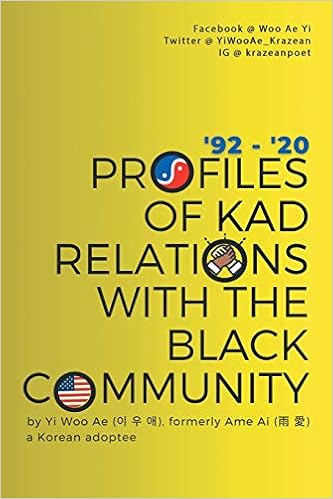
Profiles of KAD Relations with the Black Community by Yi Woo Ae, is a study and exploration of the ways in which the lives of minorities, especially the Asian and Black communities, in the United States are intertwined. The book is divided into three complimentary and enlightening parts: a short history, profiles, a quick-start guide, and an explanation of traumas that result from adoption.
The author, who is a Korean adoptee, offers a unique and varied perspective on these issues. She makes a case for the Korean Adoptees acting as a crucial link in the Black Lives Matter movement. She advocates for the strength of the Black-Korean relations and also states the need for including adoption-based and race-based trauma in the Diagnostic and Statistical Manual of Mental Disorders. The writing is engaging and clear– giving a background history and showing the intersection of different lives in a well-researched and factual manner. It is very interesting to see how she overlaps her personal experiences with the underlying narrative.
Watching the Black Lives Matter movement unfold, while I felt moved and enraged, I was unable to comprehend the nature of the movement in its entirety. This book went a long way in helping me understand the way Asian communities perceive and interact with African American communities. While I am not a part of either community, it helped me to identify the key variables of these issues and I found myself pondering the ways in which my own community interacts with others. I was especially drawn to the profiles- the anecdotes and confessions of KADs growing up in an environment that is simultaneously their own and foreign. They are insightful because they talk about the grounded reality of racism and show the ways in which their lives and thought processes are impacted by it. Even though this is targeted towards Koream adoptees– as a guide for them on how to have difficult conversations, I felt like I came away more confident in both my knowledge and curiosity.
Profiles of KAD Relations with the Black Community is a profound book of depth and intelligence that shines a light on a little understood, and acknowledged, problem in society. This is a thought-provoking book that is well researched and provides wise and rational insight on a topic that is vitally important.
Pages: 272 | ASIN: B08NLLMB9W
Freedom Begins Inside Ourselves
Prison From The Inside Out tells the story of life in prison and how the justice system treats people. Why was this an important book for you to write?
I didn’t want to die taking my story with me – I wanted to free myself and telling my story was one way to do that. I started with journals, which made be realize I had to tell my story to my family and to you, and Simone gave me that opportunity.
What was the writing collaboration process like with Susan Simone?
It was like talking to my best friend from high school, an old friend. Simone has a great way of asking questions to draw me out.
What is one thing you hope readers take away from your book?
Freedom begins inside ourselves.
I appreciated the candid nature with which you told your story. What is one piece of advice you would give to your younger self?
Value your time more than you value money.
Author Links: GoodReads | Website
On March 30, 1991, William “Mecca” Elmore fired a gun toward a parked and occupied van in an attempt to protect a friend who he thought was actively involved in a drug deal gone bad. In court two years later, that same friend testified that Mecca had aimed directly at the van’s occupants, one of whom died of his wound before reaching the hospital. Mecca admitted to firing the gun, but he did not plan to kill anyone, so although the public defender urged him to take a plea bargain, he insisted on taking the stand. Today, Mecca sees giving that testimony as a turning point in his life.
Mecca was sentenced to “mandatory life,” a sentence that meant he would spend the rest of his natural life in prison with no possibility of parole.
Prison From The Inside Out tells the story of how that sentence was served.



 LITERARY TITAN