Blog Archives
Witches and Pumpkins, Fur and Fangs
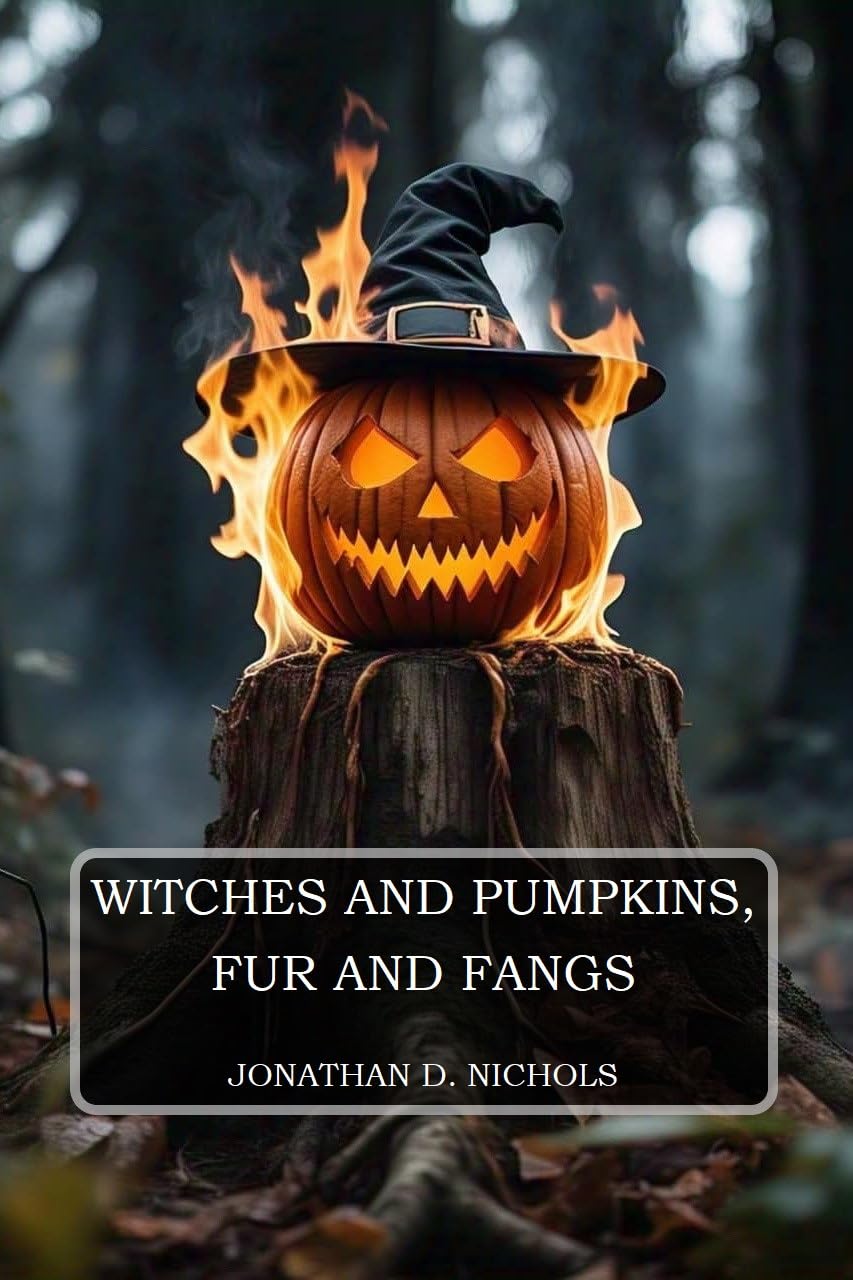

The book is a collection of eerie short stories that all orbit around Halloween, monsters, and the uncanny. From haunted pumpkins to mischievous goblins, from restless spirits to twisted killers, each tale drops the reader into a familiar world that quickly spirals into the unsettling. What makes the book stand out is how it taps into both folklore and modern horror, shifting easily between campfire-style legends and grittier contemporary scares. Every story feels like it belongs to the same haunted neighborhood, and that gives the collection a strong, cohesive flavor.
This is a very entertaining collection. I was caught up in the thrill of the scares, the build-up of tension, and the shocking payoffs. I found myself grinning at the way the author played with tropes I thought I knew inside out. Some of the stories reminded me of watching late-night horror movies as a kid, the kind where you want to cover your eyes but never actually do. The writing doesn’t waste time. It dives headfirst into dread, yet still leaves room for atmosphere, the kind that makes you glance at the shadows in your own room.
Some stories hit harder than others. A few felt predictable, but even then, I didn’t mind, because the fun was in the ride, not just the destination. When the author’s imagination really kicked in, though, the stories burned bright. “Jack of the Lantern” and “Hob Gob” stuck with me the most. They had this creeping inevitability that made me uneasy in the best way. I also liked how the collection never tried to be highbrow. It doesn’t put on airs or dress itself up. It just tells spooky stories the way they’re meant to be told, direct, raw, and with a wicked grin.
I’d say this book is perfect for readers who want to get lost in Halloween vibes any time of the year. If you like scary stories that mix folklore with fresh, gory twists, this is for you. If you want a jolt, a chill, or that delicious sense of dread before bed, you’ll enjoy this ride. I’d recommend it to horror fans, casual readers looking for a scare, and anyone who still feels that spark of excitement when the October moon rises.
Pages: 189 | ASIN : B0FM335L3H

Whisk Of Dust


Sherman Kennon’s Whisk Of Dust is a collection of poems that weave together themes of love, faith, struggle, and beauty. The book moves from meditations on nature’s quiet power to reflections on family, peace, and the eternal search for meaning. Some pieces are tender love poems, others carry a sharper edge as they question hate, violence, and the human tendency toward conflict. Each poem stands alone, but together they create a tapestry of longing, resilience, and hope.
Kennon has a way of turning simple moments into something luminous. Rain becomes music, stars become unreachable love, and a whisper turns into a lifeline. The writing isn’t complicated, and that’s part of its charm. I found myself lingering on certain lines, not because they were ornate, but because they were plainspoken truths that cut deep. At times, I wished for more polish or variety in rhythm, but I also realized that the rawness gave the poems their sincerity. They feel like words written in the quiet hours, when thoughts spill out before being smoothed over.
I also felt a kind of ache reading this book. The poems about loss and confusion carry weight, and the ones about love glow with warmth. There’s a rhythm of hope throughout, even in the darker verses, and that rhythm kept me turning pages. Some poems made me pause and smile, others had me staring out the window, letting the words sink in. The simplicity sometimes made me question if a deeper complexity was hiding underneath, or if the point was simply to embrace the words as they are. Either way, I felt pulled along by the honesty in the voice.
I’d recommend Whisk Of Dust to readers who appreciate straightforward yet heartfelt poetry. It’s a book of feeling, of spirit, of small truths stitched together into something larger. If you enjoy poetry that feels like a conversation with someone who’s seen both joy and struggle and wants to share both, this book is worth your time.
Pages: 31 | ASIN : B0CZ7DS197
Well, Mama, This is It (it’s Now Or Never)
Well, Mama, This is It (it’s Now Or Never) is unlike anything I’ve read before. It’s part confession, part storytelling, and part letter-writing, all stitched together with raw honesty and a strong emotional pulse. The book moves between voices, sometimes it’s a teenage boy writing to his grandmother, other times it’s a young woman chasing a dream life, or even a haunting personal tale of loss and survival. At its heart, though, the book is a letter to her mother, a brave and vulnerable coming-out story wrapped in poetry, reflections on love, faith, and the messy business of being human.
In “A Story of a Friend of a Friend,” when Adaina shares her journey from being a teacher to a stripper, the descriptions are almost cinematic. She writes about smoky eye makeup, French pedicures, and stepping into the strip club as if it were a Hollywood set. It’s dazzling, but then the tone flips as she describes the loneliness and danger behind the glamour, and suddenly I was pulled from the surface glitter into the heavy silence of regret. That swing between fantasy and reality is something the book does again and again, and it made me feel the same kind of emotional whiplash she must have lived through.
I also loved the way she mingles imagination with truth. Take “Secret Agent (Voodoo Princess),” where Rebecca Tanon, a demon-child-turned-undercover-agent, blurs the line between folklore and personal reflection. At first, I thought it was a sharp left turn into fiction, but it clicked for me as a metaphor for how heavy family expectations and inherited trauma can feel like being born with a mission you never asked for. The story gave me chills, not just because of the supernatural edge, but because of what it revealed about how powerless a child can feel in the hands of adults.
In “To My Newest Pen Pal, Jant Leaps,” Adaina writes a heartfelt letter that evolves into a romantic confession, blending vulnerability with defiance against judgment. In “Sexual Orientation,” she reflects on faith, family, and identity, ultimately affirming that love is sacred regardless of gender. She weaves in verses about love, love with a woman who makes her feel free, love that pulls her away from Hennessy and Ecstasy, love that feels holy even when the world insists it’s wrong. There’s vulnerability in her admission, “I never thought I could fall in love with Eve’s gender,” but also defiance when she insists, “Yes, I am a Christian, but my religion is kindness.” That blend of fear, yearning, and courageous self-acceptance struck me deeply. It’s not polished in the way mainstream memoirs often are, but that’s what makes it powerful. It feels like a real letter, one that trembles with truth.
In the end, I walked away from this book feeling like I had just sat across from someone who didn’t hold anything back. It’s raw. It’s uneven at times. But it’s alive with feeling, and that’s rare. I’d recommend this book to anyone who craves honesty in writing, teens struggling with self-expression, readers curious about queer coming-of-age stories, or anyone who wants to feel less alone in their own mess of faith, love, and identity. It’s not a book for someone looking for clean lines or tidy endings, but if you’re okay with sitting in the chaos of someone else’s truth, then Well, Mama, This is It (it’s Now Or Never) will move you the way it moved me.
Pages: 51 | ASIN : B0DT7FZS7Q
Fairy Lights: Bed Time Poems & Gallery of Fairytale Art from Yesteryear

Fairy Lights is a wonderful collection of bedtime poems interwoven with fairy lore, myth, and timeless art. Moving through the seasons of the year, the book gathers stories of spirits, shape-shifters, ocean dwellers, elven royalty, and everyday enchantments. It draws from Irish, Nordic, Greek, and New World traditions, blending them into verses that feel both ancient and freshly spoken. Each section carries its own mood, from the playful revels of spring to the melancholy mysteries of autumn and the haunting stillness of winter. Alongside the words, the author curates a gallery of fairytale art from past centuries, which adds a lovely echo of history to the poetry.
What struck me most was the way the poems refused to be pinned down. They could be lyrical and delicate in one breath, then strange, even eerie, in the next. A piece like A Piece of Amber felt tender and tragic, like a whispered legend by firelight, while something like The Baallad of Blaackie Coal made me grin with its folkloric humor and Scots cadence. I loved how the writing carried me away from reason into a place where fairies still dance, seashells sing, and even the smallest bird is mourned with reverence. The language is musical and sometimes unpredictable. At times, I found myself rereading lines not because I needed to but because I wanted to savor the rhythm.
The author clearly delights in layering metaphor upon metaphor, which creates a rich tapestry. This very quality also gives the book its dreamlike atmosphere. It reminded me of wandering through a forest at dusk, you don’t always know what you’re seeing, but the mystery is the point. I also appreciated how personal some of the poems felt. Knowing that pieces like To Wee Russet Tuft came from real experiences gave the collection an intimacy that balanced out the more mythic material.
Fairy Lights feels like a gift for anyone who still listens for magic in the quiet hours. I would recommend it to readers who love fairytales, folklore, or poetry that doesn’t mind breaking free from neat structure. It’s especially suited for those who want to share stories aloud, whether with children at bedtime or with the inner child who still believes in hidden worlds.
Pages: 181 | ISBN : 0473742454
Romantic Renderings

The Empathy of Rain is a lyrical collection of poems that uses rain, in all its moods and forms, as a mirror for human feeling. What inspired you to write this particular collection of poems?
When I finished my first book, Turbulent Waves, which explores the human condition under conditions of emotional turbulence (think of the global pandemic and the change in American politics), I wanted to move away from turbulent conditions to one more in step with nature, so I picked the various forms of rain as a conduit for the empathy that surrounds us.
How did you decide on the themes that run throughout your poetry book?
This was actually the easy part; as I used all of the various types of rain as the overall themes, and once I had my content, I matched each poem to the specific form of rain, including “coronal rain,” which is rain that falls onto the photosphere of the sun.
Do you have a favorite poem in the book, and if so, why does it hold special meaning for you?
“Melancholy’s Ghost”
January’s angel touched me with an afternoon kiss
As she spied Melancholy’s ghosts dining on my mind
Like lost desert rain that never finds the ground here
She weeps as they huddle together waiting in the sky.
We met one day as a lover’s glance bid me farewell
You will learn to sleep with me as my dreams are yours
And as the days fall in love with years, I will never leave
Let me fill the rooms of your mind with my children.
Her eyes implored, why do you love everyone, darling?
Desert sand covered a blue sky as lips prayed to answer
Yet only the sun could taste my desolate reply to her
Like the rain, my words stolen away by her sweet breath.
Most of my poetry is essentially enigmatic, melancholic, and romantic renderings. If there’s a common denominator that courses through our minds, it’s our emotional dialogue regarding love: lost and found. This poem considers such musings as a ghost of our electricity, which never quite fades away.
How has this poetry book changed you as a writer, or what did you learn about yourself through writing it?
I began writing poetry six years ago when the global pandemic began. It would take me over an hour to write a poem that would work in a Twitter “tweet” back then. Prior to that, I had written software technical documentation for thirty-five years, so I was completely comfortable using language as a tool to express difficult conditions or situations. Since then, I have written 2500 poems, self-published my first book, published #2 & #3 via two publishing houses, and I am well into finishing #4. As I look back over the evolution of my poetry, I can easily see how my thoughts have matured and deepened regarding how to express the enigmatic melancholy that comes to mind when my muse, Calliope, shares a thought. I write listening to music via vinyl records, and it’s the vibe rather than the lyrics that creates the river for my poetic meanderings, and now the entire process takes half the time to complete compared to my initial poems.
Author Links: GoodReads | X (Twitter) | Facebook | Website | Amazon
What We Hold No Longer
Aaron Gedaliah’s What We Hold No Longer is a collection of poems that circle around memory, aging, identity, and the haunting void that lies beneath it all. The book moves through phases of transformation, wrestles with the Lacanian “Thing,” looks at the unraveling of society, and then slips into reflections on love, loss, desire, and imperfection. It blends the deeply personal with the philosophical, balancing childhood recollections with meditations on mortality, politics, and the quiet strangeness of being human.
Some of the poems struck like sudden jolts. They’re raw, unfiltered emotions that left me uneasy in the best way. Others drifted, slow and lyrical, catching on the edges of memory. Gedaliah doesn’t shy away from pain, whether it’s private grief or public horrors, and I respected that. I thought the psychoanalytic undertones and references added a fascinating depth to the collection. They gave the poems a layered richness that invited me to think as much as feel. What made the book especially strong, though, was the way those ideas blended with moments of plain vulnerability. The balance between theory and raw emotion kept the work dynamic, and the times when the language leaned into honesty and looseness stood out all the more because of that contrast.
The book feels like someone holding a mirror up to both his own past and the chaos of the present world. He talks about adolescence with brutal honesty, aging with rueful wit, and political violence with fury. I connected with the tenderness in “Birds on a String,” the ache in “Paradise Lost,” and the weary warning of “When the Shelves Are Empty.” There’s something relatable in the way he lets contradictions live side by side, rage and love, despair and beauty, the personal and the universal. It made me stop more than once and just sit with my own ghosts.
I’d say What We Hold No Longer is best for readers who like poetry that wrestles hard with ideas yet still finds room for confession and story. It would suit anyone interested in memory, loss, or the philosophical edges of spirituality.
Pages: 85 | ASIN : B0FPG8MLQ9
Hidden Meanings

Fists in the Eye that Blinks on a Pin is a collection of poetry that feels both raw and surreal, and moves between moments of tenderness and moments of violence, exploring themes of memory, loss, and fractured identity. What inspired you to write this particular collection of poems?
This collection of poems was actually inspired by a very specific event. I was gearing up to see Billy Corgan perform at the Good Things festival when there was a sudden announcement that he would be performing an intimate acoustic set at a small venue called The Gem. The Gem is a tiny bar in a suburb called Collingwood in Melbourne, Australia. I managed to secure tickets and was huddled in this room of maybe 100 people, watching the legend Billy Corgan perform this unbelievable, stripped-back acoustic set. Truly a dream come true.
He opened up the floor to questions, and I asked how he manages to separate the emotional connection to his songs from the need to view them objectively for release to the world. His answer mesmerised me, as he talked about themes of going back to the freedom of creativity you have in childhood… reminiscing on how we have this creative flare that lets us do anything, we draw rabbits that are red with blue feet, we colour outside the lines; and it’s only once people start telling us that we’re wrong and that our drawing is terrible, that we focus on how we perceive things should be… he advocated for returning to the freedom of creativity before someone told us it was wrong. And so that’s what I tried to do with this book – just write with freedom and creativity, without concern for anything else.
How did you decide on the themes that run throughout your poetry book?
Following on from question one, there really were no preconceived themes or concepts. I didn’t set out to write the book with a particular arc or angle; nor did I know where it was going to go. Everything that was written was just written organically with a kind of spur-of-the-moment enthusiasm for creating something with freedom and enjoyment.
How do you strike a balance between clarity and ambiguity in your poetry?
It’s a good question, but probably not one I can answer. I think each reader would have a different perception of the balance between clarity and ambiguity in the book. For me, I like the idea of poetry that is more on the ambiguous side; that demands a bit of curiosity and a willingness to look for hidden meanings. But I don’t think the wider audiences like to unpack poetry anymore; people don’t want to sit down and read something that doesn’t make sense, and that they have to unravel like a code… but to me that’s what poetry is supposed to be – it’s supposed to be ambiguous, decoded…it’s supposed to challenge the reader to look deeper than merely reading the words. So who knows?
How has this poetry book changed you as a writer, or what did you learn about yourself through writing it?
I enjoyed the freedom of writing for myself first. I think my other poetry works have all been written with somewhat of a plan, a structure, a sense of narrative, and thematic linking points; I had fun writing as a homage to an experience, for the mere outcome of creating something. That was fun.
Author Links: GoodReads | Amazon
This is a rabbit painted red, with colour outside the lines; a blue foot, an orange ear – creative bliss and a child’s mind
Toward a Theory of Everything

When I opened this book, I didn’t expect it to be such a sweeping mix of science, spirituality, and poetry, yet that’s exactly what I found. Harper begins with his lifelong quest to make sense of existence. He sketches a vision of two interwoven realms, the physical and the spiritual, and then spends the first part of the book expanding on what that means for everything from the birth of the universe to the mystery of human consciousness. After that, he shifts into poetry, both intimate and universal, before closing with collected quotations that highlight the themes he has lived and breathed. The book is less a tight academic theory and more a tapestry of reflections, stories, and insights born from decades of learning and personal searching.
I found myself caught off guard by the way Harper writes. At times, his prose felt deeply personal, like he was letting me peek into the inner conversations he’s been having his whole life. He weaves science with faith, mixing astrophysics and ancestral spirits in the same breath, and though the connections are unconventional, they carry a kind of honesty that’s hard to dismiss. I didn’t always agree with his conclusions, but I respected the curiosity that drove him there. His ideas about memory, reincarnation, and the merging of science with spirituality made me pause more than once and reread passages.
What struck me most emotionally was the poetry. It wasn’t just filler after the theory section; it was the heart of the book. The poems softened the heaviness of the philosophical ideas and grounded them in human experience, like grief, joy, friendship, faith, and love. Reading them felt like sitting across from Harper and hearing his voice shift from lecture to prayer to conversation. There’s a warmth in his writing, even when the subject matter is heavy. I felt his sincerity and his longing for people to live with more awareness and compassion.
I’d recommend Toward a Theory of Everything to readers who aren’t looking for airtight arguments but who enjoy being nudged into reflection. It’s for people who don’t mind wandering between science and spirituality, who enjoy a mix of heady ideas and heartfelt poetry. If you’re open to curiosity, to a voice that blends scholarship with faith, this book will give you plenty to chew on and maybe even leave you feeling a little more connected to the mysteries of life.
Pages: 264 | ASIN : B07KZPY5YP



 LITERARY TITAN