Blog Archives
Childhood’s Hour: The Lost Desert
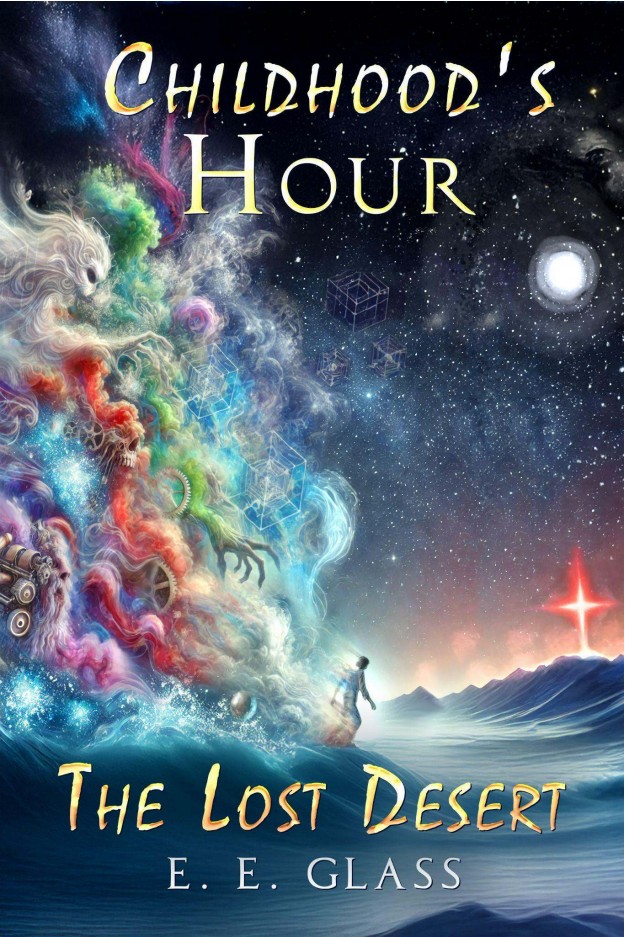

The Lost Desert unfolds like a fever dream. It tells the story of a man named Loste who escapes from a strange mist called the Fray and wanders into a dazzling desert of blue glass. He meets Nadhez, a wild, furred man who travels with a fierce, intelligent creature named Chihiti. The story drifts between hallucination and revelation, full of alien landscapes, glowing moons, and fragments of scripture that hint at a shattered world. Every page glimmers with dense imagery, where survival feels like both punishment and rebirth. It’s a story about memory, loneliness, and the fragile border between madness and faith.
I’ll be honest, this book messed with my head in a good way. Glass writes with the kind of poetic precision that makes you reread sentences just to taste them again. The prose is thick and alive, like breathing through incense smoke. At times I felt lost, much like Loste himself, drifting through scenes that seemed too vivid to be real. Yet, that confusion felt intentional. It put me right inside the character’s fractured mind. The dialogue between Loste and Nadhez was raw and strange but full of quiet heart. There’s something relatable in the way they stumble toward trust, both suspicious and starved for connection. And the imagery, my god, the imagery lingers. Every creature, every shimmer of sand feels carved from light and sorrow.
But this book isn’t easy. It asks patience. It doesn’t care if you understand everything. There were moments where I felt overwhelmed by the world-building, where the sacred words and mythic passages blurred into noise. Still, I never wanted to stop. The rhythm of the writing hooked me. It’s haunting and weirdly beautiful, like a dream you can’t shake off even when you wake. I felt equal parts awe and unease, that quiet tension between wonder and dread. It reminded me how fragile sanity can be when beauty becomes too much to bear.
I’d recommend The Lost Desert to readers who crave atmosphere more than clarity. If you like stories that make you feel rather than explain, that drown you in imagery and leave you gasping for air, this one’s for you. It’s not a comfort read. It’s a plunge into the surreal, but it rewards anyone willing to surrender to it. Lovers of dark fantasy, strange worlds, and lyrical writing will find something unforgettable here.
Pages: 550
IN THE WRATH OF LEGENDS

David Buzan’s In the Wrath of Legends is a sweeping historical thriller that fuses mythology, frontier violence, and spiritual depth into a relentless narrative. The story picks up in the late 19th and early 20th centuries, following Chenoa Winterhawk, a fierce, complex Nez Perce woman, caught between two worlds. As she navigates the tensions between Native traditions and the encroaching modern age, she becomes entangled in a web of military secrets, supernatural terrors, and personal reckonings. From the haunted mines of Oregon to the skies above the Blue Mountains, Buzan crafts a story where the past refuses to stay buried, and every legend hides a truth too monstrous to ignore.
The writing is vivid and poetic, often leaning into raw, sensory detail that grips your imagination and refuses to let go. Buzan doesn’t just write scenes; he paints them. The dialogue snaps with tension, and the pacing, alternating between explosive action and quiet, meditative passages, keeps the heart engaged and the mind uneasy. I was struck by how seamlessly he weaves indigenous spirituality and historical realism together. It’s not a romanticized view of history, but a hard look at betrayal, survival, and the thin line between faith and fury. At times, the prose feels almost cinematic, but what gives it weight are the moral undercurrents. This isn’t just a story about monsters; it’s a story about what people become when they’re forced to face them.
Emotionally, the book hit me harder than I expected. Chenoa’s journey is one of constant loss and rediscovery, and I found myself rooting for her even when the darkness seemed too heavy to fight. The monsters in the story, both human and otherwise, serve as mirrors, showing what happens when hope falters. I felt anger, awe, and even sorrow while turning the pages. Buzan writes with a kind of unfiltered honesty that sometimes cuts close to the bone. He doesn’t shield the reader from violence or grief, yet every brutal moment seems to serve a deeper truth about resilience and spirit.
In the Wrath of Legends is for anyone who wants to understand how myth and history can intertwine to reveal the soul of a people. It’s perfect for readers who love stories with grit, mystery, and heart, people who crave character-driven tales set against a backdrop of real pain and impossible beauty. If you want a book that challenges your emotions while thrilling your imagination, this one deserves your time and then some.
Pages: 298 | ASIN: B0FWS1BD91

The Living Bridge
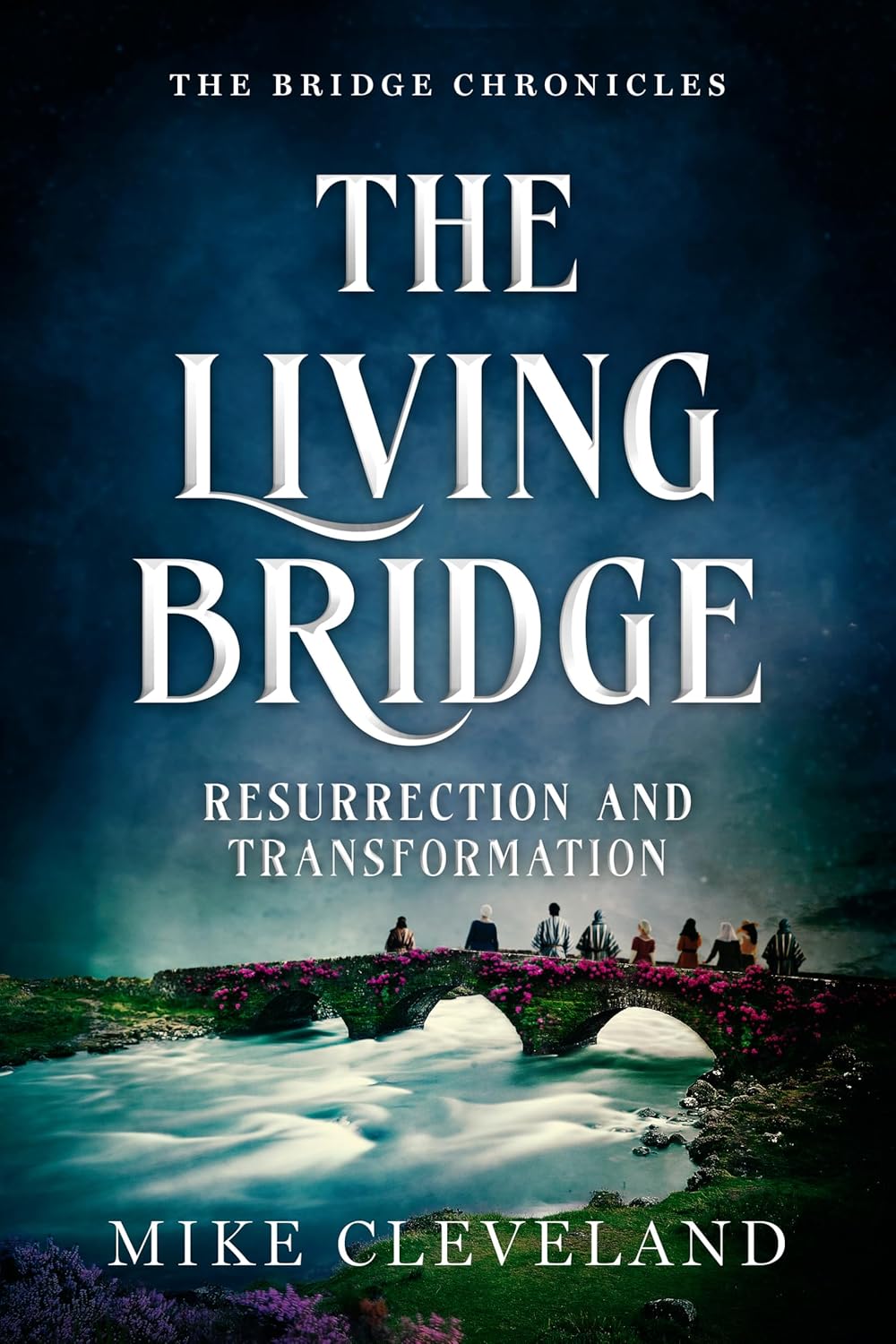
Mike Cleveland’s The Living Bridge continues the sweeping saga begun in The Broken Bridge, drawing us back to the world split apart by the shattering of the ancient stone span across the Vitae River. This second volume narrows its focus to five broken lives in the months before Geshriel, the carpenter, gave himself as the keystone of a new living bridge. We meet Mary, tormented by demons of grief and despair; Lydia, stranded far from her family and branded an outsider; Matthias, the cursed builder crushed by guilt over his son’s death; Cleopus, a revolutionary consumed by anger; and Tamar, condemned by her own betrayal. Their stories unfold in three movements that build toward the moment when Geshriel’s love begins to transform both individuals and communities. The book blends allegory, spiritual reflection, and raw storytelling in a way that feels both ancient and startlingly present.
I found myself drawn in by the way Cleveland writes pain. He doesn’t dress it up or keep it at a safe distance. Instead, he lays it bare. Mary’s torment felt claustrophobic and heavy, yet it rang with truth about how grief can twist into lies we start to believe. Lydia’s yearning for her family carried me straight into her loneliness, and I felt her ache as if it were my own. The sorrow runs thick, and I caught myself needing to set the book down just to breathe. But that intensity is also its strength. It’s not a story of quick fixes or shallow hope. The book forces you to sit with loss before it shows you healing, and that honesty made the moments of light feel earned rather than cheap.
I appreciated the style of the writing. At times, it leans into bold, sermon-like declarations that give the story a sense of weight and authority. The message often comes through with such clarity that I found myself stopping to take it in, underlining sentences I didn’t expect to linger on. Phrases about love that refuses to let go or hope that survives silence stayed with me. The blend of allegory and character-driven narrative gives the book a unique rhythm, and when the two meet, the effect is powerful, striking straight at the heart.
The Living Bridge presses on wounds most of us carry in some form. But for readers who are willing to wrestle with grief, forgiveness, and the idea that love is stronger than death, it offers something rare. I would recommend this book to anyone who enjoys Christian fantasy with a strong allegorical bent, and to anyone who needs a story that admits the depth of human pain yet still dares to point toward healing.
Pages: 227 | ASIN: B0FX5WS62Y
Wing Haven

Wing Haven, by Naomi Shibles, is a beautifully imagined fairy tale that feels both timeless and new. It tells the story of Almond Nettlesworth, a reluctant fairy who doesn’t quite fit into her messy, mossy world. After being outshone and betrayed by her younger sister, who suddenly becomes queen, Almond is thrust into an adventure that forces her to confront danger, friendship, and her own sense of belonging. Alongside unlikely allies like a chipmunk named Nutsie, she journeys through the wild forest in search of purpose and freedom, discovering a forgotten dollhouse that becomes a kind of refuge. Beneath the fantasy, the story hums with ideas about independence, family, and what it means to find beauty in imperfection.
What I liked most was how the book blended the charm of childhood imagination with the weight of adult emotion. The writing is lush and cinematic, full of textures like glittering wings, sticky sap, and the smell of damp moss. Shibles has a gift for description that makes even tiny moments feel alive. Still, it’s the heart of the story that got to me. Almond’s frustration with her world, her yearning for cleanliness and order in a place ruled by chaos, hit closer to home than I expected. I found myself rooting for her even when she stumbled, even when her pride made her prickly. The relationship between Almond and Pepper, sisters bound by rivalry and love, felt raw and real. Their clash mirrors the kind of quiet wars siblings fight when one grows up too fast and the other gets left behind.
I felt the pacing sometimes slows under the weight of its detail. The world-building is rich, like a garden that needs a little pruning. Yet, I didn’t mind walking through that garden. The story invites you to pause and notice the small wonders that are hiding. I also admired how the author used the natural world not just as a setting, but as a character. The forest breathes and sighs, both nurturing and cruel. It reminded me of how nature holds contradictions, beauty and decay, danger and shelter, and how those same tensions live inside us.
Wing Haven left me with a quiet ache and a deep sense of wonder. It’s a story for readers who still believe that magic exists just out of sight, for dreamers who feel out of place in the noise of the world. I’d recommend it to anyone who loved The Secret Garden as a child and now wants something more grown, more tangled, and more tender.
Pages: 219 | ASIN : B0FQBXFWPQ
Monsters Don’t Say Meep: Even the tiniest roar can make the biggest difference
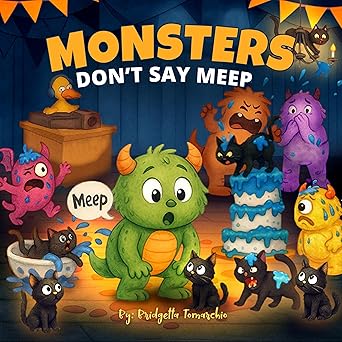
This children’s book tells the story of Meep, a little monster who just can’t roar like the others at Monster Scare Prep School. Everyone around him belts out their big scary sounds, but poor Meep can only squeak his tiny “meep.” He tries everything, roaring in caves, wearing a pumpkin helmet, even stuffing his mouth full of gooey pumpkin guts, but nothing works. When the Monsters’ Ball goes wild with chaos and scared kittens, it’s Meep’s soft, sweet “meep” that saves the day. Turns out, his quiet voice is the one that really matters.
I loved this children’s story from the very first page. The writing feels playful and full of rhythm, like it’s meant to be read out loud with silly voices and giggles. The way author Bridgetta Tomarchio paints Meep’s struggle is both funny and heart-tugging. It captures how it feels to not fit in, especially when everyone else seems bigger, louder, or braver. The humor, pumpkin guts, fart sounds, and monster mishaps keep it light and fun, while the message sneaks up softly. It’s not about being the scariest; it’s about being yourself. And that “meep”? It’s adorable.
You can tell this story comes from a place of love, especially knowing it was inspired by the author’s son. The idea that our real voices matter, even when they sound different, is such a beautiful thing to teach kids. The vibrant and charming illustrations burst with playful energy, perfectly suited for a children’s picture book. It features a delightful cast of colorful monsters. The warm, bright color palette, combined with the monsters’ expressive faces, creates an inviting and positive atmosphere.
I’d totally recommend Monsters Don’t Say Meep for kids ages three to seven, or anyone who’s ever felt too small to be heard. It’s the kind of book that makes you smile and maybe tear up a little at the end. If you’ve got a shy kid, a loud kid, or any kid in between, this story belongs on your shelf. It’s got the kind of magic that makes bedtime stories worth staying up for.
Pages: 42 | ASIN : B0FQK4N98J
We Have Agency
Time and Space follows a woman on the verge of turning forty who, on the way to work, is kidnapped by three university-aged young men from the future and is taken forward in time to a society built on patriarchal dominance. What was the inspiration for the setup of your story?
I remember becoming angrier and angrier at the objectification of women and the failed promise of equality.
Women’s Liberation hit the news when I was in school. I also grew up with a Zoroastrian father who taught us, in accordance with his religion, that men and women are equal. I didn’t understand the need for Women’s Lib until my later university/early working years, when I saw how women were treated in the workplace. Decades on, and except for Federal and provincial Canadian laws, nothing had changed. Women who felt they were liberated because of issues around sex having been loosened were wrong. It seemed like only the older generation understood that changing laws and mores didn’t translate to women being treated and perceived as equal to men. Whether women were virtually unclothed in one culture or covered up to the eyeballs in another, they were still being treated as objects for men to control. They still had less value.
I was also getting fed up with how Toronto and Ontario treat Toronto’s public transit and the commodification of every aspect of life.
On a personal note, I had little control over any part of my life because of my brain injury. I guess I was telling myself through Time’s story that we may not see it, but we have agency.
What are some things that you find interesting about the human condition that you think make for great fiction?
Our weaknesses. And the forces that both exploit them and force us to grow. That often surprises us when they lead us to fulfilling our own potential.
What were some themes that were important for you to explore in this book?
Sexism:
- The objectification of women and how they’re perceived as either baby bearers or sex fulfillers for men.
- What equality truly looks like when men and women perceive women as having inherent worth.
- Women recognizing their own intelligence, both to receive help and to problem-solve their own challenges.
Classism:
- Through the neglect of public transit.
- In the commercial arena or public spaces.
Racism:
- I’ll leave this to the reader to ponder the way I presented it and its meaning.
Ageism:
- I made Time an older woman.
- Since then, I began writing a trilogy (The Q’Zam’Ta Trilogy) featuring a woman in her 60s. Book one, The Soul’s Awakening, is out now.
- With such an emphasis on stories with younger people and the whole mindset that the youth will “save us,” we need to hear stories about older people also able to “save us,” especially older women in nondescript jobs.
What is the next book that you are working on, and when can your fans expect it to be out?
I’ll be publishing The Soul’s Reckoning, book 2 of The Q’Zam’Ta Trilogy, in December 2025 and am currently writing book 3, The Soul’s Turning, which I hope will come out at the end of 2026.
I’m particularly excited about The Soul’s Turning because it’s set in far, far future Toronto, London, and Mumbai, and expands on some of the technology and themes I first explored in Time and Space. However, I’ll be making climate change an essential background to the character development and plot settings. And unlike Time and Space, it delves into the latter aspects of Revelation — what would a world without Satan and the beasts of “the elite” actually look like?
Author Links: GoodReads | Bluesky | Website | Amazon
Time is turning forty, but her ordinary morning walk to work shatters when three university-aged boys from the future snatch her into a shimmering white cube. Their destination: a technologically advanced, male-dominated future where girls are tightly controlled, kept cosmetically perfect, and denied knowledge and autonomy.
When their professor discovers the abduction, he’s furious. The boys had promised never to interfere with the past again. Now he orders them to dump Time in a desolate era few dare visit, The Nasty Time. It’s 2411. The world is stripped of equality, connection, and choice. Time is abandoned and left stranded.
But someone unexpected intervenes, offering Time a sliver of hope—and knowledge she never asked for. Now, survival may depend on learning more than she ever imagined.
Smart, satirical, and deeply unsettling, Time and Space is a genre-defying journey across centuries and systems of control. Shireen Jeejeebhoy blends speculative science, biting social commentary, and sharp humour in a story that asks: “What happens when the powerless are forced to reclaim their life—or be erased from their future?”
Time is waiting. Don’t delay.
Heartwarming Journeys

The Adventure of Alex and Er follows a brave knight and his unicorn mare who embark on a quest to recover a snowman’s missing broom. What was the inspiration for your story?
My son’s name is Alexander. A few years ago, he went away to his pre-med school.
Because he was 3,000 kilometers away, my parental obligations were reduced to zero; I had the time to think and create. One day, while thinking about him, I realized that his moniker consists of two names: Alex and Er. I also thought of developing a children’s story about two characters named Alex and Er. Why a children’s book, you may ask. Picture books allow me to employ my talents to write, illustrate, and design, and THE ADVENTURE OF ALEX AND ER became my first publication.
What scene in the book did you have the most fun writing?
The most rewarding moment was when I connected an innocent snowman and an evil old witch through an item they both used—a broom.
What were some goals you set for yourself as a writer in this book?
My goal was to create a whimsical yet straightforward and enjoyable story. I planned to create a good book for young readers who love magical tales and heartwarming journeys. First, I wanted to make it as authentic as possible, with typos and imperfections. Then I realized that children’s books have a significant educational component and should never give their readers bad grammar lessons. The story has been updated, but an older version may still be available on the web.
What is the next book that you are working on, and when can your fans expect it to be out?
Number seventeen will be an adventurous in spirit roller coaster of action that will be lavishly illustrated and handwritten to please children and book lovers of all ages. Cinderella, Aladdin, Rumpelstiltskin, Thumbelina, and other fairy tale characters work together to make a sad and abandoned wooden horse happy again. The title of the new publication? LITTLE RED RIDING HORSE.
Author Links: GoodReads | Facebook | Website | Amazon
Defenseless Sea Life
The Tralls of Colum follows two siblings from the Tralldom of Colum, who face challenges tied to environmental changes, friendship, courage, and discovery. What was the inspiration for the setup of your story?
I was a primary school teacher for many years, and on rainy days, I’d tell my class stories of the tralls and their battles to protect their environment.
I noticed that after a storytelling session, my young audience would become more conscious of their effect on the surroundings and more interested in the local flora and fauna.
So, when I retired from teaching, I decided to publish the stories in the hope of reaching a wider audience
and making more children aware of the ways they could protect their own environments.
What were some ideas that were important for you to personify in your characters?
The Tralls of Colum was written for two of my grandchildren, and the main characters Jai and Emi were fashioned on them. They are often complimented on their co-operation, resourcefulness, perseverance, and tolerance, and I wanted to focus on those characteristics in the hope they would resonate with, and influence, my young readers.
What were some goals you set for yourself as a writer in this book?
I live near the coast, so I often see the deleterious effect that plastic waste is having on our beautiful oceans and our defenseless sea life. I wrote The Tralls of Colum to highlight those problems and make our younger citizens aware of the problems that we will face in the future if we don’t act to rid all our waterways of this dangerous material.
What is the next book that you are working on, and when can your fans expect it to be out?
The Trall Series consists of five published books, and each one revolves around a different environmental problem.
The Tralls of Nindarry – displacement of people due to mining.
The Tralls of Mundi – watercourses, aquifers, lakes, and rivers being diverted or polluted due to mining.
The Tralls of Maruchus – the dangerous effects of fracking on the environment.
The Tralls of Colum – the danger our oceans and sea-life face due to plastic waste.
The Tralls of Nosa – the danger faced by native flora and fauna when invasive species are introduced.
Author Links: GoodReads | Facebook | Website | Amazon
When Emi overhears her grandfather and two of his chars making plans for them to leave their ancestral lands she is devastated but the next morning a huge island of fresh green kelp and thousands of plump jellyfish miraculously appear off-shore, and she quickly realizes this precious gift from Mother Ocean will change everything.
Emi and Jai are determined to collect as much of the unexpected bounty as they can before the sea creatures devour it all but unfortunately, their dugout is overturned by a mysterious creature. Emi is almost drowned and Jai is lost at sea, and sadly, their exploits were in vain because the kelp and jellyfish are not what they seem. They are an unknown substance that is inedible and very dangerous for all living things.
Eventually, the tralls are forced to leave their beloved tralldom and begin their trek south in search of a new home.
Could this signal the end of the Tralldom of Colum?
The Tralls of Colum is the fourth book in The Trall Series – a collection of environmentally-themed portal fantasies that are set in the Sunshine Coast region of Australia. Each book in the series can be read individually but when read in sequence, they introduce the reader to an enchanting world full of unforgettable characters and locations..
The series is suitable for competent middle-grade readers.


 LITERARY TITAN