Blog Archives
Hunting in the Orion Nebula

Jupiter’s Ghost follows a pilot who enters dangerous waters when he joins the crew of a spacefaring whaling ship. What was the inspiration for the setup of your story?
I’ve always love sci-fi and fantasy. Years ago while I was watching the Moby Dick movie I decided to combine the two. I was fascinated by the obsession of Captain Ahab and how it drove him to destruction. For the Ishmael character, I picked an alien, a real outsider to humans, to join the crew – this way we get to see it through someone who was brand new to hunting in the Orion Nebula and his reactions.
I also wanted to show a vision of our future where humans still have base emotions, like revenge.
Did the image of Jupiter’s Ghost itself come first, or the legend of the Great Blue?
It was the legend of the Great Blue that came first. A large Nebula Whale that wrecked whaling spaceships. The whale is driving the story for Moby Dick and Jupiter’s Ghost.
How did you balance large-scale science fiction spectacle with the older maritime traditions running through the story?
It was tough, because I wanted to work in the traditions to pay homage to the original Moby Dick. But I had to work hard to blend the two, keeping enough maritime traditions without going overboard (pun intended)… The more difficult part for me was finding challenges that you couldn’t duplicate in space, for example, in the age of sail – when there’s no wind your just floating in the ocean until the wind picks back up. But in space your having to think about engines and power system failures instead.
What is the next book you are working on, and when will it be available?
I’m working on a YA Sci-fi/fantasy series that I wrote for my teenage niece. The premise is that my niece gets recruited for an international high school and ends up on a Space station training to become a magical warrior. The first book should be out this year.
Author Links: GoodReads | X | Facebook
Jóre, an alien outcast, joins the nebula whaling ship Jupiter’s Ghost—a vessel haunted by loss and hunted by something far worse. Whispers speak of the Great Blue, a monstrous whale that shatters steel and devours entire ships. In a crew bound by desperation and old grudges, trust is scarce and survival is a thin hope.
As Jupiter’s Ghost sails deeper into Orion Nebula, the line between hunter and hunted fades, and Jóre must decide how much of himself he’s willing to sacrifice for glory—and for revenge.
Not all who sail into the nebula will return.
Some dreams are meant to be swallowed whole.
* 2025 Storytrade Award Winner for Best Science Fiction
Long Leg: From the Blighted Earth: Book II


R.M. Tembreull’s Long Leg: From the Blighted Earth: Book II is an ambitious work of environmental fantasy that blends mythic adventure, eco-fiction, and climate fiction into a sweeping speculative tale. Set in a damaged world where the Natural Order struggles against Chaos and the Force Corrupted, the novel moves north into the Great Plains and centers its conflict on drought, water, ecological collapse, and the fragile bonds that connect all living things. It’s a book with large stakes, but its emotional pull comes from small, unlikely heroes carrying the fate of the world on their shoulders.
At the heart of the story is Long Leg, a Gifted burrowing owl whose loyalty to the earth elemental Okaraxta gives the novel both intimacy and purpose. Through Long Leg’s journey, Tembreull turns animals, elementals, fungi, water, wind, and land into active participants in an ongoing struggle for balance. The result is a richly imagined mythic fantasy world where the natural world isn’t just scenery; it’s alive, wounded, watchful, and capable of resistance. The book’s use of Lakota-inspired themes, especially the idea that all beings are related, gives the story a spiritual framework that feels central to its identity.
The novel’s strongest quality is its sense of scale. Tembreull writes with the scope of epic fantasy while grounding the story in recognizable environmental concerns: drought, wildfire, overuse of water, disappearing habitats, and humanity’s troubled relationship with the planet. Water becomes both a sacred presence and a force of renewal, which gives the adventure a clear emotional and thematic current. The prose is often expansive and philosophical, but that style suits a story designed to feel like a legend, a warning, and a quest all at once.
Readers who enjoyed Richard Adams’s Watership Down may find a familiar appeal here: animal protagonists move through a dangerous world shaped by forces larger than themselves, and their courage matters because they’re vulnerable. Tembreull’s book is more overtly supernatural and environmental in its focus, but it shares that sense of small creatures becoming central to a vast struggle. The journey also carries the feel of an eco-fantasy quest, where survival depends not on domination, but on cooperation, memory, sacrifice, and respect for the living world.
Long Leg is a thoughtful and imaginative speculative fiction novel for readers who appreciate mythic worldbuilding, animal-centered adventure, and environmental themes woven into epic fantasy. It’s not simply a story about a broken world; it’s a story about connection, responsibility, and the possibility of restoration. Tembreull delivers a distinctive continuation of the Blighted Earth series, one that invites readers to care deeply about the smallest beings and to see the natural world as a powerful, sacred community.
Pages: 338 | ASIN : B0GVPT5DMM

Beneath the Crescent Shadow
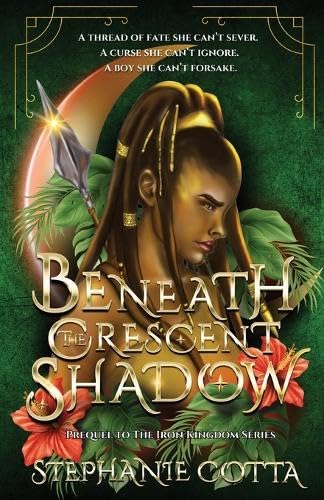
Beneath the Crescent Shadow by Stephanie Cotta is an adult fantasy novel and a prequel to The Iron Kingdom Series. The story follows Naja, a young Karahvelan warrior whose life changes after a storm brings death, a shipwreck, and an abandoned ashen child named Rowan to her isolated village. What begins as a tale of survival becomes something more intimate: a story about grief, fear, motherhood, prejudice, and the painful question of whether fate is something we obey or something we fight.
I enjoyed how sensory the writing is. I could feel the wet sand, the jungle heat, the storm pressure, and the salt in the air. Cotta builds Karahvel with care, not just through maps, customs, and language, but through the way the people think. Their beliefs about Mother Sea, omens, warriors, birth, and duty shape every choice they make. At times, the worldbuilding is dense, but I appreciated how authentic and deep it felt. The book doesn’t rush to explain everything from a distance. It lets me stand inside Naja’s fear, stubbornness, and grief, and that made the village feel less like a setting and more like a place with weight.
I also found the emotional center of the novel stronger than the fantasy mechanics themselves. The curse, the shaman’s warnings, and the red crescent moon give the story its tension, but the real pull is Naja’s slow, reluctant movement toward love. She isn’t naturally soft. She doesn’t suddenly become maternal because the plot needs her to. I felt like that choice mattered. Her bond with Rowan grows through duty, anger, guilt, protection, and finally something deeper. I liked that Cotta lets love be complicated. The book is candid about how fear can turn a community cruel, and how easily grief can be shaped into suspicion. Some scenes hit hard. But the clean adult fantasy approach keeps the focus on consequence and emotion rather than graphic excess.
By the end, I felt that Beneath the Crescent Shadow works best for readers who enjoy character-driven fantasy with strong family themes, moral pressure, and a bittersweet tone. I would recommend it to fans of clean fantasy who want something more reflective than flashy, and to readers who appreciate stories about found family, sacrificial love, and the cost of protecting someone the world has already condemned.
pages: 298 | ASIN: B0GX2WLKWG
Library in the Clouds: Children of the Blue Knight


Library in the Clouds: Children of the Blue Knight, by Hal Olsoe, is a fantasy adventure about Gwen and Landon, two children forced onto the road after their home is burned, their father is killed, and their mother is taken. What begins as a desperate journey to find her slowly opens into something larger, involving old powers, hidden knowledge, political betrayal, and a legendary library that feels half myth and half warning. At its heart, though, this is a story about siblings trying to survive when the world has asked far too much of them.
What I appreciated most was how grounded the book feels, even with its gods, kingdoms, sacred places, and ancient books. Olsoe does not rush the children from one grand fantasy set piece to the next. Instead, the story spends real time on hunger, sore horses, bad inns, dirty clothes, fear, and the small choices that keep people alive. It gives the fantasy genre some dirt under its fingernails. Gwen, especially, carries much of that weight. She’s brave, but not in an easy way. Her courage is practical, tired, and sometimes harsh. Landon brings a softer counterpoint, and I found their bond to be the emotional center of the book. They argue. They misunderstand each other. They keep going anyway.
The author’s worldbuilding is ambitious, and I could feel how much thought went into the gods, temples, social order, and history of the realm. The appendices reinforce that sense of a wider world beyond the immediate plot. The story leans on travel and explanation, and some sections move more slowly than readers expecting constant action might prefer. But that slower pace also allows the book to breathe. The danger feels earned because the quiet moments matter, too. I was especially drawn to the way the book treats knowledge. The library isn’t just a magical idea. It becomes a question: who gets answers, who controls them, and what happens when wisdom turns into a weapon? That stayed with me.
I would recommend Library in the Clouds to readers who enjoy character-driven fantasy adventure with medieval settings, sibling stories, and a sense of myth woven through everyday hardship. It will appeal most to readers who enjoy quests that are as much emotional as physical. This is not a light romp through a magical kingdom. It’s more like a long road taking you to beautiful places, frightening places, and worth following if you like fantasy that takes both its world and its young characters seriously.
Pages: 220 | ASIN : B0GZP9FP8Q
What is the source of their magic?

Diamonds and Roses, Vipers and Toads follows mistreated Gwendolyn Honeydale as a magical gift turns her voice into a source of beauty, desire, and danger, while her cruel sister’s curse exposes the costs of envy, family cruelty, and being seen. What was the inspiration for the setup of your story?
I’ve always been fascinated by fairy tales and folklore, and as a child I was particularly haunted by Diamonds and Toads by Charles Perrault. It’s a surprisingly short story, sparse on details, and only one of the characters, Fanny, has a name. She receives a brutally unfair punishment: to spew vipers and toads whenever she speaks. What was the fairy’s motivation for cursing her so cruelly?
That led to questions about fairies themselves: Who are they? How do they live, and where? What is the source of their magic? I also wanted to answer a question raised in Cinderella: How did Cinderella come to have a fairy godmother?
Gwendolyn’s gift seems beautiful at first, but it also makes her vulnerable to exploitation. How did you approach that tension?
One of the things I wanted to know after the end of this fairy tale was what life would be like for a farm girl suddenly elevated to princess and future queen. How would she adjust? Would she really be comfortable living in a palace governed by strange and rigid protocols? How would she interact with nobles and officials who might look down on her as a commoner?
Surely, she would become a target for anyone who saw her as a diamond mine. As I was writing Gwen, I thought about Lady Diana Spencer, who, despite her aristocratic background, was not prepared for life as a princess and did not marry a man who truly loved her. I also thought about families whose lives were worsened after winning the lottery—people who ended up battling one another and being exploited by opportunists.
The glassmaking scenes give the novel a strong sense of craft and longing. Why was that world important to Gwen’s journey?
Gwen is in the marketplace when she witnesses the arrival of glassmakers from a distant land. They have brought something colorful and exotic that seems almost magical in her drab world. The young man to whom she is attracted has dedicated his life to creating beauty, and through him Gwen comes to recognize her own desires and begins to see who she truly is.
The transformation of sand by fire into a beautiful vessel symbolizes the transformation she longs for in her own life.
The book mixes grotesque magic with emotional realism. How did you balance fairy-tale logic with the darker adult themes of the story?
My Antasy series is science fiction, and I was rigorous about the scientific aspects of those novels. When writing Diamonds and Roses, Vipers and Toads, I knew it would be fun to indulge in the liberties of magic, but I was equally determined that there had to be rules and limitations. It’s boring when heroes face an extreme threat and the problem is solved by a wizard with a simple wave of a staff.
The world of the characters in my novel is rooted in history and the real conditions of life in Britain at the dawn of the Renaissance. Life was far more difficult then for most people—even for royalty—and especially for women. Women had little power and little control over their own lives.
Witches and fairies, in the popular imagination, were women who possessed power, making them both appealing and frightening. For the most part, they were imagined as beings who rejected men and gloried in sisterhood. This novel would have lacked substance if it did not depict the realities of a time when medicine was primitive, plagues and famine were a problem, warfare was constant and a woman was often regarded as the property of her father or husband.
Author Links: GoodReads | Facebook | Website
This one delivers consequences.
Inspired by the tale by Charles Perrault and set in a richly imagined Renaissance world, Diamonds and Roses, Vipers and Toads follows two sisters raised on a remote farm whose lives are irrevocably altered by an encounter with a woman who calls herself their fairy godmother—and whom others insist is a witch.
Kindhearted, dutiful Gwen is granted a magical gift that opens the doors to a glittering world of wealth, status, and admiration. Her sister Fanny, self-involved and vain, is cursed instead and driven into a forbidden forest where mortals dare not venture. One sister ascends. The other is cast out and left for dead.
But which world is more dangerous? Which is more beautiful? And who, in the end, was truly cursed—and who was gifted?
Lush, unsettling, and subversive, Diamond and Roses, Vipers and Toads reimagines a familiar fairy tale to tell a razor-sharp story about women, power, and the perilous magic of refusing to be diminished.
THE SAPPHIRE SEAL OF SOLOMON: Book One of the Concealer Chronicles

The Sapphire Seal of Solomon, by Kirt Seuchan, is a Caribbean fantasy adventure about Kai Ramkissoon, a grieving teenager who discovers that his grandfather left behind a hidden Bible, a glowing blue stone, a map, and a warning tied to the legendary Seal of Solomon. What begins as a family mystery quickly becomes a dangerous chase across Trinidad and Tobago, with Kai, Anika, Jamal, and a shifting circle of adults trying to reach the truth before Malachi Voss can twist it into something powerful and frightening. As the first book in The Concealer Chronicles, it works as both a treasure-hunt story and a coming-of-age fantasy, rooted in local history, family secrets, and the hard question of what truth is worth.
I was immediately drawn to the story’s setting. The book doesn’t treat Trinidad and Tobago like a postcard or a backdrop. It feels lived in. The rain, the route taxis, the smell of pitch at La Brea, the family kitchens, the sharp humor between friends, all of it gives the adventure a real pulse. I liked that the fantasy grows out of the place instead of being dropped on top of it. The Pitch Lake, Gasparee, Fort King George, and Tobago all feel like they belong to the mystery. That makes the genre work especially well. This is a fantasy adventure, but it’s also a story about inheritance, memory, and what gets buried because people are afraid of what will happen if it is found.
I also appreciated the author’s choice to keep the young characters emotionally believable. Kai is scared, impulsive, and grieving, which makes sense. Anika is the kind of friend who organizes panic into a plan, and that balance gives the story a lot of warmth. Their conversations are often funny without breaking the tension, and I found that refreshing. The book moves quickly, but that speed suits the chase. There are moments when the ancient mystery and the villain’s long game lean into familiar adventure-story territory, but the characters and Caribbean grounding keep it from feeling generic. The strongest idea, for me, is that truth is not treated as a simple prize. It can heal, expose, endanger, and demand sacrifice. That gives the ending more weight than a simple “find the artifact” finale would have.
I would recommend The Sapphire Seal of Solomon to readers who enjoy young adult or middle-grade fantasy adventure with puzzles, hidden histories, dangerous artifacts, and a strong sense of place. Fans of quest stories, treasure hunts, and books where friendship matters as much as magic will likely have a good time here. It’s especially appealing for readers looking for fantasy that steps outside the usual medieval or European-inspired settings and builds its wonder from Caribbean soil, sea, and memory.
Pages: 275 | ASIN : B0H221JQ9C


