Blog Archives
Quantum Mind


In Quantum Mind, by M.D. Hanley, readers are taken on a gripping science fiction journey with twins Kat and Pat as they encounter the mysterious Alder. Asserting that Earth is not just a passive planet but a sentient being, Alder offers compelling evidence to back his claim. As the twins discover their quantum abilities, resembling superpowers, they become entangled in Alder’s mission, driven by the potent colored stones he holds. Their adventure takes them across England and Ireland, revealing that Alder is part of a broader network of cosmic mystics. Some are his allies, while others stand opposed. The twins’ involvement becomes paramount for Earth’s very survival.
Though the second in a series, newcomers to Hanley’s world will swiftly acclimate. The prologue quickly lays the groundwork, and Alder’s insightful dialogues further bridge any gaps.
Quantum Mind pays homage to concepts treasured by fans of the Star Trek universe – from sentient planets to humanoid guardians for these celestial bodies. While the book may tread on familiar terrain, this doesn’t diminish its charm. The twins, Kat and Pat, are engaging leads, and Alder’s intricate connection to Earth offers layers of emotional depth.
The unfolding narrative steadily amplifies the urgency of their quest. Remarkably, the Earth transforms from a backdrop to an emotive entity with desires and imperatives as compelling as its human protagonists. Hanley personifies the planet, deserving commendation for this nuanced portrayal. Dive into Quantum Mind for an enthralling read that blurs the lines between the cosmic and the personal.
Pages: 383 | ASIN : B09QRX7376

Conflict Within a Conflict

River’s Reach follows a high school senior who is torn between his family’s beliefs in conservation and the rights of the Nisqually tribe in the Fishing Wars, and he must decide what side to stand with. What was the inspiration for the setup of your story?
During the late 1960s, I began paying more attention to the news, probably because of the conflict in Vietnam and the Civil Rights movement. The Fish Wars became part of the news cycle in the Pacific Northwest and garnered my interest. At some point, I had the idea of a story wherein a kid whose father was a Washington State Game Department officer begins to gravitate to the tribe’s point of view. The conflict within a conflict seemed like a viable storyline. For many years, I’ve been concerned about declining salmon stocks and what might be causing the drop. The fishing scenes are reminiscent of my attempts to catch steelhead. I have always been impressed with Billy Frank Jr., who was often interviewed in connection to news reports on the Fish Wars.
Are there any bits of you in this story?
As I think back on it there are quite a few autobiographical influences. The fish egg caper is something that I actually did, although it was with the Nooksack rather than the Nisqually. The Steilacoom fishing trip is recounted almost as I experienced it in real life. I’m sorry to say that the drunk-tank scene is something that I also lived through, although not for drinking or any other heinous crime (perhaps the subject for another story). “What you are to be, you are now becoming” was my High School motto, but I didn’t attend North Thurston HS. The snowstorm in the story loosely fictionalizes an event that took place while I was teaching sixth grade in the Snohomish School District.
What kind of research did you do for this novel to ensure you captured the essence of the story’s theme?
The most salient research/inspiration is simply living in the northwest during the mid-1960s about sixty miles north of the Nisqually River. I visited Frank’s Landing (or what’s left of it since the Fish Wars) several times and checked out the tribe’s relatively new casino, which partially funded the new tribal center and contributes to many of the tribe’s current aspirations. I reviewed multiple online reports from the Fish Wars as well as several local histories of the tribes. I think it’s also fair to say that time spent on a river trying to catch a steelhead qualifies as research for this book.
What is the next book you are working on, and when can your fans expect it to be out?
The next book is set in Seattle during the blackouts in 1943. As the war rages in Europe, the home front is portrayed through the eyes of fifteen-year-old Scotty Johansen. When an unknown party begins setting fires during the blackouts, Scotty, his sister, and some of Scotty’s friends set their minds to solving the mystery of who’s igniting them. I’m hoping to release the book next spring.
Author Links: GoodReads | Facebook | Amazon
Life is good for high school senior Alex Haugen. He has a group of buddies to fish the Nisqually River with, his membership on the football team guarantees status with his peers, and he’s recently set his sights on Amanda Schneider – an engaging blend of brains, beauty, and personality. He’s beginning to think that the lead cheerleader and star lineman go together like burgers and fries.
Learning that his dad participated in the latest fishing raid at Frank’s Landing, Alex’s curiosity is piqued. The more he reads, the more he realizes how little he knows about the deep-rooted conflict between the Washington State Game Department and local tribes. The state claims the right to enforce conservation measures and the tribes claim that their treaty rights supersede state regulations.
Alex has strong convictions about conservation but wonders if there’s more to the story. Indian netting can’t be the only reason fish are in decline. Strident and entrenched certainties dominate both sides of the fishing controversy, and Alex begins to resent that a side may have been chosen for him at birth.
Chancing conflict with his dad – an officer with the game department – Alex’s quest for understanding rouses discovery of his own voice and the courage to stand apart from his parents and peers. Along the way, he befriends Charlie McCallister, a Nisqually Indian his dad arrested in a raid.
Amanda, whose mom does pro bono work for the tribe, is a social justice warrior at heart. As the fish war heats up, her readiness to support the tribe clashes with Alex’s reluctance to rock the boat with his father and threatens to drive a wedge in their blossoming romance.
Charlie, Amanda, and the Nisqually River form the key catalysts for Alex’s awakening as the story unfolds against the backdrop of a nation gripped by the civil rights movement, the Vietnam War, and the seismic tunes of rock ‘n roll.
This novel is suitable for MG/YA and the young at heart. It contains no gratuitous language, but there are a few swear words, in keeping with the characters and story.
Pompeii Fire

Pompeii, a remarkable time capsule, has long captivated historians, archaeologists, and the everyday explorer alike. The city’s haunting remnants, depicting residents frozen in their final moments by a devastating volcanic eruption, have been the muse for numerous tales. Among the throngs of visitors drawn to this poignant destination is Stephanie, a travel journalist, whose adventure in Pompeii leads her to an incredible discovery.
Pompeii Fire, by Sharon E. Cathcart, seamlessly intertwines two enthralling love stories – one set in the modern era, and the other in ancient Pompeii. As Stephanie delves into Italy’s post-pandemic landscape, she finds herself entranced by a charismatic historian. Simultaneously, readers are transported to ancient Pompeii, where a young maiden’s heart is stolen by a dashing gladiator. Is there a mystical thread binding these two romances? Can both couples secure their fairy-tale endings, or will unforeseen circumstances thwart their aspirations?
Cathcart’s evocative language and vivid settings conjure images of a sun-soaked holiday romance. Targeted at young adults, this book can best be likened to the warm embrace of a Hallmark film. While the narrative may tread familiar romantic pathways, it doesn’t detract from its charm, making it an idyllic escapist read. With its emphasis on the nuances of affection over explicit intimacy, it’s a refreshingly chaste romantic tale, perfect for those seeking a gentle, heartwarming journey.
Pompeii Fire is a delightful respite from the everyday hustle, immersing readers in a world of timeless love and enchantment. Highly recommended for those desiring a light, enchanting escape.
Pages: 159 | ASIN : B0CGHPTNCD
The Unsung Heroes

Lone Star Justice follows Texas Rangers Hondo Stone and Kid Carter, who do their best to bring justice to Old San Antonio against the mounting opposition who outnumber and outgun them. What was the inspiration for the setup of your story?
First, let me thank you for this great interview from your prodigious company, Literary Titan. I truly appreciate it. The inspiration for my story is manyfold. But first and foremost, my inspiration is my late brother, Duane “Mr. Bear” Campos, who is the heart and soul of the 2-Bru Krew. The way he lived with honor, courage, true friendship, and unwavering principles according to his Code of Honor inspired me to write this series of Western novels. The setup of the story is an homage to people of strength and resilience everywhere: law enforcement, soldiers, and other protectors of citizens who put the well-being of others ahead of their own. They are unsung heroes whom an ever-fickle modern society heralds with tickertape parades and yellow ribbons when it makes them feel good, then that same public oftentimes turns around and hypocritically chastises and scrutinizes these same defenders when they see that it takes a wolf to protect the sheep from other wolves.
What is the biggest thing that people THINK they know about the old west/western genre that isn’t so?
Most people live under the misconception that during the Old West, Texas was populated by mostly Hispanics or Whites from the South, when the truth was Texas was a melting pot within the “melting pot” of the United States. Though it is true, Hispanics made up a great percentage of the population and were there long before Anglos, Texas, was filled with Indigenous Native Americans of many different tribes. And Texas was similar to New York in being a key destination for immigration, such as the “Forty-Eighters”, who were European immigrants that came to Texas in the late 1840’s-1850’s and not only settled throughout the state but also founded many new towns with their European culture. My series of Western novels, starting with “Old San Antone” and continuing with “Gunfighter’s Requiem” and “Lone Star Justice”, has several leading characters who are German-Jewish immigrants that settled in Old San Antone, such as the Birnbaum Family, Dr. Issak Jaffe, and Papa Schultze, to name a few. There are a slew of other Europeans too, like the Bohemian Czech gunman Dutchy Laszlo, the French gambler Taj, and perhaps most prominently of all, one of the main characters, the Englishman “Kid Carter”. Other main characters are also transplants to the west: Captain Hondo Stone is originally from Illinois, Jess LeBeau is from Kentucky, Kay Hart is from New York, Sara-Belle Garnett is from Philadelphia. Not to mention the antagonists such as: J.B. Jenkins who is from Ohio, Dickie Diamond and Dexter Gaff are from New York, and the gunman Domino McGillicutty is from Ireland. But the ethnic group that is oftentimes most overlooked is African-Americans, and I’m proud to say they are represented well in my novels, with the lead characters Ma’am Daisy Brown, the gambler Red-Dog Rouge, Madam Rose, the young lad Toby, and an assortment of gunmen, and of course, Moses Brown, whom Hondo makes the first Black volunteer Texas Ranger.
Your novels are extensive and detailed, showcasing the real old-west. Were there scenes you ended up cutting you wish you could’ve kept? Describe them and the decision-making process.
Thank you for the compliment about the detail of my novels, I truly appreciate it, it means a lot to me. To me, a novel should be detailed. People read to be immersed in a world within their mind, and as authors it’s our job to transport them there with words that fly off the page, enter their mind, and take them to another place in time where they can live and experience another life as though they were living it themselves. It’s easy for an author to pump out a 125-page pamphlet that reads like a quick screenplay with little to no description, which leaves the reader guessing what happened, and transports them no where except to a place where they wasted a handful of cash and a few boring hours sifting through a book that should’ve been left unread. But it takes dedication and love of the craft of writing for an author to pour their heart and soul into their books. I am a writer who does that. My blood is in those pages… Not “on” them, but “in” them… Did I cut anything out? No. It’s all there. That’s why I made the conscious decision to make this an ongoing series of books, where one picks up where another left off. Maybe some people might think them long. But to paraphrase the prodigious author Victor Hugo about his novel Les Misérables: “Due to the great length of my book, I don’t know whether this story will be read by everyone… But it is meant for everyone. Because it is written for everyone…”
Do you plan to write more books surrounding Hondo Stone and Kid Carter? If so, where will the story take readers?
That’s a great question. Most definitely, I’ll be writing more books following the “Chronicles of Hondo Stone and Kid Carter”. For those who’ve read the first 3 books thus far, they know that each novel begins with a “Prologue” that takes place in the year 1900, with a young journalist coming to Old San Antone wanting to find out more about the lives of Hondo and Carter, so he can write a series of stories about them. He meets a grizzled old newspaperman who knew them, and the widow of Carter, and together, they tell this journalist the tale. The chapters of each book then immediately transport the reader back to 1867, and they get to “live” the experience first-hand, seeing the events unfold as they did at that time. At the end of the book, it returns to the year 1900, with the journalist begging to know more, and knowing the story will continue in the next novel. So the future books will continue the tale of the two best friends, Hondo Stone and Kid Carter, and the people closest to them, Jess LeBeau, Rachel Birnbaum, Sara-Belle Garnett, Daisy Brown, Professor Birnbaum and his wife, and other main characters, as their lives intersect with events, both tragic and triumphant, that shape not only themselves, but the State of Texas over the years, chronicling the wild west as it actually happened. I am currently working on the 4th installment, which I plan to publish before the year is out. Thank you so much again for this wonderful interview with your great company and staff. I can’t thank you enough, Literary Titan. You are awesome.
Author Links: GoodReads | Twitter | Website | YouTube
Heroes never quit and never surrender. Sometimes they die, but they don’t ever give up. They fight to the bitter end, win or lose, live or die, and they take honor and glory with them. No one could ever ask for more than that. This is a story about heroes. This is a story about Captain Hondo Stone, Texas Ranger, and his best friend and brother-in-arms, Kid Carter.
This is the third installment in the continuing tale of Hondo Stone and Kid Carter: two imperfect heroes for an imperfect world, that was suffering an imperfect time in history… The world might deem them as anti-heroes, because they may seem hard to fully understand at times, but all great men of honor usually are… They’re complex souls, who may appear to be insufferable to those who don’t appreciate the kind of unique lives that they live, but they’re also the most tender-hearted of all people to those that they love. For they live lives that are vastly different from what others may deem to be a “normal” or “ordinary” life. But that’s what it takes to be the stuff of legend: to be heroes in a world that has grown too cynical to believe in heroes anymore.
Picking up right where “Gunfighter’s Requiem” left off, “Lone Star Justice” is the exhilarating and much-anticipated continuation of the “Chronicles of Hondo Stone and Kid Carter”, which culminates the events of the first two books in an explosion of an exciting action-packed climax that’ll thrill you to your very core!
For, during the Christmas of 1867, in Old San Antone, there would be no peace on earth, and no good will towards all men… Rather there would be an ominous hell-storm of violence and vengeance unleashed within the city as the final battle between the Texas Rangers and the Jenkins Faction would playout on a fateful morning in which debts would be settled, vendettas would be resolved, lives would be lost, the balance of power would be changed, history would be made, legends would arise, and Lone Star Justice would be served, all by the hands of Captain Hondo Stone. What you must ask yourself is, do you have what it takes to seek out Lone Star Justice alongside Hondo and the Kid? Because if you do, then the greatest story of your life is only a turning of a page away.
River’s Reach: Coming of Age Amid the Fish War
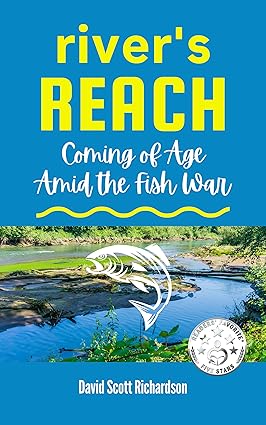
Prepare to embark on a transformative journey through the pages of River’s Reach by David Scott Richardson, a compelling coming-of-age novel that introduces us to Alex Haugen, a high school student on the cusp of self-discovery. Set against the backdrop of a long-standing conflict between the Washington State Game Department and local Indian tribes, this captivating story unfolds as Alex stumbles upon a revelation about his father’s involvement in a historic fishing raid at Frank’s Landing. Intrigued and spurred by a thirst for understanding, Alex delves deep into the history of the Nisqually tribe, a journey that raises thought-provoking questions about the narratives that shape our beliefs and values. Along this enlightening path, he forges unlikely friendships that open his eyes to the multifaceted nature of truth.
River’s Reach is an educational and enthralling tapestry that artfully weaves together historical context with themes of environmental conservation and civil rights. As readers become immersed in Alex’s personal odyssey, they are simultaneously drawn into a broader exploration of history, social justice, and cultural complexities. The evolution of Alex’s character is nothing short of commendable, as he evolves from a conforming teenager into an independent thinker. The relationships he forms throughout the narrative add depth and nuance, underscoring the significance of empathy in bridging cultural divides. Through Alex’s journey, the book challenges the notion of birthright and opens the door to new perspectives. While River’s Reach is well-suited for a younger audience, it does contain occasional strong language. However, this minor caveat should not deter readers of all ages from delving into this enriching tale that seamlessly balances entertainment with deep reflection. At its core, the book imparts a valuable lesson: true growth springs from questioning the status quo and discovering our own voices.
River’s Reach by David Scott Richardson, while rich in historical detail, may occasionally veer toward excessive exposition, which can momentarily slow the narrative’s pacing. Nevertheless, the story remains authentic to its characters and their experiences, ensuring a memorable reading experience that will leave its mark on its audience.
Pages : 326 | ASIN : B0CCSSKK73
The Freedom In His Creation

Hieronymus tells the fictional story of the iconic painter Hieronymus Bosch, who little is known about. What was the inspiration for the original and fascinating idea at the center of the book?
My book addresses mainly the condition of the artists and the freedom of creation that were always dependent on the socio-economic realities of the times they lived. The main character’s creations were ahead of his time, making Hieronymus Bosch to be regarded as the father of Surrealism. Considering the historic and religious realities of the 15th century in northern Europe, and the following religious reform, or the daily life in Northern Brabant, Bosch’s paintings are not only intriguing and mysterious, but raise questions about how they been tolerated by the Catholic Church or the Inquisition. The relationship of Hieronymus (Jeroen in dutch) with his wife Aleid van Merveene, known as being wealthy and older than him – even though, at the time, the term “older” applied to women could be very different from nowadays standards – was a great subject to touch, as fascinating as the enigmatic sect of the Adamites persecuted over the centuries by the Catholic Church. Overall, the idea of writing a fictional story about a famous painter was inspired by the freedom in his creation that transcends the centuries.
What kind of research did you do for this novel to ensure you captured the essence of the story’s theme?
The amount of research was enormous. I started to write the play with the same title in 2010. In 2012 was produced at LaMaMa ETC in New York City, and in 2014 at the National Theatre of Iasi, Romania.
In 2011, I visited ‘sHertogenbosch, Hieronymus Bosch hometown, St. John’s Cathedral, the church he frequented and some of the old streets and Central Square that are and discussed with a few local specialists in the life and works of the painter.
A big help came from a Dutch historian who published documents from the town’s archives, that was a great source of research.
I study the socio-political situation of North Brabant as well that was a part of the Holy Roman Empire at the time, and the political tensions between the locals and the Habsburg Dynasty, that was reflected in the daily life of ‘sHertogenbosch society.
What were some themes that were important for you to explore in this book?
Besides the artist’s position in the society, I was interested in the women’s condition at the time.
The sexuality is another important theme of the book. The Middle Ages sexuality was tapped by many writers of the time such as Geoffrey Chaucer in his “Canterbury Tales”, or Petrarca in “Decameron”. As far as Bosch’s paintings contain a lot of nudity and some explicit scenes among the horrors of the Hell depicted in his tryptic, I considered important to bring to surface this aspect of the Middle Ages daily life. I exploited as well, the existence of the strange sect of Adamites who practiced the nudism and were persecuted and executed in public spaces for their heresy.
Other main themes are the creator’s solitude, the religion and the horrors of the Inquisition.
What is the next book that you are working on, and when will it be available?
I just finished another novel, “The Other Weapons”, inspired by the experiments with psychedelics made on human subjects by the CIA and USA Army during the Cold War.
The book follows the destinies of a young doctor and a painter whose lives are influenced by the strange military experiments. The action takes place in the late fifties and sixties at Edgewood Arsenal in Maryland and in the effervescent artistic circles on New York City.
Author Links: GoodReads | Amazon
Based on the little historical information about the artist’s life, the novel tries to dissect the context in which Bosch’s imagination incorporated the sacred and the profane, the symbol and the metaphor, around which the dramatic life of the creator revolves.
Some documented facts of Bosch’s life regarding his marriage to a wealthy woman whose dowry allowed him the freedom of creation, or his survival of a plague epidemic and the great fire of 1463 in ‘s-Hertogenbosch, are mentioned in the novel to identify the artist’s personality and recreate the social and historical context of the western European Middle Ages, haunted by the fear of the Inquisition and religious reform. The artist immerses in the creation process in which the factual circumstances disappear and re-emerge into his artistic universe populated by fantastic characters, grotesque situations, tortures and suffering, that evaporates at the end of the story like a nightmare in the morning light.
Lone Star Justice

Lone Star Justice by John Campos seamlessly follows the thrilling events of Gunfighter’s Requiem. Set against the evocative backdrop of Old San Antonio, Texas, during Christmas of 1867, this narrative dives deeper into the tense standoff between JB Jenkins, head of the formidable Jenkins Faction, and the dogged Texas Rangers, chiefly Hondo Stone and John “Kid” Carter.
In the previous book, Hondo Stone had narrowly escaped multiple assassination attempts by JB. This new installment portrays JB Jenkins as a leader on the edge, making desperate, impulsive choices that signal his potential downfall. This shift from the meticulous tactics he once employed is a telling exploration of the perils of ineffective leadership. While Hondo and Carter are undeniably adept as gunmen, they face an opponent who boasts superior numbers. One can’t help but ponder how different the outcome might have been had JB exhibited strategic leadership, given his resources. His often ill-conceived strategies, coupled with a lack of respect for his allies, hindered his ability to foster unwavering loyalty.
A notable evolution in this Western crime thriller is Campos’s decision to delve into the personal lives of Hondo and Carter. The introduction of romantic arcs for both protagonists provides a refreshing contrast to the high-octane confrontations. It’s a joy to witness moments of genuine happiness and intimacy, which were scarce in their previous adventures.
However, while Campos’s meticulous descriptions enhance immersion, I feel they occasionally verge on excess. I think a more measured approach might have tightened the narrative. Additionally, I feel presenting Hondo with steeper challenges could have heightened the stakes, offering readers an even more gripping experience.
Overall, Lone Star Justice is an enthralling continuation, painting a vivid picture of Old West confrontations while also illuminating the intricacies of its protagonists’ hearts.
Page: 778 | ASIN : B0C3SCW14K
Brazzaville – A Sequel to Casablanca
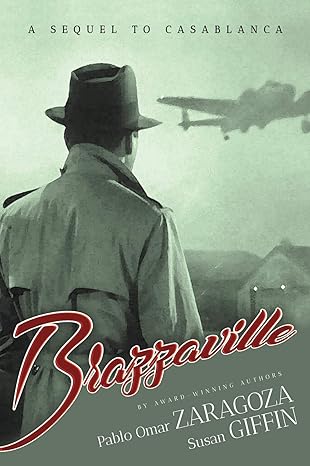

Following the cinematic triumph of Casablanca, whispers of a potential sequel titled Brazzaville buzzed through Hollywood, yet it never graced the silver screen. In a masterstroke of imagination, authors Pablo Omar Zaragoza and Susan Giffin unveil their vision of this elusive sequel in a riveting novel. Picking up immediately after Casablanca’s poignant finale, we are thrust into a world with Rick, Louis, and Ilsa, battling the encroaching shadows of Nazi terror. As Ilsa and Lazslo make their desperate escape to Lisbon, they find themselves not out of danger, but rather delving deeper into its grip. Concurrently, Rick and Louis ally with the resistance, embarking on daring missions to free innocent souls from Nazi clutches.
One of the book’s most captivating elements is its expansion on the theme of “found family.” The narrative showcases the resilience of relationships forged in adversity, emanating warmth even in the darkest of times. The unwavering affection Fletcher harbors for Amalia serves as a bittersweet backdrop amidst the tumultuous events. Rick’s assertion, “Besides, my greatest asset isn’t money; it’s family and friends, and of those, I have plenty,” captures this sentiment beautifully.
Zaragoza and Giffin’s writing style deserves commendation for its incredible realism. The palpable tension as characters hang onto every word from the radio and the meticulously detailed battle scenes make the reader feel ensconced within the narrative. Brazzaville: A Casablanca Sequel interweaves adrenaline-pumping action with heart-tugging emotion, a balance that is all too rare. The introduction of fresh faces to the narrative feels organic, enriching the plot without overshadowing established characters. For fans of the classic film, as well as enthusiasts of action tales, this novel promises an exhilarating journey.
Pages: 498 | ASIN : B07Z45XX7Y



 LITERARY TITAN