Blog Archives
The Fox and the Garbage War


The Fox and the Garbage War is such an unusual and thought-provoking read. On the surface, it has the appealing ingredients kids are drawn to right away, like animal characters, dramatic conflict, and richly imagined settings, but underneath, it offers a surprisingly meaningful story about power, dishonesty, and the consequences of selfish ambition. Francis the Fox is the kind of character children will instantly recognize as charming yet untrustworthy, which makes the story especially engaging. It feels like a modern fable, one that invites young readers to think a little more deeply while still enjoying the suspense of the plot.
What I loved most is that the book trusts children to follow a layered story in which greed and manipulation slowly grow into something dangerous, as Francis and Linda build HypeX and create fear around Stargaze. The book introduces big ideas like public deception, corruption, environmental neglect, and courage in the face of lies, in a way that’s accessible through animals and vivid storytelling. As a parent, I appreciate books that open the door to real conversations, and this one certainly does. After reading it, I could easily imagine talking with a child about honesty, leadership, and why people should question things that do not feel right.
The illustrations are also a real strength. They have a soft, hand-drawn quality that contrasts beautifully with the darker turns in the story, creating a visual world that feels dreamy. That balance works so well in this children’s book because it keeps the story inviting even when the themes become more serious. I was especially struck by the images of Francis presenting himself so confidently, the fenced-in city of Stargaze, and the growing sense of secrecy around the research center; they add emotional texture without overwhelming the reader. The artwork helps make the story memorable and gives parents plenty to pause over and discuss with their children.
This is a children’s book that stands out for its ambition. It is not just cute or entertaining; it has something real to say. I would recommend it to families who enjoy storybooks with substance, especially those who like animal tales that carry a strong moral thread. For me, The Fox and the Garbage War is the kind of picture book that reminds me why I love children’s literature so much: it can be imaginative and beautiful while still encouraging wisdom, empathy, and critical thinking. It may be best suited to children who are ready for a slightly more complex and serious story, but in the right home or classroom, I think it could spark wonderful conversations.
Pages: 46 | ISBN : 978-9528205982

Geographical Quirks

The Strains of Malice follows a 15-year-old girl baker’s daughter in Ghantiss, who is pursued by authorities after rescuing an ill-fated dog from a bloodsport ring. Where did the idea for this novel come from?
Emilya (the baker’s daughter) is just one of many character threads, which cover royalty, miners, druids, astronomers, gladiators, naval captains – and a baker’s daughter! I wanted to start the story with Emilya so that it begins grounded in ordinary folk – but who soon have the misfortune to cross paths with the entitled elite.
As for the idea for the novel, I sat down in December 2019 and designed my world first. Next came an outline of what was originally intended to be a five-book series, with a catastrophic event right at the end. Alongside this, I began creating the characters, and that was when Emilya and her pathway through the book was established. I even created timelines for my main ten POV characters, all mapped together a bit like a Gantt chart!
I then started designing the secrets of the world of Thera – and which will be revealed in a book called Decoding the Hidden World of Thera, which I plan to release at around the same time that Books Three and Four in The Nessemiah series are released. Only two other people know about these secrets, and they are bursting with impatience for the cat to be let out of the bag!
Finally, just to clarify, The Nessemiah is now a four-book series that only covers what was originally intended to occur in Books One and Two of the five-book series I planned back in 2019! The final three volumes of that story will now form the sequel series to The Nessemiah!
As the opening book of a series, what did you most want readers to understand about this world in the first installment?
It was important that the world of Thera itself should be slowly revealed in Book One, along with the pending catastrophe that ultimately ends the series. Thera is a world of some ancient mystery and interesting geographical quirks that I loved creating and slowly begin to reveal in Book One. Indeed, one reviewer who was being very generous about the depth of my human characters declared that Thera itself is almost a character in its own right. That said, there is nothing fantastical about Thera. There are no dragons, elves, magical powers or thousand-year-old prophecies waiting to be revealed/fulfilled. It is a hard, gritty world, for which the publisher uses the strapline, “Poldark meets Gladiator…on another world.” That is very apt.
The strapline refers to the temperate polar islands which resemble British regency times, and the brutal Theran Empire further south, which is a throwback to Ancient Rome. These are two cultures which are destined to collide, but which are currently kept apart by one of my favourite geographical quirks!
It is also worth adding that many reviewers have picked up on the depth and quality of my world-building, given the book is front-loaded with detailed maps, layouts of monasteries, explanations of geographical features, temperature charts, the daily and monthly cycles, and even Thera’s solar system. This is all important information that is going to come significantly into play as the four-book story unfolds.
Where did you get the inspiration for Prince Magnus’s traits and dialogue?
Every book needs at least one villain. Mine has several – hence The Strains of Malice. But Magnus does seem to be everyone’s favourite. I guess he must be a little bit of every nasty villain I’ve ever read about myself, from several thousand novels. Of course, his traits and dialogue have been dictated by his privileged upbringing: entitled, never been disciplined, and can do whatsoever he pleases with whomsoever he pleases. And, of course, he does!
I can tell you that he was an absolute joy to write! I suppose if I were to be pushed on an inspiration, it would have to be A Song of Ice and Fire. There have been review comparisons to Prince Joffrey, but as one wise reviewer pointed out recently, Joffrey was still boy, albeit an incredibly cruel one; Prince Magnus is very much a man – and far darker than Joffrey. Maybe there’s a bit of Cersei in him as well, if that makes sense? But not Jaime Lannister; there is absolutely no good in my Prince Magnus!
As for the dialogue, I guess he is very British. But again, he isn’t cliché’d. As one reviewer recently said, “He does not monologue. He does not twirl his cape. He is simply a man who has never once in his life been told that his desires have consequences.”
I suppose that if there is one character from literature for whom there is perhaps a fair likeness to Prince Magnus, it would be a certain character from my childhood called Count Grendel of Gracht – and you would have to go all the way back to 1978 to find out who he is! I hated him, back in the day, and I think he must have hidden in my subconscious for over forty years before covertly embedding himself into The Strains of Malice!
Can you give readers a glimpse inside Book 2 of The Nessemiah?
Book Two of The Nessemiah, Cold Sanctuary, is essentially a continuation of the various plights of all of the POV characters introduced in Book One, but with the threat of Nessemi becoming ever-more real as their storylines progress and The Event draws nearer. I also significantly ramp up events in the supercontinent of Epanaga, with brutal gladiatorial fighting pits taking centre stage alongside Emperor Calidius’ Expurgatio – a cruel and callous purge of various demographics of Theran society in preparation for the arrival of Nessemi.
Pretty much every reviewer has stated that Cold Sanctuary is better, deeper and darker than The Strains of Malice, and reviews so far have been out of this world – with most reviewers desperate for Books Three and Four. Happily, they will both be released shortly.
Author Links: GoodReads | X (Twitter) | Facebook | Website | Amazon
Is anywhere on Thera safe from Nessemi? Or the hell that lies beyond?
“I’m afraid there are good and bad everywhere, Emilya. It’s a fact of life that wherever you look, there are strains of malice.”
Fifteen-year-old baker’s daughter, Emilya Luca, is in serious trouble with the Glennadian Crown. Her crime: to prevent a small dog from being torn apart by hounds belonging to the callous Prince Magnus. Having been rescued by former naval captain, Jake Oscom, the unlikely pair become fugitives, hunted across Glennad – initially for cruel sport but latterly after Oscom is framed for a heinous crime committed by Magnus himself.
Elsewhere, in a world with unusual geographical quirks and subtle energy lines, hardships endure for a close-knit community of miners and unimaginable foul play befalls a Glennadian princess – but these trials pale into insignificance compared to what northern astronomers have just discovered. Four hundred leagues south, in the ancient city of Thera, the cruel eyes of Calidius Antoninus Dominius have seen the same thing – but to him it merely expedites his imperial ambitions and presents a justified opportunity to brutally murder thousands of his subjects.
Honor, Regret, and Loyalty

Dark Wolf’s Howl centers around a young woman holding an ancient secret who finds herself on the run after helping with a theft that goes terribly wrong. Where did the idea for this novel come from?
The idea for the novel was that I wanted to take the traditional epic quest and spin it a little differently. I love the tabletop role playing game Shadowrun, and some of the themes and ideas come from the adventures I had with a group I ran with years ago.
Many characters wrestle with honor, regret, and loyalty. Why were those themes so central to this story?
I wanted to write a story that didn’t necessarily follow the epic quest trope, where a group is out to save the world. While they are out to save the world, I wanted the book to center more on their personal journeys. Honor, regret, and loyalty are all things I feel like people can relate to, whether it is dealing with a bad decision or struggling with a friend or family member who made such a decision and now needs help.
Dark Wolf’s Howl mixes adventure with political intrigue and class tension. How did you balance those elements while keeping the story focused on the characters?
Varya is supposed to be a fantasy version of our own world, where things are more complex than just right or wrong. Sometimes, in our world, you aren’t sure who the bad guys are, and I wanted my story to have a similar feel. You might start with one assumption and then change how you feel as you learn more information, letting the reader journey with the characters, their own thoughts and feelings on Varya changing as the character’s views change.
Can you give us a peek inside the second installment of the Varya series? Where will it take readers?
Diadrilath Selda, book two in the Varya series, the war is over, and our heroes struggle to reclaim their lives. So much has happened that they can’t just go back to doing what they were doing before, and in the midst of their personal struggles, there is a new mystery. Something else is happening, and they have to navigate the new threat while also still dealing with the aftermath of the events of the first book. The readers get to see more of the history of Varya, as well as dive deeper into the characters.
Author Links: GoodReads | Facebook | Website | Amazon
When a reckless heist goes terribly wrong, a young woman finds herself branded a traitor by her own government, hunted not for her crime, but for the ancient secret she’s stumbled into. A secret powerful enough to shatter the kingdom’s foundations.
Now, as a long-exiled enemy rises to unleash vengeance and civilization teeters on the brink of annihilation, she must join forces with a mysterious rogue agent and a thrill-seeking adventurer. Together, they’ll face conspiracies, betrayals, and the weight of history itself.
But can one unlikely heroine find the courage to undo her mistake before it unleashes the end of the world?
Called “an ambitious and heartfelt modern fantasy” by Independent Book Review, Dark Wolf’s Howl blends modern society with familiar fantasy themes in an action packed adventure story.
Profound Human Elements at Stake

Talisman: Nexus follows a man known as the Talisman on a quest to rescue his sons as he faces the consequences of the cosmic bargain he made to bring back his wife. When you finished the first book in this series, did you know the direction you would take with Book 2?
No, because I never really do. As a pantster, I write very organically. Although I have a rough idea of where I’m going, I honestly didn’t have a clue with Talisman. I knew generally what I wanted to accomplish with Talisman: Subterfuge, but with Talisman: Nexus (and Talisman: Halcyon), they were the hardest novels I’ve ever written – I mean that – and they required a lot of extra push, imagination, stretching, and intentionality to get them done. In some ways, I feel like I had nowhere to go with the characters in Talisman: Nexus, given that they were all essentially trapped in The Refuge. The only one who could teleport out of there would be Liam. Ultimately, I did know that I wanted to have some kind of redemption, but I wasn’t sure what shape or tone that would take. I’m content and glad at how it all transpired, however.
Family is clearly the emotional core of the novel. How did Liam’s role as a father shape the way you wrote the stakes of the story?
Well, I’m a daddy of two boys, 10 and 6. If I were separated, or disconnected, or alienated from them, I would be disassembled. They are the title of one of my latest books: You are my whole Earth. They truly are. Where do you go if you don’t have an Earth? You drift. That’s what Liam’s doing…. Drifting, mindlessly and numbly fulfilling this Faustian bargain foisted upon him in the bleak hope that the Aeterium Axis will do what they said and restore his wife to him. It’s not founded on a false premise or fantastical thinking: they’ve proven that they’re mysterious and able to channel Janine’s voice to him. So he does have proof. Nonetheless, it’s pulled him away from his remaining family, his sons; it’s alienated him from his in-laws, his deceased wife’s parents, and it’s made him a vigilante on the run. All of that has taken a great toll on him, and he wants nothing more than to be connected with his boys.
When writing science fiction with dystopian elements, how do you keep the world grounded emotionally?
With humanity at its center. There have to be profound human elements at stake, and those stakes have to be great and weighty. I tried to do that with Nexus. I knew that Carson & Joseph had to be captured by The Zorander. What would happen to them after that, however, was anybody’s guess. I certainly didn’t know. Would I, as the writer of the story, allow them to be killed, plunging the already-vigilante Liam further into darkness and thirst for vendetta? I couldn’t do that because that’s what the Zorander is, and Liam is not the Zorander. He is very much human. I had to keep coming back to that loss, that dread, that pain of losing his wife eternally and now his sons temporarily. The stakes were real and profound, and, again, as a daddy, I would be disassembled if I were alienated from them or if I lost them.
Can you give us a glimpse inside the next book in the Talisman series? Where will it take readers?
Talisman: Halcyon is the most sci-fi of ANY sci-fi books I’ve ever written. It took me to Asimovian levels of creativity. James SA Corey stuff. I have always written in this universe, but suddenly I was hopping the multiverse with sorcerers, magic, intelligent and conversant aliens, superpowers, large ships with thrusters, strange planets and star systems, teleporting across worlds, I mean, I have NEVER written stuff of this gravity before. It truly stretched me as a writer, and I’m so grateful for that. Writers SHOULD be stretched at every turn, and the Talisman series stretched me in ways I never thought possible. You’ll see some crazy stuff happening in Talisman: Halcyon that will directly unite it with my Dissonance series, as well as with my other books, The Slide, The End, and The Phoenix Experiment. It’s truly turned into an Aaronverse, and I think that’s very cool. 😊
Author Links: GoodReads | X (Twitter) | Facebook | Website | Amazon
===
Talisman: Nexus opens in the bleak, icy expanse of Svalbard, where Liam “Foxy” Mayfield – known as The Talisman – stands at the crossroads of personal devastation and cosmic intrigue. His sons, Joseph and Carson, have been abducted by The Zorander, a former Talisman driven by vengeance, forcing Liam into a confrontation that is as much about family as it is about fate.
He is now gutted, having bargained with the alien Aeterium Axis to save one thousand lives in exchange for the resurrection of his wife, Janine… and his mission has become nothing short of a nightmare.
Within The Refuge, a clandestine Svalbard base, Liam’s allies and loved ones gather in anxious anticipation. The group is fractured by blame, particularly toward former President Vance Cardona, whose alliance with President Evelyn Lynch led to Liam’s exposure and vulnerability. Journalist Onyx Sleater, once obsessed with unmasking the vigilante she dubbed the “Dark Ghost,” is now fiercely protective of Liam.
Will Liam be able to save his sons? Will he triumph over The Zorander? What will the relationship dynamic be between Liam and his sons? And will Onyx Sleater have a much greater part to play that binds everyone together in an unexpected nexus?
The shift from personal quest for resurrection to universal battle for liberation approaches.
===
From the author of Talisman: Subterfuge comes its stunning sequel, Talisman: Nexus, balancing intimate family drama with escalating cosmic stakes. The pacing moves from tense, character-driven confrontations to high-stakes action and revelation. Aaron Ryan of the Dissonance alien invasion saga, THE END Christian Dystopian saga, Forecast, The Slide and The Phoenix Experiment delivers yet another explosive story in Talisman: Nexus. Read it and prepare for the final reckoning in Talisman: Halcyon!
Getting the Twist Right

Terminus centers around an aging intelligence officer tasked with impersonating another agent in order to trace a rogue numbers station. What was the inspiration for the setup of your story?
John Post, my protagonist, originally appeared in a short story I wrote for the Promptly Written Podcast. He was never meant to appear again, but he popped up in a couple more short stories despite this, and then I eventually had the compulsion to give him the full-length treatment. I wanted to do something pulpy, a story with some of the Ian Fleming tropes, but with John Le Carre’s cynicism. Something vintage like those old Signet paperbacks (as evoked by the Terminus cover art) that someone might read on a weekend excursion. I needed a plot, of course. I don’t recall why I chose to incorporate numbers stations, other than they intrigued me. But during WWII, Fleming was known for daring, unorthodox intelligence operations that he and his cohorts came up with, and so I brought him into chapter two of the story with an undercover cameo as “James Secretan” (an early, unused character name before Fleming landed on James Bond). Secretan’s risky plan to get Post to impersonate another agent whose likeness he shares seemed like just the sort of thing Fleming would’ve come up with. The Soviet parapsychology programs were real things at the time, and I thought their inclusion would add some really nice intrigue.
What is the most challenging aspect of writing a thriller? The most rewarding?
The most challenging aspect might be the research involved. Thrillers often hinge on technical knowledge of a particular craft or profession. For Terminus, I had to do a lot of reading about the Cold War in the 60’s, West Berlin, the early days of the CIA, etc. The time period and locations of the book are times and places I didn’t experience, and so I had to rely on others’ accounts. Fortunately, there is a lot of material documenting this era of history. I even went so far as to get menu items right, as taken from photographs of an old Cafe Schloss Marquardt menu, for example. There’s very little that I invented, aside from the plot, of course. And I mean very little. I endeavoured to accurately replicate the West Berlin clubs, architecture, and OSS/CIA details to the best of my ability. Any inaccuracies I made were not for lack of effort/intent.
The most rewarding aspect of a thriller is getting the twist right. Every thriller (at least conventional thrillers) needs to have a twist of some kind, and I think (hope!) I got it right with Terminus.
What were some themes that were important for you to explore in this book?
Part of John Post’s problems stem from the fact that he’s the old guard. I very much feel I’m the old guard in my personal life, especially at work. I kind of riffed on the feeling of pending obsolescence that one gets despite having been successful in the past, despite having a good track record. At some point, things begin to change quicker than you can adapt to them, and you wonder whether you’ve still got what it takes. You also tend to get more jaded the older you get, and I think Post is less than enchanted with the CIA and his role with them. Add to all of that Post’s fear of loss, particularly that of relational loss, and you’ve got an uneasy mix of negative emotion. But the main theme of the novel is one of trust. “Trust is a luxury” is a phrase that gets bandied about in the narrative, and it comes to represent the main idea of the novel. Even with what constitutes his strongest allies, Post wonders whether he isn’t ultimately expendable to them–and if not expendable, then at least his demise is worth risking.
Can we look forward to more work from you soon? What are you currently working on?
I recently started writing the fourth book in my Reeve series, titled The Reeve, the Veil, and the Rifle. I refer to it as a Gothic Western series, though I suppose it might be billed as Weird West. Essentially, it’s a Low Fantasy genre mashup of Batman, a Western, and Alternate History with some philosophical underpinnings. There will be five books when it’s all said and done.
Author Links: GoodReads | Facebook | Instagram | Website | Amazon
Grow in Faith

Philomena: The Brave Daughter of Light is the story of a young woman’s trials on Earth, her loyalty to God, and the miracles that resulted from her prayers. Why was this an important book for you to write?
I was first introduced to St. Philomena during a time of deep personal loss in my life. A parishioner, who was a friend of my Eucharistic adoration partner, gifted me a book about her, and her story left a lasting impression on my heart.
I was deeply inspired by St. Philomena’s unwavering faith and remarkable courage at such a young age. Her witness invites me to reflect on my own faith and to ask whether I would have the same strength and trust in God that she demonstrated at just thirteen years old.
This book was important for me to write because I wanted to share her light with others, especially young readers, so they may grow in faith, deepen their love for God, and find hope in her example. My hope is that her story reaches hearts everywhere and inspires many to live with courage, trust in God’s providence, and to embrace a life of devotion to God and purity of heart.
When you began writing, did you already know you wanted it to focus on her courage and faith rather than historical details?
Yes, from the beginning, I felt called to focus on her courage and faith, while still offering a brief glimpse into the historical context. My goal was not to present a detailed historical account, but to highlight the spiritual strength that defined her life.
St. Philomena’s courage reflects the same hope and trust in God that sustained many early Christians during the persecutions under Emperor Diocletian. By centering on these virtues, I hoped to present her story in a way that is accessible, inspiring, and rooted in faith for readers of all ages.
Why did you choose to write Philomena’s story in verse?
I chose to write Philomena’s story in verse to create a poetic and memorable journey for young readers. The rhythm and rhyme help present a serious story in a gentle and approachable way, allowing the reality of her martyrdom to be understood without overwhelming the reader.
I also wanted the text to flow beautifully when read aloud, whether in a classroom or at bedtime. In this way, the story can be both engaging and prayerful, inviting families and educators to reflect on her courage, faith, and hope together.
What is one thing you hope young readers take away from your book?
I hope young readers come away with a deep sense of hope and the understanding that they are never alone in their struggles. Through St. Philomena’s example, I want them to see that even in difficult moments, they can trust in God’s presence and remain steadfast in faith.
I also hope they discover the comfort of the communion of saints, knowing that the saints walk with us and intercede for us when we turn to them in prayer. Ultimately, my desire is that her story helps young hearts grow in courage, trust, and love for God.
Author Links: GoodReads | Facebook | Amazon
Are you looking to inspire courageous faith in your children?
Step into a story that has inspired generations.
Philomena: The Brave Daughter of Light tells the inspiring true story of St. Philomena, a 13-year-old virgin martyr whose unwavering trust in God shone brighter than fear. Rooted in the rich tradition of the Church and the lives of the saints, her witness of courage, purity, and devotion continues to inspire young hearts to remain faithful to Christ, even in the face of trials.
Born to a Greek king and queen after their conversion to Christianity, Philomena grows in kindness, joy, and devotion to God. When faced with an impossible choice, she remains faithful, trusting fully in God’s providence. Strengthened by divine help, she endures great trials with radiant hope, leaving behind a legacy of courage and light that continues to inspire readers of all ages.
Through eloquent storytelling and vivid illustrations, young readers are drawn into Philomena’s fearless stand against the Roman Emperor Diocletian, choosing faithfulness to Christ over worldly power. Her story imparts timeless lessons on bravery, faithfulness, and love for Christ.
Highlights Include:Introduces children to the life of a beloved Catholic saint
Encourages virtue, holiness, and faithfulness to Christ
Supports spiritual formation in young hearts
Beautiful, reverent illustrations that bring the story to life
Gentle, poetic storytelling ideal for bedtime or prayerful reading
A message of hope rooted in faith and perseverance
A Treasured Catholic Book for Kids and Teens
Designed for heart-to-heart reading, this beautifully crafted Catholic picture book is a keepsake families will cherish for years to come. A standout among Catholic books for kids and teens, it offers a faith-filled story that gently forms young hearts through the witness of a beloved saint.
Set aside a screen-free moment and share Philomena’s journey during bedtime, family prayer, homeschooling, or classroom enrichment.
Perfect for:First Communion gifts
Confirmation gifts
Birthdays
Feast Day celebrations
Easter baskets
Christmas stockings
Give your family a story that endures. This reverent Catholic saints book for children belongs on every faith-filled bookshelf, offering a timeless example of holiness, strength, and steadfast devotion to God.
Parents, grandparents, and educators will appreciate how this story reflects the virtues at the heart of the Catholic faith, helping young readers grow in courage, moral clarity, and trust in God’s providence.
Get your copy today and share with your children a radiant example of bravery rooted in faith and wholehearted love for Christ.
The Inheritance of Light

Charles L. Templeton’s The Inheritance of Light is a work of historical fiction that braids together the stories of two family lines, the Templetons and the Sewells, across generations of war, migration, labor, marriage, grief, and survival. It begins in the Revolutionary era and moves forward through the War of 1812, the Civil War, and into the twentieth century, using linked episodes, family memory, and a strong sense of inheritance to ask what exactly passes from one generation to the next: blood, certainly, but also courage, stubbornness, tenderness, damage, and a way of seeing the world.
Templeton is not trying to be slick, detached, or fashionably ironic; he is trying to honor people. That choice gives the novel an unusual warmth. I felt it especially in the letters, the battlefield passages, and the domestic scenes where homes are being built even as history keeps barging through the door. At its best, the prose has a weathered musicality to it. It’s full of smoke, mud, river, iron, and lamplight, and the book understands that endurance is rarely glamorous. It is usually repetitive, familial, and half-invisible until someone remembers it properly.
I also admired the ambition of the structure. This is not a narrow historical novel but a generational mosaic, and mosaics always risk becoming static. Here, though, the book keeps finding pulse through recurrence: fathers and sons, brothers and wives, duty and homecoming, violence and mercy, the old ache of leaving and the old ache of return. I respected the scale of the undertaking. I finished the book feeling that Templeton had written not just toward the past but toward obligation, toward the belief that family history, however ragged, is a kind of lantern.
I’d recommend The Inheritance of Light to readers of historical fiction, family saga, multigenerational fiction, Southern historical fiction, and genealogical fiction, especially anyone drawn to novels where lineage matters as much as plot. Readers who enjoy the rootedness of Wendell Berry, or the generational reach of books in the vein of Jeff Shaara’s war-centered historical storytelling, will likely find something to admire here. This is a book for people who like their history human-scaled and their memory hard-won. I think The Inheritance of Light argues, persuasively and with heart, that what survives a family is not just blood, but light.
Pages: 323 | ASIN : B0GGJQS3FC
My Friends and I Spot Fantasyland: A Puzzle Picture Book
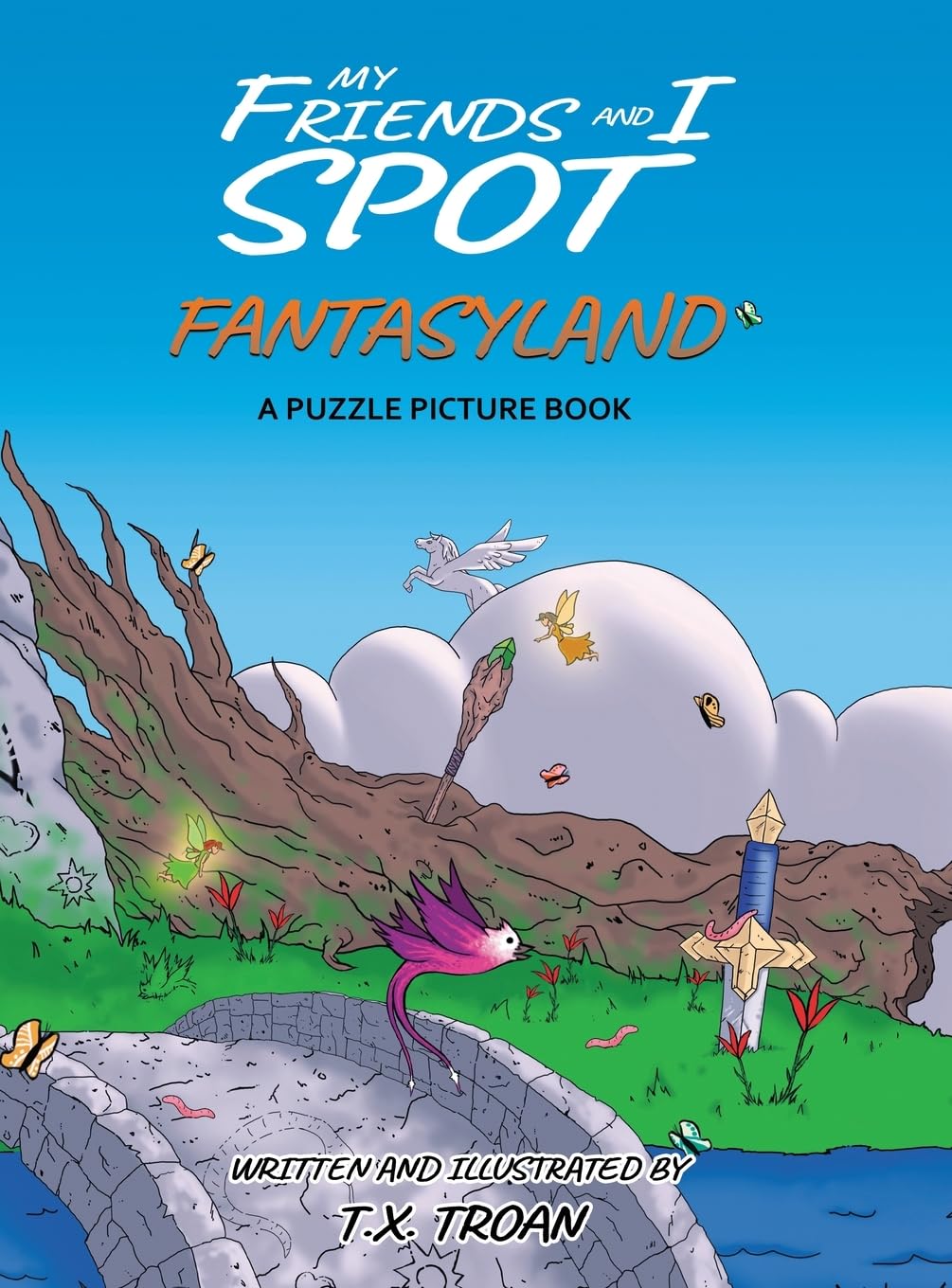
My Friends and I Spot Fantasyland is the kind of puzzle book that feels like story time and play time rolled into one. It follows Evan and Page through a colorful fantasy world packed with hidden objects, magical creatures, and fun little surprises on every page. What makes it especially charming is that it doesn’t just ask children to read, it invites them to look closer, explore, and really interact with the book. It has that classic hidden-object appeal, with the same kind of excitement that made those puzzle pages in kids’ magazines so memorable.
One of the things I appreciated most is how fun this book feels. The illustrations are charming, and that gives the whole adventure a warmth and personality that really works for this kind of picture puzzle book. The artwork is bright, imaginative, and full of detail, so younger readers can still enjoy the search-and-find elements without getting frustrated. I also liked that there’s a light storyline running through the book, which gives children a reason to keep turning pages instead of just treating it like a random collection of puzzles.
The digital version works perfectly too, since kids can take it anywhere and enjoy the search-and-find fun on the go. The story has a fun old-school feel that reminds me of a classic text adventure mixed with a traditional search-and-find book. There isn’t a lot of text to read, but readers will find plenty of fun in soaking up the details on each page.
My Friends and I Spot Fantasyland is a fun and imaginative puzzle picture book that is perfect for children who love spotting hidden details and exploring fantasy worlds. The real joy is in the adventure of searching through each scene and discovering all the little touches tucked into the artwork. It’s an entertaining pick for children, a great shared activity for families, and the kind of book that can easily be enjoyed in classrooms. It seems like the sort of book that could keep kids happily busy while also entertaining adults.
Pages: 38 | ISBN : 978-1999481384


