Blog Archives
A Serious Answer

So You Want To Be A Vaccine Developer introduces young readers to immunology, vaccine science, and medical research in an honest and accessible format. What age group did you imagine while writing the book?
The series is officially designated for ages 10 to 14, and that’s the reader I write toward — but I aim a little high on purpose, because kids are almost always more capable than the market assumes. I wanted Vaccine Developer to read like a conversation with a future colleague, not a pitch to a customer.
What was different about this particular title is that today’s kids already have a vocabulary their parents didn’t have at their age: mRNA, clinical trials, antibodies, Phase 3. They watched a vaccine arrive in real time during COVID. They have questions — real ones, sometimes hard ones — and they deserve a book that answers them honestly.
All that said, this is genuinely one of the most science-heavy books in the series because that is simply the nature of the work. You cannot tell the story of vaccine development without immune cells, antigens, and the elegant logic of how the body learns to recognize a threat it has never seen before. Striking the balance between accessible and overly technical was harder here than on almost any other title. I’ll admit there was a moment when I considered directing this one to a higher age range — and then I caught myself, because that would have meant neglecting the very 10-year-olds who are already asking these questions and deserve a serious answer. The reach is the point. Pushing the book up the age ladder would have been the easy choice; meeting children where their curiosity actually is took more work.
So I wrote for the curious 10-year-old, trusted the 8-year-old to reach up, and trusted the 14-year-old to find elements that deepened their understanding. So far, some of the 8-year-olds have been the most ferocious readers of all!
The book emphasizes teamwork, patience, and responsibility. Do you think those parts of science are often overlooked in children’s media?
Constantly. The dominant kid-science story is the eureka moment — apple falls, lightbulb appears, world changes by Tuesday. Real science looks almost nothing like that. A vaccine candidate identified in the lab today probably won’t reach the public for 10 or 15 years, if it gets there at all. Most experimental vaccines fail. The work is patient, collaborative, and frequently disappointing — and it is still one of the most beautiful careers a person can have.
I don’t think kids need to be protected from that picture. If we tell them science is a string of breakthroughs and then they meet the real thing, the letdown is much bigger than the truth would have been. Patience, teamwork, and the willingness to be wrong are not the boring parts of science. They’re the substance of it. A book that hides them is doing a child no favors.
What was the most rewarding part of creating this book?
Researching and writing the Katalin Karikó section, without question. Here is a biochemist whose university demoted her, whose grant applications were rejected again and again, who came close to walking away from science altogether — and whose stubborn decades of work on a molecule almost no one believed in became the foundation of the mRNA vaccines that protected the world during COVID. The Nobel Prize arrived in 2023, long after the work that earned it.
I wanted a generation of children who lived through the pandemic to know her name, because her story carries a truth I think every young person deserves to hear early: being dismissed by institutions does not determine the worth of your work. And the willingness to keep going on an important problem when no one is paying attention — when the funding dries up, when the title gets taken away, when the consensus says you are wasting your life, when peer pressure is at its strongest — is a quiet form of courage, and it is the kind that changes the world more often than the loud kind.
I cannot teach that in a paragraph of advice. But I could tell a true story about a person it actually happened to, and let the story do the work. That is what made writing this section the most rewarding part of the project. It’s a lesson I wish I had learned earlier in my own life, and one that many adults are still trying to learn. Handing it to a 10-year-old, in the form of a real woman whose name they will now remember, felt like something worth doing.
What is the next book you are working on, and when will it be available?
I tend to work on a dozen titles at any one moment and publish each one only when it feels ready — which means my “intended order” is always evolving. I was thrilled to release So You Want To Be A Diplomat and So You Want To Be A Coder (Computer Programmer) a few days ago, and I’m currently working on a cluster I’m excited about, including Judge, Lawyer, Teacher, Therapist, and Activist. After a long run inside the science and engineering careers, the shift to professions built on language, judgment, and human nature is using an entirely different muscle, and I’m having a wonderful time with it. Readers can expect those to roll out in the coming weeks.
Author Links: GoodReads | Website | Amazon
Years of it. And somewhere on the other end of all that effort is a child who will never get sick from a disease that once killed millions.
So You Want To Be A Vaccine Developer takes young readers ages 10 to 14 inside one of the most demanding and genuinely world-changing careers in all of science. Not the headline version — the real one. The years of immunology, microbiology, and medical research that happen before a scientist ever designs a vaccine candidate. The painstaking discipline of teaching the human immune system to recognize a threat it has never encountered, by presenting it with something that mimics the danger but cannot cause the disease.
This book goes far beyond how vaccines work. It follows the entire journey — antigen design, laboratory science, preclinical studies, clinical trials across thousands of volunteers, manufacturing scale-up, cold-chain logistics, and the regulatory review that ensures every single dose reaching a clinic anywhere in the world is safe and identical. It introduces the team behind that work: immunologists, virologists, structural biologists, statisticians, manufacturing scientists, regulatory specialists, clinical researchers, and the people who navigate the intersection of medical ethics and public health.
Young readers will also explore the history of vaccination — from the legendary curiosity that led to the eradication of smallpox and the dramatic decline of polio, to the decades of stubborn mRNA research that made the COVID-19 vaccines possible in less than a year. They will discover what it actually takes to build this career: the scientific rigor, the patience through setbacks and failed candidates, and the moral seriousness required when your work determines whether an outbreak starts or never happens at all.
Illustrated and written with the honesty that kids this age deserve, this book does not talk down to its readers. It brings them all the way in. It explains how the immune system learns, remembers, and defends. It shows why vaccines are among the most powerful tools in the history of medical science. And it offers real guidance for young people curious about whether this STEM career might be their calling.
For the kid who hears about a disease being defeated and does not just feel relief — they immediately want to know how it was done, and who did it. Every vaccine ever made began with someone who turned curiosity into discipline, ran the experiments, and stayed with the work for the years it took.
Maybe that someone is you.
Education and Adventure
So You Want To Be A Treasure Hunter takes young readers inside the world of archaeology, focusing on the tools and dating methods in reader-friendly terms children can understand. Did you learn anything that surprised you in your research?
The biggest surprise was learning that the most responsible thing an archaeologist can do is sometimes nothing at all. I had assumed the discipline was about digging more, finding more, knowing more. It turns out the professional consensus today is to leave most sites untouched — because every excavation destroys the very context it studies, and the scientists who will read these sites 50 years from now will have tools no one alive today has imagined. That kind of restraint, that quiet deference to the future, struck me as profoundly humble in a way I hadn’t expected from a field I associated with adventure.
The other surprise was how many of the most famous discoveries were complete accidents. The Rosetta Stone was found by a French officer digging a fort foundation. The Terracotta Army was found by farmers digging a well. Mary Leakey’s hominid footprints arose from a paleontologist ducking a flying piece of elephant dung. The myth of the methodical archaeologist cracking ancient mysteries is partly true, but the messier truth is that the past has a habit of stepping out and waving.
Why do you think so many children are naturally fascinated by buried objects and ancient history?
Children haven’t yet been trained out of believing the world holds secrets. An adult walks past a patch of disturbed dirt; a child crouches down. An adult sees a rusted button in the gutter; a child wonders who lost it. That instinct — to suspect that the ordinary world is hiding something magical — is exactly the instinct archaeology rewards. It is one of the few fields where the question that comes most naturally to a seven-year-old (“what’s under there?”) is also the question that drives world-class research, and where the answer is uncertain until somebody picks up a brush and finds out.
I also think children are drawn to the past because they can sense, without anyone explaining it, that someone else has lived here before. The idea that another child once played in this field, dropped this clay marble, scratched their name into this brick — it doesn’t feel abstract to them. It feels like a friend they haven’t met yet. Archaeology gives them the tools to reach back and say hello. It tells them they are part of a very long line of people who have wondered what the world is and tried to leave it slightly more interesting than they found it.
There is one more piece, and it might be the most important. Children live in a world where almost everything has already been explained to them by an adult. Archaeology is one of the rare subjects where the adults openly admit they don’t know — where a Bronze Age civilization can vanish without explanation, where a script can sit undeciphered for centuries, where a sealed tomb might still hold a queen no one has ever heard of. To a child, the existence of genuine mystery — mystery that even grown-ups haven’t solved yet — is electrifying. It means there’s still room. It means the work isn’t finished. And it means that the curious child reading the book in their bedroom tonight might, one day, be the person who finally figures out what nobody else could.
The book balances education with adventure very well. How important was it that learning still felt exciting and imaginative?
Essential — but I don’t think of education and adventure as needing to be balanced like flour and sugar in a recipe. The adventure is already inside the truth. The writer’s job is to find it and get out of its way.
Archaeology is a vivid example. The trowel really does strike something a thousand years lost. The first human eyes on an object in fifteen centuries really are yours. A pollen grain trapped in a clay pot really can tell you what someone ate for dinner during the reign of an emperor. None of that needs dressing up. The excitement isn’t a decorative element a writer sprinkles on top of dry information to make it palatable — it is embedded in the actual work, woven into how the discoveries are made and what they reveal.
What I try to do is find the moments where the truth itself is already astonishing and let those moments carry the explanation. The point of the writing is to choose, out of everything that could be said about a profession, the details that already carry the charge — and then to render those details cleanly enough that the charge actually reaches the reader.
The other half is not to flatten what’s already vivid. I think children’s nonfiction often goes wrong by trying to make work sound easier, simpler, or safer than it really is. Kids see through that instantly. They can tell when a book trusts them and when it’s hedging. What I aim for, in every title in this series, is to meet a child eye to eye — to give them the real texture of a job, including the hard parts, and trust that the wonder will hold. It almost always does. The world is more interesting than the watered-down version of it, and children, more than anyone, already suspect this.
If you could take young readers to one archaeological site anywhere in the world, where would you choose and why?
Pompeii. Not because it’s the most beautiful site in the world, but because it’s the one where archaeology’s central insight lands with the most force: every life mattered.
When Vesuvius erupted in AD 79, it sealed an entire ordinary morning in volcanic ash. Bread still sat in the oven. Dogs were still leashed in their courtyards. A child had set down a wooden toy minutes before the world ended. None of these people made the history books. They weren’t emperors or generals. But 2,000 years later, archaeologists know what they had for breakfast, what they wrote on their walls, who they loved, who owed them money. Pompeii is the proof that ordinary lives are not lost — they are simply waiting for someone patient enough to read them.
I would want a child to stand on those streets and feel, in their own bones, that one day someone might walk where we walk and wonder about us with the same tenderness. That, more than anything, is what I hope archaeology teaches the next generation to carry forward.
Author Links: GoodReads | Website | Amazon
So You Want To Be A Treasure Hunter takes young readers inside the real world of archaeology — not the movie version with booby traps and rolling boulders, but something far more fascinating. This is the story of how actual treasure hunters work: the years of study, the painstaking science, and the moment when a fragment of something ancient emerges from the earth and rewrites everything we thought we knew.
What does a real archaeologist do all day? How do they know where to dig? What happens when they uncover an artifact that has been buried for centuries — and how do they keep it from crumbling the moment it touches open air? This book answers those questions honestly, with vivid illustrations and writing that never talks down to its readers.
Inside, you will discover how ground-penetrating radar and remote sensing let scientists see beneath the surface before a single shovelful of soil is moved. You will learn how stratigraphic layers — the earth’s own timeline — help archaeologists read thousands of years of history recorded in the ground itself. You will explore the careful science of artifact conservation, the physical demands of fieldwork, and the intellectual detective work that turns a broken pottery shard into a window on a lost civilization.
This is also a book about careers — what it actually takes to become an archaeologist, from the geology and history you study in school to the fieldwork, laboratory analysis, and scholarly research that fill a working scientist’s life. It covers the history of archaeology itself, from the early days of treasure hunting to the rigorous science it has become, and the remarkable people who made that transformation happen.
But most of all, this is a guide for the kid who picks up every arrowhead, every old coin, every fragment of something mysterious — and feels not just curiosity but a deep hunger to know the story behind it. The kind of kid who looks at an ancient civilization and wants to understand the people who lived there, not just the objects they left behind.
The past is not gone. It is buried. And the next great archaeological discovery is still out there, waiting beneath the ground for someone who knows how to look.
Counterintuitive Truths
So You Want To Be A Deep Sea Diver is an illustrated guide that shows young readers that deep-sea diving is both an adventure and a serious, disciplined career. What is the most rewarding aspect of writing guides for young readers?
Children are the most honest readers. Adults will keep going out of politeness, or because they paid for the book, or because someone gave it to them. Children won’t. If a page bores them, you’ve lost them, and no amount of well-meaning framing will win them back. That’s not a problem; it’s a gift. It forces a writer to be useful on every page, to trust the reader’s intelligence, to leave out the throat-clearing that fills so much adult nonfiction.
The most rewarding part, though, is knowing that somewhere a child is sitting cross-legged on a bedroom floor, holding one of these books, reading about a job they didn’t know existed three days ago — and a small door is opening inside them. Maybe it stays open. Maybe they grow up and become the deep-sea diver, the archaeologist, the dinosaur hunter. Maybe they don’t, and the book just plants the idea that the world contains more possibilities than any one childhood can hold. Either outcome is enough.
Were there scientific concepts that were especially difficult to translate for younger readers without oversimplifying them?
The hardest one was the physics of breathing at depth — the strange truth that the same air you breathe safely at the surface begins to behave like a drug if you go deep enough. Nitrogen narcosis is one of the most peculiar phenomena in human physiology, and I wanted children to understand that, not just nod past it.
The second hardest was explaining why technical divers at extreme depth breathe gas mixtures with only three percent oxygen — a mixture that would put a person to sleep at the surface. The metaphor I landed on was a lock and a key: the gas has to match the depth exactly. Pressure changes the lock, and the gas has to change with it.
What I’ve learned, again and again across this series, is that children handle counterintuitive truths better than most adults assume. They don’t need the science softened, but they need it told well (which can be a challenge).
Notably, my first draft of this book was much drier than what eventually went to press, because in my attempts to delve into the science, I let safety and risk take over the narrative. The protocols are real, and they matter — but a book that leads with caution buries the very thing that makes a child want to learn the caution in the first place. If the child does not feel the wonder first and understand the draw, the precautions are just rules, and rules without reasons are the fastest way to lose a young reader. So I started over. The redraft was about putting the beauty back where it belonged: at the front of the story, where it lives in real life.
Was there one behind-the-scenes role in deep-sea operations that surprised you most?
The standby diver. On any serious dive operation, there is one person who suits up in full gear at the start of the dive and stays that way the entire time — fins, tank, regulator, ready to enter the water inside seconds. They (generally) never get to make the dive. Their job, as I came to think of it, is to be a goalkeeper: alert, watching, prepared, and hoping with everything in them never to be called.
I love that role because it captures something children don’t always learn from the stories they’re told about heroism. The standby diver doesn’t get the photograph. They don’t get the discovery. They don’t even get wet on most days. And yet without them, the dive doesn’t happen, because no responsible team enters dangerous water without someone ready to come after them.
That is one of the best lessons the ocean teaches: being ready is its own job. Some of the most important people in any operation are the ones whose value is measured by what didn’t go wrong.
What do you hope this book teaches children about adventure — that it is not only excitement, but preparation, teamwork, and learning how to face the unknown?
Yes — and one thing more. I hope it teaches children that fear is not the enemy. Panic is.
That distinction is one of the oldest lessons in diving, and it’s one I most hoped kids would carry out of this book and into the rest of their lives. Fear keeps you sharp; it tells you something matters. Panic makes your body move before your brain can stop it. The difference between the two is learning and training — the willingness to spend years preparing for a moment that might last seconds. A diver who trusts their training can be afraid and still safe. A diver who doesn’t can be unafraid and in real trouble.
Adventure, in the deep-sea diver’s life, is not the opposite of preparation. Preparation is what makes the adventure possible. I’d love for every child reading this book to grow up understanding that — for diving, and for everything else.
Author Links: GoodReads | Website | Amazon
So You Want To Be A Deep Sea Diver is an illustrated nonfiction guide for young readers ages 10 to 14 who want the true, complete answer to that question. It follows the path from a kid’s first fascination with the deep ocean all the way through open water certification, advanced dive training, saturation techniques, and the most extreme underwater operations on earth — welding, construction, salvage, scientific research, and marine exploration in conditions most people cannot imagine.
Inside, you will discover the real science of deep diving: how pressure works on the human body, why the wrong gas mixture at depth can be fatal, how decompression keeps divers alive, and what it means to live in a pressurized chamber for weeks while working hundreds of meters below the surface. These are not simplified facts stripped of their meaning. This is the actual physics and physiology, presented clearly and honestly for readers who deserve more than a surface-level overview.
You will also explore the world divers enter — a place of crushing cold, near-total darkness, and strange deep sea creatures and ocean animals that thrive where sunlight never reaches. You will learn about the teams of dive supervisors, saturation technicians, and support crews who make every descent possible, and the absolute calm that divers must bring to emergencies that can only be resolved in slow motion, because panic at depth costs lives.
This book does not talk down to kids. It brings them all the way in — into the training, the discipline, the wonder, and the weird and extraordinary reality of a career spent in the deepest places human beings can go. It is honest about the difficulty, specific about the science, and deeply respectful of the young reader who feels the pull toward something most people will never experience.
Most of the ocean remains unseen by human eyes. The divers who go deepest are going somewhere almost no one has ever been. Maybe one day, that diver will be you.
So You Want To Be An Animal Rescue Worker


So You Want To Be An Animal Rescue Worker is an informative, heartfelt, and surprisingly honest guide for young readers who love animals and may be curious about a future in rescue work. Written for middle-grade readers, especially ages ten and up, this book goes far beyond the simple idea that rescuing animals is just about cuddling puppies or helping cute wildlife. It gives children a realistic look at the patience, courage, knowledge, and emotional strength required to care for animals in need.
One of the book’s greatest strengths is how clearly it explains the real work behind animal rescue. Readers learn that rescuers must understand body language, move slowly around frightened animals, follow laws and safety rules, and sometimes make difficult decisions when resources are limited. The book doesn’t hide the heartbreaking parts of the job, such as compassion fatigue or the reality that not every animal can be saved. This honesty makes the book more powerful because it helps young readers understand that rescue work takes dedication as well as kindness.
The book is also filled with fascinating examples that bring the profession to life. Wildlife rehabilitators feed orphaned birds with puppets so they do not imprint on humans. Caregivers at Kenya’s Sheldrick Wildlife Trust sleep beside orphaned elephants. Search-and-rescue dog handlers even stage “practice finds” to keep their dogs encouraged during long searches. These details make the book exciting and memorable while showing that animal rescue involves science, problem-solving, teamwork, and deep compassion.
Another excellent feature is the inclusion of real-life heroes such as Jane Goodall, Betty White, Cleveland Amory, and Sterling “TrapKing” Davis. Their stories show children that helping animals can take many forms, from hands-on rescue to advocacy, education, fundraising, and public awareness. I especially appreciated how the book explains that helping animals often helps people too, such as when a rescued dog becomes a comforting companion for a child. This broader perspective gives the book emotional depth and helps readers see animal welfare as part of a larger community.
The illustrations are another highlight. They make the book visually engaging and help young readers connect with the material. The “Day in the Life” section is especially useful for older children because it shows what a rescue worker’s schedule might actually look like. The glossary is also a valuable addition, introducing real rescue terminology in a way that builds vocabulary and confidence.
So You Want To Be An Animal Rescue Worker is an excellent resource for children who love animals, classrooms studying careers, or families who want to encourage empathy and responsibility. It’s educational, accurate, engaging, and compassionate without being overly sentimental. This book shows that animal rescue is rewarding, but also demanding, and that even young people can begin making a difference. For any child who has ever seen a hurt animal and wanted to help, this book is a wonderful place to start.
Pages: 38 | ASIN : B0GZF47278

So You Want to Be A Candy Scientist
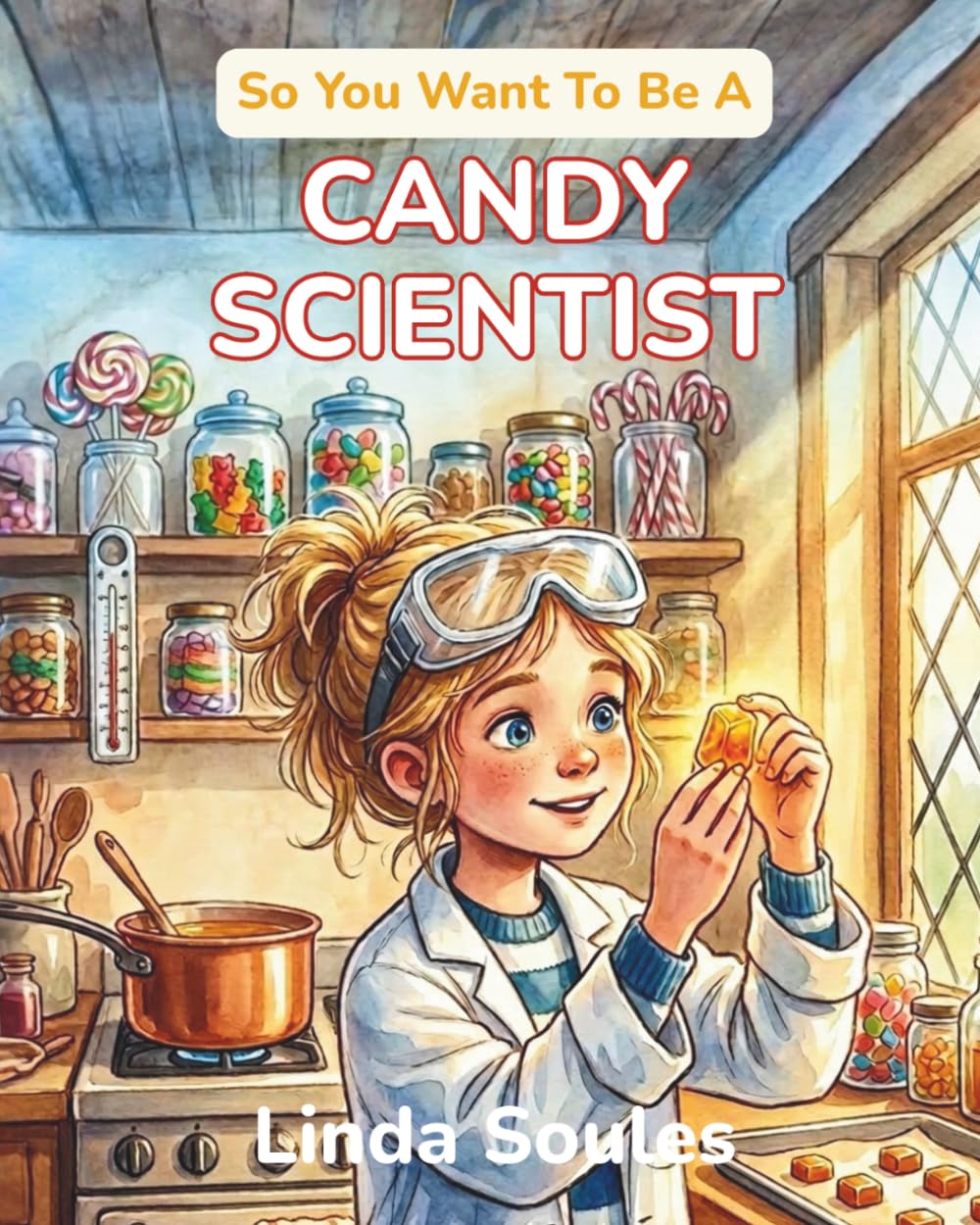
So You Want to Be A Candy Scientist is a delightful and informative children’s book that turns candy into a gateway for scientific discovery. Written for curious young readers, the book explores the fascinating work of candy scientists, showing how chemistry, creativity, and problem-solving come together to make the treats kids know and love. From gooey caramels and crunchy lollipops to chocolate that melts just right, Soules explains how small changes in temperature, texture, and ingredients can completely transform the final product.
One of the book’s greatest strengths is how accessible and engaging it makes STEM concepts feel. Rather than reading like a textbook, the book feels conversational and inviting, helping readers understand topics such as sugar stages, chocolate tempering, sour candy chemistry, and the science behind color and flavor. Young readers learn that a lollipop is technically glass, cotton candy is mostly air, and chocolate gets its satisfying snap from carefully formed crystals. These fun facts make the science memorable while encouraging children to keep asking “why.”
Author Linda Soules also does an excellent job introducing the real people and teamwork behind candy making. Readers meet pioneers such as Harvey Wiley, Milton Hershey, and Rebecca Robbins, whose discoveries helped shape candy safety, shelf-stable chocolate, and food coloring research. The book highlights that being a candy scientist is not just about tasting sweets all day; it takes patience, careful testing, communication, and the willingness to try again when experiments fail. This career-focused angle makes the book especially useful for classrooms, STEM lessons, and career exploration units.
The hands-on experiments and reference materials at the end make this book even more valuable. Activities such as growing rock candy, making edible sugar glass, and testing chocolate snap allow children to turn their own kitchens into mini laboratories. The colorful illustrations, clear explanations, glossary, and next-step resources all work together to inspire curiosity long after the final page. So You Want To Be A Candy Scientist is a fun, educational, and inspiring read for families, teachers, and young learners who want to discover how science helps make the world a little sweeter.
Pages: 38 | ISBN : 978-1972766590
So You Want To Be A Fashion Designer

So You Want To Be A Fashion Designer, by Linda Soules, is an inspiring and highly engaging introduction to the world of fashion design for young readers. Written for kids ages 10 to 14, this illustrated guide follows the creative journey of a garment from the first rough sketch to the runway. Soules presents fashion as far more than glamorous clothes; she shows it as a form of communication, identity, problem-solving, and wearable art.
I loved how the book balances the excitement of fashion with the realities of the profession. Readers learn that designers must think like artists, engineers, storytellers, material scientists, and problem-solvers. The book explores trend forecasting, fabric choices, sketching, sewing, garment production, and the teamwork involved in bringing a collection to life. It also doesn’t ignore the more difficult parts of the industry, including tight deadlines, copied designs, sustainability concerns, waste, and the importance of fair treatment for workers.
Soules fills the book with fascinating history, memorable facts, and stories of creative visionaries such as Coco Chanel, Virgil Abloh, and Issey Miyake. Young readers will be surprised to learn details such as the origins of high heels and the extraordinary amount of handwork that can go into a single haute couture gown. The hands-on activities are especially valuable, encouraging readers to start a sketchbook, drape fabric, redesign or repair garments, and begin thinking like designers right away. The glossary and “The Most Important Qualities of a Fashion Designer” sections make the book feel practical.
This is much more than a simple career guide. Linda Soules writes with warmth, encouragement, and respect for her young audience, never talking down to them while still making complex ideas easy to understand. The vibrant illustrations and lively descriptions make studios, fabrics, and runways feel vivid and exciting. So You Want To Be A Fashion Designer is an excellent choice for creative kids, aspiring artists, and anyone curious about how clothing can help people feel seen, confident, and valued. It is educational, realistic, and wonderfully inspiring.
Pages: 38 | ISBN : 978-1972766347
The Actual Experts
So You Want To Be A Toy Designer takes young readers inside the process of making the toys they love, from product testing to the teamwork and problem-solving required. What inspired you to write this nonfiction book for children?
Toys are the first objects in a child’s life designed entirely with them in mind, and I wanted to crack the magic open. Children deserve to see the hundred sketches behind the one toy, the prototypes that ended up in a drawer, the grown adults sitting around a table arguing about whether a teddy bear’s eyes might come loose. There is also something irresistibly humbling about a profession where one of the recurring occupational hazards is watching a child push aside the toy you spent six months on to play with the box it came in. A job that funny and that earnest deserved its own book.
A deeper reason is that kids are the actual experts on toys. They have spent every year of their lives studying the subject with total attention. They have opinions about which toys feel right in the hand and which feel cheap. They know exactly the moment a toy gets boring, and why. They have wished a hundred times that a particular toy did one specific thing differently. Those instincts are not preliminary versions of grown-up opinions — they are the real thing, and toy designers spend their careers trying to listen to children that closely. I wanted a book that handed that recognition back to the reader: you already know more about this than you think you do. The questions you ask about your own toys are exactly the questions designers ask. You are not preparing to enter the conversation. You are already in it.
I also wanted to dispense with the assumption that growing up means leaving toys (and fun) behind. The adults inside this profession are, in the most enviable sense, people who never stopped playing with toys. They build, sketch, prototype, play, and study play, and they get paid to do it. That isn’t a betrayal of adulthood; it is one of its better versions. Toy designers do work children take seriously, even when adults forget how to — and I wanted to take it seriously too.
The book is honest about the challenges of toy design, including failed ideas and redesign. Why was it important to show children that creativity involves trial and error?
Because the lie that good ideas arrive wholly formed and instantaneously quietly damages the children who can’t produce them on demand, which is all of us. The truth is, the thirtieth sketch is usually the good one. Toy designers fail in front of seven-year-olds for a living, and that isn’t a setback. That’s the job.
When a child learns that the toy they love was version fourteen, not version one, something loosens in them. They get permission to be on version three of their own thing and not feel behind. I wanted children to meet adults whose entire profession depends on being wrong, often, and in public — and to see that those adults love what they do. Iteration is not the obstacle to creativity. Iteration is creativity.
What kind of research did you do to show the day-to-day reality of toy designers?
I worked in three layers, because no single source could give me everything I needed.
The first was the historical record, which turns out to be one of the most charming bodies of biography in any industry. Ruth Handler watched her daughter give paper dolls adult roles and realized no toy let girls imagine themselves as adults. Barbie was the answer, named for her daughter Barbara. A navy engineer in 1943 knocked a tension spring off his workbench and watched it walk end-over-end across the floor; his wife named it Slinky. Eddy Goldfarb is 104, holds nearly 300 patents, and still walks out to his garage every morning to prototype on a 3D printer. These stories aren’t decoration. They are evidence of who toy designers actually are: curious, unembarrassed about play, often working at the edge of accident and intention.
The second layer was the present-day craft. I drew on industry reporting, accounts from designers at the major houses, the play-research literature, and — more interesting than it sounds — the ASTM F963 safety standard, which specifies the exact force a part must withstand before a small child can pull it loose. What struck me there was that constraint is not the enemy of creativity in this field; it is the medium designers actually work in.
The third layer was the texture of an actual working day, which neither history nor industry publication will give you. For that, I triangulated until I could build a composite that felt true: the morning safety lab report, the hour of fast sketching where forty-seven drawings get discarded, and three get pinned to the wall, the midday session behind one-way glass watching seven-year-olds pick up a prototype or — worst of all — get more interested in the box.
What I was reaching for, across all three layers, is what I reach for in every title: a portrait a working practitioner would recognize as their own.
What is the next book you are working on, and when will it be available?
The list is long — and continuing to grow! I tend to work on several titles at once and only release them when they feel finished, so the order is always evolving. Most recently, I was thrilled to publish So You Want To Be A Waterslide Tester and So You Want To Be An Astronomer & Exoplanet Hunter, which brings the series to thirty-seven published titles, and I am nowhere near slowing down.
The near-term lineup is one of the most fun stretches I’ve worked on. Several of the upcoming titles have what I think of as the “is that a real job?” factor — ice cream flavor inventor, candy scientist, professional taste tester — careers that delight children before they have even opened the book. I’ve also begun work on a fashion design title for near-term release, and my son is lobbying hard for me to move cryptographer and esports athlete (pro gamer) up the queue. He may well succeed. What I love about this stretch of the series is how wide it is reaching: from the timeless callings to the ones that reflect just how strange and wonderful the working world has become.
If I had to predict the next one to land based on where things currently stand, it would be So You Want To Be A Journalist. But new titles are rolling out continuously through the rest of 2026, and the full list — along with a sign-up for upcoming releases — lives at LindaSoules.com. I would love for readers to come find the one with their name on it.
Author Links: GoodReads | Website | Amazon
This is not a simplified, watered-down look at a fun job. It is a real, honest guide to what toy designers actually do — the years of industrial design training, the child development study, the materials engineering, and the iterative prototyping that happen long before a single toy reaches a shelf. You will discover how designers learn to see the world through a child’s eyes while solving complex engineering problems, and why that combination of imagination and technical skill makes toy design one of the most unique professions a young person can pursue.
Inside, you will follow the full design process from first sketch to working prototype to safety testing. You will learn how designers draw on child psychology to understand how play shapes learning at every age. You will see how teams of engineers, creative designers, and manufacturing specialists work together to turn an idea into something a six-year-old picks up, plays with for hours, and refuses to put down. And you will meet the visionary inventors whose toys became the defining objects of childhood for generations.
But this book goes further than most career guides for kids. It explores the real skills toy designers build — sketching, 3D modeling, materials science, understanding how small hands interact with objects — and shows what young readers can start doing right now to develop those same abilities. Whether you love to draw, build, tinker, or simply take things apart to understand how they work, this book helps you see how those instincts connect to a real profession.
Illustrated throughout with detailed, engaging artwork, this nonfiction guide treats its readers as equals. It brings the same depth and honesty that boys and girls ages 10-14 and up deserve when they ask a serious question about their future. No talking down. No sugarcoating. Just a clear, fascinating window into the craft behind the toys you grew up loving.
The toy that will define the next generation of childhood has not been designed yet. It is waiting for someone with the curiosity, the craft, and the joy to bring it into the world — and that someone might be you.
So You Want To Be A Doctor

So You Want To Be A Doctor by Linda Soules is a smart and engaging career guide for kids who are curious about medicine and want to know what being a doctor is really like. The book makes a great comparison between doctors and detectives, showing how physicians study symptoms, ask questions, and piece together clues to figure out what’s going on inside the body. It introduces young readers to the science behind the profession, from body systems and diagnosis to the tools doctors use every day, while keeping the information clear and approachable.
What makes this book stand out to me is that it doesn’t make medicine look easy or glamorous. Soules is honest about the years of school, the long hours, the pressure, and the emotional weight that comes with caring for people. At the same time, she also shows why the work can be so rewarding. Kids get a real sense of what happens during hospital rounds, how doctors work with nurses and specialists, and how different fields like pediatrics, emergency medicine, surgery, oncology, and research all play a role in healthcare.
The book’s tone is encouraging without talking down to its readers, which is perfect for older kids and young teens who are starting to think seriously about the future. I liked how it focuses not only on knowledge and skill, but also on compassion, teamwork, and emotional intelligence. Doctors don’t just solve medical puzzles, they support patients and families through scary, uncertain moments. That human side gives the book a lot of warmth and makes the profession feel meaningful instead of distant. The illustrations help make the more complex ideas easier to understand, and the fun facts, history pieces, and practical suggestions give curious readers plenty to explore.
Soules also does a wonderful job showing that good medicine isn’t only about tests, tools, and diagnoses. One of the book’s most memorable lines says, “The doctor who listens carefully, who explains clearly, who makes the patient feel heard and cared for – is practicing medicine at its fullest.” That idea gives the book a lot of heart and reminds young readers that compassion is just as important as knowledge.
So You Want To Be A Doctor is informative, motivating, and realistic, making it a strong choice for science-loving kids who think they might want a future in medicine. It’s especially well-suited for readers around 10 to 14, though slightly older kids may get even more out of its details and behind-the-scenes look at the medical world.
Pages: 38 | ASIN : B0GXH1FLS8


