Blog Archives
What’s Normal Is When the Emotion Matches the Circumstance


William W. Hedrick, MD, author of What’s Normal Is When the Emotion Matches the Circumstance, has spent his medical career wrestling with one stubborn question. What is a normal emotion, and when does it become an illness? He walks through his early training, his unease with the DSM checklist style of diagnosis, and his doubts about simple “chemical imbalance” stories. He then builds his own model of six primary emotions, tied to brain centers and neurotransmitters, and he defines “normal” as when the type and level of emotion match the actual situation on a simple one-to-ten scale. Along the way, he folds in cognitive therapy ideas, brain chemistry, addiction to our own internal chemicals, and many case examples to show how his framework might work in real clinics.
I was genuinely pulled in by his main idea that context and proportion matter more than labels. The notion that anxiety in a grocery store and anxiety on the edge of a cliff are not the same thing, even if the body feels similar, clicked for me right away. His definition of normal emotion as “the emotion that fits the circumstance” feels both humane and practical, and I could picture real patients using that one-to-ten scale to check their own reactions. I appreciated the boldness of some of his stronger claims. For example, he treats major depression as almost entirely a rogue “depression center” that drugs must calm, and he is clear about his doubts that talk therapy alone can fully reach it. I understood the logic, and I saw real compassion in his effort to remove blame from people who are suffering, and his stance pushed me to think harder about biology, medication, and responsibility.
Hedrick’s tone stays calm and professional, and he explains brain chemistry and therapy ideas in plain language, with stories, history notes, and even word origins that give the book an old-school charm. Some chapters slow down to take longer side trips into the DSM or historical theories, which helped me see how deeply his ideas are rooted in the broader story of psychiatry. I appreciated how often he brought things back to real people in real rooms.
I came away feeling this book would suit thoughtful readers who like to sit with ideas and do not mind a slower, reflective pace. Primary care clinicians, therapists in training, and medically curious readers who have lived with anxiety or depression themselves would probably get the most from it. If you want to see how one experienced doctor tries to rebuild our understanding of emotion from the ground up, this is a smart and often moving read.
Pages: 128 | ASIN : B0B193TDVK

A Tough Subject

Nurse Florence®, What are Signs Something is Wrong with My Kidneys? follows three curious girls chatting with the school nurse at lunch, who want to learn how the kidneys work and what warning signs to look for. What was the inspiration for your story?
I think that in the year 2026, kidneys are still a little bit of a mystery for many people, so I just thought it would be nice to do a book to inform people of the times when they need to see a doctor.
How do you take complex medical terms and turn them into a story that will not overwhelm younger readers and also entertain them to keep them interested in learning more?
It’s the magic of Dow Creative Enterprises® 🙂
What Nurse Florence book has been your favorite one to write so far, and why?
The dementia book with Lindsay Roberts. We tackled a tough subject and still made it very informative. It took 105 drawings to teach the subject and is our longest Nurse Florence®.
If you could give one book to a group of children to introduce them to your series, what book would that be?
The Nurse Florence®, How Does Our Brain Work? book. The brain is fascinating, and we should all have common knowledge about how it works.
Author Links: GoodReads | Facebook | Website | Essay Contest | Book Animation | Dow Creative Enterprises® | YouTube | LinkedIn | Amazon
Vulnerability Is Strength

The Work In Between is a memoir sharing your experiences of losing over 100 pounds, surviving cancer multiple times, and going through a period of self-reinvention. Why was this an important book for you to write?
I kept getting asked where my book was. People assumed I had written one given my experiences. After a lot of self-reflection, therapy, and conversations, I felt I was ready to tackle a book. To be honest, I wasn’t convinced I had that interesting of a story. I wasn’t sure anyone would care. However, some conversations made it clear that it might be helpful to others, if only to show you can go through some pretty tough stuff and still be a compassionate, successful, and joyful person. So, I wrote it. The response has been overwhelmingly positive.
I appreciated the candid nature with which you told your story. What was the hardest thing for you to write about?
It’s the only way I know how to be. I’m not very good at sugar coating things or only telling one side of the story (i.e., where I only look good). The hardest part was writing about when my brother Eric died. I cried when I was writing about losing all of my family, but Eric’s death was particularly difficult. Still is. I laughed a lot, too, though. I ended up remembering things I had forgotten. Good memories. Happy memories.
How has writing your memoir impacted or changed your life?
I’m happy that it’s resonated with so many people. Writing the book has made me realize I have a lot more work to do. I wrote a chapter in The Backyard Peace Project anthology and got a fantastic response to my chapter about loving ourselves harder when we stumble and fall. I think it’s a really important message to get out there, especially with all of the negativity and skewed reality from social media.
I’ve learned through my book that vulnerability is strength. Most people are tired of branded packages of unrealistic life. I think they are hungry for real, honest conversations about hard things. That’s how we grow. I was once told that I talk about things people usually keep in the shadows. That’s true. I do that because if I try to carry it all alone, it makes me sick: physically, emotionally, spiritually, and mentally unhealthy. We aren’t supposed to walk around with shame and guilt. Talking about it is healing, and it helps others process their experiences. Everyone has experienced hard things; sharing them helps us heal and grow.
What do you hope is one thing readers take away from your story?
That they are worthy just as they are and worthy of love and a good life. It doesn’t matter what the scale says, what other people tell you, or where you started in life. If you want to improve your physical, mental, emotional, or spiritual health, great. Do that. However, you are worthy of love and an amazing life no matter what.
Author Links: GoodReads | Website | Amazon
Witty, frank, and richly thoughtful, The Work In Between is peppered with wisdom from the author’s expertise in the field of Health Communication. Holmes brings an astute eye to the relationship between outward appearances and medical experiences as she draws from her doctoral education and years of service as a hospital executive. And yet, the complex web of stories that characterize The Work In Between extend far beyond Holmes’s own experiences. As this memoir makes clear, we carry family trauma in our bones. Until we do the inside work of facing our demons and declaring our worthiness, we cannot live the full, happy lives we were meant to live.
Easy-To-Use Tactics
Dr. Toad’s Short Book for a Long Memory is a guide that blends humor with practical advice, vivid examples, quirky illustrations, and down-to-earth explanations to show how memory works and how anyone can strengthen it. Why was this an important book for you to write?
Among several reasons, I wanted to be a physician because I receive tremendous satisfaction from helping people with challenges. No longer in clinical practice or teaching, I realized some time ago that everyone—no matter their age—worries about lapses in memory. I knew I could help by offering my simple, easy-to-use tactics.
What is a common misconception you feel people have about memory and learning to improve it?
If you are young, under 40 years old, you worry about looking dumb when you can’t remember someone’s name or phone number. If you are older, you worry about early dementia. A lot of people assume they have a memory problem if they can’t recall everything. Not true! As I describe in my book, forgetting things is common. Good memory does not require brilliance. It only requires a small effort to employ one’s imagination.
Learning to strengthen memory can be overwhelming. What were some ideas that can help readers feel more comfortable with starting this process?
Start with a name you want to memorize. Use your imagination to turn that name into a mental image that is outlandish. If that image makes you laugh, you are on the right track. This may sound silly at first, but it works! Turning one’s wristwatch over and linking it to an item or date is another simple technique.
What is one thing that you hope readers take away from Dr. Toad’s Short Book for a Long Memory?
I hope readers will believe that they truly can improve their memory for things that are important by using the simple, easy-to-understand techniques that anyone can use. They can DO it!
Author Links: GoodReads | LinkedIn | Website | Amazon
Dr. Toad’s Short Book for a Long Memory is the first book in the Dr. Toad series, created to share simple, achievable solutions for the everyday challenges we all face on the path to better health and well-being.
A Trusted Source

Nurse Florence®, What is Albumin? follows three friends who are talking to the school nurse as she outlines what albumin is, its role in the bloodstream, and its significance in overall health. Why was this an important book for you to write?
The human body is amazing, and we should all learn how it operates. Human physiology should be taught from a young age all over the world so that we have societies that perform at high levels due to increased knowledge and healthy living. Nurse Florence® seeks to support that objective.
How much research did you undertake for this book, and how much time did it take to put it all together?
I referenced a research document about albumin from the Mayo Foundation for Medical Education and Research to guide my writing. Nurse Florence® always uses research-based documents to guide all discussions so that the series can be a trusted source of medical information. I review these documents and then summarize the findings into a fifth-grade reading level.
What were some ideas that were important for you to share in this book?
I wanted to make sure the purpose of albumin was clearly stated, as well as issues that can occur if there are low levels of albumin in the blood. Hopefully, this book helps remove a little bit of the complicated mystery that the human body is.
What topic are you currently in the middle of writing a book on?
We have around 150 Nurse Florence® books in production, with a new book published every 3-7 days. We hope to not just bring knowledge to the world, but also motivation for current and future generations to live a healthy life so that we can be as productive and helpful as possible.
Author Links: GoodReads | LinkedIn | Nurse Florence Project | YouTube | Website

Lifelong Learner

Nurse Florence®, What is a Mast Cell? follows three curious schoolgirls and their approachable school nurse, who discuss mast cells and their role in the immune system. What inspired you to write about this topic?
Nurse Florence® seeks to spark a global movement of health promotion and literacy. We explore how the human body works in each book, as well as discuss disease topics with our numerous disease-related books. We will be publishing around 700 books in the series, and this topic finally came up to the top of the list of books needing to be written.
How did you decide what to include and leave out in your Nurse Florence books?
Writing the Nurse Florence® books is an art since we don’t want to overload kids with too much science information, but we need to bring college-level information down to a fifth grader’s level. Every book is a little complicated to write, and I decide what to include out of inspiration from my illustrator’s drawings. Disney might say they have Disney magic to help produce their movies, while we have DCE magic to produce Nurse Florence® books to help even adults stay engaged with each page of the books.
What was the most challenging part of writing these books, and what was the most rewarding?
The most challenging is to decide what info to include, and the most rewarding is getting feedback that whole families are learning from each book.
What is one thing that people point out after reading your book that surprises you?
Grandparents have even said on GoodReads that they are learning. I was surprised at first since I thought I was writing just for kids. I’m happy to hear that everyone is learning. Being a lifelong learner is so important in the world that we live in.
Author Links: GoodReads | Website | LinkedIn | YouTube | Nurse Florence Project | Amazon


The Art of Thinking Critically with Clarity for Optimal Health: Your Longevity Is Determined by How You Think!


The Art of Thinking Critically with Clarity for Optimal Health focuses on sharpening our thinking when it comes to our health. Author Jerome Puryear takes a practical approach, breaking down complex concepts into simple lessons on weighing choices, sorting through misinformation, and making decisions with both heart and reason. He explores ways biases cloud our judgment, how logic strengthens choices, and the tools like emotional intelligence and metacognition that can shape healthier outcomes. What makes it stick is the way he ties everything back to real life, choosing a doctor, weighing treatment options, or simply trying not to drown in endless health information.
Reading it, I felt both challenged and reassured. I appreciated Puryear’s clarity, never hiding behind jargon. Some parts felt a bit heavy with lists and frameworks, almost like a textbook, but that structure also made it easy to digest.
What really stood out for me was his honesty about how messy decision-making can be. He didn’t promise that critical thinking is a magic fix. Instead, he demonstrates that this is a skill we stumble through and build over time. That gave me a sense of relief. I felt less pressure to “get it right” every time. The sections on misinformation and bias also hit close to home for me. I caught myself thinking of moments where I’d trusted a headline or gone with my gut, only to regret it later.
I’d recommend The Art of Thinking Critically with Clarity for Optimal Health to anyone who feels overwhelmed by health choices or just wants to think more clearly day to day. It’s especially useful for people who prefer having a toolkit they can actually use, not just theory. If you want a guide that balances practical advice with a thoughtful framework, this is an essential read.
Longevity for the Lazy
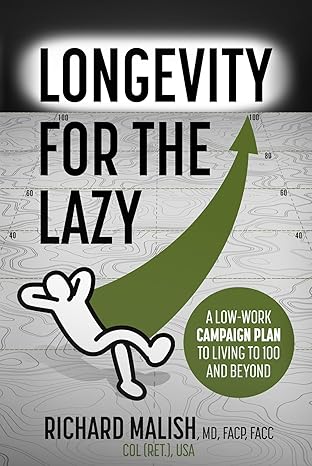
Longevity for the Lazy is a clever, practical, and surprisingly compassionate guide to extending your life without overhauling your entire existence. Dr. Richard Malish, a military physician turned longevity strategist, uses his deep knowledge of public health, cardiology, and human nature to offer a framework he calls the “Longevity Mental Model.” Rather than pitching another trendy diet or rigid routine, the book helps readers understand the major causes of early death, namely atherosclerosis and cancer, and how to fight them with minimal effort. It blends scientific research, history, and strategy into a mental map for living longer, even for those of us who’d rather do the bare minimum.
What I like most about this book is its voice. It’s equal parts seasoned doctor and war-hardened realist, but with an unexpected sense of humor and humility. Dr. Malish writes like someone who’s seen behind the curtain and is now giving you the straight truth without fluff. He acknowledges up front that most people are lazy, and rather than judging it, he embraces it. The book is packed with practical advice, yet it’s never preachy. The core message, kill your killers early and often, lands hard, but he delivers it with enough compassion and realism that I didn’t feel overwhelmed. I appreciated that he doesn’t idealize superhuman health habits. Instead, he arms the reader with simple strategies that don’t require daily marathons or going vegan overnight.
At times, I found myself surprised by how motivating the book was, especially considering its “lazy” theme. It made me feel less guilty for being myself. The military metaphors, enemies, campaigns, and offensive weapons worked better than I expected. They added urgency without melodrama. The science is solid but never dense, and the recurring “Take-Home Messages” made the lessons stick. That said, if you’re looking for glossy photos, flashy life hacks, or someone to tell you aging is optional, this isn’t the book. It’s grounded in reality, and that’s what makes it powerful. It respects your time and your intelligence.
If you’ve ever felt overwhelmed by wellness advice, or if you know what you should be doing but never seem to get around to it, this book is for you. It’s also a great fit for skeptics, minimalists, and anyone who wants to understand the science of longevity without feeling shamed into perfection. Longevity for the Lazy won’t guilt you into green smoothies and CrossFit. Instead, it’ll make you think smarter, act sooner, and want to live better.
Pages: 203 | ASIN : B0DGDBFZ94


