Blog Archives
More Hype Than Anything
The Gestalt in the Machine follows a tech journalist as he’s dragged from covering an AI hype-fest into a deadly conspiracy that forces him to question who’s lying and what it means to be real. What was the inspiration for the setup of your story?
I used to be a tech journalist and I’ve sat through a lot of hype. The bombast and over-the-top promises of PanoptiCon are actually pretty realistic, at least as far as what tech companies claim, and AI is more hyped than anything.
What’s different with AI is that there’s even less skepticism about it than other new technologies, I think because pessimists who might otherwise call out a bubble are instead drawn towards something else: The fear that it will destroy the world. With fans of the technology hoping that it will give them eternal life, the stakes are pretty high.
Adam Arrowman is an intriguing and well-developed character. What were some driving ideals behind his character development?
I wanted the protagonist to have realistic human flaws, which naturally are expressed more as he’s under the stress of investigating a murder. He isn’t some crime-solving mastermind: He quickly gets out of his depth, a feeling I think we all have when dealing with tech giants, and doesn’t necessarily react to that well. Then when he does make progress, he’s often reliant on others.
I tried to do the same with the other characters. Kelvin Clipper is the main antagonist and the book is in some ways a warning about the risks of his worldview, but I hope that readers will be agreeing with what he says at least some of the time. Who wouldn’t want to live forever?
What were some themes that were important for you to explore in this book?
The two big ones are the effects of AI on our society and what happens when the push for an ever-accelerating economy runs up against physical constraints. I think that Singularity vs. Limits to Growth is going to be one of the biggest issues we face in the future, if the machines don’t destroy us first.
The book isn’t just about that, though. It’s a story of young people trying to make it in a world many see as doomed, of a devastated media that’s left a smoldering crater in place of consensus reality, and of where we invest our hopes for salvation following the death of God. And, I hope, an exciting thriller.
What is the next book that you are working on, and when will it be available?
When I was writing the book, I thought it would be one and done. Not because I’d run out of things to say, but because AI was progressing so fast that I assumed it would replace human authors before I had a chance to write another.
Now I’m not so sure: Though the Internet is drowning in AI slop, a language model still can’t match a good human writer. I think the reason I was wrong isn’t so much because AI has slowed as that it’s moved on to things that are potentially more profitable than stringing words together. In fact, that seems a good topic to write about….
Author Links: GoodReads
His detective work takes him into the world of Kelvin Clipper, an imperious CEO who promises that ever-accelerating artificial intelligence will let him outrun death. Thousands of protesters disagree. Their warning: Infinite growth is an illusion and Big Tech is actually racing toward the extinction of humanity.
Caught in the middle, a band of hackers searches desperately for a way to align algorithms with human needs. More violence hints at a connection to a president threatening World War III, lobbyists trying to free corporations from their stockholders, and an app that claims to resurrect the dead.
Can Adam find the killer before the killer finds him? What secrets did the victim die to protect? And will Clipper’s Singularity deliver immortality in our time, or damnation for us all?
Fate Can Toss a Boomerang: A Murder Mystery
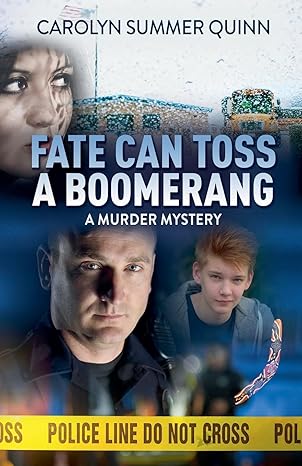

After reading Fate Can Toss a Boomerang: A Murder Mystery by Carolyn Summer Quinn, I can say it’s a mystery that sticks with you for more than just its plot. At its core, the book follows Detective Knox Wanamaker, who is called to investigate a murder in his small Wyoming town. The victim turns out to be Petra Turkett, a long-feared and loathed gym teacher with a dark, abusive past, a predator who managed to evade justice for decades. As Knox peels back the layers of Petra’s history, we’re drawn into a town’s underbelly and a personal reckoning that ties back to his own teenage trauma. The mystery unspools through sharp dialogue, emotional memory, and slow, gritty uncovering of truth.
I was impressed by how bold the writing was. Quinn doesn’t shy away from ugly topics or watered-down feelings. Knox isn’t your slick, emotionless detective. He’s wounded, he’s angry, and he carries his past like a second badge. His voice is raw and real. It felt like listening to a guy telling you his life story. The writing’s straightforward and personal, not fancy or overly stylized, which works here. And the small-town setting, all claustrophobic and cold and oddly cozy, adds to the pressure-cooker feeling. I was invested not just in solving the mystery, but in how Knox would come out the other side.
The story is emotionally heavy. This isn’t your clever-whodunit-with-a-twist kind of mystery. It’s soaked in anger, regret, and trauma, especially around child abuse and how communities fail to deal with it. Sometimes that made it hard to read, especially when the past crept into the present in vivid, painful ways. I found myself torn between cheering on justice and wincing at what justice actually costs. Petra isn’t just a victim, she’s a monster, and the book never lets us forget that. But that raises complicated feelings when you’re rooting for her killer to stay free. It’s messy. But life’s messy, too. I appreciated that honesty.
I’d recommend this book to readers who like character-driven mysteries with emotional depth and moral gray zones. If you like stories that push buttons and leave you chewing on them after the last page, this one delivers. It’s angry and heartfelt and kind of exhausting, but in the best way.
Pages: 174 | ASIN : B0FDDCJ1RW

A Fatal Affair

A Fatal Affair is a cozy mystery with a sharp, sly, character-rich story set in the sleepy town of Nyes Landing, where drama unfolds both on stage and off. The plot kicks off with Officer Callum Nowak dealing with a belligerent actor at a local tavern, and it snowballs into a tangled mess involving poisoned meatballs, backstabbing actors, an ambitious theater production, and one very chaotic opening night. As the small-town cops try to uncover what made a dozen townsfolk sick and nearly killed Oliver Crispin, the reader is treated to a fast-paced, often hilarious, and sometimes poignant whodunit.
From the very first chapter, I was thoroughly engaged. Callum emerges as a compelling narrator, direct, introspective, and burdened with a complex personal history that adds real depth to the narrative. From the opening barroom confrontation with the volatile Crispin, a character who consistently tests the boundaries of acceptable behavior, it’s clear this is no conventional detective story. Williams’s writing is sharp and kinetic, with brisk dialogue and a narrative pace that rarely lets up. Scenes unfold with a kind of controlled chaos, where tension builds only to erupt in the most unexpected ways, such as the unforgettable moment during the theater scene, when guests begin hallucinating and turning on each other in a frenzy of accusations. It’s outrageous, unpredictable, and thoroughly compelling.
Williams also handles the emotional undercurrents of the story with remarkable sensitivity. Callum’s relationships, particularly with his boyfriend, Demetrius, and his longtime friend, Annie, are portrayed with nuance and authenticity. His emotional distance and reluctance to fully embrace intimacy add a compelling layer to the central mystery. Moments like the tense camping discussion, the uneasy dinner with Demetrius and Annie, and the confrontation at the crime scene reveal a man grappling not only with external conflict but with internal scars that refuse to fade. This is as much a story of emotional survival as it is of uncovering the truth.
Some of the dialogue occasionally veers into melodramatic territory. Characters like Daphne, the self-styled diva, and her theatrical circle often feel as though they’ve stepped out of a reality television set, with moments of exaggerated flair that strain plausibility. Lines such as “They’re witches!” or Ernest Drucker’s over-the-top reactions can be both amusing and distracting. However, this heightened drama ultimately suits the tone of the novel. Nyes Landing is a town brimming with unresolved tensions, long-standing feuds, and relentless gossip, and it’s this very turbulence that fuels the narrative’s energy. Even the local goat farm is not without its share of theatrics.
A Fatal Affair is sharp-witted, queer-friendly, and packed with snappy dialogue and messy humans. If you’re into small-town mysteries with theater kids, found families, emotional baggage, and a touch of camp, this book’s for you. Fans of Only Murders in the Building, Knives Out, or even Gilmore Girls with body bags will feel right at home in Nyes Landing.
Pages: 286 | ASIN : B0F9X8ZZR1
The Nature of Artistic Inspiration

Seren follows an art dealer whose pursuit of a dead painter’s final work leads him into a surreal spiral of obsession, identity, and the dangerous power of the muse. What was the inspiration for the set-up of your story?
SEREN is a follow-on to the short story, “Deadfall”, which appeared in the New Guard anthology published a few years ago. Four of the major characters in “Deadfall”—Moss, Seren, Bainbridge, and Haller—are part of the main cast of SEREN. Moss only makes a cameo appearance in the short story but was thrust into a larger role in the novel.
How did your background as a visual artist shape the way you wrote the more surreal or atmospheric passages in the book?
As a painter and Art Professor, I’ve long been intrigued by the nature of artistic inspiration. To personify such a mysterious and elusive element requires the creation of a powerful, and equally mysterious and elusive creature—someone who, through various attributes, can assist artists in transcending themselves. With her, they are able to enter a state of intense limerence where no effort to please is too great.
The muse/artist relationship has generated much interest over the years, by both art critics and social critics. The idea of a deadly muse isn’t original on my part, but the concept of a personification of inspiration/genius always seemed a two-edged sword to me. The fact that history often chooses to diminish or ignore the role of the muse made the job all the more intriguing. The muse’s true story is only hinted at in the novel, but she inhabits the book as much as Moss—just in a different way. The relationship is very much that of lovers.
Margaret Atwood in her essay “MacEwen’s Muse” examines the nature of the muse (this time male) as experienced by Gwendolyn MacEwen the Canadian poet.
“I now know a language so beautiful and lethal
My mouth bleeds when I speak it.
Gwendolyn MacEwen
“You now comprehend your first and final lover
In the dark, receding planets of his eyes
And this is the hour when you know moreover
That the god you have loved always
Will descend and lie with you in paradise.
Gwendolyn MacEwen
I think the ecstasy of the muse could be described as a euphoria so intense it could easily be mistaken as agony.
Fairchild is such a vivid character. Did you always envision him as the protagonist, or did he evolve during the writing?
Moss is composite character loosely based on three individuals I’ve known for a long time. The art world is full of eccentrics, posers, and charlatans, as well as intelligent and talented individuals who are willing to sacrifice much of normal life for their calling. Moss is a flawed and failed human being who hopes to find meaning for his life. Selling the work of creators, but not able to create yourself is a heavy burden. Through Claudine he finds purpose, and connection. With Seren the last vestiges of his middleclass vanities are burned away.
What is the next book you’re working on, and when will it become available?
I’m currently in the middle of a follow-on novel to SEREN—working title AIX—which follows Moss and Claudine to Aix-en-Provence, France, where they pick up the trail of the muse. Given the verities of the publishing process, I’m guessing it will be released in 2026-27.
Author Links: GoodReads | Website | Instagram
SEREN
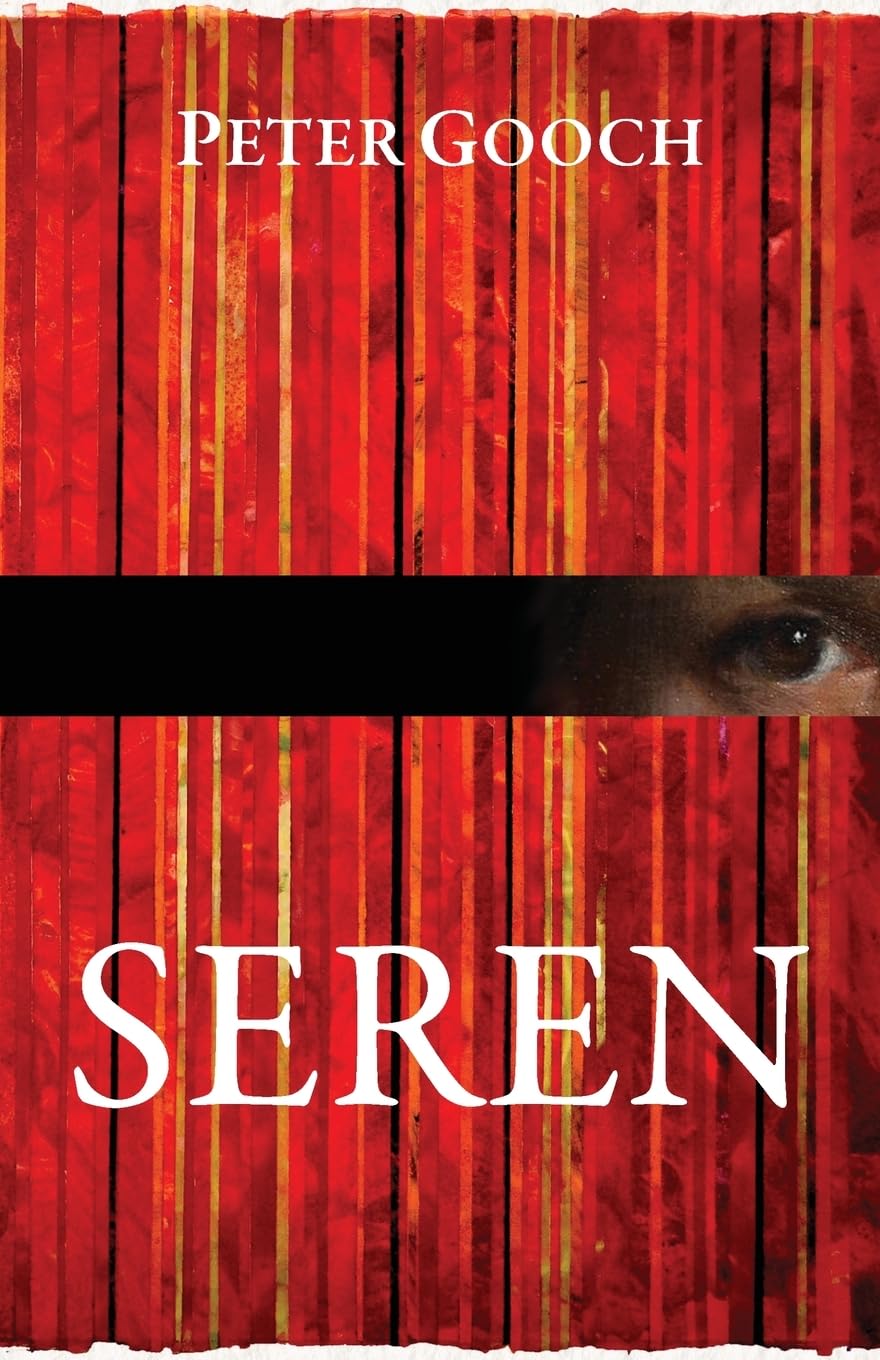

After reading Peter Gooch’s Seren, I find myself marveling at a novel that weaves a murder mystery into the messy fabric of artistic obsession, identity, and legacy. At its center is Fairchild Moss, a once-promising painter turned weary art dealer, who becomes captivated by the final painting of a deceased, reclusive genius, Norris Bainbridge. The titular Seren, model, muse, maybe something more, appears as both a literal woman and a haunting symbol, driving Moss to unravel the truth behind the painting’s strange power. The book shifts between boozy lunches, high-art pretensions, urban decay, and moments of surreal introspection, all with a painterly eye for mood and detail.
What stood out to me most was the writing. It’s deft, sardonic, and at times almost hallucinatory. Gooch has a knack for painting with words, which fits, given his background as a visual artist. The prose rolls like jazz, sometimes smooth and stylish, other times jarring. Characters pop with distinctive quirks, and the dialogue hits that tricky sweet spot of sounding real without being mundane. Moss’s ruminations and side quests, though full of voice, sometimes slow the story. Still, I couldn’t help but be drawn into Moss’s unraveling, both in his investigation and in his own midlife malaise.
The real kicker, though, is the way Seren plays with the idea of the muse, not as a passive, dreamy figure, but as a living force that might inspire or destroy. Seren’s presence is slippery, both ethereal and grounded in flesh and snow and paint. The book doesn’t spell her out, and that ambiguity works. It makes you lean forward, ask questions, and doubt your own reading. I loved how it blurred the line between inspiration and possession, between art and madness. It feels like a meditation on how far someone might go to touch something real in a world of reproductions and sales tags.
I’d recommend Seren to readers who like their mysteries with layers, who don’t mind a story that flirts with the surreal and doesn’t tie every thread into a tidy bow. Artists and art lovers will find plenty to chew on, but even if you’ve never set foot in a gallery, the book’s humanity and humor are what really shine.
Pages: 378 | ASIN: B0DZBLG3Q8
1989: An Eye For An Eye

1989: An Eye for an Eye is a riveting and emotionally tangled novel that centers around a decades-old murder case that left deep scars on a small Southern town. At the heart of the story is Ingrid, a woman haunted by her hidden identity, a web of family secrets, and a burning desire to clear her father’s name. After faking her death to go underground, she returns under a new identity, determined to expose the corruption that destroyed her family. What unfolds is a suspense-filled narrative that weaves together revenge, redemption, and revelations, touching on systemic injustice, identity, and the burden of legacy. With alternating perspectives and past secrets slowly coming to light, the novel drips with tension, building a compelling mystery around who’s guilty and who deserves justice.
I found myself genuinely pulled in by Smith’s writing. It’s not fancy or highbrow, but it’s honest and raw, and that made it powerful. The dialogue feels real, like you’re eavesdropping on two people who have been through hell together. The way he builds emotional weight around every choice Ingrid makes, especially the internal tug-of-war between vengeance and doing the right thing, hits hard. That said, the book has a big cast, and a few times I had to flip back to remember who someone was. Still, the pacing and reveals kept me hooked. It’s a big story with layers of betrayal, hidden ties, and long-buried pain. Every time I thought I’d figured something out, another twist would shake it up.
What really got me was the heart underneath all the thriller elements. The relationships, especially between Ingrid and Nicole, carry the emotional muscle of the story. You see how trauma doesn’t just affect one person, it ripples through generations. And when Ingrid gets her moment to finally breathe and step out of the shadows, you feel it. You also feel the price she pays to get there. The moral ambiguity in this book is thick. You’re constantly questioning what’s justified and what isn’t. And while some characters are undeniably evil, others live in this gray space that makes them unforgettable.
It’s gripping, it’s personal, and it asks big questions without offering easy answers. I’d recommend 1989: An Eye for an Eye to anyone who loves mystery, family drama, or stories about strong women navigating impossible choices. If you’re into slow-burning revenge tales that pack a gut punch, this is your kind of read.
Pages: 278



 LITERARY TITAN