Blog Archives
The Value of Mercy

Mercy Town follows a reporter returning to her rural hometown, who digs into the town’s latest development project, where she is forced to unearth and deal with the long-buried trauma of her younger brother’s accidental death. What was the inspiration for the setup of your story?
My inspiration came from a short story I published many years ago, “When the Sun Kissed the River.” The story ended with the accidental shooting of Bean, Margaret’s younger brother. It focused on the beauty of the natural world and how the arrival of spring stirred joy and excitement in a young boy’s heart. At his sister’s urging, he walked to the little bridge at just the right moment to see the water below sparkle like diamonds. What was a magical moment was also a sudden tragedy. The short story’s ending was not the true ending. I wanted to know what happened to the family and to the town after such a tragic accident and what impact it had on everyone.
I enjoyed the depth of the main character, Margaret. What was your process to bring that character to life?
Bringing Margaret to life was all about exploring the relationships she had with her family, the people of Waunasha, and most powerfully, with Mr. Kipp, the man who accidentally shot her younger brother. Her life emerged through raw, honest dialogue and the emotional weight carried in those exchanges. I focused not only on what she said and did, but also on what she thought—the inner dialogue that revealed her doubts, grief, and resilience. The interactions and private thoughts make a character real.
What were some themes that were important for you to explore in this book?
The value of mercy and the power of unconditional forgiveness were the top two themes that were important to show in this story.
Where do you see your characters after the book ends?
After the book ends, the characters are still healing. Even though it has been ten years since the accidental shooting, the intense emotions of the Payne family and the residents of Waunasha will gradually find a place to settle, finding forgiveness along the way, but never forgetting. Margaret will continue writing feature stories for the newspaper, but with more of an emphasis on how a single, life-altering event can ripple through an entire community. Her parents will feel a new sense of freedom as they learn to accept mercy and forgiveness. The people of Waunasha move on, remembering Mr. Kipp with a more compassionate understanding.
Author Links: GoodReads | Facebook | Website | Amazon
After years away, Margaret Payne returns to her rural northern Wisconsin hometown on a work assignment, only to find it still haunted by the tragic accidental shooting of her younger brother, Bean. Amidst the lingering pain, Margaret uncovers plans for a development on Dell Landing, a hill home to generations of Indigenous people—including Mr. Kipp, the reclusive man responsible for Bean’s death.
With her mother trapped in denial, her father consumed by anger, and a town bitterly divided, Margaret must confront both the past and the present, rising tensions. Facing Mr. Kipp will test everything she believes, but before it’s over, Margaret will discover the freeing power of unconditional forgiveness—even for her brother’s killer.
A poignant, redemptive tale, Mercy Town reminds us how forgiveness, even in the deepest sorrow, heals wounds, binds us as human beings, and remains truly unconditional.
Mercy Town
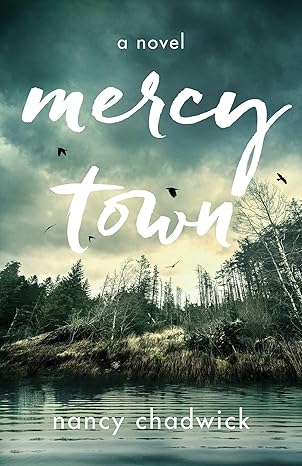

Nancy Chadwick’s Mercy Town is a tender and stirring story about grief, forgiveness, and the roots that keep us tethered to home, whether we like it or not. It follows Margaret “Ret” Payne, a reporter who returns to her rural hometown of Waunasha, Wisconsin, under the guise of a journalistic assignment. As she digs into the town’s latest development project, she’s forced to unearth the long-buried trauma of her younger brother’s accidental death and confront the emotional wreckage that followed. It’s a story that swings between past and present, personal memory and community reckoning, heartbreak and healing.
Reading Mercy Town hit me harder than I expected. Chadwick’s writing is patient. Her prose breathes, settling deep into the emotional grain of things without ever rushing. She’s especially good at capturing the feel of a small town. Its rhythms, its silences, its gossip, its grudges. The scenes between Margaret and her husband Jesse are warm and believable, full of the kind of understated affection that makes a relationship feel real. And Bean, Margaret’s younger brother, is rendered so vividly in memory that his absence aches. Chadwick doesn’t just tell us what loss looks like. She lets us sit with it, wander around inside it, and see how it shapes a life.
Some scenes leaned on introspection and repetition, and the back-and-forth between timelines occasionally blurred the story’s forward motion. Still, I appreciated that the book didn’t sugarcoat the complexity of grief. Margaret isn’t always likable, and she doesn’t have all the answers. But that’s what made her journey resonate. There’s something relatable in her hesitation, in the way she avoids her pain until it corners her. The way Chadwick threads this emotional unraveling through the lens of a journalist chasing a story made for a compelling structure.
I’d recommend Mercy Town to readers who enjoy quiet, character-driven novels with emotional depth. If you’ve ever carried the weight of unfinished grief or struggled to forgive someone (including yourself), this book will feel like a gentle, persistent tug at your heart. It’s not a fast read, but it’s a worthwhile one.
Pages: 248 | ASIN : B0DVD27S8R

Conflict Over the Centuries
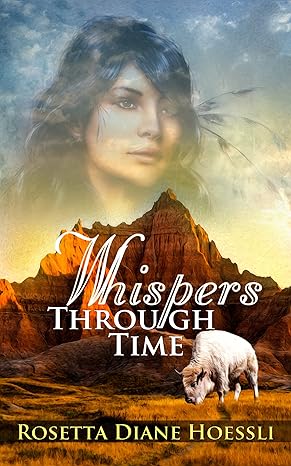
Whispers Through Time follows a successful writer whose life is upended when a former lover reappears with a stack of photographs and a secret about her origins, leading her on a journey of cultural identity and into a decades-old mystery surrounding the American Indian Movement. What was the inspiration for the setup of your story?
The inspiration for Whispers Through Time came from a trip my husband, Kevin, and I made in 2000 to South Dakota, which is a truly magical state. While there, we visited, among other historical places, the Pine Ridge Indian Reservation, the Wounded Knee Memorial, and the American Indian Movement (AIM) Museum, which commemorated AIM’s 1973 Occupation of Wounded Knee. As I stood beside the Wounded Knee Creek, near where the original massacre had occurred, I had a strange, empathic experience that changed my life…and gave me the most important kernel of truth to build on in Whispers Through Time: Heroine Sierra Masters learns that through her newly-discovered Lakota maternal bloodline, she can receive visions that help her ‘see’ historical mysteries and solve them.
The supporting characters in this novel were intriguing and well-developed. Who was your favorite character to write for?
That’s a really hard question because I love them all, but I think – outside of Sierra Masters – my favorite character to write had to be Nathan Winterhawk. He was based on several Lakota elders I met while on our vacation, or have followed over the years. He came to life immediately. His humor and optimism were interspersed with his love of tradition, and his right-below-the-surface, always-simmering rage was almost eerie in its truth. His dialogue and unusual way of expressing his feelings wrote themselves, as did his compassion for Sierra’s situation. He was certainly the easiest character to write because I felt like I knew him intimately after 20 years of research.
What were some themes that were important for you to explore in this book?
These are really great questions – thank you so much! More than anything else, I wanted to tell a really great story.
But I also wanted to show both sides of the White/Indian conflict over the centuries and to explore the vantage point of both ethnicities, from a historical view as well as from the White, without making the novel a political commentary of left vs. right. I think we’ve had enough of that. I also wanted to illuminate to people of all races across the US and the rest of the world the truth about the 1973 Occupation of Wounded Knee, and what AIM was trying to illustrate by taking it over. Finally, I wanted to create a real, honest-to-God love story between a man and a woman that was long-lasting with real heartache that had occurred many years earlier, but still affected them now.
When will Book Two be available? Can you give us an idea of where that book will take readers?
I’m nearly finished with the first draft of Journey of the Heart, Book Two of the Whispers Through Time series, so I don’t know at this time when it will be out. It will take readers into Comanche Indian territory on the Llano Estacado of Texas, a centuries-old treasure hidden in a canyon located on a Panhandle ranch belonging to Sierra’s best friend’s grandfather, and the final truth about a young girl with red-gold hair captured by Comanches during the 1860s.
Author Links: GoodReads | X (Twitter) | Facebook | Ronni Hoessli | Website | Amazon
Hunter Davenport realizes the evidence he’s shared with Sierra could indeed destroy her—but it could free her as well. The decision is yanked from her hands when the past and present collide through a historical portal on sacred Native American land. Will she take the gift that is offered? And will Hunter do what he didn’t do twelve years earlier—stand by her? Only time will give them their answers.
Whispers Through Time
Whispers Through Time follows Sierra Masters, a successful historical fiction writer whose life is upended when a former lover, Hunter Davenport, reappears with a stack of photographs and a secret about her origins. What begins as a deeply personal reunion quickly spins into a tale of political resistance, cultural identity, and a decades-old mystery involving the American Indian Movement, the 1973 Occupation of Wounded Knee, and Sierra’s true parentage. As Sierra navigates her family’s past and her own shattered sense of self, the novel shifts seamlessly between romance, mystery, and historical fiction, creating a rich and emotionally charged story.
What struck me most was the emotional honesty in Hoessli’s writing. Her prose is straightforward and often stark, but that works in her favor. There’s just raw, heartfelt truth. Sierra’s breakdowns, her self-doubt, her fury, and her quiet moments of awe are painted vividly. I felt like I was sitting in that dusty adobe house in Big Bend, Texas. The pacing can feel slow at times, especially when the backstory expands into historical context, but the emotional payoff is worth every beat. The dream sequences and flashes of past trauma are especially affecting.
Sometimes characters drop into exposition mode and sound more like history teachers than people talking. But even then, the ideas they’re exploring, identity, betrayal, legacy, are weighty enough to hold my attention. The relationships, especially between Sierra and her mother, are what really gave the book its weight. Also, Hunter. He’s a classic storm-you-can’t-look-away-from kind of guy. I didn’t always like him, but I couldn’t stop watching him.
Whispers Through Time is a powerful blend of historical fiction, romantic suspense, and contemporary drama. A story about finding the truth, even when it hurts. It’s perfect for readers who crave novels full of long-buried family secrets, emotionally raw relationships, and a deep dive into forgotten corners of American history.
Pages: 276 | ASIN : B098278M38
Raven’s Legacy (A Jonah St. Clair Mystery)


Raven’s Legacy is an atmospheric mystery set in the remote Alaskan village of Koloshan in 1980. At the center is Jonah St. Clair, a war veteran and former LAPD officer turned village cop, who’s suddenly tasked with investigating the shocking theft of sacred Tlingit artifacts from the local Native Arts Center. The heart of the mystery is the missing Raven House screen—a symbol of cultural pride and community history—setting off a tense clash between tradition, greed, and the ghosts of the past. As Jonah digs deeper, he uncovers more than just clues; he finds tangled loyalties, unresolved grief, and a reckoning with cultural identity that makes this story far more than your average whodunit.
The opening prologue, where a young Jonah first lays eyes on the Raven House screen, is quietly haunting. That scene stayed with me, not because of flashy writing but because of the reverence and weight Stuart gives to culture and memory. There’s this moment where elders stand around naming each missing artifact in Tlingit—“Káa yooka.όot’ x’όow,” “Naaxein,”—like they’re reading names off a memorial. It’s a grief not just for stolen objects, but for a fading culture being ripped away in broad daylight.
Stuart’s writing is sharp but not showy. It flows easy, like a local telling a story over coffee—personal, thoughtful, no wasted words. I loved how she grounded everything in real place and texture. Koloshan doesn’t feel like a backdrop—it’s a character. The muddy roads, the rusting buildings, the church steeples clashing with old totems. It all feels lived-in and complicated. Stuart also gets small-town politics and family dynamics just right—the way gossip travels faster than police radios, and how history never stays buried. Especially when we get to the elder characters like Harold and Ray, each with their own ideas about what the artifacts “should” mean. It’s not just mystery—it’s a debate about identity, and who gets to decide what legacy survives.
The pacing drags a bit midway through Jonah’s hunt for leads, especially during the logistics-heavy stretch in Juneau. But even then, there’s always an emotional undercurrent. She writes with empathy. There’s tension, yeah, but also a real sense of stakes for these quiet, ordinary people caught in something bigger than them. Jonah himself is a standout. He’s tough, sure, but there’s a vulnerability there—he feels things deeply, and that gives the story its soul.
Raven’s Legacy is a thoughtful, rich, and emotional mystery with a lot of heart. If you’re looking for a mystery with real depth, layered characters, and a powerful sense of place, you’ll get a lot out of this one. I’d especially recommend it to fans of Dana Stabenow or those who love stories that blend culture, community, and quiet suspense.
Pages: 305 | ASIN : B0F3M8VPPP
The History of Mankind

Desert Guardian follows a young man on a post-graduation trip, who literally falls into a hidden world of illegal artifacts, danger, and unexpected friendships. What was the inspiration for the setup of your story?
The grandeur and other-worldly feel of the gorges, rivers, and hoodoos of Canyonlands National Park provided the inspiration for the set-up of this story.
What were some ideas that were important for you to personify in your characters?
Ethan is a “reluctant hero,” dropped into the setting by accident, so one of his main themes was finding the strength to persevere, uncover the theft of ancient artifacts, and fight not only for his own survival but for that of newfound friends.
What were some themes that were important for you to explore in this book?
Our relationships with the earth, wilderness, and the history of mankind are themes in the novel. The thieves see the artifacts not as precious history but as something to be exploited. Relic, and eventually Ethan, see their connections with the past and the place that shaped it and work to protect them.
What is the next book that you are working on, and when will it be available?
I have a total of six Relic novels and am working on the seventh. It is not likely to be ready for another year or so.
Author Links: GoodReads | Amazon
Get ready for an epic adventurous thrill ride into danger and murder
A moonshining hermit. A campus bookworm. A midnight murder. Can an unlikely duo and a whitewater crew save themselves and an ancient Aztec battlefield from deadly looters? Ethan’s world turns upside-down when he slips off the edge of red-rock cliffs into a world of twisting ravines and coveted artifacts. Saved by a mysterious desert recluse named Relic, Ethan must join a whitewater rafting group and make his way back to civilization. But someone in the gorge is killing to protect their illegal dig for ancient treasures… When Anya, the lead whitewater guide, is attacked, he must divert the killer into the dark canyon night, but his most deadly pursuer is not who he thinks… Ethan struggles to save his new friends, face his own mortality, and unravel the chilling murders. But when they flee the secluded canyon, a lethal hunter is hot on their trail…
Desert Guardian
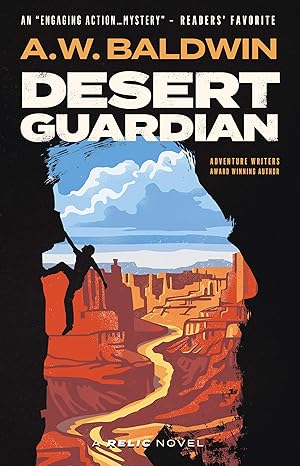
Desert Guardian by A.W. Baldwin is an action-packed adventure set against the vast and rugged backdrop of the American Southwest. The story intertwines past and present, starting with a flashback to a Pueblo ambush on Mexica warriors in 1224 A.D. This historic tension sets the stage for the modern-day narrative, where Ethan, a young man on a post-graduation trip, literally falls into a hidden world of illegal artifacts, danger, and unexpected friendships. After surviving a bike accident, Ethan is saved by Relic, a desert hermit, and the two forge an unlikely bond as they navigate the harsh desert and the shady underworld of artifact smugglers.
The author perfectly captures the wild beauty of the desert, making it a character in its own right. The descriptions are vivid. Baldwin writes with a clear reverence for the setting, and that love of the environment adds depth to the story’s more intense moments. The setting is well-crafted, but the dialogue and character development, at times, feel less polished. Ethan’s internal monologues occasionally lean toward melodrama, particularly when he reflects on his near-death experience, which may momentarily disrupt the immersion. Relic’s gruff yet wise personality shines through, especially in moments where he imparts desert survival tips or shares cryptic advice.
The pacing of the novel is generally quick, with moments of introspection balanced by bursts of action. The scenes involving the artifact smuggling ring are tense and engaging, especially as the reader starts to unravel how deep the conspiracy goes. Boss, the antagonist, is suitably ruthless, and his cold demeanor makes for a chilling counterbalance to the more humane characters like Relic and Ethan. The subplot involving ancient Pueblo petroglyphs and hidden trails gives the novel an air of intrigue that kept me flipping pages, wondering how all the pieces would connect.
Desert Guardian is an entertaining adventure novel for those who enjoy thrillers with a historical twist and a strong sense of place. Baldwin’s love for the desert landscape shines through, and the fast-paced plot will appeal to adventure lovers. I’d recommend this book to anyone who enjoys stories about survival, hidden treasures, and characters who live by their own rules in the unforgiving wilderness.
Pages: 209 | ASIN : B08MB6XL8S
Kernels of Truth

Pennsylvania Fireside Tales Volume 2 is a delightful anthology that captures Pennsylvania’s heart and soul by retelling some of the folktales that have been passed on through the generations. Where did the idea for this collection come from, and how did it develop over time?
My inspiration was both homesickness and books by an early collector of central Pennsylvania mountain stories named Henry Shoemaker. After graduating from Penn State in 1967 I ended up working in New Jersey. I missed the mountains of my central Pennsylvania Tom Sawyer boyhood, and when browsing through books in Princeton’s Firestone Library I found many books by Shoemaker. His stories and descriptions brought home right into my lap since I recognized many of the places and family names he wrote about. After I had read all the Shoemaker materials I could find, the thought occurred to me that I could collect similar tales on my own and write about them. Not only would it give me a chance to roam the mountains I loved once more, but it would also alleviate my homesickness. And it did!
What were some themes that were important for you to explore in this collection of tales?
When I started interviewing people to collect my tales back in 1970, we had just put a man on the moon, and I was looking for old-time Pennsylvania mountain folktales, legends, and human-interest stories whose roots went as far back as the Civil War, and even further back than that. Much to my surprise, the old tales could still be heard, and I’m finding some yet today! In fact, to get my arms around my collection I decided to categorize them into four types:
Native American-based episodes that included legends those aborigines passed on to early settlers related to landmarks and tribal traditions. Much to my delight I also found many human-interest stories handed down through families as oral histories that have never made the history books concerning how ancestors sometimes fought battles with Native Americans, sometimes were captured by them, etc.
Early hunting episodes when there were still packs of wolves and mountain lions in the Pennsylvania mountains, and stories about how people hunted them and were hunted by them – men and women alike, including one Little Red Riding Hood-type episode!
Ghost, witch, and supernatural tales. There’s a strong dose of that no matter which legendary domain you explore, and Pennsylvania is no different. What really surprised me the most when collecting these tales was how deeply rooted the superstitions are that form their basis. In fact, in 1970 I could still find old-timers in the more remote valleys who still believed in the old-time kinds of witches – those who could change themselves into black cats, ride broomsticks, cast evil spells, etc. One old-timer in particular stated, “They say there’s no such things as witches, but they’ll never convince me of that!”
Then my fourth category is kind of a catch-all. Stories of lost treasure, hidden gold, exaggerated animals, gypsies, moonshiners, and whatever else seems part of the genre.
What were some goals you set for yourself as a writer in this book?
Unlike Henry Shoemaker, who I later learned was prone to much exaggeration and romanticization of his tales, and even inventing some on his own, I wanted to preserve the tales as they were told to me, but I also wanted to explore the history behind them. I, therefore, envisioned myself as an investigative reporter to put the tales in historical context, even though most sounded like the proverbial “tall tale.” By doing this I could decide whether the tales have any kernels of truth buried in them at all. Did they have any basis in fact at all, and what were their origins? It has truly blown me away sometimes by what I found using this approach.
What is the next book that you are working on, and when will it be published?
My Sunbury Press publisher has asked me to write a fourth volume for my three-volume Pennsylvania Mountain Landmarks series that they have already published. No publication date has been set yet.
Author Links: Goodreads | Sunbury Press Authors | Pennsylvania Fireside Tales | Website | Amazon
In offering a second volume of Pennsylvania mountain legends and folktales to the reading public, the author does so with a note of appreciation to all who found the first volume of legends of interest – public and press alike. The old stories and folktales which appeared in my Pennsylvania Fireside Tales Volume 1 and which seemed to strike a “chord” within me, also apparently appealed to others as well. Most people like these survivors from a bygone day – a time that was simpler in many ways than this present hectic age. In turn, these “survivors” not only help to perpetuate that feeling of kinship some of us feel toward these rugged Pennsylvania hills, but they also connect us to a rich fabric of history and to the people who lived it. With that link or connection, they cause us to feel closer to the past; our life’s span seems extended, and we seem less mortal. It is with this background, then, that this second volume of Pennsylvania fireside tales is presented for the public’s reading enjoyment. As explained in the first volume of this series, the title “fireside tales” comes from the fact that these stories and legends are variants of, or are exactly like, episodes that were related by early settlers sitting around their fireplaces on cold winter evenings when story-telling was the only form of entertainment by which to relax. Return now to those days of old when the pace was slower and life was harder. Keep in mind, however, that people then seemed content with their lot, finding pleasure in simple things like a wolf’s howl, a panther’s cry, a firefly’s glow, or a flaming sunset sinking slowly behind the everlasting hills.
In this volume:
- The Black Ghost of Scotia
- Juniata Gap
- Through the Veil
- Snakes, Snakes, Snakes
- The Lower Fort
- Spellbound
- Last of the Big Shots
- Haunts of the Highway
- More Snakes
- Little Red Riding Hood?
- Burned at the Stake
- Ridden
- Dead for Three Days?
- Mollie Maguire Memories
- Sitting with the Dead
- The Throwback
- Bloody Run
- Beyond Belief
- Jack’s Narrows
- Nights in the Colby Narrows
- Western Pennsylvania Wolf Days



 LITERARY TITAN