Blog Archives
Like Clockwork: Run Your Business with Swiss Army Precision


Sam Goodner’s Like Clockwork is a pragmatic and well-structured guide to building a business that functions with precision, clarity, and resilience. Drawing on his background as a Swiss Army special forces officer and his experience scaling multiple technology companies, Goodner outlines a systematic approach to operations, leadership, and execution. Each of the book’s 30 concise chapters introduces a core business principle, pairing it with a compelling narrative from his military or entrepreneurial past, followed by clear, actionable strategies. Rather than focusing on grand visions or abstract theories, the book emphasizes building systems that allow businesses to operate efficiently and sustainably regardless of who’s at the helm.
One of the book’s most compelling strengths is its use of personal storytelling to illustrate professional principles. Goodner contrasts his tightly coordinated first day of military training with the disorganized, impersonal experience he had on his first day at Dell. The lesson is clear: a new employee’s first day sets the tone for their entire experience. At Catapult Systems, Goodner made onboarding a priority, introducing structured welcomes, immediate assignments, and even personalized gifts. It’s a simple practice, yet profoundly effective, and one that many companies overlook.
Goodner discusses how he and his team at Catapult codified their organizational wisdom into a set of “Golden Rules,” a compact manual that outlined 60 best practices. He emphasizes the importance of not just creating guidelines, but embedding them in the culture through memorable storytelling. One such story, involving two consultants who damaged a client relationship by arriving late and underprepared, illustrates how even small missteps can have lasting consequences. These stories bring clarity and context to principles that are often treated superficially in other business books.
While the prose is not especially literary or stylistic, it is clear, direct, and well-paced. Goodner writes with a sense of purpose and humility, often acknowledging his own missteps and the lessons they provided. This reflective tone lends credibility to his recommendations and makes the book feel grounded in real-world experience rather than theory. His Swiss Army anecdotes are particularly effective, they serve not as gimmicks, but as thoughtful parallels that reinforce his belief in discipline, preparation, and systems thinking.
Like Clockwork is best suited for entrepreneurs, managers, and business leaders who are actively responsible for building and running operational systems. It offers a highly practical, experience-based framework for leading teams, scaling efficiently, and minimizing chaos through intentional design. While it is not an inspirational read in the traditional sense, its insights are actionable and repeatable. For those seeking lasting operational effectiveness over short-term motivation, this book delivers exceptional value.
Pages: 371 | ASIN : B0F921HN2J

Why Aren’t Things Improving?

Unlocking Innovation introduces leaders to a framework called the ABCs—Behavior, Architecture, and Culture — by blending personal anecdotes, fictionalized case studies based on real people, and practical tools to guide readers through the psychological, structural, and cultural challenges that make or break innovation efforts. Why was this an important book for you to write?
For a long time, I resisted the idea of writing a book. Having spent most of my career in corporate innovation, the one thing I knew for certain was that the world did NOT need another book about innovation! There are thousands, maybe millions, out there, yet none of them have changed the results that corporates get from their innovation investments.
But then it hit me: If there are so many books about how to improve something, why aren’t things improving?
As I reflected on my experiences, patterns emerged: brilliant executives treating innovation like operations, teams getting crushed by unrealistic expectations, and 90% of corporate labs shutting down within three years. But it all boiled down to one thing.
Innovation isn’t an idea problem. It’s a leadership problem.
We’ve got plenty of ideas. What we don’t have are leaders who understand that everything that made them successful operators will doom them as innovators. This book exists because every executive tasked with innovation deserves better than innovation theater and false hope.
What were some ideas that were important for you to share?
First, do the opposite of your instincts. Like George Costanza, if every instinct you have is wrong, then the opposite would have to be right. It’s a simple concept that is incredibly hard to adopt. After all, your professional success created and honed your instincts, so ignoring them isn’t just difficult, it’s illogical. But innovation and operations are opposite worlds, which is why you need to do the opposite of the instincts that made you a successful operator.
Second, stop obsessing over finding the perfect process or structure for innovation. Those things are necessary but not at all sufficient for success. Instead, take a holistic approach by building the ABCs: Architecture, Behavior, and Culture. And focus on leadership behavior first because that’s what makes or breaks innovation investments.
Third, innovation is not an event. Stop wasting time and money on one-off hackathons, shark tanks, and startup field trips. Innovation ROI requires long-term investment not a one-day offsite.
What is one piece of advice you wish someone had given you when you were younger?
“I don’t have time” means “It’s not a priority,” and that’s perfectly fine because not everything can be a priority. As leaders, though, we need to own it and be honest about why we’re not engaging in something. And, as innovators, if we think something should be a priority, we need to work to figure out why it’s not and how to make it one.
Also, reflection isn’t navel-gazing; it’s how you turn experience into wisdom. Make time for it.
What is one thing you hope readers take away?
Success isn’t about beating the odds—it’s about changing lives. Every time you show someone they’re capable of more than they imagined, you’ve won. The real innovation isn’t the product you launch. It’s proving that doing the impossible is actually possible.
Plus, you should definitely have a cookie while doing all this. I recommend chocolate chip.
Only 1 in every 50,000 incubated ideas reaches $1 million in sales. If you ask most corporate executives why their companies’ innovation efforts fail, they’ll blame a lack of ideas or not enough big ideas. Innovation expert Robyn M. Bolton knows that innovation isn’t an idea problem, it’s a leadership problem. To drive real innovation, executives must defy the very instincts and behaviors that made them successful operators.
In Unlocking Innovation, Bolton draws on her twenty-five years of advising leaders to provide a practical, holistic innovation framework. Her ABCs of Innovation show leaders how to reshape their roles, teams, and organizations to create new value and catalyze corporate renewal from within. Using real-life stories, Bolton follows innovation leaders’ trajectories from heading up a new team and generating first results to navigating the inevitable crosswinds, complications, and conflicts—and ultimately delivering success. Unlocking Innovation is the essential guide for any leader tasked with innovating inside an established organization.
Unlocking Innovation: A Leader’s Guide for Turning Bold Ideas Into Tangible Results
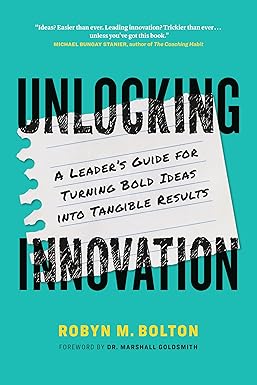
After reading Robyn M. Bolton’s Unlocking Innovation, I can confidently say this book is a grounded, clear-eyed roadmap for any leader tasked with driving innovation inside a large organization. Structured around a three-year journey, the book presents a framework called the ABCs—Behavior, Architecture, and Culture—to help leaders navigate the real-world messiness of turning ideas into results. Bolton blends personal anecdotes, fictionalized case studies based on real people (like Hope, Faith, and Victor), and practical tools to guide readers through the psychological, structural, and cultural challenges that make or break innovation efforts. It’s not about dreaming up ideas; it’s about executing them.
Bolton’s voice is smart and strategic without being stiff. She has a gift for calling out corporate B.S. in a way that makes you laugh. Her stories, especially those that show leaders hitting roadblocks or being sidelined, felt familiar. The emphasis on behavior was a refreshing twist. Most business books obsess over frameworks and processes, but this one starts with the leader’s instincts, habits, and emotional resilience. It reminded me that sometimes, the biggest barrier to innovation isn’t the budget or the board, it’s us. Her advice to “do the opposite” of what made you successful in traditional roles resonated with me.
The year-by-year breakdown sometimes felt rigid, but even then, Bolton anticipates this and builds in flexibility. Her “Know Your” sections and TL;DR summaries are smart additions—like breadcrumbs through a dense forest. And the running joke about cookies was both charming and weirdly effective.
Unlocking Innovation is one of the few business books I’d recommend without hesitation to anyone leading innovation inside a complex organization. It’s especially useful for middle and senior managers who feel stuck between the C-suite’s demands and their team’s frustrations. If you’re tired of fluffy innovation talk and want something that respects both your intelligence and your time, this book is for you.
Pages: 223 | ASIN : B0DTRXX23S

ImmiGRIT: How Immigrant Leadership Drives Business Success

In ImmiGRIT, Ukeme Awakessien Jeter expertly explores the intertwined themes of immigration and leadership, crafting an insightful narrative on the unique advantages that immigrant leaders bring to the table. Unlike many works that treat these subjects separately, Jeter merges them, revealing how the immigrant experience can significantly enhance leadership qualities. This book serves not only as a tribute to immigrant resilience and innovation but also as a practical guide for business leaders aiming to harness the full potential of immigrant talent. The book opens with a historical perspective on immigration, highlighting its profound impact on societal and economic development. From the British settler John Rolfe in the 1600s to modern tech giants like Sergey Brin of Google and Eric Yuan of Zoom, Jeter illustrates how immigrants have been pivotal in shaping industries and driving innovation. These narratives are not merely historical footnotes but powerful reminders of the ongoing contributions of immigrants to the global economy. “Powerful” aptly describes this book.
Jeter also offers a personal perspective from her time as an international student, providing a timeline of her immigrant experience up to her becoming a lawyer and beyond. Her story is a poignant exploration of resilience, adaptability, and determination—qualities that many immigrants embody and that are critical attributes of effective leadership. This personal journey culminates in a compelling argument for the indispensable role of immigrant leaders in today’s globalized society.
Human resource professionals, talent developers, and diversity, equity, and inclusion advocates will find ImmiGRIT to be a treasure trove of insights. Jeter outlines practical tips and real-life examples to create a roadmap for maximizing the benefits of a diverse workforce. Her work is a call to action, inspiring efforts to support immigrant talent, address biases, and facilitate inclusivity in the workplace. One of the most notable aspects of this book is the author’s bravery. Jeter courageously challenges existing leadership paradigms and advocates for a new approach that recognizes and nurtures the unique strengths of immigrant leaders. Her no-holds-barred approach aims to transform how we perceive and cultivate leadership in the modern workplace.
Ukeme Awakessien Jeter’s eloquent and groundbreaking discussion of the immense value of immigrant leadership is a must-read. Her analysis is well-informed, enriched with storytelling, and highly persuasive. This book is both essential and inspiring.
Pages: 196 | ASIN : B0D3M18RHD
We Can’t Avoid Change

CHANGE MATTERS: Stories About Taming the Corporate Jungle and Leading Transformation shares with readers your experience working as a Global Management Change Director and the lessons you learned. Why was this an important book for you to write?
Over the years, many of my clients and former colleagues have told me that those real-life stories, and examples were the best illustrations to demonstrate what my “teachings” are about. It is not just about the theory but about the practical application that catches my stakeholders’ mind and heart. Taking the time to gather those stories, learnings, and shaping them into a book was a truly insightful experience and journey, and I am glad that through this book, I can continue spreading the word for what I believe about why Change Matters in new ways!
What is a common misconception you feel people have about change management?
- That it is common sense (which it is)… yet it is not common practice. We need to simplify and relate!
- Resistance is negative: at first, it might be seen that way, indeed, but we can harness it positively and build on those insights very well.
- One size fits all. While I have managed and consulted on dozens of change and transformation initiatives, there are lots of nuances, and there is no one roadmap to success. It is a collaborative approach.
- Change management is about communication: yes and no. So many leaders think about communications, beautiful posters in the offices and warehouses. It is just one element. Capability building or training is another. However, intentional stakeholder management is the basis for good change management. The three come together.
What were some ideas that were important for you to share in this book?
- We live in a constantly changing world; we can’t avoid change.
- To survive, we need to adapt, and it does not have to be difficult. Acknowledge the challenges and the learnings, and manage the change for yourself first so that you can then support others through the emotional cycle of change, too!
- Without a strong, visible, and active executive change leadership, one would lose the essential compass to success.
- There are many change tools out there but what matters is to rely on our inner wisdom and intuition and then use the tools to make them more tangible.
What is one thing you hope readers take away from your book?
They have everything it takes to succeed in leading the change, they need to listen to their inner wisdom and rely on good practices.
Author Links: Website | LinkedIn
The Power of Change: Effective Strategies to Leverage Change, Thrive, Innovate, and Lead in Tomorrow’s World

“Change is not merely necessary to life — it is life,” as Alvin Toffler once said, and Melissa Leich’s The Power of Change: Effective Strategies to Leverage Change, Thrive, Innovate, and Lead in Tomorrow’s World artfully underscores this reality. In her book, Leich presents a compelling argument for the embrace of change, not as a mere inevitability but as an opportunity for growth and innovation. She skillfully guides readers through the complexities of change, offering strategies to become more adaptable, flexible, and resilient.
Leich begins by dissecting the nature of change and its profound impact on both individuals and organizations, setting the stage for an in-depth exploration of the subject. Her narrative is both accessible and profound, employing a conversational tone and familiar terms to demystify the concept of change. For those who find change challenging, Leich dedicates an entire chapter to overcoming resistance, delving into the psychological underpinnings, and offering actionable strategies for influencing others.
Beyond its insightful content, The Power of Change is structured to maximize engagement and retention. Each chapter includes an exercise and a case study, transforming the reading experience into an interactive journey. The exercises are designed to be both enjoyable and enlightening, while the case studies provide real-world context and clarity. Additionally, the key takeaways at the end of each chapter serve as memorable and shareable gems of wisdom. Leich’s insightful and empathetic approach makes her a relatable guide through the often turbulent waters of change. Her book is a timely resource for a wide audience, from students and CEOs to religious leaders and community advocates. It offers a fresh perspective on the necessity of growth and adaptation, emphasizing the transformative power of change.
The Power of Change is a roadmap to embracing change with confidence and grace. It’s an essential read for anyone seeking to understand and harness the dynamism of change to lead a more innovative, thriving, and fulfilling life.
Pages: 179 | ASIN : B0CPD4YYY5
CHANGE MATTERS: Stories About Taming the Corporate Jungle and Leading Transformation


Change is an inevitable and often complex facet of life, impacting every corner from personal growth to corporate dynamics. In CHANGE MATTERS: Stories About Taming the Corporate Jungle and Leading Transformation, Margit Takacs offers a unique exploration of this universal phenomenon, guiding readers through the intricacies of organizational change with a blend of personal insight and professional expertise.
Takacs’s approach is both enlightening and accessible, breaking down complex corporate concepts into understandable terms. She adopts a personal tone, weaving her own experiences with broader human-centered narratives to illustrate key lessons on change management. This book isn’t just a collection of theories; it’s a window into Takacs’s professional journey, sharing her triumphs, setbacks, and the invaluable lessons gleaned from both. Her candidness in discussing personal vulnerabilities is particularly commendable, adding a layer of authenticity and connection for the reader.
Each chapter of the book is a reservoir of wisdom for professionals across the spectrum – from those in the corporate world to budding entrepreneurs. Particularly impactful are discussions on preemptive problem-solving and strategic decision-making. These sections don’t just advise but challenge readers to engage in critical thinking and consider the long-term implications of their actions. Takacs’s writing is not only thought-provoking but resonates deeply, encouraging a reflective and foresighted approach to leadership. Beyond the confines of professional development, Takacs extends her guidance to personal growth and fostering positive change. Her holistic view of leadership encompasses not only the skills to lead others but also the introspection and adaptability required to grow continuously. She pushes readers to look beyond the immediate, to consider the broader horizon of the future and its possibilities.
The essence of Takacs’s message is perhaps best encapsulated by the John F. Kennedy quote she references: “Change is the law of life. And those who look only to the past or the present are certain to miss the future.” CHANGE MATTERS is a mentor in print, urging its readers to embrace change, to learn and lead with an open mind, and to envision a future shaped by informed, intentional decisions. It’s an essential read for anyone seeking to navigate the complexities of change in any aspect of life.
Pages: 185 | ASIN : B0CBCV8WP7
The Leadership Quotient

In The Leadership Quotient: Practice Meets Theory, the author provides an in depth examination of the qualities of a leader, explains how to be the best leader, helps readers deal with different characters, and shows readers how to apply their intelligence in their quest to guide others. Author Tony Marolt is well versed in matters of leadership and he is detailed when expounding on topics that are not familiar to many. Every topic in this enlightening book is well-researched and well-written. The author does not write based on assumptions; he uses facts and experiences.
The author starts by explaining the various quotients that a leader needs to have. Tony Marolt writes about Intelligent Quotient (IQ), Emotional Quotient (EQ), Action Quotient (AQ), and Decision Quotient (DQ). The author explains how crucial each of these quotients are for a leader, and how they should balance. I really enjoyed the discussions on AC and DQ as I found it most relevant to me personally. I especially appreciate how clear the author was when discussing those terms, given that they are not as known or observed as IQ and EQ. The author’s description of Action Quotient was apt and learning about Decision Quotient was fulfilling. The author advises readers on how to behave as a leader, and what to display to those that are looking up to you. Are you required to say yes, no, or maybe? The reader is enlightened on making decisions and how to respond when faced with a dilemma.
As a reader, you get immersed in the world of leadership, get exposed to the challenges those in positions of power face, and even gauge your leadership skills. The author is practical and knows how to engage his audience. As you read every chapter, you get to connect with the author on different levels. The author shares lessons that will help you become a leader and grow in whatever capacity of leadership you have.
My favorite part of the book was the tips shared and the exercises. Tony Marolt also shares his experiences while in the Navy and in corporate life. The author’s stories are enlightening, entertaining and carry with them substantial life lessons. My biggest takeaway from the author was how to take charge of your environment. I learned that you can control a situation even as an individual who is not in a leadership position.
This book is the ideal guide for individuals that are aiming to be leaders in both small and big positions. Are you looking for a management position? Do you want to head your department? Do you want to earn more respect as the head of your family? Tony Marolt has all the answers for you. With practical guidance and actionable tips The Leadership Quotient is the decisive guide that prospective leaders need.
Pages: 132 | ASIN: B093L5MJSB



 LITERARY TITAN