Blog Archives
Black Architects


Black Architects by Regina Shepherd is a symphonic celebration of Blackness in its many shades, shapes, and histories. The book unfolds as a lyrical prayer, a hymn to identity, love, and survival. It reads like a tapestry woven from poems, affirmations, and meditations, each line drenched in rhythm and reverence. There’s no plot to follow, no characters to cling to, only the pulse of language that paints the beauty and burden of being Black. Shepherd’s words are both intimate and universal, like a whisper passed down generations. It’s a work of devotion, and at times, defiance.
The writing is lush. I found myself rereading certain lines, letting the repetition of “Black” sink in until it became something sacred. It’s not just a descriptor, it’s a chant, a heartbeat, a home. There’s a rhythm in the way Shepherd builds her world, one that feels alive, like she’s conducting a spiritual ceremony through words. The imagery is vivid, the sound of it musical. It’s not always easy to grasp every metaphor, but that’s part of its power, it demands presence, not quick understanding. I could feel her pride, her pain, her joy, all twined together.
I also enjoyed how the book blurs the line between poetry and prayer. It’s vulnerable and fierce at once. The repetition might feel heavy-handed to some, but to me, it felt necessary. Shepherd insists that Blackness be seen, named, celebrated, again and again, until the world can’t look away. There’s so much love in these pages, and also a quiet kind of rage, a refusal to let beauty be forgotten or erased. It made me think about legacy, about ancestry, about the sacredness of existing in a world that often misunderstands you.
I’d recommend Black Architects to readers who love poetry that breathes, who find comfort in rhythm and repetition, and who crave writing that feels alive. It’s for anyone who wants to experience words not just as text but as ritual. This book would resonate deeply with artists, dreamers, and anyone who carries history in their bones. It’s not light reading, it’s immersive, emotional, and raw, but it’s worth every page.
Pages: 55 | ASIN: B09RGYC7FQ

Birth, Death, and Survival

Melanie Whyte’s Birth, Death & Survival is a raw and intimate poetry collection that traces a lifetime of pain, growth, and resilience. It unfolds like a memoir in verse, starting from the innocence of childhood and winding through heartbreak, abuse, motherhood, healing, and eventual renewal. The poems feel deeply lived-in, each chapter marking a phase of her life, from the trembling echoes of a broken home to the quiet triumphs of rediscovered love and strength. There’s a narrative thread that ties every piece together: the human instinct to keep breathing, to keep going, even when the air feels too heavy to bear.
Whyte doesn’t hold back, and I admired that honesty. Her words are simple but sharp, and she lets emotion take the lead. At times, the poems read like confessions whispered in the dark. Others feel like letters written to her past self, forgiving, reflecting, reclaiming. What struck me most was the rhythm of her healing. It’s not neat or linear, and she doesn’t pretend it is. Some verses gutted me with their quiet truth, like “The Room With No Windows,” while others, like “Still I Rise From Shadows,” filled me with soft and steady hope.
As I read, I found myself pausing often, not because the writing was difficult, but because it felt too close. There’s beauty in the way Whyte turns trauma into art without glamorizing it. The collection pulses with empathy, and even in the darkest corners, there’s light breaking through. I liked how she weaves motherhood, love, and survival together; it reminded me that rebuilding isn’t just about leaving the pain behind, it’s about learning to live alongside it.
Birth, Death & Survival is for readers who crave truth, who’ve walked through something hard and come out changed. It’s a book for survivors, for mothers, for anyone who’s ever had to rebuild themselves piece by piece. I’d recommend it to anyone who wants to feel seen, or to those who want to understand what resilience looks like when it’s written in poetry and inked with life itself.
Pages: 181 | ASIN : B0FPXNQFMP
Things That Defied Categorization

The Meteor Symphony is a colorful mix of short stories, poems, and microfiction, stitched together with music, humor, grief, and hope. What was the inspiration for this collection of writings?
At first, this was going to be the title story developed into a full-length novel. But the story was fully baked as barely a novella. All the while, I’d been writing short stories for a jazz website called Jerry Jazz Musician as well as poetry for who-knew-what (at the time).
I’d amassed lots of material that was a reflection of my experiences and my interior life as well as some fun fiction and other things that defied categorization. It felt right to put this out under one book, encompassing prose and poetry.
How did you go about organizing the writings in the book? Was there a specific flow or structure you were aiming for?
My main goal was to present different moods and perspectives in a random order, much as what life gives us. Things come at us daily without being organized or predictable. In fact, quite the opposite.
What themes were particularly important for you to explore in this book?
Dealing with grief and disappointment; dealing with love that may not be reciprocated; and also the silly, funny moments of being a human.
What is one thing that you hope readers take away from The Meteor Symphony?
Not to deny the feelings and moods that come over you. Allow them and when they’re overshadowing living your life, put them in a box. Find a poker game to join (see my poem “Deal ’Em”).
Author Links: GoodReads | Website
“From the first sentence, Burke brought me into the world of her words. She is a gifted writer.” – Donna Kenworthy Levy, author of A Soul Promise
– – – – – – – – – – – – –
Debbie Burke is the author of twelve books (fiction and nonfiction), mostly about jazz and art. She is also a professional photographer, focusing on architecture, industrial design, and the liminal, as well as a professional editor and author coach at Queen Esther Publishing LLC. Burke’s jazz and photography blog at debbieburkecreative.com has garnered international acclaim. Originally from Brooklyn, NY, she now resides in the Tidewater region of Virginia.
Understanding and Solidarity

Well, Mama, This is It (it’s Now Or Never) is part confession, part storytelling, and part letter-writing, all stitched together with raw honesty and a strong emotional pulse with reflections on love, faith, and the messy business of being human. Why was this an important book for you to write?
This book was important for me to write because it allowed me to explore different characters and express what I had imagined. It was a way for me to connect with readers who may be going through similar struggles and offer them a sense of understanding and solidarity. This book is a testament to the power of vulnerability and the beauty of embracing our imperfections.
What were some ideas that were important for you to share in this book?
There were key ideas that I found important to share. Some of these ideas include the importance of self-love, unapologetically being yourself, and the value of perseverance in the face of challenges.
How has writing this book changed you as a writer, or what did you learn about yourself through writing it?
Writing this book has changed me as a writer, and it’s all thanks to amazing readers like yourself and everyone who has been a part of this journey. I have learned that I am capable of overcoming challenges and self-doubt to produce a work that I am truly proud of. This experience has not only improved my writing skills but also boosted my confidence in my abilities as a storyteller. Writing this book has shown me that with dedication and passion, I can achieve my writing goals and continue to grow as an author. Once again, thanks to everyone!
What do you hope is one thing readers take away from Well, Mama, This is It (it’s Now Or Never)?
I hope that readers take away a sense of empowerment and inspiration.
Author Links: GoodReads | Snapchat
We don’t have to fight
We do not have to cry for the rest of our lives
Cause Boys
Girls
And Everyone we know
Seems to drift away just a little bit
That’s life”
Step into a world where love knows no bounds and equality reigns supreme. In this gripping tale, a group of men and women defy the odds and fight for their right to be themselves. As they navigate the twists and turns of their lives, they discover that the greatest strength comes from within.
Meanwhile, teenagers grapple with their own struggles, trying to find their place in a world that often seems to be against them. But as the characters’ stories intertwine, they learn the power of love, the importance of equality, and the beauty of being true to oneself. This is a story that will inspire young women and men in our community to embrace their uniqueness and strive for greatness. So come along on this unforgettable journey of self-discovery and empowerment, and discover the power of love and equality in a world that often seems to be lacking in both.
Literary Titan Book Award: Poetry

The Literary Titan Book Award recognizes poets who demonstrate exceptional artistry and proficiency and push the boundaries of language and expression. The recipients are poets who excel in their technical skills and evoke deep emotional responses, challenge thoughts, and illuminate new perspectives through their work. The award honors those who contribute to the literary landscape with their unique voices and powerful words.
Award Recipients




Visit the Literary Titan Book Awards page to see award information.
Whisk Of Dust


Sherman Kennon’s Whisk Of Dust is a collection of poems that weave together themes of love, faith, struggle, and beauty. The book moves from meditations on nature’s quiet power to reflections on family, peace, and the eternal search for meaning. Some pieces are tender love poems, others carry a sharper edge as they question hate, violence, and the human tendency toward conflict. Each poem stands alone, but together they create a tapestry of longing, resilience, and hope.
Kennon has a way of turning simple moments into something luminous. Rain becomes music, stars become unreachable love, and a whisper turns into a lifeline. The writing isn’t complicated, and that’s part of its charm. I found myself lingering on certain lines, not because they were ornate, but because they were plainspoken truths that cut deep. At times, I wished for more polish or variety in rhythm, but I also realized that the rawness gave the poems their sincerity. They feel like words written in the quiet hours, when thoughts spill out before being smoothed over.
I also felt a kind of ache reading this book. The poems about loss and confusion carry weight, and the ones about love glow with warmth. There’s a rhythm of hope throughout, even in the darker verses, and that rhythm kept me turning pages. Some poems made me pause and smile, others had me staring out the window, letting the words sink in. The simplicity sometimes made me question if a deeper complexity was hiding underneath, or if the point was simply to embrace the words as they are. Either way, I felt pulled along by the honesty in the voice.
I’d recommend Whisk Of Dust to readers who appreciate straightforward yet heartfelt poetry. It’s a book of feeling, of spirit, of small truths stitched together into something larger. If you enjoy poetry that feels like a conversation with someone who’s seen both joy and struggle and wants to share both, this book is worth your time.
Pages: 31 | ASIN : B0CZ7DS197

Well, Mama, This is It (it’s Now Or Never)
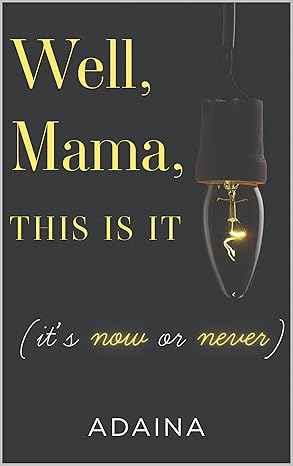
Well, Mama, This is It (it’s Now Or Never) is unlike anything I’ve read before. It’s part confession, part storytelling, and part letter-writing, all stitched together with raw honesty and a strong emotional pulse. The book moves between voices, sometimes it’s a teenage boy writing to his grandmother, other times it’s a young woman chasing a dream life, or even a haunting personal tale of loss and survival. At its heart, though, the book is a letter to her mother, a brave and vulnerable coming-out story wrapped in poetry, reflections on love, faith, and the messy business of being human.
In “A Story of a Friend of a Friend,” when Adaina shares her journey from being a teacher to a stripper, the descriptions are almost cinematic. She writes about smoky eye makeup, French pedicures, and stepping into the strip club as if it were a Hollywood set. It’s dazzling, but then the tone flips as she describes the loneliness and danger behind the glamour, and suddenly I was pulled from the surface glitter into the heavy silence of regret. That swing between fantasy and reality is something the book does again and again, and it made me feel the same kind of emotional whiplash she must have lived through.
I also loved the way she mingles imagination with truth. Take “Secret Agent (Voodoo Princess),” where Rebecca Tanon, a demon-child-turned-undercover-agent, blurs the line between folklore and personal reflection. At first, I thought it was a sharp left turn into fiction, but it clicked for me as a metaphor for how heavy family expectations and inherited trauma can feel like being born with a mission you never asked for. The story gave me chills, not just because of the supernatural edge, but because of what it revealed about how powerless a child can feel in the hands of adults.
In “To My Newest Pen Pal, Jant Leaps,” Adaina writes a heartfelt letter that evolves into a romantic confession, blending vulnerability with defiance against judgment. In “Sexual Orientation,” she reflects on faith, family, and identity, ultimately affirming that love is sacred regardless of gender. She weaves in verses about love, love with a woman who makes her feel free, love that pulls her away from Hennessy and Ecstasy, love that feels holy even when the world insists it’s wrong. There’s vulnerability in her admission, “I never thought I could fall in love with Eve’s gender,” but also defiance when she insists, “Yes, I am a Christian, but my religion is kindness.” That blend of fear, yearning, and courageous self-acceptance struck me deeply. It’s not polished in the way mainstream memoirs often are, but that’s what makes it powerful. It feels like a real letter, one that trembles with truth.
In the end, I walked away from this book feeling like I had just sat across from someone who didn’t hold anything back. It’s raw. It’s uneven at times. But it’s alive with feeling, and that’s rare. I’d recommend this book to anyone who craves honesty in writing, teens struggling with self-expression, readers curious about queer coming-of-age stories, or anyone who wants to feel less alone in their own mess of faith, love, and identity. It’s not a book for someone looking for clean lines or tidy endings, but if you’re okay with sitting in the chaos of someone else’s truth, then Well, Mama, This is It (it’s Now Or Never) will move you the way it moved me.
Pages: 51 | ASIN : B0DT7FZS7Q
What We Hold No Longer
Aaron Gedaliah’s What We Hold No Longer is a collection of poems that circle around memory, aging, identity, and the haunting void that lies beneath it all. The book moves through phases of transformation, wrestles with the Lacanian “Thing,” looks at the unraveling of society, and then slips into reflections on love, loss, desire, and imperfection. It blends the deeply personal with the philosophical, balancing childhood recollections with meditations on mortality, politics, and the quiet strangeness of being human.
Some of the poems struck like sudden jolts. They’re raw, unfiltered emotions that left me uneasy in the best way. Others drifted, slow and lyrical, catching on the edges of memory. Gedaliah doesn’t shy away from pain, whether it’s private grief or public horrors, and I respected that. I thought the psychoanalytic undertones and references added a fascinating depth to the collection. They gave the poems a layered richness that invited me to think as much as feel. What made the book especially strong, though, was the way those ideas blended with moments of plain vulnerability. The balance between theory and raw emotion kept the work dynamic, and the times when the language leaned into honesty and looseness stood out all the more because of that contrast.
The book feels like someone holding a mirror up to both his own past and the chaos of the present world. He talks about adolescence with brutal honesty, aging with rueful wit, and political violence with fury. I connected with the tenderness in “Birds on a String,” the ache in “Paradise Lost,” and the weary warning of “When the Shelves Are Empty.” There’s something relatable in the way he lets contradictions live side by side, rage and love, despair and beauty, the personal and the universal. It made me stop more than once and just sit with my own ghosts.
I’d say What We Hold No Longer is best for readers who like poetry that wrestles hard with ideas yet still finds room for confession and story. It would suit anyone interested in memory, loss, or the philosophical edges of spirituality.
Pages: 85 | ASIN : B0FPG8MLQ9



 LITERARY TITAN