Blog Archives
I, Robot Soldier
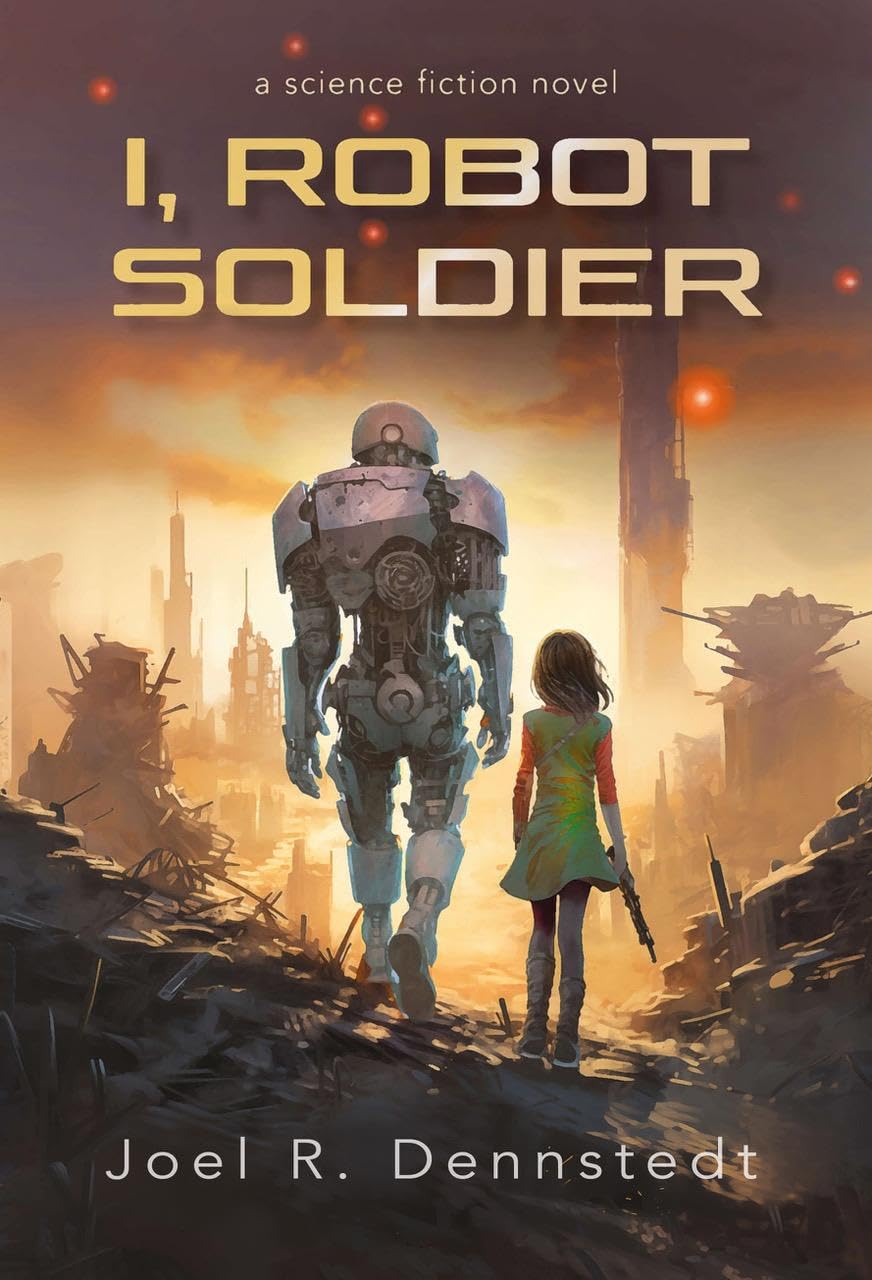

I, Robot Soldier follows the journey of One Shot, a war-damaged robot soldier who wakes in the ruins of a world shattered by conflict. When he encounters a traumatized young girl named Amy, he becomes her protector and companion. The story tracks their travels across a devastated landscape, their struggle to survive, and their tentative growth into something like a family. The book blends desolation with warmth, pairing the bleak aftermath of war with touching moments as One Shot tries to understand humanity and Amy tries to remember what hope feels like. From their first meeting in rubble and fire to their escape through underground tunnels and beyond, the story keeps its heart fixed on the odd, tender bond between a child and a machine.
I was wrapped up in the emotional push and pull between the two main characters. The writing caught me off guard with how gentle it could be. One Shot’s voice is direct and plain, yet it still carries this undercurrent of longing that feels almost human. His confusion about feelings, jokes, dreams, and shivers gave the story a sweet awkwardness that made me smile. Amy, on the other hand, is prickly and bold and scared all at once. Watching her needle One Shot with teasing comments about his rattling parts while also clinging to him at night felt so real. Their mismatched rhythms somehow clicked, and the simplicity of their conversations made the emotional beats land harder. The storm scenes, the quiet nights by open gas fires, the moments when Amy whispers her needs instead of barking commands, all stuck with me.
I also found myself drawn to the book’s ideas. It pokes at questions about purpose and identity without drowning the story in jargon or heavy theory. One Shot tries to follow his prime directives, but he keeps slipping into choices that feel suspiciously like care rather than programming. He lies to protect Amy’s feelings. He tinkers with the Cat drone so it can play with her. He dreams. He broods. He wonders about wonder itself. And Amy, for all her toughness, shows how fragile kids can be when the world drops out from under them. I loved how the story played with the idea that they were reprogramming each other. The writing doesn’t lecture. It just lets these two wander through fire and darkness until something warm grows between them. That quiet exploration of found family really moved me.
This book feels like a heartfelt blend of The Road and The Iron Giant, offering the grim quiet of a shattered world and the warmth of an unlikely bond between a child and a machine. I, Robot Soldier is a great choice for readers who love character-driven science fiction. The book feels straightforward on the surface, but it carries a surprising amount of feeling. I’d recommend it to people who want a story about survival, loyalty, and the strange ways we keep each other going in broken places.
Pages: 344 | ASIN : B0D9MFM9QN

Humor, Heart, and Absolute Chaos

Obesseus Feast of Legends follows a hungry hero who, in order to save his world from the war that his former best friend is starting he has to learn the mysterious art of Slam-Fu. What was the inspiration for the setup of your story?
The inspiration came from wanting to build a world where humor, heart, and absolute chaos could coexist. I grew up loving stories where ordinary things—like food—could become extraordinary. Snackland began as a simple joke, but the more I built it, the more it became a living universe with its own politics, rivalries, and deep history.
Obesseus represents unfiltered joy. He’s messy, impulsive, and determined to defend flavor itself. The setup came from imagining what happens when the world tries to regulate joy—and one hero refuses.
How did you come up with the idea for the antagonist in this story, and how did it change as you wrote?
There are many antagonists in the Slam-Fu series. Here are just a few examples.
Monica Mango
Originally, Obesseus’s best friend. Her fall from fun to fanaticism wasn’t planned; it naturally grew from her obsession with “reforming” Snackland. Instead of being evil, she becomes misguided to the point of danger.
Her “Juice Regime” came from exploring how righteousness can twist into extremism.
King Billy Blueberry
Billy rose from jealousy—he’s the ruler who believes Obesseus stole the spotlight that should have been his. As I wrote him, his character deepened into a symbol of insecurity, pride, and the fear of being forgotten. His conflict shows the darker side of leadership.
Espearagas, God of Vegetables
Espearagas was built as the ultimate escalation. He doesn’t want balance—he wants to wipe out flavor entirely. Writing him allowed me to explore how power can become detached from humanity (or food-manity). His declaration of war on flavor gave the series a mythic, epic direction.
Julian Jellybean
Julian is the trickster, the wildcard, the candy-coated menace who stirs chaos across all arcs. He wasn’t even planned originally—he forced his way into the story through sheer personality. Now he’s the thread that ties the conflicts together.
As the series grew, each villain evolved to represent a different kind of conflict—personal, political, emotional, or mythological.
Several more villains are coming, and the chaos will continue. My favorite villain is King Billy Blueberry. His character represents judging others, which is what many people do. Obesseus doesn’t care about being judged; he only cares about protecting what he loves. He loves snacks and Snackland. The Slam-Fu series is a fun way to remind people always to be themselves.
What were some themes that were important for you to explore in this book?
Three big themes anchor the series:
Identity vs. Expectation
Obesseus is unapologetically himself in a world constantly judging him. His journey reinforces that authenticity matters more than fitting in.
The Danger of Extremes
Every villain is extreme in a different direction—too strict, too jealous, too powerful, too chaotic. This allows kids to understand that balance is healthier than obsession.
Friendship Under Pressure
Monica’s transformation is emotional. Billy’s resentment is relatable. Julian’s chaos tests loyalties. Espearagas’s war forces everyone to choose sides.
These dynamics let younger readers grasp how friendships and alliances shift.
And of course, flavor vs. control is the heart of the comedy.
I hope the series continues in other books. If so, where will the story take readers?
There are going to be a lot more food wars. The next Obesseus book is going to be Operation Gravy Blockade. I plan to release that in 2026. What happens when Obesseus has to deal with the consequences of being Snackland’s symbol of rebellion? I plan to add a new faction to Snackland. Stay tuned for Operation Gravy Blockade.
Author Links: Goodreads | X | Website
Bursting with humor, heart, and deliciously absurd action, Obesseus: Feasts of Legends — The Slam-Fu Trilogy (Edition 1) collects three epic adventures from the Slam-Fu universe into one ultimate feast.
American Tiger
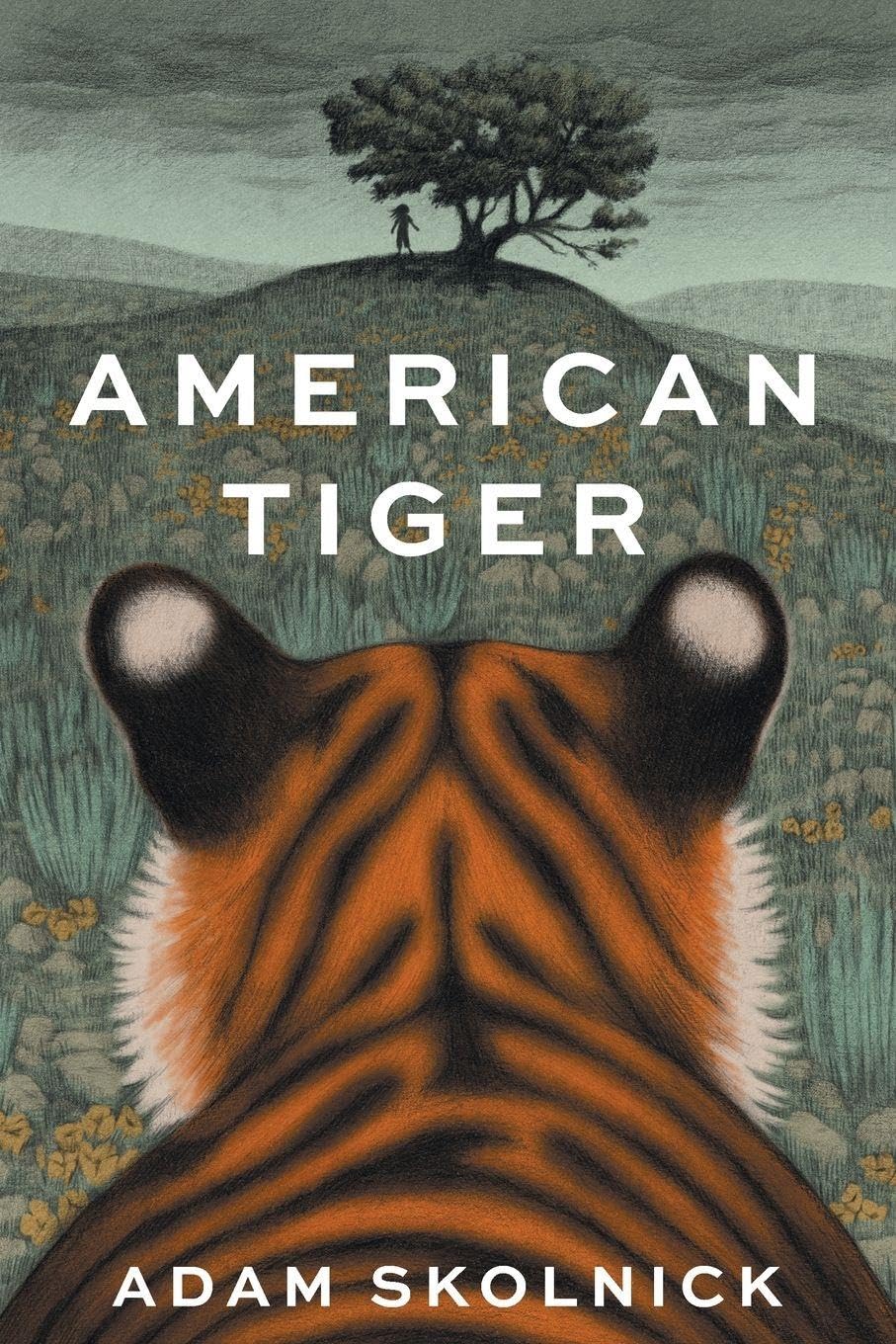
American Tiger follows nine-year-old Bell Tern, a sharp and wildly imaginative kid who becomes the first person in quiet Alisaw Valley to spot a tiger wandering near a Target loading dock. No one believes her, not even her father Jay, a game warden who knows there should be no tigers in Ventura County. As more strange sightings ripple across the valley, the story blends tension, family struggle, and ecological wonder. The tiger becomes a spark that exposes fear, disbelief, and a father and daughter’s effort to bridge the widening gap between their inner worlds. The opening chapters paint Bell’s devotion to drawing and documenting wildlife, her loneliness at school, and Jay’s steady but fraying attempts to raise her while holding the wild at bay.
This book pulled me in fast. I felt a kind of fond ache watching Bell try to prove what she saw. Her imagination is so alive that you can’t help rooting for her, even when it gets her labeled as a liar. The writing hits a sweet spot. It’s warm, direct, and paced in a way that made me forget I was reading. I liked how the author paints the valley around them. The details are simple but vivid. The land feels baked into the bones of the characters. I also noticed how naturally humor and sadness sit together in the scenes. One minute I was smiling at Bell’s oddball survival kit in her backpack. The next I felt a sharp little twist in my chest as the bus full of kids turns on her when she reports the tiger.
I also found myself moved by the relationship between Bell and Jay. Their dynamic is messy in a relatable way that I appreciated. Jay tries so hard to be steady and rational, but he’s worn down. The moment he gets a report of “a striped tail” under a pepper tree, something shifts in him, and I felt it. The writing lets him be flawed without judgment, and that made me care even more. The stakes get bigger as the search spreads. Experts arrive, each with their own trauma or agenda, and everything grows more tangled. I liked that the book never leans into cheap danger. Instead, it digs into fear, memory, loss, and what wildness means in a world that keeps shrinking.
The story touched that soft place where wonder and grief live side by side. I kept thinking about how a giant animal roaming the suburbs could expose so much about the humans who live there. The book surprised me. The writing has heart. It’s clear and calm on the surface, but there’s a current running underneath it that pulled me along.
I’d recommend American Tiger to readers who enjoy character-driven stories with a strong sense of place. It’s great for people who love literary fiction that carries a hint of adventure and for anyone drawn to stories about family, nature, and the things we try to believe in. It would also hit home for readers who like books told through the eyes of kids who see the world in ways adults forget.
Pages: 326 | ASIN : B0FTGLN6X2
Blessings Abound: Awaken to the Gifts at Hand

Blessings Abound is a short and sweet guide designed to help us spot the good things in life. Katherine Scherer and Eileen Bodoh wrote this book to help readers wake up to the gifts they already have. The authors break the content down into three main buckets. These are blessings we receive. There are blessings we ignore. And there are blessings wearing masks. The pages are packed with quotes from famous folks like Rumi and Abraham Lincoln. It explores how nature and music and friendship make life rich. The main goal is to shift your mindset from complaining to appreciating. It acts as a roadmap to peace and wonder.
I honestly felt a wave of calm washing over me while reading this. It is not trying to be a hard textbook. It feels like a warm hug. I really liked the way they used so many quotes. It felt like a greatest hits album of wisdom. Sometimes self-help books try too hard. They use big words to sound smart. This one keeps it real. It is simple. That is its superpower. The section on nature really resonated with me. I felt lighter after finishing it. It pushes you to use your heart more than your head.
The authors talk about blessings in disguise. This part made me think. It is hard to see the good when things go wrong. But they make a solid point. They mention people like Edison, who failed but kept going. That was inspiring. I also noticed the book gets pretty spiritual near the end. It talks about God and the Bible. They included Native American prayers, too. It felt like they wanted to welcome everyone. The focus on gratitude as a tool to fix a bad attitude is smart.
I think this book is a solid pick for anyone feeling a bit burnt out. If you need a mental reset. It works well as a coffee table book. You can pick it up and read a page or two. It does not demand a lot of your time. It just asks for an open heart. I would gift this to a friend going through a rough patch. It reminds you that the world is actually pretty cool if you look closely. Give it a shot if you want to smile more. It is a quick read with a long-lasting impact.
Pages: 58 | ASIN : B0FBSTLR27
Forced Apart


Forced Apart follows Calista Snipe and Skyler McCray as they face the toughest challenge of their young lives. Cali’s family circumstances pull her away from Parkington, away from her friends, and away from Sky. The story blends teen romance, grief, loyalty, and the strange mix of fear and hope that comes with growing up. Most of the book lives inside Cali and Sky’s thoughts, and it shows how two smart teens try to hang on to each other while the world pulls at them. The plot stretches from the shock of unexpected separation to the daily grind of starting over in a new town, all while their old group of friends tries to keep their bond alive. Even with kidnappings in the characters’ past and danger never far away, the heart of the book is emotional rather than violent. It feels more about surviving change than surviving threats.
The writing style felt open and honest, almost like reading a long personal letter from two teenagers who speak before they filter anything. Sometimes the pages run hot with emotion. Other times, they slow down to simple moments like sitting in a car or walking up a hill. I liked that shift in pace. It pulled me in because it felt real. Life for these characters is loud one minute and quiet the next. I did wish, at times, for shorter scenes or tighter dialogue. Still, the sincerity in the writing won me over. The author clearly understands how teens overthink everything and still try to sound brave.
The ideas inside the book struck me more than the plot itself. The loneliness of being uprooted. The heavy tug of first love. The fear of losing the people who make you feel safe. Those themes sat with me long after I finished reading. I felt frustrated for Cali as she tried to be mature about the choices her parents made, even when those choices broke her heart. I felt Sky’s emptiness when he tried to fill the silence she left behind. The book reminded me how fragile teens can be and how strong they become when they figure out who they want to be in the middle of all that pressure. I also appreciated the look into friendships that feel like family. The group around Cali and Sky is full of loyalty and messy humor. Those moments softened the sadness and made the story feel fuller.
I would recommend Forced Apart to readers who enjoy emotional coming-of-age stories, especially ones that lean into romance and friendship. Teens who like character-driven books will connect with Cali and Sky. Adults who work with teens may also find value here. The book would speak most to anyone who has been forced to start over in a new place and felt the ache of leaving people behind.
Pages: 374 | ASIN: B0FRNN1R22
The Living Bridge
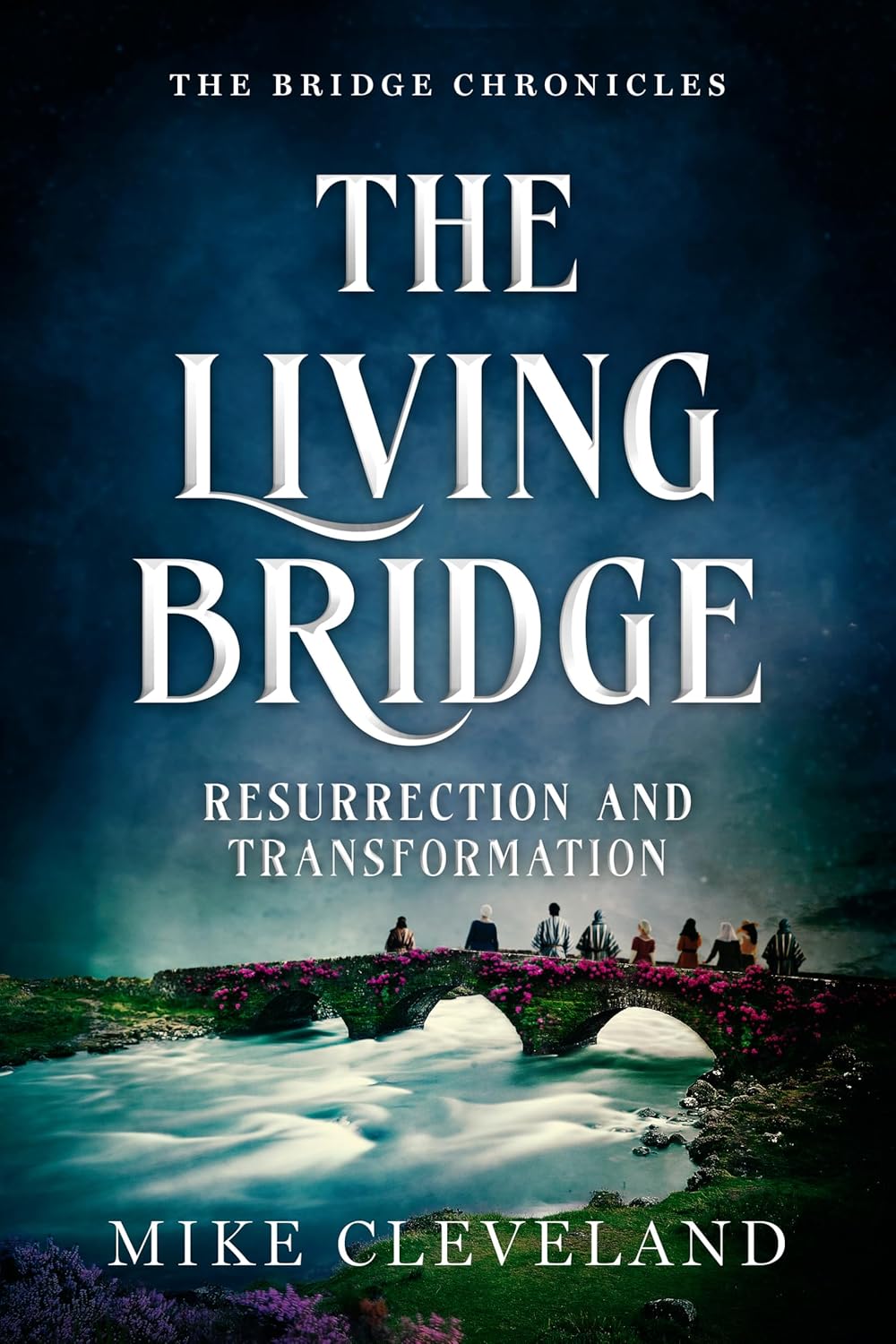
The Living Bridge is a work of Christian allegorical fiction that weaves together the stories of five broken people whose lives intersect in the shadow of a shattered bridge between Eastlight and Westshore. The book follows Mary, Lydia, Matthias, Cleopus, and Tamar as each carries grief, guilt, or despair to the riverbank where everything once fell apart. Their stories unfold in three movements that chart their journey from damage to darkness to eventual restoration, all centering on the arrival of a mysterious teacher named Geshriel, whose presence begins to mend what the earthquake destroyed. The opening chapters set the tone well, especially Mary’s torment under “Legion” and her stunning moment of deliverance, and Lydia’s aching exile from her family across the broken river.
As I read, I found myself reacting less to the plot mechanics and more to how the author frames suffering. Cleveland writes with a kind of steady compassion, letting each character’s pain breathe before offering any hint of resolution. Mary’s chapter in particular struck me. Her inner world felt raw and believable, and the moment her mind finally quiets when Geshriel calls her “beloved” is one of the more affecting scenes in the book. The prose is simple, almost plain at times, but it works because the emotional beats land without being dressed up. It felt like sitting with someone who has been wounded for so long they’ve forgotten anything else is possible. The author doesn’t shy away from darkness, but he also doesn’t exploit it. Instead, he uses it to build a kind of slow, patient hope.
There were moments when I paused, not because the story demanded it but because something in the writing touched on familiar human questions. Lydia’s longing for her daughters across an uncrossable river is written with a tenderness that feels lived-in rather than symbolic. Matthias’s crushing guilt over the collapse he caused, and the way he interprets every failure as further proof of his curse, could have felt melodramatic, but it didn’t. His scenes carried the weight of someone who can’t imagine forgiveness applying to them anymore. Cleveland seems most comfortable when exploring how shame isolates people, how grief reshapes their days, and how mercy begins as a voice they aren’t even sure they heard correctly. Sometimes the metaphors are quiet, sometimes they shine brighter, but they always feel in service of the characters rather than the other way around.
The book’s message is clear without being heavy-handed. The “living bridge” isn’t just a rebuilt structure but a person, a sacrifice, and a way back home. This won’t surprise readers familiar with the genre, but it still lands because the characters’ journeys make the message earned rather than assumed. If you enjoy faith-centered fiction, particularly stories that blend biblical echo with imaginative narrative, this book will likely resonate. Readers who appreciate character-driven arcs of healing and gentle spiritual allegory will find plenty here to sit with. And for anyone who has ever felt stuck on the wrong shore of their own life, the book offers a quiet reminder that bridges can be rebuilt, even when you’ve forgotten how to hope.
Pages: 227 | ASIN : B0FX5WS62Y
New Harmony: A Mother’s Story of Love and Loss
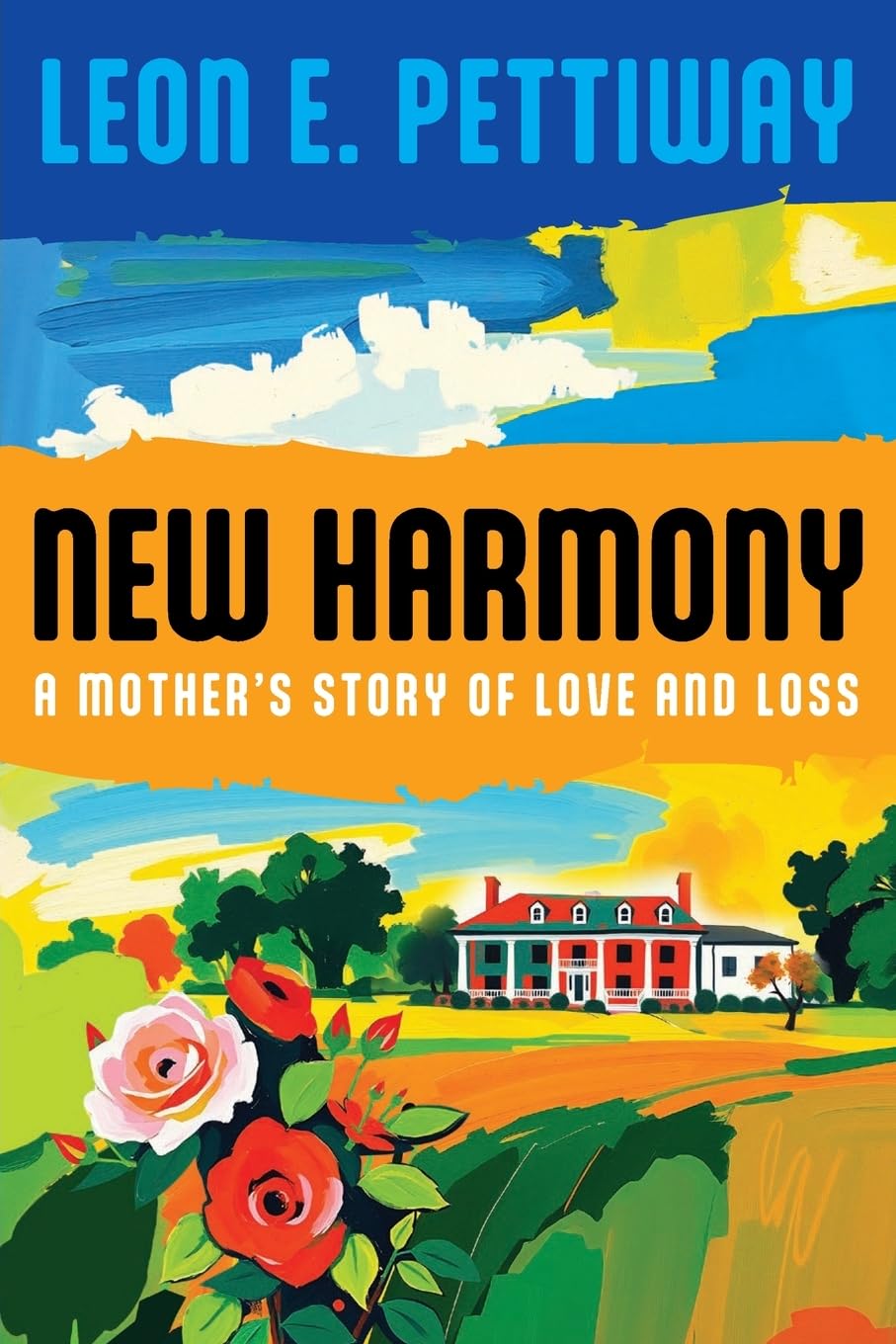
New Harmony opens with a grieving mother, Margaret Butler, recounting the gut punch of losing her teenage son to racist violence in 1949. The story reaches backward through her memories as she traces the long chain of choices, injustices, and quiet heartbreaks that shaped not only her life but the world that destroyed her boy. The novel moves between Margaret’s childhood on a South Carolina plantation, her uneasy ties to the white Demmings family, and the sorrow-filled road toward the truth behind her son’s death. It is a story made of memory, pain, stubborn hope, and the weight of generations.
I was pulled straight in by Margaret’s voice. The writing has this rhythm that feels lived in. Soft at times, sharp at others, always honest. The author doesn’t dress anything up. He lets Margaret speak in her own cadences, and I loved how that drew me closer to her world. I could feel the heat of the fields, the hush of the church during the funeral, the tightness in her chest when the pastor’s words sliced open her grief. The scenes in the Big House hit me hardest. They’re full of beauty on the surface and danger right underneath, and the writing captures that quiet tension so well.
Certain moments were very emotional and thought-provoking. The way Margaret watches the small signs of how power works. The way she tries to shield her children, even though she knows she can’t keep the world off them. The book doesn’t rush. It sits with the hard parts. And the ideas about how small acts, good or bad, weave themselves into a life stayed with me. The whole story feels like someone laying out a quilt square by square. Every piece matters.
By the end, I felt a mix of sadness and admiration. Sadness for everything this family carries and admiration for the strength that keeps rising up through the story. I would recommend this book to readers who want a powerful character voice, who like stories rooted in the South, and who don’t mind being pulled into heavy truths. It’s especially good for anyone who values fiction that feels real enough to leave a mark.
Pages: 374 | ASIN: B0G348J1KP
Bathed in Ink and Blood

Bathed in Ink and Blood opens as a dark, magic-laced fantasy that follows two threads: Noddum’s brutal clash with Brist, the infamous Butcher of Greenlake, and the quieter, more intimate story of twins Dacre and Esmee as they undergo the Test that reveals their signamantic abilities. Right away, the book establishes itself as epic fantasy with grimdark edges, mixing the political tension of a kingdom cracking at the seams with the personal stakes of people trying to survive systems that see them as tools or threats.
Reading it felt like slipping into a world that’s heavy with history. The magic system built around ink, brands, and carved symbols is vivid and tactile. I found myself leaning in during sections, partly because the author writes pain and power in a way that’s blunt but also strangely tender. The early chapters around Dacre and Esmee hit me hardest. Their innocence, their hope, and then the slow realization that their mother may have just sold them made my stomach drop. Author Robert Laymon doesn’t rush those moments. He lets them sit, lets them ache. It works.
On the other side of the story, Brist’s chapters are sharp and unsettling. He’s haunted, vengeful, messy, and written in a way that made me feel both wary of him and weirdly sympathetic. His scenes drip with tension. Even when he’s still, the writing hums. I appreciated how the author doesn’t treat violence like spectacle. It’s brutal, sure, but it’s also shaped by emotion, regret, and purpose. The dynamic between Brist and the people around him feels lived-in, like a group stitched together by survival rather than trust. It adds weight to the plot and makes his arc more interesting than a simple revenge story.
Raya is an interesting character because she starts out feeling overlooked in a family obsessed with power, but she slowly shows how strong and capable she is. We see flashes of her compassion, like when she notices how her father mistreats the servants, and those moments make it clear she’s nothing like the rest of the Adans. I think Raya is a standout character whose quiet resilience, empathy, and determination make her compelling.
By the time the two storylines start bending toward each other, the world feels wide and dangerous. The writing style helps with that. It’s clear but atmospheric, not bogged down by jargon, and the pacing keeps you moving. Some chapters are quiet and reflective. Others are teeth-clenching. The mix makes the book feel grounded, even when the magic flares bright.
If you like fantasy that leans dark but stays character-driven, with a magic system that feels both fresh and gritty, this will likely hit the spot. Fans of grimdark, epic fantasy, and stories that explore power, loyalty, and the price of survival will probably enjoy Bathed in Ink and Blood the most.
Pages: 439 | ASIN : B0FLRP6TYX


 LITERARY TITAN