Blog Archives
The Cultural Threat
Dollartorium follows a struggling corndog shop owner who chases a too-good-to-be-true business scheme, only for the fallout to expose the hollow promises of hustle culture. Did this novel begin as satire, social commentary, or character study?
The Dollartorium began as a play, inspired by Aristophanes’ Clouds, but instead of satirizing philosophers (not much a target these days), I thought better to take on that new class of hustlers and the culture they have created. Like most satire, it became social commentary and, sadly, even more relevant now than when I began.
The Dollartorium scheme feels disturbingly familiar. How closely did you model it on real-world programs? Were you more interested in exposing the scam itself or the conditions that make people vulnerable to it?
Ha! It is disturbingly familiar to me as well. The Dollartorium is a critique of the many ways our culture, especially business culture, creates a numbness in ourselves and in our relationships with others. The Dollartorium is more about the cultural threat, the scam itself, but of course, the scam would hardly be a threat if we, like Ralph, weren’t vulnerable to it. Fortunately, Ralph and Phyllis recover with the help of a more reality-grounded Stella.
The novel is funny, but there’s an undercurrent of anger beneath the jokes. How do you balance humor with critique?
Without humor, I’d go mad. The heart of the book is in the lectures at the Dollartorium. I use each lecture to ridicule one thing. If the book revealed the totality of living under the culture of uncontrolled capitalism, it would be humorless and unbearable. These little things, from sex in advertising to dilution of food, are pieces we all experience, and up close they are both funny and disconcerting. To see their absurdities enables us to distance ourselves from them a bit. But to be so used, so often, makes me angry.
The book closes on a realistic, not idyllic, note. Why was that the right ending?
I would be gratified if the ending were realistic, that we simply open our eyes and live and work doing what we can as best we can, bearing in mind the needs of others. After a brutal journey for Ralph and his daughter, I hope the ending shows that things do not have to be the way they have become, and that the journey to a saner world is a personal, as well as social, responsibility. Even Phyllis finds pleasure in honest work. Still, the Money Master endures, intent on his own selfish worldview, doesn’t he?
Author Links: GoodReads | X (Twitter) | Facebook | Website | Amazon
Glorious Hyperbole

The Capricious Nature of Being is a collection of short stories filled with intrigue and satire about the unpredictable turns life takes, and how ordinary people stumble, resist, adapt, or come undone. What was the inspiration for this collection of stories?
Life! Almost every story in the book is based on an experience of mine or one of a person I knew. “Dick & Jane” was inspired by Stephen King’s book On Writing, and Jane is a composite of a couple of women who blazed through my life. “Uber” came from research I was conducting for a business column, and “The Accident” practically wrote itself at a wedding I attended. I haven’t a clue where Dr. Margaret Mary McAllister came from, but I love her to death. “The Other Side of the Tracks” was kind of a goof I was playing around with that sprouted wings and took off like a big old 747, tequila and all. However, most of the time when I write, I haven’t a clue where I’m going until I get there.
You often place people and stories in familiar environments. Why is everyday life such an effective stage for inner upheaval?
Because that’s where it happens. I’m not a big fan of a lot of descriptive narrative or metaphorical muscle flexing. I like my characters to develop themselves through dialogue and behavior, and the drama of their situation to emerge from within. Familiar, low-keyed settings allow that drama to play out without a lot of superfluous distractions, and I believe it allows the reader to better identify and empathize with the emerging personalities.
What were some themes that were important for you to explore in this book?
The capricious nature of being! Like WTF, man! Life’s a bitch and then you die, and all that hard-edged confetti wherein we frame our experiences. Everybody, to one degree or another, has some kind of cross to bear, and how you perceive that challenge, how you deal with it, is the story of your life. There are no victims, only the vanquished and survivors, and it’s your choice.
What is the next book that you are working on, and when can your fans expect it to be out?
It’s titled How to Sell the Plague, a memoir I’ve been working on for about 15 years; the story of my life in all its overstated and glorious hyperbole. Only most of it’s true, and I hope interesting. It’s subtitled From Woodstock to Wingtips, and it’s ostensibly about me morphing from hippie to businessman, but the real theme is finding out who I am amidst a slew of confusion and misdirection. The narrative winds through my emotionally formative years with lots of side alleys and illusionary backdoors, like doing jumping jacks in a jock strap in front of a Broadway producer or smashing my guitar against a tree (a la Peter Townsind) on the top of a Sierra Nevada mountain to impress a pretty young blond (wink, wink). Like the driving issue in all my writing, it’s about perspective and choices, and some of the fun along the way.
Author Links: GoodReads | X (Twitter) | Facebook | Website | Amazon
These engaging tales will make you laugh and cry…and leave you wanting more.
Bad Americans: Part I


Bad Americans: Part I is a big collage of stories wrapped inside a wild and strange summer retreat. Twelve Americans head to the Hamptons during the first Covid summer, brought together by a billionaire who wants them to share meals, go on dates, compete in games, and tell stories every night. Their tales reveal pieces of pandemic life, cultural friction, loneliness, and hope. The frame narrative follows the guests as they argue, flirt, bond, and judge one another. Inside that frame sit the stories they tell, each one capturing a different slice of American life during a time when everything felt fragile. The book moves from hospitals overflowing with fear to city streets full of noise and protest.
I was pulled in by the bold mix of voices. The writing jumped between tones and moods, and sometimes it caught me off guard in the best way. One minute I was laughing at a character’s dry remark, and the next I felt a lump in my throat as someone described a loss. The author writes with an energy that propels you forward, and I liked that. The moments with Andrea, the nurse, especially resonated with me. Her story about the ICU felt authentic and honest, and I could almost hear the alarms and taste the fatigue that soaked every shift. The book’s choice to set these heavy stories inside a glitzy mansion made everything feel even stranger, and somehow more real.
The author leans into the messiness of America. People squabble over politics, race, class, and identity. They misread one another. They cling to their own truths. I wished the dialogue would slow down sometimes, but I think that constant rush was the point. The country has not been quiet for a long time. The book mirrors that noise, and it does it with heart. I respected the risks it took.
I would recommend Bad Americans: Part I to readers who like big casts, sharp contrasts, and stories that jump from tender to chaotic without apology. Anyone interested in how fiction can capture a national mood would get a lot out of this book. It is not a simple read. But it is full of life, and it stirs emotions that stay with you for a while afterwards.
Pages: 390 | ASIN : B0FF5DZ7GV

A Comitragedy In Five Cantos

Theoryland: A Tragedy In Five Cantos follows an ambitious academic who dives headfirst into the world of highbrow theory only to have his arrogance grow, leading to his collapse into disillusionment. What inspired you to write this very unusual poem?
The date was roughly 1999. I was studying the falderal (H. L. Mencken’s word) in our public schools. I learned about flashy Academic trends such as Post Structuralism. My alumni magazine rejected an article on sophistry. A winter of discontent. I was broke. The more I read about the theories rampant at our universities, the less impressed I was. I always admired honesty and brevity as opposed to the strutting of pretenders.
I thought some of our professors ripe for mockery. You can see Theoryland start as a straight takeoff of T. S. Eliot, then you see it shift gears. Why? I was worried it would get stuck in a narrow rut so I jumped into a new car. A new ride, you might say.
In the rooms the critics come and go
sneering at the status quo.
On the dry grass, in a dry wind,
students throw a frisbee, joking.
I didn’t want to be predictable or pinned down by any particular tone. I wanted to surprise myself. The poem erupted. Abruptly, the janitor laughs, smoking. The subtext was always madness. I didn’t want to lose that at any point.
How long did it take to write?
I finished this wild thing in two or three weeks. I didn’t know what to make of it. Where do you place a very long poem? I put it on the shelf for almost 10 years! Then, one fine spring day, I took it out in the backyard and plunged in. To my surprise, I laughed and cried at all the same places. I decided this may be strange but it’s good.
Conventionally, many long poems obey traditional schemes and rules, so they are safe but also boring. Isn’t that the challenge? I took lots of chances. I had a lot of Eliot in my brain and careened from one souvenir to another. Maybe, I hoped, I could entertain people who normally don’t read poetry. This has enough story to be a play or a small arty movie. I think it would be so much fun to watch.
Were there any poets or other writers who influenced your work on this collection?
Early on my favorite poets were Walt Whitman. e e cummings. A Roman named Catullus. Ezra Pound. Lawrence Ferlinghetti. Walt Whitman coined the phrase “my barbaric yawp.” I think Theoryland is “my very own barbaric yawp.”
Eliot created the hero’s personality. J. Alfred Prufrock is a passionate but timid man. And we have all been there. Prufrock remains the same throughout his poem, but the narrator of Theoryland knows conquest and as well defeat.
What was one of the hardest parts in Theoryland for you to write?
To a great degree, it wrote itself. I worried about getting in my own way. Let it go, I kept telling myself. Take chances. What’s the most interesting thing that could happen now??? I’ve read this poem almost 50 times and every time was fun.
What is the next book that you are working on, and when can your fans expect it to be out?
I have two novels out now that were inspired by AI: Frankie and The Boy Who Saves The World.
I think they’re both excellent for telling people what scary things could happen.
In 2026 I hope to release Art and Beauty, detective mystery, and Carla –Manhattan Love Story.
Six Stories Up- Tales of Whimsy, Imagination, and Hey, A Little Satisfying Comeuppance

Six Stories Up is a lively collection of short tales that bounce between playful fantasy, sharp humor, and a soft punch of moral comeuppance. Each story stands on its own, from the rain-soaked artistic swirl of 1920s Paris to a Vietnam vet’s barroom confession, to a smart-mouthed seagull convincing a fisherman to take a swim. The book wanders through imagination with a kind of wink that says, stay loose, anything can happen here. There is trickery at times and reflection at others, and by the end of each tale, I felt that small, satisfying click of a truth landing where it should.
I enjoyed the author’s voice. It feels relaxed and mischievous, almost like someone at the far end of a bar spinning stories just for the fun of it. The writing moves fast and never takes itself too seriously. I got pulled in by the rhythm of it. Scenes like the boisterous café in Paris or the smoky bar in Seattle feel alive because the dialogue snaps and the characters talk like people who actually exist. I was grinning at the chaos around Tinkham in Paris, and then sinking into the slower, thoughtful mood of the old veteran’s tale in The Doppelganger War. The book shifts tones with ease, and I enjoyed that unpredictability. It kept me alert, never quite sure where the next turn would land.
And the ideas, honestly, surprised me. At first, I thought I was settling in for pure entertainment. Instead, I found myself thinking about belief, about luck, about the lies we tell ourselves to get through life. That talking seagull cracked me up, but it also made a point about trusting the wrong voices. The stories play with morality in a lighthearted way, but they still sting a little when the consequences show up. I liked that combination. I could sense the author having real fun with these characters while still nudging me to look a little closer. That balance made the whole collection feel richer than I expected.
I would recommend Six Stories Up to readers who love quirky short fiction with personality. People who enjoy clever twists, fast dialogue, and a mix of humor with heart will get a kick out of this book. It is great for anyone who wants something playful yet thoughtful, something that can make them laugh and then make them pause for a second. I had a good time with it, and I think anyone who likes stories that wander off the well-worn path will too.
Pages: 251 | ASIN : B08KXSX4WP

Dollartorium

Ralph earns his living in a modest Kansas shop, frying corndogs that are undeniably good and reliably popular. The work keeps him afloat for a while. It offers routine, modest comfort, and a sense of pride. Eventually, though, the numbers stop working. Sales stall. Bills pile up. Stability slips away.
At that moment of strain, Ralph’s wife introduces him to “Dollartorium,” a tantalizing promise discovered through an infomercial. The course offers bold ideas and glossy solutions. At first, it feels like salvation. New business concepts suggest a way out, maybe even a breakthrough. Then the foundation collapses. What seemed like an opportunity quickly unravels, leaving Ralph to reckon with the fallout. With the help of his daughter, Stella, he is forced to retrace his steps and search for a more realistic way forward for his family.
Dollartorium, by Ron Pullins, is a work of fiction that probes capitalism, hustle culture, and the pressures these forces place on families. Humor runs throughout the novel, but it never fully softens the sharper insights beneath the surface. The comedy entertains; the implications linger.
Pullins shows a clear awareness of how precarious financial life has become for many people. Ralph’s anxiety feels earned. His frustration resonates. The sense that the system is tilted against ordinary workers gives the story its urgency. The Dollartorium scheme itself feels uncomfortably familiar, echoing countless real-world programs marketed to those already struggling. These promises prey on desperation, and Pullins does not shy away from exposing their ethical rot.
Stella emerges as the novel’s moral and intellectual anchor. She tempers Ralph’s desperation with reason and clarity. Her perspective restores balance and nudges the story toward resolution. Yet even as the family regains its footing, the larger problem remains unresolved. The system that cornered them still stands. Pullins underscores this truth with restraint, allowing the message to land without sermonizing.
The novel closes on a note that is satisfying, though far from idyllic. That choice feels intentional. Pullins has more to say than a neat ending would allow. Through his characters, he gives voice to frustrations that have become commonplace, about inequality, exploitation, and the illusion of easy fixes. The odds remain stacked against the little guy, and the allure of grand, risky schemes proves hard to resist. Dollartorium captures that tension with clarity, humor, and an undercurrent of quiet anger that makes it linger after the final page.
The Capricious Nature of Being

The Capricious Nature of Being is a collection of short stories about the unpredictable turns life takes, and how ordinary people stumble, resist, adapt, or come undone as fate nudges them down unexpected paths. The book opens by framing life as a kind of “Secret Santa,” full of surprises we never signed up for, and the stories that follow lean into that idea with characters who face moments they never planned for and can’t control. In story after story, we meet people caught between who they thought they were and who life seems determined to make them become.
As I read, I kept pausing to absorb the way author Richard Plinke writes about internal struggle. His characters are flawed in ways that feel human rather than dramatic. They think too much. Or too little. They cling to old hurts or old hopes. In “The Safe,” Hope’s entire life tilts because of a single discovered date, and the writing lets her unravel in a quiet, almost tender way. I found myself nodding along, feeling that tug between wanting the truth and wanting the comfort of not knowing. Plinke seems to enjoy letting readers sit in discomfort, not to punish us but to remind us that most turning points in real life aren’t big cinematic events. They’re small realizations that land with surprising weight.
What struck me in many of the stories is how the author uses familiar settings to explore less familiar emotional terrain. A sales manager on a bike ride. A widow cleaning out a house. Someone facing the remains of a broken relationship or a restless conscience. The ideas in the book aren’t complicated, but they’re honest, and the writing doesn’t hide behind fancy language. Sometimes the sentences hit like a quick tap on the shoulder. Other times they stretch out, winding through a character’s history the way a person might ramble when they finally feel safe enough to tell the truth.
By the time I finished the last story, I felt like I’d been listening to a friend talk through the strange business of being alive. That’s probably what I appreciated most. The book has a reflective quality that never slips into preaching. Instead, it invites you to think about your own unexpected turns and how you handled them, or didn’t. If you enjoy character-driven fiction, if you like stories that pause on the small moments where everything quietly shifts, or if you simply want a collection that feels both grounded and thoughtful, this one will likely speak to you.
Pages: 357 | ASIN : B0FFWGLNP7
Too Complex: It’s a (Enter Difficulty Setting Here) Life
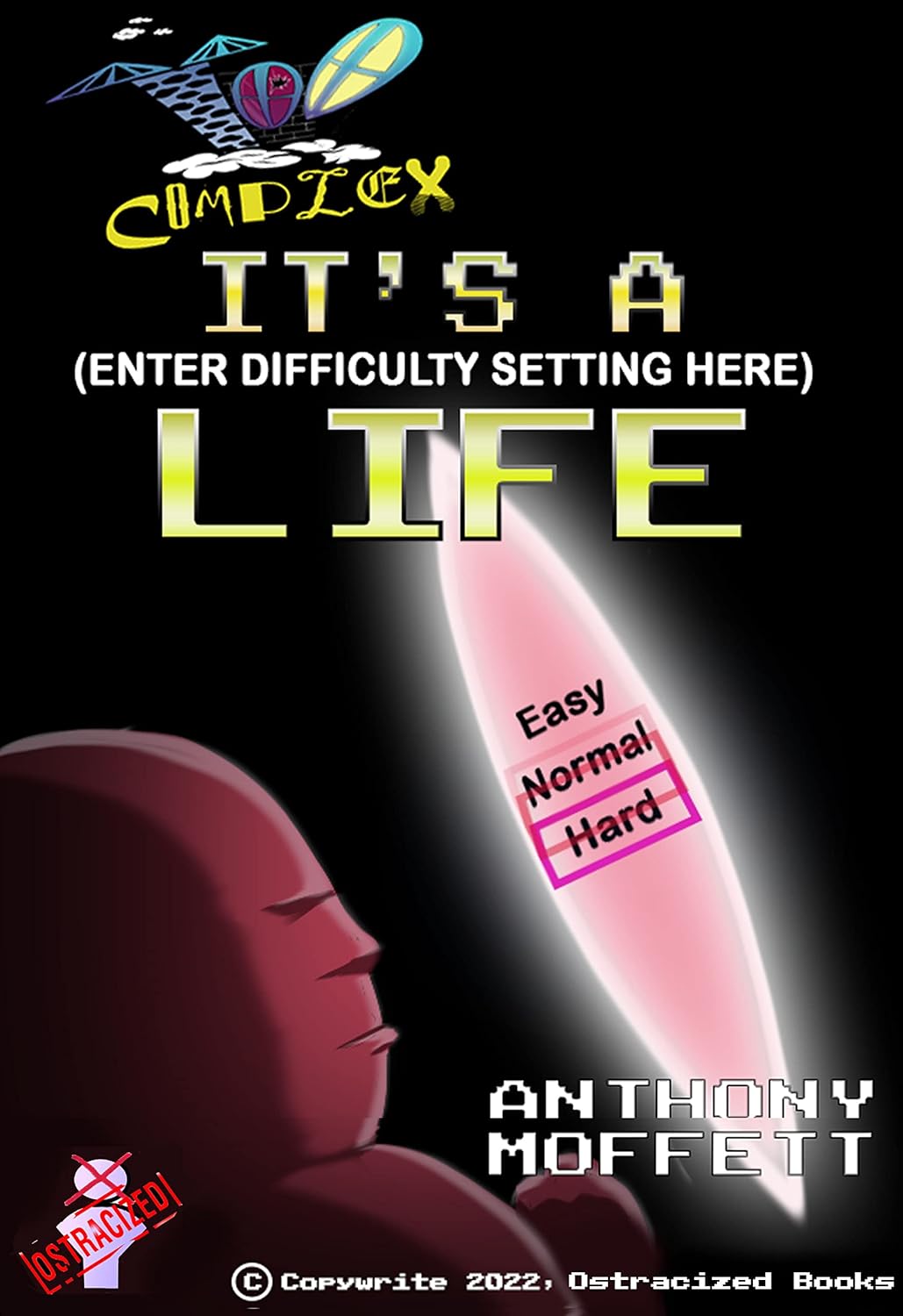
Cody Redbond lives to game. Addiction defines him. His fixation centers on Fantasy Estate, an online battle royale that consumes his days and erases everything else. Hours disappear. Priorities collapse. The game becomes his only reality, while the world beyond his screen loses all appeal. Employment slips away. Social skills erode. Eventually, eviction follows. Even then, Cody refuses to move on. He is too deeply embedded in the digital realm to disengage on his own.
Enter leasing agent Mavirna Holmes and property manager Corey Dwellen. Their task is simple in theory and nightmarish in practice: reach Cody and reclaim the apartment. Doing so requires navigating a living space that has deteriorated into absolute chaos, a physical manifestation of Cody’s inward retreat.
Too Complex: It’s a (Enter Difficulty Setting Here) Life, by Anthony Moffett, is a compact and sharply comic work that blends prose with illustrations. It occupies a space somewhere between novella and graphic novel, using visuals to punctuate its humor and heighten its absurdity.
At its core, the book is an absurdist adventure tailored to video game enthusiasts, but its reach extends further. It functions as a satire of modern adulthood, skewering burnout, disconnection, and the quiet despair that drives escapism. As Cody’s story unfolds, sympathy becomes inevitable. He has not merely abandoned reality; he has replaced it with something brighter, louder, and more responsive. Ironically, the so-called real world offers little incentive to return. It appears dull, unforgiving, and deeply uninspiring by comparison.
This contrast captures the enduring appeal of video games. They promise immersion without consequence, excitement without monotony. When everyday life feels hollow or exhausting, fantasy becomes irresistible. Mavirna and Corey, the unfortunate duo assigned to retrieve Cody, find themselves on a quest of their own, one that mirrors the very games Cody adores. The ultimate irony lies in the aftermath of his obsession. The artificial world he clung to has reshaped reality itself, transforming his apartment into a grotesque, pest-ridden dungeon.
The result is a book that is unabashedly fun. It is silly, unhinged, and gleefully excessive. Beneath the humor, however, lies a pointed warning. Too Complex entertains first, but it also lingers, offering a sharp and thoughtful reflection on escapism, avoidance, and the cost of choosing fantasy over life. I highly recommend this humorous and highly relatable tale to gamers and non-gamers alike.
Pages: 73 | ASIN : B0BR4J3L9Y



 LITERARY TITAN