Blog Archives
Lawton Passage


In Lawton Passage: As Told by a Tennessee Storyteller, author Tim Duning follows Liam Menschen from his childhood at Vale Hollow in small-town Tennessee through adolescence, college, adulthood, grief, and return. Framed by his father’s polished Christmas newsletters, the book becomes a memoir about family mythology, Southern manners, church, friendship, mischief, race, class, memory, and the strange ache of outliving the world that made you.
I found the book most alive when it lets childhood look at adult life from under the table. The cigarette smoke, cocktail parties, school bus rides, church pews, Kroger gum, and family performances all carry a comic charge, but Duning is not merely being nostalgic. He has a fine eye for the absurd choreography of respectability: the way a family can cultivate manners while quietly avoiding certain truths, the way a Christmas letter can be both love song and scorecard, the way a child can understand more than adults think and less than he imagines.
What stayed with me was the book’s gradual deepening. Early chapters have the bright, anecdotal snap of porch storytelling, but later sections gather a more elegiac gravity. Duning writes about parents, old friends, hometown rituals, and return without embalming them. His tone can be funny, rueful, tender, and sly within the same scene. At times, the abundance of episodes gives the book a meandering, oral-history feel, but that looseness is also part of its charm; it reads like someone pulling chairs closer as the night gets longer.
This book will appeal to readers of Southern memoir, coming-of-age story, family history, small-town Americana, and nostalgic literary nonfiction. Readers who enjoy Rick Bragg’s work, especially his blend of humor, family devotion, and regional memory, will find a familiar warmth here, though Duning’s voice is more shaggy, conversational, and quietly self-interrogating. Lawton Passage is a loving inventory of a vanished place, told by someone wise enough to know that home is never as simple as memory makes it.
Pages: 354 | ASIN : B0H3WV4RQ4

Atlas Falls to Earth
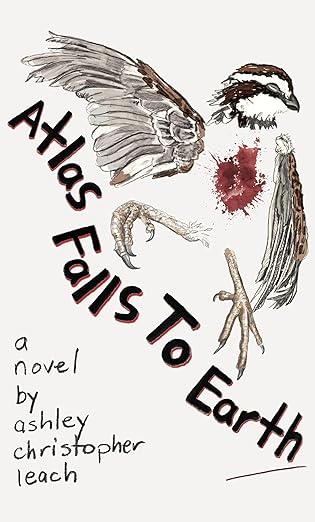

Atlas Falls to Earth, by Ashley Christopher Leach, is a literary coming-of-age novel with strong Southern Gothic and magical realist elements. It follows Atlas, a sensitive thirteen-year-old boy in rural North Carolina, as he struggles under the weight of his father Jason’s expectations, finds comfort in Alex’s quiet care, and escapes into a strange book-within-the-book called Misadventures in Being: The Strange Tale of Bunny and Munk. The novel moves between Atlas’s painful real world and the eerie, fable-like world of Bunny and Munk, using both stories to explore loneliness, identity, imagination, violence, and the aching need to be understood.
I liked how intensely Leach writes atmosphere. The book is full of damp fields, old wood, cold rooms, wounded birds, smoke, and silence. You can feel the farmhouse pressing in on Atlas. The prose often lingers, sometimes beautifully, sometimes heavily, and I found myself admiring its ambition. This isn’t a spare novel. It wants to be lush, strange, sad, and philosophical all at once. That choice gives the story a haunted quality, especially in the scenes where Atlas’s gentleness clashes with Jason’s rough idea of masculinity. Those moments hurt. As they should.
I was also fascinated by the author’s decision to fold Bunny and Munk’s fantasy tale into Atlas’s story so deeply. At first, it feels whimsical and odd, almost like a dark children’s book hidden inside adult literary fiction. But the longer I sat with it, the more it felt like a mirror Atlas uses to understand himself. Munk’s longing to be human and Bunny’s simple, instinctive joy play against Atlas’s own fear of being wrong in the body, family, and world he has been given. The inner story is dense, and the dialect is heavy. Still, there is real vision here.
I would recommend Atlas Falls to Earth to readers who like literary fiction that is dark, symbolic, and emotionally raw. It will especially appeal to people drawn to Southern Gothic family stories, magical realism, and novels about fragile young outsiders trying to survive a world that keeps asking them to become harder than they are. It has a strange tenderness that stayed with me after I finished the book.
Pages: 159 | ASIN : B0F2GSBN2V
Faith Foundations

Baker Vaughan follows a man in his fifties who leaves a polished but hollow life in New York, heads to Idaho, and tries to reclaim a calling to the priesthood that he abandoned decades earlier. What was the inspiration for the setup of your story?
The setup came directly from my own life, though Baker’s journey diverges significantly from mine in the details. Sixteen years ago, I left New York City for Idaho—traded the polished surfaces and relentless pace for something quieter, more spacious. Five years after that move, I began discerning a call to the Episcopal priesthood. I spent two years in that process before ultimately deciding it wasn’t my path.
What I discovered during those two years became the heart of this story.
As a parishioner, I liked the church, but I didn’t love it. I found meaning in the liturgy, community in the congregation, and solace in the rituals. But when I stepped into discernment—when I began to see the church not from the pews but from the inside—everything shifted. I encountered the business of it all: the politics, the bureaucracy, the institutional machinery that keeps a church running. Budgets, committees, and personnel issues. The gap between the idealized faith I’d held and the messy, human reality of the institution was… painful. Disorienting.
That disillusionment is what I wanted to explore with Baker. He comes to Idaho carrying an old, half-remembered sense of calling—something he abandoned decades earlier. Unlike me, he had that youthful pull toward the priesthood, but he never pursued it. Now, in his fifties, with his polished New York life feeling increasingly hollow, he decides to try again.
And like me, he’s never seen behind the curtain before. He’s been a believer, perhaps even devout, but always from a distance. When he finally steps into the inner workings of the church, he discovers it’s not what he imagined. The sacredness is still there, but so is the machinery—the compromises, the egos, the institutional inertia.
I wrote this story because that reckoning felt important to me. Not as a condemnation of the church, but as an honest exploration of what happens when our ideals meet reality. What do we do when something we’ve held as sacred reveals itself to be deeply, stubbornly human? How do we reconcile faith with institution? Those questions haunted me during my own discernment, and they haunt Baker throughout his journey in Idaho.
The novel resists the idea of “starting over” and leans into excavation. When did that distinction become central to Baker’s story?
Baker’s excavation is multifaceted—he’s digging into all three layers. The first layer is his younger self. He has to examine why he abandoned the priesthood impulse decades ago. The concrete reason is clear: his wife died in the middle of seminary. But what he’s been wrestling with for the next forty years is whether that was the right decision—whether grief was reason enough to walk away, or whether he used it as permission to run from something he was already afraid of. What was he running from? What was he running toward? The loss is real and devastating, but there’s something else in that younger version of himself—some fear or ambition or wound—that he never fully understood. He can’t reclaim a calling without understanding why he let it go, and whether the reason he’s told himself all these years is the whole truth. The second layer is his faith foundations. Baker has held an idealized version of faith for most of his life—a set of spiritual assumptions that shaped him, or perhaps shaped the absence of a life. Now he has to question those foundations. Were they ever solid? Were they his, or were they inherited, unexamined? Excavation here means asking whether the faith he thought he had was ever real, or just a story he told himself. The third layer is the church’s institutional reality. This is where he uncovers what the church actually is beneath the preconceptions—the business behind the sacredness. The politics, the compromises, the human messiness. It’s not what he imagined, and that gap forces him to reckon with whether his calling was to an ideal that never existed.
You treat religion as complicated, entangled, and sometimes uncomfortable. Why was it important not to present faith as easy or purely redemptive?
As the author, I was deliberately avoiding the redemptive arc—the one where disillusionment becomes cathartic, where seeing the church’s flaws leads to clarity and renewal. That felt dishonest to me. In my experience, and I think in most people’s experience, faith doesn’t work that way. The complications don’t resolve. They accumulate.
That’s where Karl Thompson came in. He’s a former bishop, and he becomes Baker’s mentor. But Karl isn’t offering redemption or answers. He’s already lived through his own disillusionment about the church. He’s seen the machinery, the politics, the human messiness of it all. And he’s made a kind of peace with the fact that faith and the institutional church aren’t perfect—that they can’t be separated from human limitation.
What’s crucial is that Karl’s peace isn’t clarity. It’s not that he’s figured it out or found a way to reconcile the contradictions. He’s simply accepted that the complications are irreducible. That faith will always be entangled with institution, with ego, with failure.
And Baker sees him as fundamentally human first. Not as a spiritual authority. Karl is flawed, tired, and sometimes cynical. He’s a man who’s learned to live with discomfort rather than transcend it. That prevents the novel from treating him as someone who offers easy answers or models a “right” way through.
I think that’s more honest to the actual texture of faith and human experience. We want religion to be clean, to offer us certainty or transformation. But it’s made of people. It’s compromised from the beginning. The peace, if there is any, comes from accepting that—not from resolving it from sitting with the entanglement rather than trying to escape it.
Baker is in his fifties, which is unusual for a “coming-of-self” narrative. Why tell this story at that stage of life? Do you believe it’s ever too late for transformation?
I don’t think it’s ever too late for transformation. But I also don’t think transformation at fifty looks like what we imagine it does at twenty-five. There are real constraints. The Episcopal church has a mandatory retirement age of seventy-two. Learning becomes harder as we age—that’s just biology. So Baker is in this liminal space where he’s old enough to know what he’s risking, young enough that he could theoretically still pursue priesthood, but acutely aware that the window is closing.
Author Links: GoodReads | Website | Amazon
Love, Rebuilding, and Discovery Keep Calling
Baker Vaughan is a man shaped by success, and undone by loss.
After heartbreak shatters his world during his second year at Yale Seminary, he runs. From grief. From faith. From himself. What follows is a carefully constructed life built on achievement and distraction, as he trades his spiritual calling for a high-powered advertising career on Madison Avenue.
For twenty-five years, Baker moves through life outwardly successful but inwardly unmoored, carrying the quiet weight of absence he has never learned to face.
Until Idaho.
In a small town with an unexpected sense of welcome, Baker begins to glimpse something he thought was gone forever: the possibility of starting again. But healing is never simple. In Boise, he meets Karl Thompson, whose presence forces him into uncomfortable questions about truth, morality, connection, and what it really means to be known.
Baker Vaughanis a deeply human novel about grief, reinvention, and the fragile courage it takes to stop running. It explores what remains when everything else falls away, and the surprising ways life offers second chances when we finally allow ourselves to receive them.
Carefully Designed Mask

The Pebble in the Pond follows a woman in personal and financial collapse who seeks a fresh start in a tight-knit Virginia town where she uncovers buried family secrets and entrenched social hierarchies. What was the inspiration for the setup of your story?
The novel began as a short story for a flash-fiction challenge, and only featured Miriam and Louise. After sharing the story with an author friend, she suggested it could be a full-length novel, so I was off to the proverbial races. Like Miriam, many of us believe relocating to a new community will enable us to leave the past behind. But what if unknown elements of our past are meant to be discovered, despite the pain they may cause?
My master’s degree is in (American) History, and my focus was race, class, and gender in the 19th and early 20th centuries. Rather unwittingly, these themes found their way into my novel, which begins in 1978 – a time when the “norms” related to race, class, and gender were being challenged and re-imagined (but not without struggle). Then, as now, the tension between “tradition” and “progress” can be polarizing – that’s the backbone of this story.
The title suggests that small actions can have far-reaching consequences. When did that metaphor become central to the story?
My main character, Miriam Llewelyn, and her husband relocate to Stuarts Landing, Virginia, after sustaining financial ruin and personal loss. The move – her grandfather’s deathbed wish – was designed to represent a fresh start, yet Miriam was ill-prepared for the catty and, at times, vicious behavior she encountered from the town’s queen bee, Louise Winston Caldwell. Despite Louise’s repeated efforts to undermine Miriam, who took a job as a grocery store cashier while having the audacity to become a member of the Women’s Auxiliary, Miriam remained true to her core beliefs and character. Her integrity, authenticity, and kindness served as a mirror of sorts for the women in her orbit. Ultimately, she changes the town for the better…just by being herself.
The novel gives women space to be contradictory—generous, petty, controlling, vulnerable. Why was that complexity important to you?
Thank you for that! I’ve read far too many books in which women were treated as stereotypes – caricatures, even. Yet women are complex; what we reveal to the world is often a carefully designed mask hiding deep, painful truths that, if acknowledged and processed, can help us become better versions of ourselves. I’ve taken that journey myself and believe in the power of standing in our full authenticity, flaws and all.
Will this novel be the start of a series, or are you working on a different story?
I am currently working on the prequel, tentatively called Playing With Fire, that begins in 1927. I expect to publish it next year.
Author Links: GoodReads | X (Twitter) | Facebook | Website | Amazon
As Miriam settles in, befriending the eccentric, wealthy Webster sisters, she uncovers a decades-old family secret linking her late grandfather to the town’s most powerful household. A tragic fire, hidden adoption, and old betrayals surface, exposing rivalries that have simmered for generations. Miriam’s arrival sets in motion a chain of revelations that threatens to upend both the social order and long-held loyalties.
In a town built on tradition, Miriam must navigate ambition, jealousy, and hidden truths while finding her own place. Only by confronting the past—and choosing forgiveness—can she uncover the life her grandfather envisioned and forge her own path to belonging and peace.
Ingram

Ingram by Louis C.K. is a literary coming-of-age novel that follows a boy named Ingram as he’s pushed out of a brutal, impoverished home and onto the road, where hunger and fear become his constant companions. The opening sets him on a farm with animals, a distant father, and a mother worn thin by hardship, then quickly snaps into motion when his father disappears, and the family collapses, forcing Ingram to leave with almost nothing and “keep going as long as you can, anyway you can.”
What I liked most is how the voice carries the whole book on its back. It’s plainspoken and has that steady, child-shaped logic where everything is literal and huge at the same time: roads feel like monsters, buildings feel like animals, and a hungry stomach is basically a second character. There’s a stubborn innocence in the way Ingram watches and reports, even when what he’s reporting is violence, neglect, and the kind of loneliness that doesn’t need any big speeches to land. The sentences can spool out, then suddenly stop short. It feels like walking with him.
C.K.’s choices as a storyteller are interesting because he leans into sensory reality and lets meaning arrive late. The early chapters make the world feel physical before it feels “themed”: bare feet on a hard road, the noise of traffic, the humiliation of stealing food, the weird, half-comic, half-terrifying moments where a kid is trying to interpret adult life without the vocabulary for it. And then there’s the way Ingram talks to his own body, like his feet have opinions, like hunger is a barking animal you can bargain with. That could have come off as a gimmick. Here, it reads more like a survival trick. When you’re alone that young, you make a little council in your head and you listen to whoever talks.
I’d put Ingram in the lane of literary fiction with a strong picaresque, American road-story backbone, the kind of book where a young protagonist moves from place to place and each stop reveals another hard truth about people. If you like novels in this genre that are voice-forward and unsentimental, and you can handle a story that sits close to poverty, cruelty, and fear without blinking, this will likely work for you. If you’ve read Cormac McCarthy, Ingram has a similar stripped-down, road-worn intensity, but it stays closer to a child’s plain, immediate perspective and leans more on raw survival than mythic bleakness. If you want a grim yet tender journey that feels authentic, Ingram is a fantastic read.
Pages: 288 | ASIN : B0F7HY9B2V
Forgiveness and Love

The Last One to Know follows a man from first love to first heartbreak and a second chance, as faith, divorce, and hard-earned wisdom teach him that love isn’t proven by how tightly you hold on, but by knowing when to let go. Was Ziggy inspired by personal experience, observation, or pure imagination?
Ziggy was largely the result of a combination of personal experience and imagination. His reaction to adultery was based on the observation of a wonderful Christian man who has always been an inspiration to me because of his capacity to show grace and forgiveness.
Ziggy’s voice is plainspoken and detailed, almost diary-like—what drew you to that style?
I often fail to understand what women think and feel, and I have to have it explained to me. Having the main character trapped in that male perspective allowed me to show his confusion and his inability to understand some of the things happening in his life. Most romances are written from a feminine perspective or an omniscient narrator. Ziggy’s struggles to grasp what is happening and why are an important part of his struggle. Female friends explain things to him, and he wrestles with God to find the right path.
What were some themes that were important for you to explore in this book?
Domestic violence, adultery, and divorce were my primary concerns. I wanted to show how these issues can damage and change multiple lives with devastating consequences. On a lesser level, I touched on abortion, racism, and standing for the right without regard to the consequences. These are real-life problems that touch every life to some extent. I tried to address them with compassion and a light touch of humor.
What do you hope Christian readers take away from the way faith is portrayed here?
The importance of forgiveness and love, even when you are hurting, as shown by Siegfried. Lisa’s graciousness in acting contrary to her own self-interest, even when it causes her great pain, is an important part of faith. She is an example to all.
Author Links: GoodReads | Facebook | Website | Amazon
In The Last One to Know, Siegfried Abel (who hates his name) struggles as he navigates physical attraction, passion, friendship, humor, and all the other aspects that draw two people together.
Siegfried has a strong sense of right and wrong. At times, it seems as though he is tilting at windmills. Will he be successful? Or will those who are more powerful take him down again, and again?
Will he find love, and how will he know it’s the woman of his dreams when he meets her?
Join Siegfried and a host of complex characters as he grows from adolescence to maturity, finding love where he least expected.
In this Clean Christian Romance, you will agonize with Siegfried as he deals with issues of life’s unfairness, disappointments, and betrayal. It is an arduous journey marked by heartache, happiness, and ultimately love.
The Cultural Threat
Dollartorium follows a struggling corndog shop owner who chases a too-good-to-be-true business scheme, only for the fallout to expose the hollow promises of hustle culture. Did this novel begin as satire, social commentary, or character study?
The Dollartorium began as a play, inspired by Aristophanes’ Clouds, but instead of satirizing philosophers (not much a target these days), I thought better to take on that new class of hustlers and the culture they have created. Like most satire, it became social commentary and, sadly, even more relevant now than when I began.
The Dollartorium scheme feels disturbingly familiar. How closely did you model it on real-world programs? Were you more interested in exposing the scam itself or the conditions that make people vulnerable to it?
Ha! It is disturbingly familiar to me as well. The Dollartorium is a critique of the many ways our culture, especially business culture, creates a numbness in ourselves and in our relationships with others. The Dollartorium is more about the cultural threat, the scam itself, but of course, the scam would hardly be a threat if we, like Ralph, weren’t vulnerable to it. Fortunately, Ralph and Phyllis recover with the help of a more reality-grounded Stella.
The novel is funny, but there’s an undercurrent of anger beneath the jokes. How do you balance humor with critique?
Without humor, I’d go mad. The heart of the book is in the lectures at the Dollartorium. I use each lecture to ridicule one thing. If the book revealed the totality of living under the culture of uncontrolled capitalism, it would be humorless and unbearable. These little things, from sex in advertising to dilution of food, are pieces we all experience, and up close they are both funny and disconcerting. To see their absurdities enables us to distance ourselves from them a bit. But to be so used, so often, makes me angry.
The book closes on a realistic, not idyllic, note. Why was that the right ending?
I would be gratified if the ending were realistic, that we simply open our eyes and live and work doing what we can as best we can, bearing in mind the needs of others. After a brutal journey for Ralph and his daughter, I hope the ending shows that things do not have to be the way they have become, and that the journey to a saner world is a personal, as well as social, responsibility. Even Phyllis finds pleasure in honest work. Still, the Money Master endures, intent on his own selfish worldview, doesn’t he?
Author Links: GoodReads | X (Twitter) | Facebook | Website | Amazon
Small-Town Scandals

Shadows in the Pleasure Gardens follows an apprentice banker who witnesses a robbery and finds himself in the middle of a small-town scandal and shady racetrack dealings. What was the inspiration for the setup of your story?
I was inspired a few summers ago, when I was working as a law clerk on the weekdays and a horse racing official on the weekends. Law clerking was dreary, dull work, but I enjoyed the racetrack, even though all the old-timers there implied it had a shady background. I find small-town scandals interesting because it’s personal to all the characters, rather than being something you have quickly heard and forgotten.
I enjoyed your characters, especially Chester. What was your favorite character to write for and why?
I loved writing about Fisheye. It was fun for me to think of ridiculous ways a reactive horse might respond in different scenes.
What scene in the book did you have the most fun writing?
I most enjoyed writing the scene where the Sheriff and Chester go to Judge Mason’s house after arresting the robbers. Judge Mason and Sheriff Hoogkirk are distinctive characters with strong personalities, and I enjoyed imagining their argument about the law.
What is the next book you are working on, and when will it be available?
My next book is The Little Pilot, and I hope it will be available in 2027. I’m also hopeful that my novel set during the American Revolution will be available this year or next.
Author Links: GoodReads | Facebook | Website | Amazon
Chester is an unambitious — or independent- minded — apprentice to Mr. Tate of Tate’s Banking and Loans when he witnesses a bank robbery and finds himself serving as Sheriff Hoogkirk’s justice-seeking assistant. His newfound role in law enforcement introduces him to gambling, carousing, and horse racing at the town’s pleasure gardens, and he is drawn to its excitement at the expense of his courtship and professional career. When an acquaintance from the racetrack is implicated in the robberies, Chester worries he must choose between truth and justice.
Shadows in the Pleasure Gardens weaves together timeless themes, including the personal search for purpose and fulfillment, pressure to conform to societal expectations, corruption of the powerful, and how horses help us escape it all, if only for a bit.


