Blog Archives
Intimacy With God: 6-Week Bible Study


Intimacy with God is a six-week Bible study by Dr. Teresa Davis that guides readers through a disciplined pursuit of closeness with God by way of seeking, repentance, forgiveness, Scripture study, prayer, meditation, praise, worship, and fasting. Its central conviction is clear from the beginning: intimacy with God is not mysterious or unreachable, but chosen, practiced, and nurtured. Davis frames the study as a “bag of tools” rather than a set of rigid rules, and that metaphor carries the whole book. Each week combines Scripture, word studies, reflection questions, memory verses, personal challenges, and practical habits, from creating a quiet place for devotion to learning how to distinguish God’s voice from the enemy’s voice.
I found the book most moving when it stayed close to the tenderness of spiritual longing. The opening question, borrowed from Eden, “Where are you?” gives the study a quietly searching pulse. Davis is at her best when she invites the reader not merely to know about God, but to “know” Him through lived experience, as in her reflections on Jeremiah 9, the Samaritan woman, and Paul’s willingness to count everything else as rubbish compared with Christ. I appreciated the way she refuses to let faith become only a mental exercise. The sections on writing out Scripture, redefining key words through Hebrew and Greek meanings, and reading biblical stories with personal questions all make the work feel active and embodied. The book asks for participation, not passive agreement, and that gives it a sincere devotional force.
The writing has a warm, pastoral plainness that will comfort readers who want structure without intimidation. Davis writes like someone sitting across the table with an open Bible, urging, warning, encouraging, and sometimes pressing hard. I admired that directness, especially in the chapters on forgiveness, where the distinction between forgiving others, forgiving oneself, and receiving God’s forgiveness feels emotionally honest. The workbook format also brings some repetition, and the prose occasionally leans more instructional. Still, there’s something earnest and unguarded here that I respected. I never doubted the author’s desire to help readers draw nearer to God.
Intimacy with God is a heartfelt, practical, and deeply committed guide for believers who want their spiritual life to become less abstract and more intentional. Its strongest gift is its insistence that closeness with God is cultivated through ordinary, repeatable acts: repentance, prayer, listening, study, gratitude, worship, and surrender. I’d recommend it especially for Christian small groups, new believers seeking devotional structure, and longtime believers who feel spiritually dry and want a guided return to daily intimacy with God.
Pages: 113 | ASIN: B0GKXBD2Z5

The Liberating Characteristic of Grace

From Theocracy to Democracy is a sweeping historical and theological argument that challenges Christianity’s reliance on fear-based authority while calling the Church back to the grace and love at the heart of Jesus’s message. What compelled you to connect the history of the papacy with the psychological effects of fear and obedience?
As a psychologist, I recognized that the anxiety about the gods that motivated obedience to authority and justified the ideology of all the theocratic empires throughout history mirrored the infant’s response to its fear of abandonment by its mother or caretaker. As a theologian and historian, I knew that this same theocratic worldview shaped the papacy after it gained control of the Christian Roman Empire. As a consequence, the liberating characteristic of grace preached by Jesus was never unambiguously taught by the Church or joyfully appreciated by Christians.
The First Communion story is deeply affecting. How did that memory shape the emotional and theological direction of the book?
In that childhood event, I remember clearly the anxious speed with which the nuns removed the girl from the Eucharistic celebration. I eventually appreciated how those nurturing women had had to suppress their human feelings in order to obey the Church’s law.
You argue that grace is central to humanization itself. How do you hope readers will understand grace differently after reading your book?
Grace is the vision of existence that sustains our right to define our humanity not merely to defend preordained divine rights. By liberating us from fear of divine retribution and abandonment, unlike the “puppet people” who execute a preordained divine plan, grace is whatever enables us to develop and enjoy our lives to the best of our cherished insights and ethical judgments.
For readers who may resist your critique of papal authority, what would you most want them to sit with before drawing conclusions?
I would ask them if they experienced any anxiety about this issue when they think about their God and to understand how theocracy’s claim that “all authority comes from God” has dominated humanity’s development and history.
Author Links: Amazon | GoodReads
From Theocracy to Demoracy: Can the Papacy move from Authority to Grace
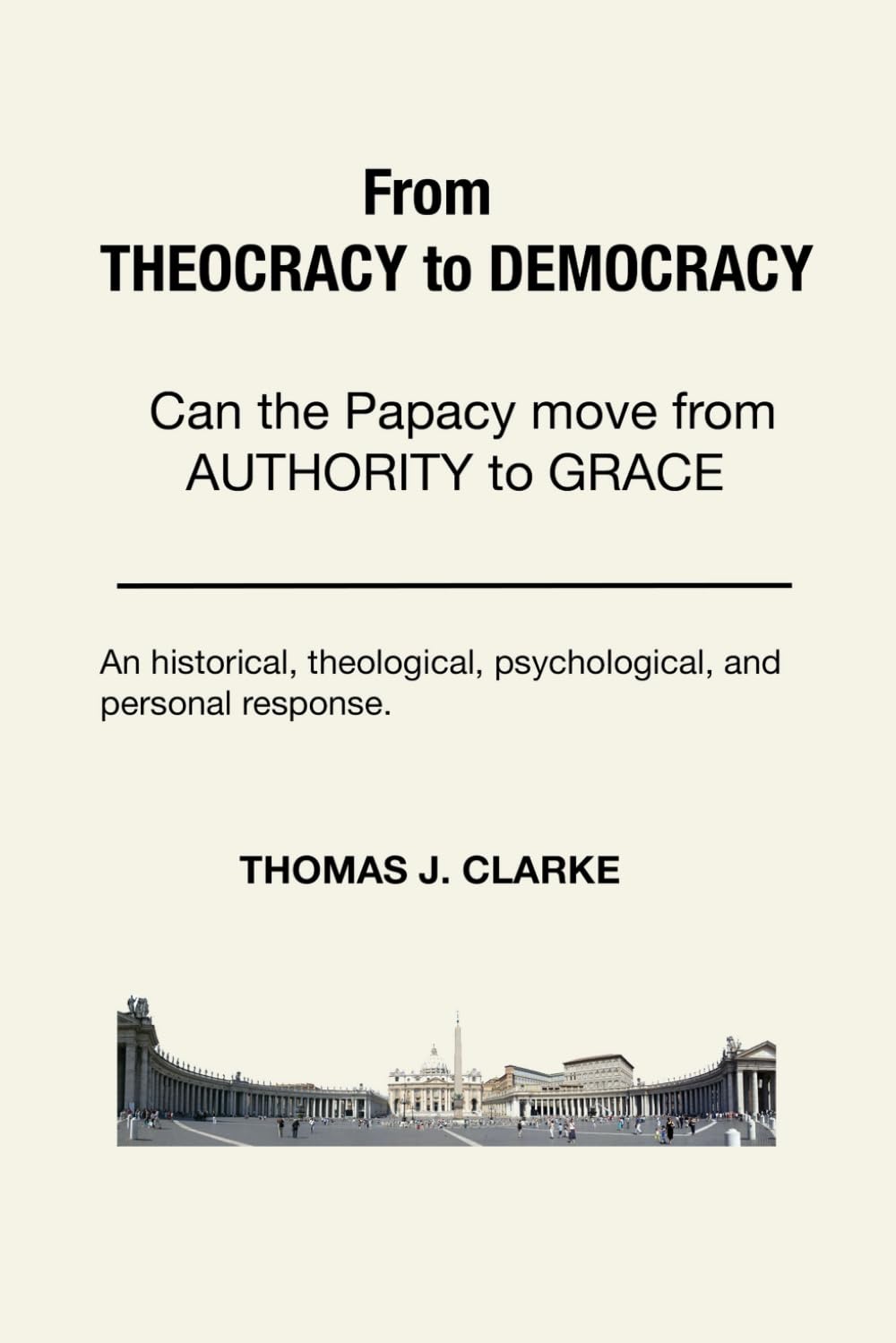

From Theocracy to Democracy is Thomas J. Clarke’s sweeping historical, theological, psychological, and deeply personal argument that Christianity, and especially the papacy, has too often exchanged the liberating grace of Jesus for the anxious machinery of theocracy. Clarke moves from ancient kingship and the “cosmological” ordering of society through Augustine, medieval papal power, the Reformation, Vatican II, and Pope Francis, always returning to one central wound: the Church has taught fear and obedience more clearly than it has taught unconditional love.
What moved me most is the way Clarke refuses to let abstraction remain bloodless. The opening memory of the little girl removed from First Communion because she had eaten or drunk after midnight is profoundly affecting in its simplicity. It tells the whole story before the argument begins: holiness made brittle by fear, authority mistaking itself for reverence, a child’s trembling body becoming the price of doctrinal anxiety. Clarke’s prose can be forceful, even thunderous, but beneath its severity I felt a sorrowing tenderness. He isn’t writing as someone eager to destroy the Church. He’s writing as someone who has loved it long enough to be wounded by it, and who still believes it might become more gracious than guarded.
Clarke’s range is formidable: the Sumerian Kinglist, the Enuma Elish, Hammurabi, Plato, Paul, Augustine, Luther, papal infallibility, fascism, Vatican II, and Francis all enter the same charged conversation. The argument presses so insistently on the contrast between theocracy and grace that the rhythm becomes more prosecutorial than exploratory. Yet the best passages have a grave, luminous power. I was especially struck by the book’s insistence that grace isn’t merely mercy after failure, but the substance of humanization itself. The late image of the man at the plane line, lifting the author into a crushing embrace, makes the theology suddenly warm. Grace becomes not a concept to be defended, but a life recognized in another person’s arms.
From Theocracy to Democracy is an impassioned and morally serious book, one whose urgency comes from both scholarship and lived pastoral ache. Clarke’s conclusions are not modest, and some readers will resist his psychological framing or his sharp critique of papal authority, but I appreciated the courage of a mind trying to rescue faith from fear without flattening its mystery. I think this book would be good for readers interested in Catholic history, theology, religious psychology, Vatican II, and the long struggle between institutional authority and human freedom. It’s a searching work for readers willing to sit with discomfort, and its final gift is a hard-won hope that grace, not anxiety, might yet have the last word.
Pages: 678 | ASIN: B0F4Q1HMQG
Vivid, Relatable, and Memorable
God’s Salvation Manifesto is a forceful work of Reformed theology that confronts the reader with humanity’s spiritual crisis and proclaims the gospel as the only sufficient answer, urging repentance through modern imagery and uncompromising conviction. Why was this an important book for you to write?
This book has undergone many transformations over the years. Repentance was always present in its core, but initially, I treated it as a means to reach my main point: exploring and challenging Reformed doctrine, which is something I enjoy. However, as I shared drafts with others, the theme of repentance kept resurfacing and became impossible to ignore. I also recognized that the field of Reformed doctrine is already filled with numerous excellent books, so I sought to create something distinct—a work that weaves together the centrality of repentance and the unique perspective of Reformed theology. Repentance is not just an aspect of the gospel; it is at its very heart. By focusing on this, I was able to present the gospel through the lens of Reformed doctrine, all while emphasizing the necessity of repentance.
It was important for me to write this book because, in many American evangelical churches today, repentance is often treated as optional, which could not be further from the truth. Without genuine repentance, there is no real faith. One cannot sincerely ask for Christ’s salvation while continuing to cling to sin, as if following Jesus is less appealing than holding onto old ways. This attitude reveals a deeper allegiance to darkness—the very thing Christ came to rescue us from. By emphasizing repentance, I hope to correct this misunderstanding and call readers back to the true meaning of faith and transformation. That is why this book needed to be written.
What led you to draw from films like The Matrix and Apollo 13 to communicate theological ideas?
Over the course of about a year and a half, I noticed that three different books I was reading used illustrations from The Matrix. This piqued my curiosity, so my wife and I decided to watch the movie ourselves. We were astonished at how often the film echoed deep biblical truths—so much so that we kept glancing at each other in disbelief throughout. While The Matrix is not a Christian movie, its script and imagery are saturated with themes that align closely with the gospel. This unexpected resonance is what truly captivated us.
I share the perspective of thinkers like Cornelius Van Til and Francis Schaeffer, who believed that authentic art—when it honestly seeks to tell the truth—inevitably reflects a Christian worldview. The artist does not need to set out with the intention of echoing Scripture; if the story is told with integrity, biblical themes will emerge, unless the goal is to glorify sin. In the case of The Matrix, these parallels were so unmistakable that you didn’t need to search for them—they were right there, plain to see.
Similarly, I found inspiration in Apollo 13. As I discuss in the book, the film serves as a metaphor for humanity in desperate need of rescue. The astronauts’ peril mirrors our own spiritual predicament, and Houston’s role—providing guidance and support—symbolizes the saving help God offers to those who call out in faith. Drawing from these films allowed me to communicate theological truths in ways that are vivid, relatable, and memorable.
Why was it important for this book to move from diagnosis to direct summons?
Answer: Moving from diagnosis to direct summons was crucial because the gospel is not merely an observation of humanity’s brokenness but a call to action. The Bible does not simply describe our spiritual condition—it compels us to respond. In the same way, this book goes beyond identifying the problem; it urgently invites the reader to repentance and transformation. The gospel message is inherently active: it diagnoses our need and then summons us to the only sufficient answer—turning to God in faith and repentance. Clarity and urgency are needed if lives are to be truly changed.
What kinds of resistance do you expect from readers encountering this message, and how do you respond to readers who struggle with the book’s emphasis on human incapacity?
This is a question I encounter frequently, given my Reformed perspective. It’s understandable that readers may resist the book’s emphasis on human incapacity, especially when it challenges the deeply held belief in unfettered free will. Let me clarify: Reformed theology does not deny that people make real choices every day—what to eat, what to wear, how to spend their time. What it does challenge is the notion that human will operates in total freedom, without limitation. We all recognize there are boundaries to our choices—no one can will themselves to be taller or to have a new set of natural talents overnight.
But the heart of the debate is whether a person can truly choose God on their own. The Scriptures and experience both suggest that while the offer of salvation is genuinely extended to all, people naturally pursue what they love most. The problem is that, apart from divine intervention, our affections are bent toward sin. Just as a hungry lion will always choose meat over hay, no matter how available the hay may be— because that is what lions do. It is in their nature. So too, the human heart, left to itself, will not choose God, because it is not in its nature. This is not about intelligence, morality, or effort; it is about the orientation of our desires. Only when God changes the heart do we find ourselves truly willing and able to respond to Him. I address this not to discourage, but to highlight the miracle and necessity of grace. I welcome honest questions and struggles with this message, because wrestling with it can be the beginning of deeper understanding and, ultimately, hope.
God’s Salvation Manifesto


James A. Hale’s God’s Salvation Manifesto is a work of Christian theology that frames the human condition as a spiritual emergency and presents the gospel, in strongly Reformed terms, as the only sufficient answer. The book moves from diagnosis to proclamation with a very deliberate architecture: it begins by arguing that the world’s visible disorder points to sin rather than merely social or political failure, then presses through themes of repentance, divine holiness, human inability, sovereignty, atonement, and final victory before ending in a direct summons to the reader. Along the way, Hale repeatedly translates doctrine into vivid modern images, setting Neo’s unease in The Matrix, the sacrificial pull of The Iron Giant, the terrible goodness of Aslan, Apollo 13’s helplessness, and the scandal of the cross into one sustained evangelical argument.
Hale doesn’t write as if he’s offering a spiritual supplement to an otherwise workable life. He writes with an intensity that gives the book real force. It feels sharpened by conviction rather than dulled by abstraction, and I found myself admiring how often he reaches for concrete, emotionally legible scenes instead of hiding behind theological shorthand. The opening use of The Matrix is clever because it captures that half-formed human suspicion that something is wrong, and the pages on Christmas versus Good Friday are among the book’s strongest because they show his instinct for contrast, tenderness, and pressure all at once. I also think he’s at his most compelling when he leans into image rather than assertion, as in the description of the torn veil, or the claim that people prefer the manger because the manger feels safe while the cross does not.
The author’s voice is clear, assured, and often stirring. He returns to ultimatum, polarity, and total spiritual incapacity. The book’s confidence in its theological framework was its strength. If a reader already leans toward Reformed doctrine, the arguments about sovereignty, repentance, and the Father sending the Son will likely feel bracing and coherent. Hale plainly believes these claims matter beyond the page, and that belief gives the book a kind of stern emotional honesty that I respected, even when I wanted more scrutiny.
I found God’s Salvation Manifesto intense, earnest, and often memorable. It’s not a cool or detached book. It wants to confront, persuade, and press the reader toward repentance, and on that front it’s remarkably consistent from first page to last. I’d recommend it most to readers interested in unapologetically doctrinal evangelical writing, especially those drawn to Reformed theology, conversion-centered preaching, and Christian books that treat belief as a matter of eternal consequence rather than private preference.
Pages: 159
Suffering Leads to Hope

James Velissaris’s Suffering Leads to Hope is part prison memoir, part devotional theology, and part spiritual self-audit. It traces a deliberate movement from denial, anger, bitterness, and surrender into repentance, humility, forgiveness, sanctification, faith, peace, freedom, and finally hope, love, joy, and glorification. What gives the book its shape is not just Romans 5:3-4 as a governing text, but the author’s insistence that suffering can become a furnace of transformation rather than a dead end. He writes out of corporate fraud, prison, family grief, divorce, childhood abuse, addiction, and the death of his stepfather, and he keeps returning to the same hard-won claim: pain doesn’t become meaningful by shrinking, only by being faced and yielded.
Velissaris is at his strongest when he lets the argument rise naturally out of lived moments: arriving at MDC Brooklyn in a fitted navy suit still half-believing the ordeal is temporary, watching Catracho drift through prison in a haze of deuce and longing for the daughter he can’t bear to see, or witnessing Abu lose what might have been his way home in a single eruption of anger. Those scenes have real force because they aren’t presented as sermon illustrations first. They feel observed, inhabited, and earned. I also found myself drawn to the way he describes interior states. His account of denial as “the mind’s final illusion of control” has a stark clarity to it, and the book is often most persuasive when it sounds wounded, chastened, and unsparing toward the self. The writing can be genuinely vivid, sometimes almost lyrical, especially when he slows down and trusts image, memory, and rhythm to do the work.
The book’s ideas are earnest and often moving. Velissaris wants to make every affliction legible inside a Christian framework. When he’s wrestling with bitterness, forgiveness, or the slow discipline of service, I felt the texture of genuine struggle. When he shifts into more explanatory, doctrinal passages, especially where he presses psychological or social analysis into firm theological conclusions, the prose can harden and the complexity thins out. Still, even there, I respected the seriousness of his attempt. He is not writing from a safe distance, and that matters. The sections on repentance, discipleship, and joy are most convincing when they show that transformation is not clean, triumphant, or instant, but repetitive, humiliating, and daily. I appreciated, too, that the book does not confuse joy with cheerfulness. Its better insight is sadder and truer: grief remains, but it is no longer sovereign.
I found Suffering Leads to Hope sincere and often affecting. It’s a book written by someone trying to tell the truth about what broke him and what he believes remade him, and that gives it a gravity that polished self-help books rarely have. I never doubted the depth of conviction behind the book. I’d recommend it most to Christian readers who are living through loss, guilt, addiction, or long seasons of unanswered prayer, and to anyone interested in spiritual memoirs. It’s a book for readers who don’t need suffering explained away, but do want to see what it looks like when someone tries, stubbornly and imperfectly, to wrestle it into meaning.
Pages: 223 | ASIN : B0GQHT9J1R
Moral Indignation

Moral Indignation: Embryonic Stem Cells, DNA, and Christians is a long, fiery walk through science, theology, and ethics from a very outspoken Christian point of view. Author Sherman P. Bastarache sets out to make a Christian case for supporting stem cell research and other modern biomedical tools. He moves from big questions about knowledge and faith, through DNA and evolution, into abortion, euthanasia, and the soul, then circles back to what it means to be truly “pro-life” in practice, not just in slogans. The book mixes Bible study, personal stories, popular science, and social commentary, and it ends with a push toward compromise and concrete ways to back research that aims to reduce human suffering.
I found the voice to be bold and charming. Bastarache writes like someone talking across a kitchen table, not like a distant academic. He leans on scripture, then jokes about Yoda, then swings into stem cell basics, and it holds together most of the time. I appreciated the very personal, unfiltered style of the writing. The chapters move freely, the arguments often circle back for emphasis, and some analogies linger in a way that lets the ideas sink in. The tone ranges from gentle and pastoral to strongly assertive, and even the occasional bit of coarse language highlights how deeply the author feels about the issues at stake.
His core line hits hard: ignorance is not holy, and refusing to use knowledge that could ease suffering is its own kind of moral failure. When he unpacks the old fear of “playing God” and reframes humans as responsible co-workers who need to grow up and act, I felt that was both theologically interesting and morally bracing. His use of real cases around high-risk pregnancies, late-term complications, and new reproductive technologies makes the debate feel grounded in actual lives. I appreciated that honesty. On the other hand, his strong feelings about certain pro-life arguments give the book a clear, unmistakable stance. He tends to focus on the human cost of inaction more than on every fine-grained worry about embryos and possible future abuses, which keeps the spotlight on real lives. I could feel the passion in those pages.
I would recommend Moral Indignation to Christians who feel torn between loyalty to their faith community and respect for modern science, and to believers who suspect that “do nothing” is not a morally neutral stance in medicine. It could also interest secular readers who want to see a serious Christian wrestle with stem cells, DNA, and bioethics without hiding behind easy platitudes. If you appreciate strong feelings and a very human voice that tries to drag faith and reason into the same room, you will find Bastarache’s thoughts inspiring.
Pages: 314 | ISBN : 978-0992159412
Christ Sent Me Not to Baptize: Paul’s Gospel and the One Baptism

Christ Sent Me Not To Baptize by Michael Del Brown lays out a sweeping study of every baptism in Scripture and funnels it toward one sharp claim. Paul teaches that only a single baptism applies to believers today. The book begins with a lexical deep dive, wanders through ancient rituals, walks carefully through Israel’s history, then lands on Paul’s letters where the author argues that Spirit baptism alone defines the present dispensation. It is a detailed trip. The argument keeps circling back to Paul’s insistence that he was sent to preach and not to baptize. That idea becomes the backbone of the entire work.
The writing often feels like a scholar talking straight at a kitchen table, which I sort of liked. It moves briskly from word studies to cultural history to doctrinal claims. The author clearly cares about precision. He keeps coming back to identification with Christ as the core theme behind baptism. I found that emphasis refreshing. I found myself energized by the pace. The ideas come one after another, and it pushed me to pause on my own and really let each point sink in. I ended up appreciating how the steady movement kept me alert and thinking as I read.
Emotionally, the strongest pull for me came from the sections that place Paul in contrast with the Twelve. That contrast shapes the whole book. It felt bold and at times almost confrontational. I appreciated the author’s confidence, though. He really believes that Paul’s revelation changes everything about how we read baptism. Whether or not one agrees, the conviction behind the writing gives the book a kind of charge. I found myself nodding, arguing back, agreeing again, shaking my head, and then leaning forward to see what he would say next. It kept me engaged even when I wrestled with the conclusions.
The book reads like a long conversation that mixes study, passion, and a firm desire to set the record straight. I walked away with a clearer sense of why the author believes water baptism belongs to Israel’s program and not to the Body of Christ today. I also walked away with plenty to think about. I would recommend this book to readers who enjoy deep dives into Scripture, to pastors sorting out doctrinal questions, and to anyone who likes wrestling with big theological claims. It rewards methodical reading and a curious mind.
Pages: 137 | ASIN : B0FSVGGFFC


