Blog Archives
Knowledge Is Power

Where Did Computers Come From? follows two young brothers who find themselves on a time-traveling adventure after they discover a sentient technological construct in their garage. Where did the idea for this story come from?
Ever since my first son, Jacob, was born, I’ve had the desire to teach him all I have grown to know and love about computers. I could not find any STEM-related books for children that taught them about the origins and future of technology.
Growing up in the late 80’s to early 2000’s, technology has seen a tremendous growth and transformation, from payphones to cellular smart phones, from Ataris to Nintendo, Xbox, and PlayStation, from cassette (mix) tapes and Walkman to Pandora and Spotify. The growth has not stopped, nor do I feel like it will in the foreseeable future, with the continued injection of Artificial Intelligence, Robotics, and future Quantum technology; however, to grow is also to know the past. My intent was to create a fun, interactive book series to teach the children of today, those that are born with technology at their fingertips, where this all started, so that they can create love and respect for it and also build the technology of the future.
Did you base Jake and Eli on real children or experiences?
I have fond memories as a child, growing up and going to early computer shows at the local racetrack with my father to buy individual computer parts, from RAM, floppy drives, CPUs and coming home to put together what was essentially my LEGO, taking all of those parts and building my own computers. Since that early age I have been taking technology apart and putting it back together. I’ve had a successful career building large computer systems from concept to operations and now focused on the cybersecurity protections of them. I apply all of the knowledge I have gained over the years as the basis of accuracy for these books. The hardest part is putting them in terms kids would understand and enjoy and that is where the magic occurs. My co-conspirators and inspiration for this series are Jacob and Elijah, my two sons (9 and 7 respectively), who I talk through my imaginary concept to ensure it makes sense and is fun.
As a child, I excelled in math and science but struggled with reading and specifically comprehension and retention of information I read. This was the driver for the interactive nature of the book series. Each book has a QR code where parents, teachers and kids can open a webpage with additional supplementary information tailored to the specific story they read to reinforce the concepts. The page content ranges from fun facts, to interactive knowledge check games, and downloadable content such as connect the dots, spot the difference, etc. The play aspect of this makes it not only fun but will hopefully help retain the overall topic taught in the stories.
Techtor is a memorable addition to the story. How did you design this character to feel friendly and approachable for young readers?
The vast majority of us have a fascination with traveling through space and time. It captivates us as we watch super hero adventures or movies that challenge our thinking of moving particles through space. In the first book adventure, we see Jake and Eli traveling through time and going into the past to meet a mainframe computer. In the second adventure, they travel into the innermost parts of a computer to learn how the parts work together. In the third adventure, not yet released, we will see Jake and Eli enter into the world of coding to learn the language of computers. These concepts were drawn from great movies like Honey, I Shrunk the Kids or even Willy Wonka where humans were transported through time and space, transformed to particles and reassembled in a different location and/or size.
Can you give us a glimpse inside the next book in the Jake and Eli’s Adventures series?
As such I strive to teach my children that the boom of technology could be used to achieve great things; however, it can also be used for harm. Each book released in the series is intended to build on the previous story. As such, a future book is focused on ensuring that everyone knows how to safeguard themselves while taking advantage of the wonderful benefits we get from technology. This protection would include knowing how to avoid cyber bullies and being aware of what scary “digital” roads not to go down. It will also highlight that protection is not the job of one individual but more of the entire family. Knowledge is power. If you know what you need to be cautious of, the better equipped you’ll be to avoid them.
Author Links: GoodReads | Facebook | Website | Amazon
Have you ever wondered where computers came from? In Jake and Eli’s Adventures: Where Did Computers Come From?, brothers Jake and Eli embark on a thrilling journey through time to uncover the secrets of technology! When their dad encourages them to explore the garage, they meet Techtor—a friendly guide who opens the door to the past. Together, they discover Max the Mainframe, a giant octopus-like computer that processes information in a whole new way! With colorful punch cards and fascinating facts, Jake and Eli learn how computers evolved from massive machines to the personal devices we use today. Filled with excitement, mystery, and fun, this adventure will spark curiosity and inspire young readers to explore the world of technology. Get ready to dive into the past and discover how computers changed our lives forever!
We Have More To Do

Pocket Watch Portals: The Timekeeper’s Revenge follows four siblings into an enchanted realm, who need to fix the time rift they accidentally created before the vengeful Timekeeper destroys every world. What was the inspiration for the setup of your story?
When I received the 1st book in the series, Pocket Watch Portal Adventure, my 3-year-old grandson Artie came to me with alligator tears, telling me, “I wasn’t done with us, we have more to do!” He started telling me about the fairy princess named Misty, and how she needs them to come back and save not only their realm but all realms. He described it as needing a “white Dragon,” later becoming the snow dragon, Erithon. and a unicorn, later named Ethel. The King & Queen, with the people of that realm, needed help to bind up the timekeeper due to the kids breaking the rules of time travel.
This book explores the consequences of time travel. Why was that important to include?
Thought about the fact that time travel would affect anything after that point and change things. So I kept this in line with the first story to show that if you don’t follow the rules, whether it be time travel or any rule, it has consequences.
Kindness plays a big role in solving problems. Was that a core theme from the beginning?
Kindness and all the core values are a part of Christian living, even though the mythical creatures and the time travel, I wanted to continue to show those values to my grandkids and the readers.
Will we see more adventures with these characters?
Absolutely, We are working on the 3rd & 4th story in the series.
Author Links: GoodReads | Facebook | Instagram | Website
Pocket Watch Portal Adventure: The Timekeepers Revenge


Pocket Watch Portals follows Justice, Teddy, Ellie, and little Artie as they get pulled back into a magical realm after a strange storm hits their grandparents’ ranch. A fairy named Misty appears and explains that their past adventures accidentally caused a dangerous rift in time. Soon the kids, along with the always-dramatic Uncle Jeff, are flying on clouds, meeting dragons, riding unicorns, and scrambling to collect a powerful crystal and a legendary flower to stop the terrifying Timekeeper from returning. The story builds into a huge battle full of fairies, dragons, unicorns, and a very panicked Uncle Jeff trying to save the day.
The writing is playful and full of little jokes that made me grin. Artie’s sweet mispronounced words melted me, and Teddy’s wild confidence cracked me up. I kept wanting to nudge Justice to relax because he tries so hard to act responsible while everything around him just gets stranger and stranger. The whole thing gave me that warm, nostalgic feeling of childhood summer adventures that always got just a bit out of hand, and I liked that the world felt colorful and soft even when the stakes were high.
I didn’t expect a children’s book to dive into the consequences of time travel in such a fun way, and I liked how each kid had a specific role in fixing the problem. Teddy bonding with the giant snow dragon might be my favorite moment. It felt so pure. The book really leans into magic as something alive and emotional, not just flashy, and I found myself weirdly touched by how often kindness solves the problem rather than power. Even Uncle Jeff’s chaotic bravery felt genuine and sweet.
I’d totally recommend The Timekeeper’s Revenge for kids who love fantasy worlds, magical creatures, silly humor, and quick adventures that never sit still. It’s also great for adults who enjoy lighthearted stories that feel like stepping back into childhood for a bit.
Pages: 60 | ASIN : B0CW1JPBHW

Brilliant Genesia
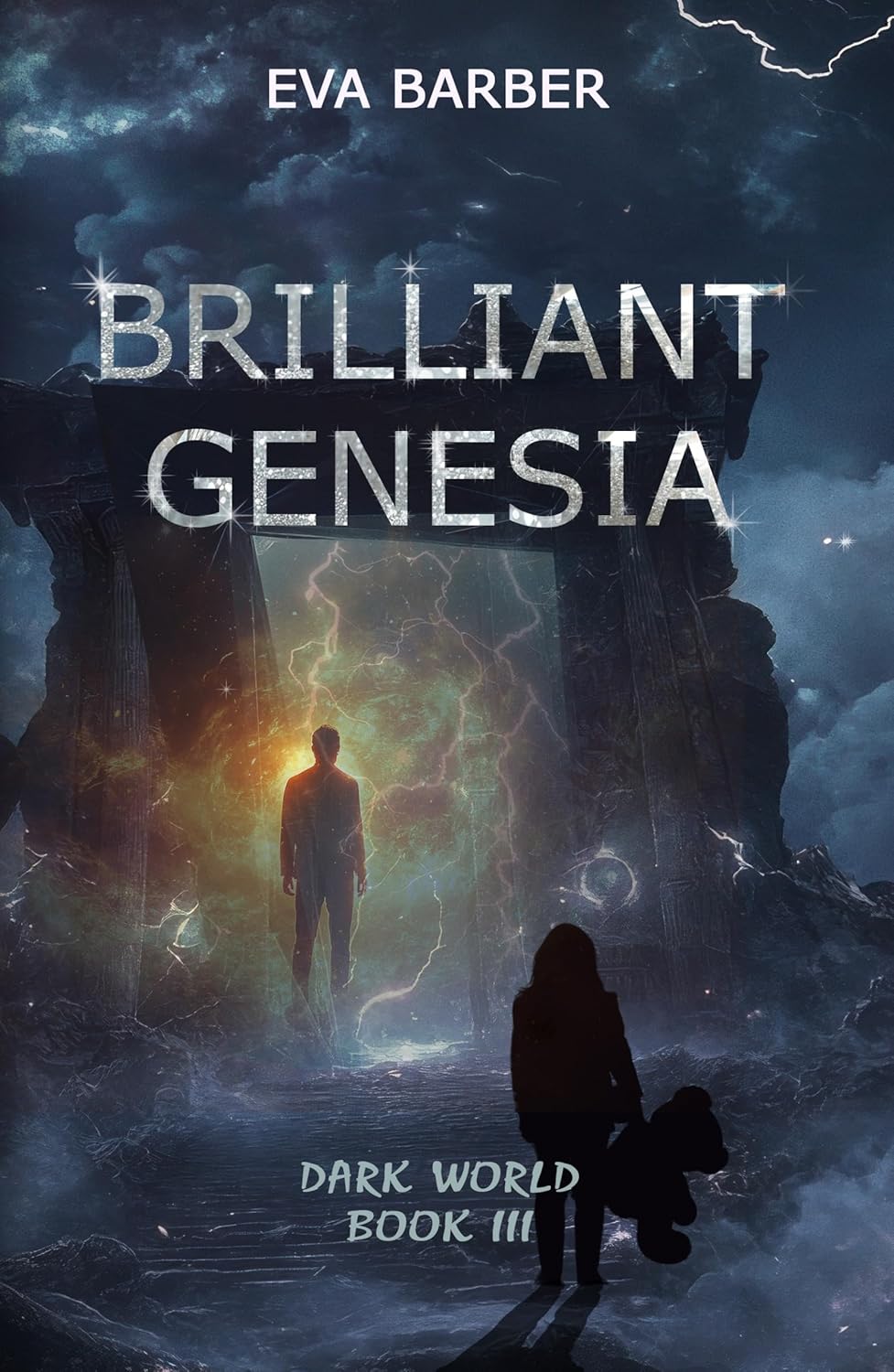

Brilliant Genesia by Eva Barber is a genre-blending speculative science fiction novel that starts like a quiet dystopian coming-of-age story and grows into a high-stakes, reality-hopping fight for humanity. It opens in Andalia, where twelve-year-old Zara is taken to a mental health clinic because she keeps seeing a dark-haired woman in frightening, increasingly vivid “visions.” As Zara grows up, her brilliance bumps up against a society that hems girls into narrow roles, and her secret inner life becomes the seed of something much bigger. Eventually, the story pivots into adult Zara’s life as a top scientist and mother, tangled in time travel experiments, missing people, and a chilling technology called “Brilliant Genesia” that promises immortality by stripping away the parts of us that make us human.
What I kept noticing, in a good way, is how Barber writes with a strong visual hand. The early pages linger on soft colors, quiet art, robes, and ritual, which makes the control in Andalia feel normal at first, almost cozy, until you realize that is the point. Those details do more than decorate the scene. They build a kind of polite cage. I also liked that Zara’s intelligence is not presented as a quirky trait, it is a pressure point. When she is forced to stay small, you feel it in her silences, and in the way she measures what she can safely say. The writing has an earnest, direct quality. It is not trying to be cool. It is trying to be clear, and I appreciated that.
The author also makes a bold structural choice: the book doesn’t just “raise the stakes,” it changes the whole playing field. One minute you’re in a tightly controlled society with a girl being studied, and later you’re dealing with a grown Zara, the Vortex, and forces that literally call her by another name, insisting she is “Olesya Solensky,” pulling her into a broader web of dimensions and old relationships. That kind of shift can feel risky, but here it mostly worked for me because the emotional through-line stays consistent: a woman trying to protect her child, and a child trying to get her mother back. When the villain argues that “Brilliant Genesia” improves life by removing love, empathy, and messy human needs, I found myself oddly unsettled because the logic is smooth on the surface, like glass, and still wrong in the bones. And the book doesn’t let you forget the social cost either. Zara’s past includes hiding who she is, even pretending to be a man to pursue her work, which gives the later ethical questions real weight instead of making them abstract.
I’d recommend Brilliant Genesia most to readers who like speculative sci-fi with a dystopian spine, especially if you enjoy stories that start intimate and then swing wide into big-idea territory (time experiments, parallel lives, and moral battles over what “progress” means). If you want a neat, single-lane plot, the genre shift might feel like whiplash. But if you like ambitious sci-fi that’s still rooted in family bonds and anger at unjust systems, you’ll enjoy this story. And if you’re the kind of reader who finishes a book and immediately wants to talk it through with someone, it gives you a lot to think about.
Pages: 408 | ASIN : B0GF8R2N5Z
The Great Question of Life

Army of Three follows two brothers bound by loss and impossible power whose fragile alliance is shattered by the murder of the woman they love; grief drives one brother to gamble with time, destiny, and reality itself. What was the inspiration for the setup of your story?
The inspiration for Army of Three began with the most tragic day of my life. At age twenty‑one, I lost my father in a deeply traumatic way. Shortly afterward, I went through my first serious heartbreak. Axel’s great loss in the story represents these two events combined into one tragic incident. There were very few people who could understand the weight that had suddenly been cast over my life. My three brothers and my two closest friends became a new kind of brotherhood. Anyone who has lost someone close has wrestled with the great question of life: What if? What if I could have saved them? What if there were a way to go back?
As for the brothers and the family dynamic, my family was always a “family first” kind. Growing up the third of four, and moving constantly, left us with only each other more times than I can count.
A major part of my inspiration was J.R.R. Tolkien. Although my stories differ greatly from his, the creation of these tales came from the same logic: to write something meaningful enough to change how a reader thinks and feels. That kind of power can truly influence—and, God willing, make a positive impact on—a struggling world. I believe the call to writing isn’t simply enjoying books or earning an English degree. Those may help, but the calling runs deeper. The true call to writing is experiencing life in a way that shapes you, and feeling inspired to use that experience and knowledge to help others.
Axel’s choices can be frustrating yet understandable. Were there moments when you struggled with his decisions yourself?
Yes and no. Most of Axel’s choices reflected the tenderness of the human spirit. The idea is that true love is so powerful it defies logic, and the idea that love can be dangerous lives in that same space. The struggle didn’t happen when my pen pressed into the paper. It happened when I made the poor decisions that inspired Axel’s—when I was wrestling with them myself.
What were some themes that were important for you to explore in this book?
Love, Loss, redemption, and brotherhood. Most importantly, in real life it isn’t always a happy ending, but there can almost always be happiness found in the ending. When my father passed, it felt like we had lost. Eleven years later, I reflected on that feeling again and realized I had grown into a far greater man than I ever could have imagined if I hadn’t suffered and endured what I have.
What is the next book that you are working on and when will it be available?
Psychic Kids: The Secret of the Orphanage will exist within the same universe but following a completely new set of characters. It is fairly early in development and the earliest you could expect it would be January 2027.
Author Links: GoodReads | Website | Amazon
Axel and Karl Fassbinder were never meant to live ordinary lives. One survived a fall no human should endure; the other grew into a man strong enough to take on armies. Together they became a whispered legend — the Army of Two.
Everything changes when Azrael joins them. Scarred by tragedy and bound to a terrifying ritual where blood costs blood, she turns their duo into the Army of Three.
But her murder rips their world apart. Axel’s grief twists into a relentless drive that hurls him into conspiracies, android ambushes, and a future drowning under rising oceans. Desperate to undo the moment that broke him, he turns to the only force more dangerous than his enemies: a machine that can bend time.
Every step threatens the world he’s trying to save, and every choice pushes him toward one unescapable truth:
Some destinies can only be changed through sacrifice.
Inside these pages:
Two brothers shaped by impossible wounds — and the woman whose death may unravel time itself.
A future swallowed by storms, corruption, and shadows no one dares name.
Silent android killers, buried conspiracies, and a forbidden ritual that demands a soul in exchange for power.
Battles that defy logic, escapes no one should survive, and technology capable of bending reality.
A descent into grief, vengeance, and loyalty — and a dangerous question echoing through every chapter: How far would you go to rewrite fate?
Warning: This book will steal your sleep. Once you step into Axel’s world, the hours disappear, the pages won’t stop turning, and you won’t escape until the very last word.
Raw, cinematic, and unflinchingly emotional, Army of Three tears open a world built on broken promises and impossible choices — and refuses to let you look away.
Not just science fiction. Not just action.
A story about what we sacrifice for the people we love — even if it destroys us.
This is the book that grips readers while everyone else is still sleeping on it.
Buy Now and don’t be the last one to feel what everyone else is losing their minds over.
My Twelve-Year-Old Wife: Erased Memories

My Twelve-Year-Old Wife: Erased Memories drops the reader straight into a world where time folds, grief bites hard, and reality keeps shifting under the characters’ feet. The book follows Dan, a man who loses his wife brutally, then hurls himself backward through time to save her. He lands in 2003 and discovers a teenage version of Celia, a younger and sharper incarnation of the woman he loved, and a chilling truth about Lang, the man who killed her. As Dan struggles to protect her, time glitches, memories warp, and past and future versions of Lang collide. The story moves fast, and the stakes sit right at the throat from the opening chapter.
I kept feeling the tension coil in my chest whenever Dan slipped between timelines. His heartbreak is loud. His fear is louder. I found myself rooting for him even when he made choices that scared me. The writing surprised me with small, quiet moments tucked between scenes of dread. A breakfast. A joke. A breath of calm before the ground cracked open. They made the danger feel personal instead of mechanical, and I loved that steady tug between ordinary life and cosmic consequences. There were times when the dialogue carried more weight than the action itself, and those were the moments that resonated with me.
Time travel is usually all rules and logic, but here it felt messy and emotional, which I liked. Time behaves like a living thing. It twitches when Dan pushes it. It punishes him when he presses too hard. I also appreciated how the author handled trauma. Nothing is graphic, but the emotional fallout hit real. Celia’s distrust, Dan’s guilt, the thin places in the world that react to their fear, all of it landed with a strange mix of warmth and dread. I kept forgetting to breathe during the scenes under the bleachers, especially when the masked figure flickered in and out of sight. The writing there felt sharp and cold in the best way.
I would recommend this book to readers who enjoy psychological thrillers with a strong emotional core, and to anyone who likes their time travel tangled with heartbreak instead of gadgets. If you want a story that creeps under your skin and sits there long after the last page, this is a good one. Author Dan Uselton turns time itself into a monster, and the result is unforgettable.
Pages: 323 | ASIN : B0G2FLTQSP
Challenging Themes

I Know You follows a Scottish teenager who, after an argument with her boyfriend, is knocked unconscious and wakes up in the past at an Ethiopian refugee camp and spends the next 48 hours traveling through time. What was the inspiration for the setup of your story?
When my younger (and quite feisty) daughter was a teenager, I used to take great delight in teasing her by adopting rather unPC attitudes which I knew she would be unable to resist challenging. That experience provided the kernel of an idea. I thought it might be fun to have two characters of similar age but with world views formed half a century apart, thrown together. Clearly, such a situation is fantastical, so I felt that any construction that ‘explained’ the phenomenon would be fine. I was keen to establish the protagonist, Eilidh, as a bright but fairly typical late teenager – hence the early argument with the boyfriend. I also wanted to establish her as a time traveller and also someone with quite a lot about her, as well as introducing the link to Walter (the other main character). Given that Walter was born fifty years before her, that provided the window in which any meetings would have to take place. I chose Ethiopia in 1984 as it would show how Eilidh responded to being thrown into a nightmarish scenario, and allow me to introduce Walter in a low-key manner that didn’t give the game away too early.
Eilidh is transported to various locations and times over a period of 48 hours. Were you concerned about disorienting readers, or was that emotional confusion part of the intention?
I wasn’t at all concerned about disorienting readers, which might identify me as not caring about my audience! I was aware that the sudden jumps through time and space, allied to the pace at which the narrative moved, could be disorienting, but I felt that might help readers to identify more closely with what Eilidh was experiencing.
What were some themes that were important for you to explore in this book?
In truth, the book is a somewhat self-indulgent exercise. I hadn’t enjoyed writing my previous novel and decided that, no matter what, I was going to enjoy producing this one. So, I chucked as many of the things that matter to me as I could think of into the pot – family, Scotland, relationships, sci-fi, love, humour, music, football (soccer), friendship. Although the story is clearly fantastical, I wanted it to still bear a few hallmarks of authenticity, so I included some of the more challenging themes that life throws at us – bereavement, illness, and the tragedy of someone close succumbing to dementia. I didn’t want those themes to overwhelm the narrative, but I did want to treat them with respect and sensitivity. I hope I managed that.
What is the next book that you are working on, and when can your fans expect it to be out?
I’ve written a sci-fi yarn set in a near-future world dominated by competing AIs, focused on a tiny number of humans who happen to be telepathic. Any publisher who has shown interest has expressed the desire that the book be one of a series. I don’t have the appetite to write another of those (at least not yet), so I don’t think that’s going anywhere. Subsequently, I’ve just finished a particularly dark psycho-sexual thriller with what I think is a pretty surprising twist. Now I need to summon the energy to get on the publisher/agent treadmill! Meantime, I have a half-formed idea for a new novel, which is probably more like I Know You than anything else I’ve written.
Author Links: GoodReads | X (Twitter) | Website | Amazon
Eilidh, bright, headstrong and feisty, gets sparkling exam results that confirm her university place. Her boyfriend reveals he has deceived her. In the ensuing argument she is knocked unconscious. She arrives in 1984, in an Ethiopian refugee camp, where she nurses a dying child, then a wounded aid worker before wakening back home in present-day Scotland. Three days later, at an isolated beauty spot trying to come to terms with her ex boyfriend’s betrayal and her experience in Ethiopia, she encounters Walter, who is in the early stages of dementia. He is there because of a tattoo on his wrist that simply states the date and location of the beauty spot. Eilidh recognises Walter’s symptoms, takes him home and contacts his niece to come and collect him.
Over the following 48-hour period Eilidh finds herself transported to various locations in Europe and North America, and time periods from the previous fifty years. Each episode draws her further into an unexpected and unconventional romance. Eventually she travels to WW2 blitzed Liverpool and meets a fellow time traveller who explains that Eilidh faces a decision with life and death consequences.
Army of Three

Army of Three follows the Fassbinder brothers through a life shaped by loss, love, violence, and the weight of impossible gifts. The story opens small and personal, then builds into something that stretches across decades, worlds, and even versions of reality. It starts with two young men chasing criminals at night and grows into a tale about loyalty, grief, and destiny. Along the way we meet Azrael, a mysterious and powerful woman whose bond with Axel becomes the heart of the book, and later we see how her death fractures everything the brothers knew. By the time I reached the final pages, the story had folded back on itself in ways that felt both surprising and strangely right, and the letter from Karl brought a quiet and emotional sense of closure.
The writing is straightforward, yet it carries a sincerity that makes the emotional moments land with real weight. Scenes like Axel holding Azrael after the attack shook me. His heartbreak felt blunt and unfiltered. The author is not afraid to lean into big feelings, and the story benefits from that. I liked how the quieter moments in forests or diners or rooftops created space for the characters to breathe. Those scenes let me sit with them, and I grew to care about them, even when they made choices that frustrated me. There is an earnestness to the prose that makes the chaos of superhuman fights and government conspiracies feel grounded.
I also found myself surprised by how much the book weighs in questions of fate and identity. Axel’s struggle to figure out what kind of man he wants to be resonated with me. The story plays with the idea that heroism is not clean or noble, and sometimes it is just two broken people trying to survive what life handed them. Karl’s evolution unfolded cleanly and was emotionally potent as well. Watching him carry the burden of protecting his brother and then eventually writing that final letter made him feel painfully human. Even the supernatural touches, like Azrael’s powers and the strange forces lurking in the dark, worked best when they mirrored the characters’ inner fears. Sometimes I wanted the pacing to slow a bit so I could sit longer with those moments, but the urgency of the plot has its own appeal.
The story closes in a way that honors its emotional core, and it left me thinking about sacrifice and second chances. I would recommend Army of Three to readers who enjoy character-driven science fiction and action stories that are fueled by emotion as much as spectacle. It is a good fit for anyone who likes tales about brothers, unlikely heroes, and love that changes the course of a life.
Pages: 219 | ASIN : B0G26F47K1


