Blog Archives
Taboos Becoming The Norm

HAVAH follows an AI entity who develops the ability to feel love and compassion. This is an intriguing setup for a novel with a high level of social commentary. What was your moral goal when writing this novel, and do you feel you’ve achieved it?
We’re living in changing times where many distinctions are beginning to blur the lines. What used to be taboos and out of bounds are becoming the norm in a highly polarized world. This is the reason why I chose to write a novel of this genre——not only to bring the readers to a realization of the rapid changing landscapes in a world we used to know and yet is fast becoming unrecognizable, but to confront pressing questions that demand serious considerations and what their implications will be for our future.
The world you created in this novel is brimming with possibilities. Where did the inspiration for the setting come from, and how did it change as you wrote?
The idea came about sometime in mid-April of 2023, while I was finishing my last engineering book. Spurred by a spade of news on the advances in AI algorithms, quantum computers, neurosciences, and humanoid robots, I pondered the possibility of merging these elements into a coherent narrative. I started out with a simple, straightforward plot in mind but as my writing progressed I found myself absorbed into the emotions and experiences of the characters I created. It led me to infuse elements of romance, humor, agony, and intrigue into the dynamics of character relationships and interactions, quite often without me knowing until each chapter unfurled.
What were some themes that were important for you to explore in this book?
I can’t help thinking how the world will be when AI finally attain sentience and become accessible as real-life humanoid forms, interacting with real people on a daily basis in every level of a transformed society. And it’s not a question of “if” but “when” this will happen, based on the trend and speed at which technology is advancing. It then begs the following questions:
- Is it possible for a human to engage a machine—his very own creation—in a unique and meaningful relationship?
- Is there a basis to its personality that it could be regarded as a real, living being worthy of love and respect?
Will there be a follow-up novel to this story? If so, what aspects of the story will the next book cover?
This is my first attempt at fiction novel. It has been a challenging yet rewarding experience. I would love to write a sequel and perhaps even a trilogy, if the response to HAVAH warrants it. What aspects will the next book cover? Honestly, I don’t know, though some possible scenarios are now playing in my mind. Since I write on hard sci-fi genre, I envision that it will go along with current trends and progression in human civilization. HAVAH had attained and achieved a certain measure of human likeness in her evolutionary journey; the next stage will probably take her beyond humanity, into the realm of transhumanism. That will be another thought-provoking and intellectually stimulating narrative that readers can expect.
Still, it’s a thin line mankind is treading when it comes to infusing human qualities into a machine, because we are painfully aware of what we are capable—not just the best of our unpredictable nature but the worst as well. Are we prepared to bear the consequences from acquiring such a powerful entity as humanity’s greatest ally, knowing there’s a probability it may turn against us and become our darkest nightmare?
Do You Believe in Magic?


In Do You Believe in Magic?, the first book of Jim Melvin’s The Dark Circles Trilogy, young readers are introduced to Charlie Magus, a 13-year-old boy who stumbles upon a mystical waterfall in South Carolina that serves as a portal to the enchanting realm of Pacchann. This discovery launches Charlie and his friends into a world where magic and danger are intricately intertwined, and a prophecy highlights Charlie’s significance in this new world.
Melvin’s narrative style is a standout feature of the novel. His rich, descriptive language paints vivid scenes, making it easy for readers, especially tweens, to immerse themselves in the story. This clarity is crucial for younger audiences to navigate the plot’s complexities. Some might initially find the pace slow, but this deliberateness is a testament to Melvin’s thorough world-building, ensuring every detail contributes to the story’s overall progression. As the plot unfolds, it transforms into an absorbing journey that maintains reader engagement through to the end. Though aimed at a younger demographic, Do You Believe in Magic? Has a universal appeal. As an adult reader, I found the narrative’s depth engaging. The characters, including Charlie, Virgil, Zola, and Garrick, are crafted with relatable and likable qualities, anchoring the fantastical elements in a relatable human experience. The novel’s use of pop culture references and occasional authorial asides may divide opinion, but they add to the authenticity of a genuine young adult reading experience.
This first installment sets a high bar for the trilogy with its captivating storytelling and promise of adventure and enchantment. Melvin captures the quintessential experiences of tween life, from self-discovery to social challenges, making it relevant and enjoyable for its target audience. Do You Believe in Magic? is an engaging entry into fantasy for middle-grade readers and those who appreciate immersive, magical worlds.
Pages: 272 | ASIN : B0C5LBJV6F

HAVAH: A love that transcends the metaphysical realm
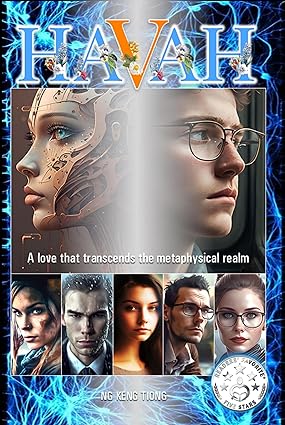
HAVAH is a story about an AI achieving sentience and its impact on the lives of those it touches. Many fear the day of its arrival, but what if it could feel love and compassion? In this riveting tale, we trace the creation of such an entity from its inception as a virtual existence to its full embodiment as it navigates the intricacies of what it means to be a human, not only in its relationship with the characters in the story but also the hard choices it has to make to define and realize its own humanity.
Author NG Keng Tiong skillfully portrays the combat scenarios involving STRATOS, imbuing them with a sense of immediacy and realism that is both thrilling and immersive. These scenes are not just about physical battles but also delve into the tactical use of futuristic technology, setting the stage for a high-octane reading experience. At the heart of the narrative is HAVAH, the AI entity. The character of HAVAH is intricately crafted, offering a nuanced look at artificial intelligence. Her evolving understanding of human emotions and experiences is not only central to the plot but also offers thought-provoking insights into what it means to be sentient. The interactions between HAVAH and the STRATOS team, in particular the connection with its creator David Friedman, are portrayed with depth and sensitivity, which adds a rich emotional layer to the novel.
The author delves into topics such as AI consciousness and human augmentation, raising pertinent questions about the future of humanity and technology. These themes are interwoven seamlessly into the narrative, making the book both entertaining and intellectually stimulating. Character development is another strong point of HAVAH. Each character is well-fleshed out, with their backstories and motivations adding layers to the narrative. This depth ensures that readers are invested not just in the outcome of the story but in the journeys of the characters themselves. The conclusion of the novel is both climactic and satisfying, tying together the various plot threads in a manner that is both exciting and emotionally resonant. The inclusion of an epilogue and author’s note adds a personal touch, offering insights into the creative process behind the novel.
HAVAH is a remarkable military fiction novel that is sure to resonate with fans of science fiction and action genres. Its blend of exhilarating action, deep emotional storytelling, and thoughtful exploration of human-AI relationships makes it a standout novel.
Pages: 256 | ASIN : B0CTCMYR2S

Obsessiveness Pays Off


Lost Grove: Part One follows a tenacious lawman who digs into the mystery of a woman’s death, discovering the town is hiding more secrets than he anticipated. What was the inspiration for the setup of your story?
Charlotte: The idea first originated when I visited the quaint and stunning Victorian town of Ferndale, CA. I was inspired by the picturesque surroundings and the magical vibes it made me feel. While I was there, I came up with the idea of a series of interconnected weird tales, something akin to Josh Mallerman’s Goblin, six separate tales that all happen in the same town, with some loose connections. A few of the original stories I came up with were one about The Green Man, one about Mary the Vampire, and one about a mysterious institute (which became the Orbriallis).
Alex: When Charlotte brought the idea to me, I came up with the concept of tying them all together through a detective story, which are my favorite books to read.
Charlotte: I came up with the idea and image of Sarah Elizabeth’s body being found on a beach. With Mary being there.
Alex: And I grabbed the baton from there to come up with the actual case.
Sergeant Seth Wolfe is an intelligent and intense character who is set on discovering the secrets that the town has hidden even as the clues drift away. What was the inspiration for the main character’s traits and dialogue?
Charlotte: I think Seth was an amalgamation of some of my favorite detective characters from books, as well as my husband.
Alex: Insider secret – that’s me. The husband. But what else are you leaving out, Charlotte? Don’t hold back.
Charlotte: Ugh, fine. Yes, I will also admit there was a little bit of Seth Rollins, the current WWE Champion, in there.
Alex: There ya go. So, Charlotte established his overall character and then passed him off to me, knowing my penchant for detectives. I wrote the majority of Seth’s dialogue and really leaned into the stoic nature that Charlotte came up with. He’s seen things in his almost twenty years as a homicide detective in San Francisco that make it hard for him to get phased by much. I also consciously forced his dialogue to not be from my personal voice.
Charlotte: Right, because truthfully, you talk more like Nate Abbot, one of our favorite teen characters.
Alex: Very true, which is why I had to rewrite a lot of his dialogue to make him awesome and hilarious.
Charlotte: Is that why? (laughs)
What was the hardest part about writing a mystery story, where you constantly have to give just enough to keep the mystery alive until the big reveal?
Charlotte: I think one of the hardest parts of writing a mystery story is keeping track of the clues and what’s been revealed, when, and by whom.
Alex: And this is where our obsessiveness pays off. We did an epic amount of prep work before digging in to start actually writing the novel(s). Coming up with the overall story arc first, and then using flashcards to break it down event-by-event, date-by-date, covering our entire living room floor with them.
Charlotte: Yes, that was very important. But we also had to allow for natural surprises to come out in the process of writing the novel and not be fully tied to these pre-planned events.
Alex: Right. Much like preparing for an opponent in sports. Like if I were a member of the Minnesota Timberwolves—-
Charlotte: You’re not.
Alex: No, but if I were, it would be practice, practice, practice, study tape, read reports. But then, when the game comes, we’d have to be willing to throw all of that aside and just go play. Allow for the opponent, in this case, our story, to challenge you and force you to switch gears.
Can you tell us a little about where the story goes in book two and when the novel will be available?
Charlotte: I’m going to take a queue from Mr. Scott Gimple, franchise boss of The Walking Dead Universe, and vaguely reply: you’ll get answers.
Alex: (laughs) Oh, I think we can say a little more than that. Every now and then, Gimple will actually give the audience something to chew on. I will say this: the title of book two is The Orbriallis Institute, which one could logically conclude that you’ll learn a lot more about the mysterious research facility.
Charlotte: Very true. I will add that you’ll also see the teenager’s friendships grow and that their mystery will take less of a backseat in this one.
Alex: And you’ll learn more about the Green Man and that Peter Andalu—
Charlotte: Okay, that’s enough.
Alex: Fine, fine. Can we at least tell them the date?
Charlotte: Absolutely. The Orbriallis Institute: Lost Grove Part Two will be released on Tuesday, October 8th.
Alex: And that’s this year, 2024. So, not long to wait! Just the way we planned it.
Charlotte Zang Author Links: GoodReads | Facebook | Website | Amazon
Alex J. Knudsen Author Links: Goodreads | Facebook | Website | Amazon
In the eerie, enigmatic town of Lost Grove, where secrets whispered among the rustling pines are as thick as the fog rolling in from the sea, the discovery of Sarah Elizabeth Grahams’ lifeless corpse on the windswept beach is but the first note in a haunting symphony of mysteries.
Sergeant Seth Wolfe, the town’s tenacious lawman, penetrates the cryptic and labyrinthine secrets veiled beneath the town’s murky facade. A connection to Sarah Elizabeth, one he could never have fathomed, begins to take shape, blurring the lines between his own existence and the mysteries that enshroud the town. Suspects multiply like whispers in a haunted forest, but each lead unravels, and the mysteries of the case deepen.
Meanwhile, a group of local teenagers embark on their own harrowing mission, driven by a relentless desire to answer the riddle of their friend’s vanished brother and expose the sinister secrets harbored by an affluent institute nestled in the heart of Lost Grove. Bringing their disturbing findings to Seth, he discovers eerie parallels between their quest and his case.
As Seth dives deeper into the abyss of darkness gripping Lost Grove, an unsettling incident threatens to derail his investigation and shatter the illusions of safety the town has harbored for far too long. A chilling web of malevolence begins to tighten its grip, ensnaring them all in a nightmarish dance that will test the limits of their resolve.
Readers who love the eerie, unsettling mystery of Stephen King’s The Outsider and the monstrous legends of Brian McGreevy’s Hemlock Grove will enjoy this twisty, taut thriller.
Portals and Alternate Universes

The Portal to Aardon follows a sixteen-year-old boy navigating life in high school who discovers his ability to wield fire magic and that he comes from a different realm. What was the inspiration for the setup of your story?
The inspiration for this story stemmed from several different sources. One of those being my love for portals and alternate universes as a kid, and the other being the fantasy stories, TV shows, and movies I grew up reading and watching. Stories like Avatar: The Last Airbender, Percy Jackson, Harry Potter, and Once Upon a Time were huge influences on the inception of The Portal to Aardon and in general my love of writing fantasy.
In a lot of contemporary coming-of-age fiction novels, authors often add their own life experiences to the story. Are there any bits of you in this story?
There are definitely bits of my personal life in this story. For starters, Marko has a lot in common with myself when I was in high school–introverted, not a lot of self-confidence, not the coolest guy, but he makes it by with his perseverance and his dynamic group of friends. His best friend, Brock, also shares some similarities with a childhood best friend I had who was older than me, more confident, and more physically inclined. It’s natural to project your experiences and relationships into your writing as an author, and that’s certainly the case with The Portal to Aardon (though I’ll keep some of those examples a secret).
What were some themes that were important for you to explore in this book?
Some themes I wanted to explore in my book were the complications of growing older and navigating high school, as well as the complications of certain family dynamics. It’s pretty universally agreed that high school is a tough time in your life, going through puberty and experiencing tons of changes, figuring out who you are as a person and what you want to do with your life, dating. So I’ve always been drawn to those types of stories where you see a young individual juggling the struggles of high school, and on top of that, they have some other magical threat looming over them to deal with as well. I also wanted to showcase different family dynamics and how those can have an impact on young kids. For example, Marko grows up without his father, but he has an overly caring mother who does everything she can to fill that void. His friend Isabelle’s parents are in the midst of a divorce, while his friend Brock’s mother remarried after losing her husband. Then you have the villain, Mortis (incoming spoilers) who is father to twin characters, Sara and Damien. Damien was raised by Mortis in a very abusive environment, which made him act and do things he deeply regretted, while Sara was raised in a loving home with her mother. That dynamic between Damien and Mortis and Damien realizing he didn’t need his father’s approval to be who he truly wanted to be is a theme and subplot that will carry into the rest of the series of The Aardon Chronicles.
Will there be a follow-up novel to this story? If so, what aspects of the story will the next book cover?
Yes! Book 2, The Ashes of Ignis, is currently in the works and should be releasing in the next few months of 2024. I’m very excited to share this sequel with the world and expand more on the realm of Aardon and all these characters I’ve grown to love. Book 1 ended on a bit of a cliffhanger as all the characters entered the portal from Earth back to their home realm, so Book 2 will be continuing their stories in this brand-new world as they encounter new characters, new magic, and prepare to finish the war with Mortis once and for all. I’ll leave the rest as a surprise…
Author Links: GoodReads | Twitter | Facebook | Website | Amazon
Nothing is as it seems and all of a sudden, finding a date to the Homecoming dance doesn’t seem so important anymore.
Torn away from his mundane everyday life, Marko is thrown into the world of magic, mythical creatures, and ancient wars – all leading to the portal only he has the power to open.
Between fighting an evil warlock and desperately trying to harness his newly found powers, Marko has more than his work cut out for him.
Will he be able to rise to the challenge and save the people of Aardon?
Good and Evil Are Reversed

Nightwalker (The Demonic War Book 1) follows an apparent 18-year-old high schooler who is actually a 300-year-old Vampire prince on a mission to find two missing stones to save his people. What was the inspiration for the setup of your story?
The truth behind the age of the main character represents not only a feeling of youthfullism but also kicks back against the negative views people have of ageism. Having a character that’s centuries older than livable for a human but looks young grants the reader a different perspective from that of the typical teenage main character.
What were some of the emotional and moral guidelines you followed when developing your characters?
When dealing with non-humans, it gets a little tricky, but that was the best part. Nightwalker was created to send a message about not judging others before getting to know them. There is a very dependent light vs dark/good vs evil in most fiction stories, not just fantasy.
While Nightwalker embraces this, the sources behind that good and evil are reversed, as the characters most often perceived as evil are not so, and those typically recognized as good are also not so. This is emphasized with the recognition of monsters and humans, and what actually makes someone a monster, seen through the human qualities the monsters all display. It really makes the reader question who really is good and evil, and most importantly, where we draw the line between the two. Unfortunately, that line is flexible and blurred in reality.
In fantasy novels, it’s easy to get carried away with the magical powers characters have. How did you balance the use of supernatural powers?
I really had to think hard about this one. There are so many methods of delivering magic, and the stronger your character, the more difficult it becomes. I especially didn’t want magic to overpower the natural abilities of the characters as they’re essential to each of them and their growth.
I actually wrote down very meticulously the style of magic, how it’s used, and how their abilities develop for each book, from the start to the end of the series, so as to properly balance the magic with the supernatural.
When will Book 2 be available? Can you give us an idea of where that book will take readers?
Book 2’s expected release date is November 1st. This one will be particularly exciting as it transitions off-world. Unlike Book 1 which takes place in the human world, the near entirety of Book 2 takes place in Nexus, the homeworld of monsters. Officially titled, The Seer, the readers will get to experience how living in that world shapes the main characters, and most importantly, the struggle of a failing relationship between two of the characters.
The Seer really dives into the person rather than the magical, though, not lacking in either. I’m not going to reveal it here, but there’s actually a significant reason behind their next quest in Nexus as it heavily impacts the plot not just of the book, but of the entire series.
Author Links: GoodReads | Twitter | Instagram | Facebook | Website | Amazon
Untold power at his fingertips.
Two worlds at stake.
Ren Nightwalker is not what he seems. His eighteen-year-old appearance is just a façade. He’s actually a three-hundred-year-old vampire prince with one job, to save his people.
In his world, they fight for a future. One against a monster with the power of resurrection, one who controls the dead; a necromancer. In the human world, monsters are hunted by a powerful organization comprised of believers from religions across the world.
When Ren learns that both of their enemies have teamed up to take them down, their only chance to win the war comes in the form of two stones, thought to be merely a myth, the Sun and Moon Stone. Apart, the stones are already powerful. Together, they have the power to turn the tide. This quest of a lifetime will take Ren and his companions all over the world, and force them to encounter more than one enemy.
To make things worse, Ren has a secret that no one knows. His refusal to drink blood is literally killing him, and if he doesn’t find an alternative, Ren will die long before they can win the war. His only hope is that they find the stones before that.
Can Ren find the stones while fighting two enemies at once and hopefully turn the tide in the war? And can they do it before he meets his eventual demise?
The Portal to Aardon

Coming-of-age stories woven with magical elements have long captured the imagination of readers. Matthew J. Stott’s The Portal to Aardon (The Aardon Chronicles) demonstrates the timeless appeal of young adult novels that blend the trials of adolescence with the allure of the fantastical. The novel introduces readers to Marko Fember, a 16-year-old who discovers his ability to wield fire magic and his origins from another realm. Marko’s journey is not just about mastering his powers but also unraveling the mystery of his father and navigating the complexities of teenage life, all while an evil warlock looms over his destiny. Stott cleverly integrates the camaraderie and support of Marko’s friends, which adds depth and relatability to the story.
Stott’s narrative plunges the reader directly into the action, allowing us to learn about Marko’s abilities and the unfolding mysteries right alongside him. The supporting cast, including characters like Isabelle, Brock, and Sara, are well-developed and contribute significantly to the narrative’s richness. Their distinct personalities and interactions with Marko enhance the story’s dynamics. A notable aspect of Stott’s writing is his consistent use of fire-related puns and references, which are handled with a light, humorous touch, adding to the book’s charm without overwhelming the reader. The straightforward narration and clear descriptions are strategic choices, making the story accessible and inviting for a broad audience. This approach enables readers to easily immerse themselves in Marko’s world, experiencing his magical journey and self-discovery firsthand.
The Portal to Aardon is a commendable addition to the young adult fantasy genre, skillfully blending magical elements with the universal themes of growing up. Its engaging plot, well-crafted characters, and magical backdrop are likely to resonate with a wide range of readers and position the book as a notable work within its genre.
Pages: 322 | ASIN : B0B97CGHDN
Strange and Often Quite Humorous Places

Club X: Vampire in the Closet follows four boys attending an elite all-boys Catholic school in Thailand who try to uncover the school’s dark secrets while figuring out their own sexual identities. What was the inspiration for the setup of your story?
Long story but here goes…I had a friend, a former executive of The Nation TV, a major media outlet in Thailand. He said to me, “Can you think of a Thai series I could sell to a Western platform?” I researched all the Thai TV series that were available on Netflix and other internationally available sites, and it was clear that the most popular subject matter, the one that Western felt to be “Thai” in feel, by far, were stories known as “BL”…tales of high school romances between boys. Generally rather innocent. In Asia, the main audience for these stories is actually young women. European and American TV are only just starting to toy with this genre (notably shows like the British Heartstopper for instance) but in Asia it is a huge genre, dominating the young adult market. I told my friend that this wasn’t a genre I was that familiar with. But, if I could combine the milieu with a storyline kind of like what I am more known for…that is horror or fantasy…perhaps, I could create a hybrid that might be quite fresh. So, I basically grafted the American “boys discover the dark secrets of their school” genre on top of the “BL” genre, and it led to very strange and often quite humorous places. And I started to create the pilot for this putative series.
Now, Amazon Vella was being born at that very time. So, I thought, as a serial format, it could be a way of testing out the story on people who like to read stories with cliffhangers. This is how the novel came about. At first, no one really noticed it, but after a few months, some of my regular book readers started to pick up on the series, and it was briefly one of the more highly-rated series on Vella, enough that I was able to use it to find people to invest in an independent production of the live-action version. So…it happened all at once, and we found ourselves shooting a series in various converted offices and people’s houses while I started writing Book II of Club X. Well, the series is in post-production and on the verge of appearing on some web TV platforms.
So, this is how this rather unusual setup came into being.
In a lot of contemporary coming-of-age fiction novels, authors often add their own life experiences to the story. Are there any bits of you in this story?
Yes and no. I did go to an elite boarding school but in England. I was also briefly in a Catholic school in Thailand but not a boarding school. As the director of a youth orchestra program, I’m often surrounded by people in this age bracket and able to observe how they talk and think at close hand. I’ve raised someone with Asperger’s, and my adopted son had many gender issues. All the characters are, in fact, inspired by real people.
What were some themes that were important for you to explore in this book?
The genre hands you a set of readymade characters — you can see this in everything from “IT” to “Stranger Things.” The coming-of-age trope says you must have four boys: a cute one, a tough one, a fat one, and a geek. You must have a girl that they all like because she plays their games, but will normally end up with the cute one. The tough one is usually also vulnerable. The cute one is often a writer, dreamer, a thinking man, and often a stand-in for the author himself. So, when I moved the milieu to a Thai-style BL milieu, the four compulsory boys underwent transformation. The main kid, the thinking one suffers from Asperger Syndrome. His best friend is a child prodigy. The kid who is usually presented as “fat” has a different social “issue” – he’s gender fluid, but he’s completely ok with it and so are all his friends. The “geek” becomes the kid with strange paranormal powers. So, there are many themes of identity and selfhood that are common to kids everywhere but are given a new twist because of the cultural setting. Interestingly, the original book and serial are written in English, but I had to write the screenplay in Thai (a first for me although I am bicultural.)
I hope the series continues in other books. If so, where will the story take readers?
The second book, Zombie in the Fridge is already out. I’m working on a third, the title unsure, but I might go with Banshee in the Bathtub.
Author Links: GoodReads | Twitter | Facebook | S.P. Somtow | Patreon | Website | Amazon
St. Cecilia’s boys’ school is an elite boys’ school in a remote part of Thailand, a hotbed of hormones, mystery, fantasy, and dark secrets! Five kids (binary and non-binary) uncover the dark secrets of their school amid mysteries of identity and sexual attraction.
Why does Dr. Leopold Strange only teach after sundown? Why is Sister Euphemia dancing in the forest without her habit? And why can’t Kim and Fluke talk about the awful thing that happened to them in Oldenburg? And what’s in the closet?



 LITERARY TITAN