Blog Archives
Hijacked
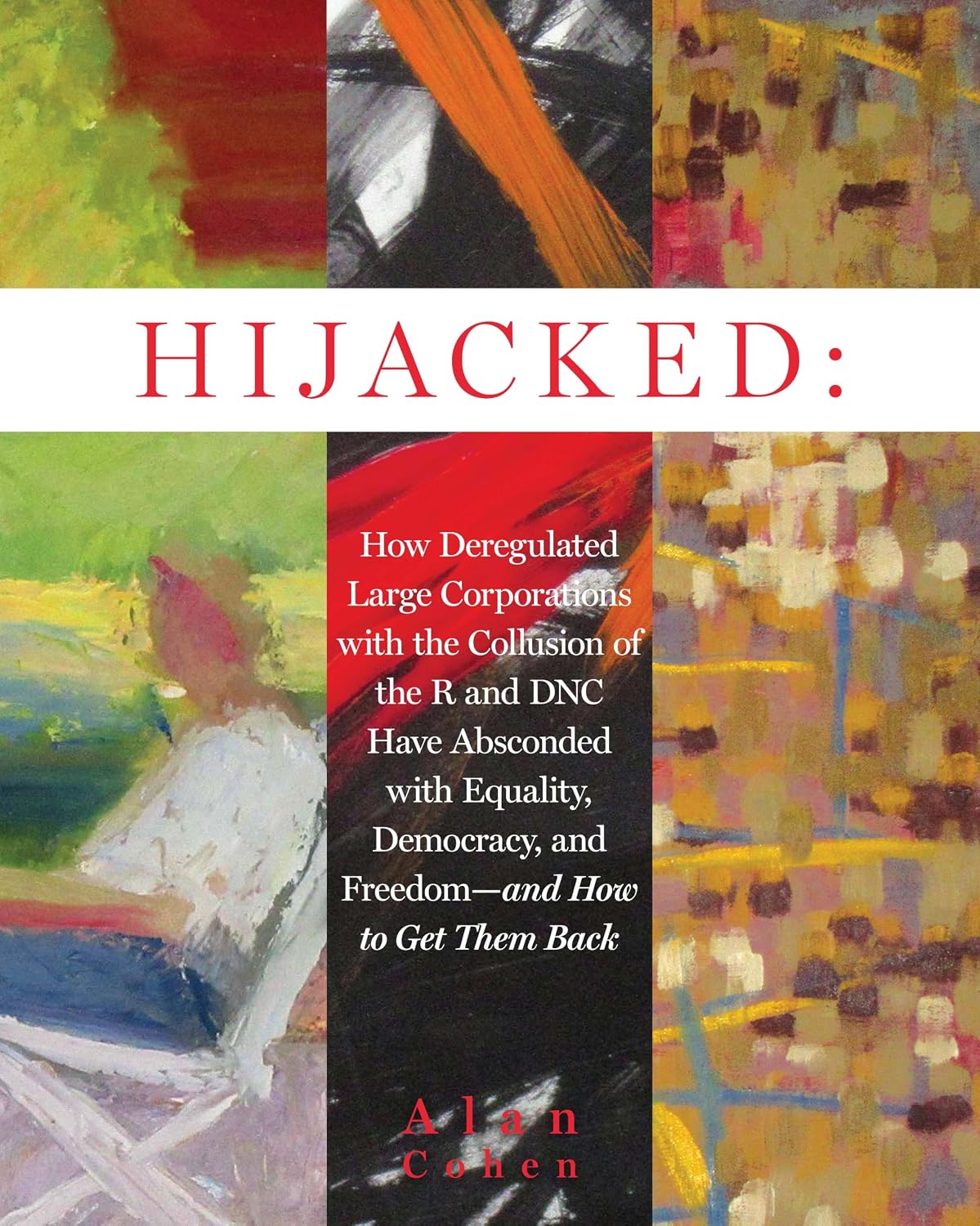

Alan Cohen’s Hijacked: How Deregulated Large Corporations with the Collusion of the R and DNC Have Absconded with Equality, Democracy, and Freedom, and How to Get Them Back is an ambitious work of political and economic criticism built around a straightforward concern: who actually exercises power in the United States, and who benefits from it? Cohen argues that over roughly the past fifty years, large corporations and wealthy interests have gained increasing influence over government while ordinary citizens have lost economic security, political influence, and equality of opportunity. He approaches this subject as someone who believes strongly in capitalism but also believes capitalism requires active government oversight to remain competitive and socially useful. The result is a book driven less by party loyalty than by Cohen’s conviction that concentrated economic power has distorted both major political parties. He describes the book as a selective introduction drawing together hundreds of sources on inequality and corporate behavior, and that description captures its character well. It’s essentially a very large argument assembled from history, economics, politics, journalism, and case studies.
One of the book’s most effective choices is to begin by asking what inequality actually means and how much of it a society should accept. Cohen acknowledges that differences in ability, responsibility, effort, and circumstance will naturally produce some inequality. His deeper concern is equality of rights, opportunity, treatment under the law, political influence, and access to economic security. From there, Hijacked builds its central case that markets don’t operate independently of government. Laws establish everything from minimum wages and bankruptcy procedures to union rights, taxation, corporate charters, environmental standards, and financial regulations, so political decisions inevitably shape economic outcomes. Cohen argues that decades of deregulation have steadily changed those rules in favor of large corporations and wealthy individuals. This historical framework is important because it keeps the book from treating present-day inequality as an isolated problem. Cohen places it in a much longer struggle between concentrated wealth and democratic power, moving through ancient societies, the American founding, the rise of corporations, the Gilded Age, the New Deal, postwar prosperity, and the turn toward deregulation beginning in the late twentieth century.
The middle of Hijacked is where its scale really becomes apparent. Cohen moves through pollution, climate change, corporate welfare, military contracting, privatization, food production, medicine, pharmaceuticals, finance, law, housing, education, the arts, retail, transportation, privacy, labor, media, science, and other parts of everyday life. His purpose is cumulative. He wants readers to see these subjects as connected expressions of the same underlying problem. The section on corporate welfare is especially revealing of his method. Cohen surveys tax advantages, subsidies, contracts, bailouts, bankruptcy protections, liability protections, failures of regulation, and other mechanisms that he believes transfer wealth and risk from the public to large corporations. From there he turns to what he calls the destruction of businesses, institutions, and professions, examining how corporate consolidation can alter the priorities of industries that once operated according to professional, civic, or local values. Reading these sections can feel like moving through an enormous case file. Cohen is interested in accumulation, patterns, and connections, and the sheer number of examples is part of his argument.
Cohen writes with urgency and with a strong personal point of view, so readers are rarely left wondering what conclusion he wants them to draw. At his best, he takes subjects that are usually discussed separately and makes their relationships easier to see. A discussion of deregulation leads naturally into corporate influence, which leads into campaign financing, regulatory capture, weakened professional independence, and growing inequality. He also spends considerable time challenging what he considers misleading cultural narratives about free markets, government, taxation, privatization, corporate efficiency, upward mobility, and the political identities of the two major parties. His style is closer to an extended civic argument than a detached academic study. That gives Hijacked energy, but it also means the reader is continually being asked to evaluate Cohen’s interpretation of a very large collection of evidence. The book rewards an engaged reader who’s willing to follow hundreds of examples and pause occasionally to consider where the evidence is strongest, where a conclusion is more interpretive, and how the pieces fit into the broader thesis.
I think Cohen wants Hijacked to produce political action. His proposed answer is an alternative party organized around what he repeatedly calls government “of, by, and for the people,” with reducing inequality and limiting concentrated corporate power as its central commitments. He argues that reform efforts in health care, environmental protection, labor rights, education, voting rights, and numerous other areas keep encountering the same political obstacles, so people working on separate causes would gain more by joining forces to change who controls government. Whether readers embrace that solution or reach a different conclusion, the book makes clear why Cohen believes structural political change has to accompany economic reform. I’d recommend Hijacked most strongly to politically engaged readers who are interested in economic inequality, corporate power, regulation, American political history, and the relationship between capitalism and democracy. It will especially appeal to readers who enjoy big-picture nonfiction that gathers material from many fields and tries to turn it into a single explanation of how contemporary America got where it is. Even when readers disagree with Cohen, there’s plenty here to argue with, think about, and investigate further.
Pages: 628 | ASIN : B0H8W5SMSX

Why Good People Are Actually Dangerous


Why Good People Are Actually Dangerous is a provocative work of philosophical nonfiction that examines the stories people tell themselves about goodness, morality, justice, and personal responsibility. Prasanth Kumar Vinakota’s central argument is that identifying too strongly as a “good person” can prevent honest self-examination. Once people become certain of their moral position, they may excuse their intentions, judge others too quickly, or defend harmful actions as righteous. The book approaches this idea through moral psychology, spiritual philosophy, social commentary, and direct questions that invite readers to reconsider some deeply protected beliefs.
The book blends reflective nonfiction with a continuing fictional narrative involving Saira and Pashi. Their encounter on a metro train becomes a practical demonstration of how incomplete information, social pressure, fear, praise, and public judgment can turn one version of an event into accepted truth. As more of Pashi’s history is revealed, the reader is repeatedly asked to reconsider earlier conclusions. This narrative nonfiction structure makes the book’s discussion of perception and moral certainty easier to follow because the concepts aren’t left floating in abstraction. They’re attached to choices, consequences, misunderstandings, and people whose intentions can’t be reduced to simple labels.
The book’s strongest sections explore the instability of morality across cultures, historical periods, circumstances, and competing perspectives. Vinakota also considers how religious and philosophical teachings can be simplified or distorted, how laws and ethics often develop after consequences are already visible, and how easily people confuse actions with intentions. Later chapters introduce frameworks such as MIST and the TRIL lens to help readers examine morality, intention, truth, and reality more carefully. The writing is forceful and intentionally repetitive, using brief sentences, thought experiments, dramatic examples, and direct challenges to keep the reader engaged. It reads like a combination of spiritual philosophy, moral psychology, and confrontational personal development.
Why Good People Are Actually Dangerous is a book about replacing moral confidence with awareness. Its message isn’t that intentions erase consequences, but that actions can’t be understood clearly without examining the motives, assumptions, desires, and limited perceptions behind them. The book asks readers to become more comfortable saying “I don’t know,” to take responsibility without turning blame into an identity, and to accept that reality doesn’t reward people simply for following moral rules. Readers drawn to philosophical nonfiction, spiritual self-help, human behavior, ethical psychology, and books about consciousness will find plenty here to discuss. It’s an intense, conversational exploration of what can happen when the need to feel good becomes more important than the willingness to see clearly.
Pages: 325 | ASIN : B0GFXXB9K2
Echoes of Memory: War, Testimony, and Survival on Sanzao Island

Echoes of Memory is a deeply personal work of public history by Robert Cupchoy and Lani Cupchoy, rooted in survivor testimony, family archive, poetry, and scholarly reflection. It traces the Japanese occupation of Sanzao Island during World War II, beginning with the shattering recollections of Fook Im Chen as planes descend over rice fields, moving through starvation, forced labor, cultural suppression, and the devastating history of the comfort women system, then widening into questions of inheritance, healing, and remembrance. What makes the book distinctive is its refusal to separate history from kinship. The authors present Sanzao not as an obscure footnote to larger wartime narratives, but as a wounded, living place whose people carried memory in stories, rituals, photographs, silence, and even in the later transformation of the family home into the Cupchoy Café.
Fook Im’s memories of bombs falling, villagers hiding food, and families clinging to one another have an aching immediacy that formal history often struggles to hold. The chapter on the comfort women is especially harrowing, not because it reaches for shock, but because it understands the intimacy of violation. Jin Yuan Lin’s presence in the comfort house, his memory of the women staring out windows, and his fear that forgetting them would mean losing them again, left me with a quiet grief that lingered after the page ended. The writing is sometimes at its strongest in these moments of restraint, when the authors trust a remembered image to carry the weight. The prose can become academically dense, with theoretical frameworks crowding the emotional field, but even then, I sensed the urgency behind it. The book wants to protect these stories from being dismissed as anecdote, and that protective instinct gives the scholarship its moral heat.
What I admired most is the book’s central idea that memory itself can be a form of evidence. That argument feels both intellectually persuasive and emotionally earned. The poems that open chapters don’t always have the precision of the testimonies, but I appreciated their function: they create a ritual threshold before the reader enters material that is painful, fractured, and sacred. I was also moved by the book’s attention to cultural survival, especially its insistence that festivals, language, family meals, and oral storytelling matter as much as destroyed homes and ruined fields. The Cupchoy Café section could easily have felt sentimental, yet it becomes one of the book’s most affecting gestures, a cup of Hawaiian coffee in Sanzao carrying the long route from violence to diaspora to renewal. That image feels humble and profound, proof that remembrance doesn’t only live in monuments. Sometimes it lives in a room where people gather again.
Echoes of Memory is a work of witness rather than a conventional history, and that is its strength. Its emotional truth is unmistakable. I closed it with a fuller sense of how war survives inside families, landscapes, and inherited silences, and with real respect for the labor required to turn private grief into communal memory. This is a thoughtful, affecting book for readers interested in World War II history, Asian and Pacific studies, oral history, trauma studies, family archives, and anyone drawn to histories told from within the circle of those who still carry them. Its lasting gift is its conviction that to remember the dead with care is also to restore dignity to the living.
Pages: 232 | ISBN : 9798279679836
ULTIMATE LAW OF SUCCESS: Provide Solutions, Solve People’s Problems, Meet Others’ Needs, Get Paid for Your Products and Services, and Attain Wealth

Ultimate Law of Success, by Peter James Kpolovie, is an expansive self-improvement and wealth-building book built around one insistent premise: lasting success comes from solving other people’s problems through useful products, services, inventions, and disciplined action. Across chapters on time, breakthroughs, skill acquisition, business websites, memory, enthusiasm, and going the extra mile, Kpolovie returns again and again to the same moral and economic equation: serve real needs, create value, and wealth will follow. He illustrates this through figures such as Willem Kolff, Steve Jobs, Thomas Edison, Stanley Mason, and everyday inventions like toothpaste tubes, razors, microwave ovens, and disposable diapers, using them as proof that human progress is often born from someone refusing to accept a persistent inconvenience as permanent.
The book is most compelling when it treats success not as personal accumulation, but as usefulness made visible. There’s a humane spark inside the argument, even when the language is intensely commercial. Kpolovie’s repeated insistence that egocentrism repels wealth and that time should be guarded for service gives the book a straightforward quality. I respected the moral pressure behind the author’s ideas. The book made me reconsider productivity less as busyness and more as contribution. The example of Kolff’s dialysis machine stayed with me because it gives the book’s philosophy a heartbeat: invention isn’t merely profitable, it can stand between suffering and survival.
The book’s confidence is energizing. The writing is passionate, repetitive, and forceful. Kpolovie favors declaration, and the book revisits principles to ensure they stick. The author writes with the certainty of someone preaching from long conviction rather than casually offering advice. I appreciated the breadth of examples, from Apple’s products to print-on-demand publishing and Stanley Mason’s small, practical inventions, because they grounded the grand ideas in recognizable things people actually use.
I came away seeing Ultimate Law of Success as a fervent, ambitious, and earnest manifesto about service, invention, and wealth creation. It has a clear purpose: to make something useful, help people meaningfully, and refuse to live passively. I’d recommend it to entrepreneurs, aspiring inventors, coaches, students of personal development, and readers who respond well to motivational writing with a strong moral charge and a practical business emphasis. For someone looking for a warm but uncompromising push toward disciplined value creation, this book offers a vigorous and memorable call to become useful in the world.
Pages: 396 : ASIN : B0G2JXDWBH
Understanding the Cost

The Cost of Service is a powerful memoir that explores the emotional, spiritual, and psychological toll of those who serve in law enforcement, ministry, and the military, as well as their families. Your book is beautifully written and addresses a subject that is not discussed enough. What led you to write this book?
I wrote this book as a therapeutic way to express that public servants are indeed “human” and endure the same and sometimes more issues of life than thought. We laugh, hurt, cry, and suffer.
What were some ideas that were important for you to share in this book?
It is important to see the public servant as they are and not as who you think they should be. Although titles come with expectations, truth is robed in normalcy.
I appreciated the candid nature with which you told your story. What was the hardest thing for you to write about?
Self-exposure. I returned from Desert Storm in the 90’s and did not talk to mental health professionals until 2016. I never wanted to appear to be “broken” as a man.
What do you hope is one thing readers take away from your story?
I hope readers learn that support of the public servant is not only appreciating the service, It is understanding what the service costs and how much we need active support structures.
Author Links: GoodReads | X | Facebook | Instagram
The Strange Tools of Human Communication: The Voice, the Pen, and the Lyre

Ruth Finnegan’s The Strange Tools of Human Communication is a wide-ranging and often unexpectedly intimate meditation on how human beings make meaning through more than language alone. Moving from the voice to writing, music, gesture, number, colour, and finally the hand itself, Finnegan argues that communication is not a single channel but a dense, historical, bodily weave. What stayed with me most was the book’s refusal to let speech monopolize the story of human expressiveness. The chapters on Limba storytelling in Sierra Leone, on pictographic systems and cave art, on music’s possible origins, and on those half-conscious forms of signifying that live in numbers and colours all feed into one large claim: we are tool-making communicators, and our tools are stranger, older, and more various than modern habits of thought usually allow.
What I admired most was the book’s atmosphere of intelligent wonder. Finnegan writes like a scholar who still feels genuine astonishment at her subject, and that astonishment is contagious. I was especially taken by the pages on voice, where she moves from the physical instrument of the larynx to the felt power of hearing poetry aloud, and then into her vivid account of Limba oral performance, with its repetitions, pauses, chorus responses, and the sly drama of “the clever cat.” Those sections have real life in them. They don’t just describe communication, they seem to perform its vitality. I also liked the book’s impatience with easy hierarchies. Her defense of pictograms and non-alphabetic systems, and her skepticism toward grand claims that writing alone transformed humanity, give the argument a welcome steadiness.
At the same time, I found the book more persuasive in its concrete chapters than in its more speculative ones, and that imbalance is part of what makes it feel human rather than mechanically “complete.” When Finnegan is close to lived example, to oral artistry, to scripts and inscriptions, to music as a social and emotional practice, I felt entirely in her hands. When she moves into swarming, unconscious intercommunication, or the more mystical reaches of shared consciousness, I was intrigued. Still, even there, I never felt she was being careless. What she offers is less a hard thesis than a roaming, seasoned intelligence thinking aloud across disciplines. The book has the texture of a learned person laying out a lifetime’s thinking, with all the warmth, digression, and oddity that implies.
I found this a stimulating book that enlarges the reader’s sense of what communication is and where it lives. I finished it feeling more alert to sound, script, gesture, ritual, and the patient labor of the hand. I’d recommend it most strongly to readers of anthropology, linguistics, music, oral tradition, and cultural history, and also to anyone who likes scholarship with personality still beating inside it. This is a thoughtful book for curious readers who don’t mind following an original mind down winding paths.
Pages: 257 | ASIN : B0CXVJB1G3

A Sense of Agency

In We Are as Gods, you present the idea that technological advancements have given ordinary people godlike powers and offer a psychological survival guide. Why was this an important book for you to offer readers?
For the past decade, Pete and I have been writing about exponential technologies and the massive opportunities they create. What became clear over time is that the story isn’t just technological, it’s psychological. The tools we now possess are extraordinary. AI, robotics, biotech, advanced materials, planetary-scale sensors—these are capabilities that, even a few decades ago, would have sounded like mythology. Yet despite living through an era of unprecedented progress, many people feel overwhelmed, anxious, and powerless.
That gap fascinated us. The problem isn’t that the future lacks opportunity; it’s that our brains didn’t evolve for the speed and scale of this moment. So the book became a kind of survival guide for the age of exponential change. We wanted to show readers both sides of the equation: first, the incredible breakthroughs happening around us, and second, the cognitive tools we need to stay grounded, resilient, and effective while navigating them. In short, the goal was to help people move from feeling like victims of the future to active participants in shaping it.
What inspired you to frame modern technology in such mythic or almost biblical terms?
Partly, it’s just the simplest way to describe what’s happening. If you look at the capabilities we now have: curing diseases with gene editing, speaking instantly across the planet, creating intelligence in machines, manipulating the climate system, those are powers that ancient cultures would have described as miracles.
Myth and religion have always been humanity’s way of grappling with forces that feel larger than us. By framing modern technology in those terms, we’re not being poetic for its own sake; we’re trying to help people feel the magnitude of the shift we’re living through.
But there’s another reason. Myths are also about responsibility. In almost every mythic tradition, when humans gain extraordinary power, the real question becomes: do we have the wisdom to use it well? That’s exactly the moment we’re in right now. Technology is accelerating incredibly fast, and the real challenge is making sure our judgment, ethics, and emotional maturity keep pace.
Do you think the biggest opportunity of this era is technological or psychological?
Technologically, the opportunity is enormous. The convergence of AI, biotechnology, robotics, and advanced energy systems is unlocking solutions to problems that have plagued humanity for centuries: poverty, disease, energy scarcity, and access to information. The tools are extraordinary.
But psychologically, we’re not fully prepared for them.
Our brains evolved to survive in small tribes on the savannah. They’re optimized for short time horizons, local threats, and limited information. Today we’re navigating a world of global networks, exponential change, and constant cognitive stimulation. That mismatch creates confusion and fear.
So the real opportunity of this era is psychological adaptation. Can we train attention? Can we regulate emotion? Can we cultivate curiosity instead of anxiety when faced with change? If we can upgrade our mindset to match the tools we’ve built, the possibilities are extraordinary. If we don’t, we risk mismanaging the very breakthroughs that could make the world better.
The final section shifts toward practical tools for resilience, attention, and meaning. Why was it important to end the book with personal strategies rather than just big ideas?
Because ideas alone don’t change behavior.
You can fill a reader’s head with amazing stories about AI breakthroughs or revolutionary technologies, but if they close the book and still feel overwhelmed, you haven’t really helped them. We wanted to leave readers with a sense of agency.
That’s why the final section focuses on tools: things like attention management, cultivating awe, pursuing grand challenges, and building resilience. These are not abstract concepts. They’re trainable skills rooted in neuroscience and psychology.
The larger message is simple: you don’t get to sit this era out. The future isn’t something that happens somewhere else. It’s being built right now by entrepreneurs, scientists, artists, and citizens all over the world. If we want that future to be wise, fair, and meaningful, we need people who are psychologically equipped to participate.
So we end the book where the real work begins, with the reader.
Author Links: GoodReads | X (Twitter) | Facebook | Website | We Are As Gods | Amazon
In 1968, Stewart Brand declared: “We are as gods—and we might as well get good at it.” Half a century later, that prophecy has come true.
We can rewrite genes, edit embryos, build artificial minds, extend life, and terraform worlds. The old miracles—omniscience, omnipresence, even resurrection—are becoming standard operating procedure. But the real question isn’t whether humanity can play god. It’s whether we can do it wisely.
In We Are As Gods: A Survival Guide for the Age of Abundance, Peter H. Diamandis and Steven Kotler—bestselling authors of Abundance and Bold—return with a sweeping exploration of our species’ next great transformation. Blending hard science with vivid storytelling, they chart humanity’s ascent from scarcity to superabundance—and the psychological, ethical, and existential challenges that come with it.
Across breakthroughs in AI, robotics, genetics, longevity, and consciousness research, they reveal a paradox at the heart of progress: as our external power expands, our inner resilience must evolve to match. Abundance without meaning leads to collapse. Intelligence without wisdom leads to extinction. To thrive in a world of everything, everywhere, all the time, we must learn to wield our godlike powers with humility, creativity, and flow.
Equal parts warning and invitation, We Are As Gods is a map for flourishing in the exponential century. Because the future won’t be built by those who fear what’s coming, but by those who know how to turn chaos into creation.
Abundance is here. Are you ready?
We Are as Gods: A Survival Guide for the Age of Abundance

We Are as Gods argues that we now live in a world where technology has quietly given ordinary people godlike powers, from AI and robotics to biotech and planetary-scale climate tools, and that the real bottleneck is not the tech itself but our ability to think clearly, emotionally regulate, and act wisely at this new speed. The book walks through how exponential technologies created real material abundance, how our Stone Age brains mis-handle this flood of power and information, and then offers a psychological survival guide that mixes neuroscience, game design, and grand challenges to help readers build agency, meaning, and resilience in what the authors call an age of abundance.
The book is energizing. The stories are vivid and sticky. The opening riff that compares modern breakthroughs to biblical miracles lands hard, and it actually made me pause and look at my phone with fresh eyes. The structure is clear. Part 1 sets the stage, Part 2 shows real companies and projects surfing the waves, and Part 3 shifts into a self-help gear that feels more intimate and practical. I liked the way authors Diamandis and Kotler weave myth, cognitive science, and startup lore. The analogies help. Comparing information overload to a wrecking ball hitting our nervous system is simple, and it rings true. Their explanation of bias and attention feels grounded, and it helped me name things I only had a fuzzy feeling about before.
I enjoyed how bold the style is. The prose comes at you fast, like a live keynote talk poured straight onto the page, and it keeps the energy high. The constant drumbeat of examples gives the book a sense of momentum. Miracle after miracle, chart after chart, and it all adds to this feeling that you are racing through a highlight reel of the future. I still found myself curious to explore a few of the tougher stories, especially in the darker chapters where surveillance, bio risk, and inequality show up and then get lifted by the next hopeful case study. Their strong faith in entrepreneurs and incentive prizes comes across as a clear, confident stance, and while I could imagine an even deeper dive into policy and power, I liked that those themes are at least present, even if they stay mostly in the wings. I finished those sections impressed by the ingenuity on display and energized by the big questions that remain about who benefits, who pays the price, and how we can guide abundance so it feels intentional, fair, and shared.
The discussion of learned helplessness, attention collapse, and victim mindset resonated with me personally. I recognized my own doom scrolling, my own habit of telling myself the future is something that just happens to me. The tools they offer in the final chapters are not completely new, but the way they frame them inside this huge story of accelerating change gave them more weight for me. Agency, awe, and grand challenges sound like big abstract words. Here they come with clear explanations, concrete examples, and a kind of gentle shove that says: you do not get to sit this era out.
I would recommend We Are as Gods to readers who sit at the intersection of technology, leadership, and personal development, and who want a hopeful but not naive story about the next few decades. If you are a founder, an executive, a policy thinker, or simply someone feeling overwhelmed by AI and nonstop change, this book will give you language, metaphors, and mental models that can help you feel less like a victim of the future and more like an active participant. If you want a big, loud, data-heavy pep talk wrapped around some solid psychological advice, this is a very timely read.
Pages: 320 | ISBN : 978-1668099544


