The Gap


The Gap is a survival-horror novel that follows a group of migrants forced through the Darién Gap under the control of brutal coyotes. The story begins with a claustrophobic march through the jungle, where the guides Pinche, Mosca, and Guapo terrorize the group, and the environment itself seems determined to finish the job. As the days stretch on, exhaustion, cruelty, and the strange dread creeping through the rainforest shape a journey that becomes as psychological as it is physical. By the time the story reaches its ending, the line between man and monster feels disturbingly thin.
The writing is direct and raw. The misery hits you in small, relentless details: ants marching through a dead boy’s mouth, water that can’t be drunk without risking agony, a jungle that seems to breathe around the characters. The choices the author makes feel purposeful, even when they’re harsh. Scenes of violence make your stomach churn. At the same time, there’s a strange tenderness woven in through the quiet connections the migrants form, even when they don’t share a language. Those brief human moments, scattered among the horror, make the whole thing feel heavier.
What surprised me most was how the novel blends realism with a slow, creeping sense of the uncanny. For a long stretch, it reads like pure survival fiction, the kind grounded in real-world danger. Then the edges blur. Nightmares start to feel prophetic. The violence becomes ritualistic. By the end, the horror has tilted into something almost mythic, and the shift feels earned because the world was already so brutal that monsters didn’t seem far-fetched. I kept thinking about how trauma can warp perception, how the mind tries to make meaning out of dread. The book never overexplains its stranger moments, and that restraint makes them even more intriguing.
The Gap is a gritty survival horror novel with psychological and supernatural undertones, and it leans hard into the reality that human beings can be more dangerous than any jungle. I’d recommend it to readers who appreciate dark, visceral fiction that doesn’t pull punches, especially those who like their horror rooted in real places and real suffering.
Pages: 356 | ASIN : B0DQJ85XCG

Cover Up

Cover Up drops you straight into the life of Leia Alexander as she celebrates her MBA graduation and then gets swept into a string of unexpected turns. The story jumps from a warm family celebration to a frightening street robbery to ambitious corporate maneuvering. Leia’s world opens up fast as her boss Michael earns a major promotion and pulls her into the center of international business challenges, leadership conflicts, and hidden agendas brewing across Europe. The book mixes personal growth, workplace drama, and hints of deeper trouble forming in the background. It feels like the start of a much bigger arc that will follow Leia as she steps into a dangerous and high-pressure new role.
As I read, I found myself drawn to Leia’s mix of confidence and self-doubt. Her reactions felt real. I liked how she tries to hold things together even when life comes at her sideways. The father-daughter moments were especially touching and grounded the story. I smiled more than once because those scenes carried genuine warmth. At the same time, the writing sometimes jumped quickly between plotlines. I occasionally wanted the story to breathe a little more before moving on to the next twist. Still, the emotional beats landed for me. I felt Leia’s panic after the robbery and her shock when Michael threw the huge job at her. Those moments kept me hooked.
The corporate world sections carried a different energy. Michael’s promotion, the tense boardroom talks, and the brewing resentment from Maximilian and Giovanni added a sharp edge to the narrative. I liked the behind-the-curtain feel. It made the story bigger and hinted at serious trouble coming. At times, the explanations of the company structure and strategy felt a little heavy for me. Even so, the ideas underneath were strong. The tension between loyalty, ambition, and power played out in a way that felt believable. The long backstory on Maximilian surprised me, but it helped me understand why he acts the way he does. His resentment and pride gave the plot a solid antagonist vibe.
I came away enjoying the mix of heart and suspense. The story sets up a world filled with family love, personal ambition, corporate danger, and a sense that something much larger is about to ignite. I would recommend this book to readers who enjoy character-driven corporate thrillers, stories about professional growth, and plots that slowly build toward global stakes. It is a good fit for anyone who likes emotional storytelling blended with rising suspense and wants to follow a young woman stepping into the toughest challenge of her life.
Pages: 195
Duck It!

Duck It! follows Lionel Romero, one of the few survivors of a world crushed by a fast and merciless sickness. He leaves his dead parents’ home in Florida and heads toward the Midwest, writing about the trip in a plain notebook. The story blends road travel with emotional fallout, and it traces how he sees the ruined world around him while digging into the memories that shaped him. The book moves between his present journey and his old hurts, which come alive again as he confronts fear, quiet, and the strange freedom of having almost no one left.
I was pulled in by the voice. It is raw, jumpy, funny in dark ways, and full of chaotic honesty. The writing has a rhythm that hits hard because Lionel keeps drifting between bold thoughts and quiet self-doubt. I appreciated how the author let him ramble, swear, and laugh at himself. Sometimes the scenes hit me with this weird mix of dread and warmth, like when Lionel finds comfort in silence or when he sees animals in the open fields and suddenly feels joy. I enjoyed that emotional swing. It made the world feel alive even though most of the people in it are dead.
The idea of being forced into a life you never chose, which Lionel describes through his years working under the Florida sun, came through with sharp detail. The book lingers on resentment. It lingers on guilt. It lingers on that strange sense of floating through your own life. Those moments felt personal. When he describes seeing the dead family on the road, I felt this heavy pressure in my chest. The scene pushed me to imagine what he was too scared to say straight out. The story works best in those places where the emotion sits just under the surface.
By the end, I felt like I understood Lionel’s loneliness, even if he masks it with jokes, curses, and stubborn pride. The book struck me as a study of what a person becomes when the whole world falls apart, and it does this without trying to be poetic or grand. It is simple in its words and messy in its feelings. That mix gives it a strong pull. I kept wanting to hear more of Lionel’s voice.
I would recommend Duck It! to readers who enjoy intimate, voice-driven fiction. Anyone drawn to end-of-the-world stories that feel grounded in real emotion would appreciate this book. It suits those who like flawed narrators, rough humor, and a story that cares more about the person than the plot.
Pages: 315 | ASIN : B0GDS32354
Cows Have Four Stomachs!

The Charms of US Farms: Finding Out How Things Work follows a class visiting two farms who discover how important farm work is to everyday life. What was the inspiration for your story?
The inspiration for the story came from my interaction with students around the time of the pandemic. I discovered children were befuddled when I asked if they knew where food came from. Most simply answered “the grocery story”. When I asked about clothing, the response was similar. They were interested, curious and often surprised to find how the natural world provides for us in so many ways.
The book teaches a lot without ever feeling like a lesson. How did you balance storytelling with information?
It was easy to see-saw facts with fun in my story line. For instance, cows are providers of meat and many other products for us, and the fun fact is they have 4 stomachs! Farm matters abound with those types of things. They are inherent to the theme of farming. Corn? Sure, we eat it, but it’s used to make our crayons, paints and paper, too!
How do you imagine teachers using this book in the classroom?
Farming is taught in elementary grades. Sometimes students have the opportunity to plant and grow their own vegetables or visit local farms for school trips and educational experiences. Reading The Charms of US Farms is an engaging way to further integrate lessons about farming in the Language Arts curriculum.
Elementary studies include science (i.e. animal life cycles) and math (i.e. measuring plant growth), both conducive times to introduce the book to students.
Will this book be the start of a series, or are you working on a different story?
The Charms of US Farms is the start of a series of early readers revealing how “extraordinary” the seemingly “ordinary” things in our natural world truly are.
Illustrator Ann Pilicer and I are thrilled to share The Charms book, and hope it sparks a little inspiration for younger generations and readers around the world.
Author Website
Be True To Yourself Always
Zombies & Butterflies is a self-help book that explores the idea that many of us move through life emotionally numb, the “zombies,” while real growth comes from becoming aware, compassionate, and fully engaged, the “butterflies.” Where did the idea for this book come from, and how did it develop over time?
The Idea for the book and how it developed over time was, in my opinion, quite unique. The book took about twelve years to write. I still had to work to provide for the family. Vehicles, lawn mowers, appliances break down and needed fixing as well as replacing shingles on the roof and other house related repairs. The kids had sporting events, plays at school and time to play with the kids. I also had obligations within the community. The ideas for the book were in my head and as far as a way to lay it all out and organize it, I had no idea. But not knowing how to do something or never having done something, like writing, never stopped me from doing it. So, I kept on writing and figured something would come to me. And sure enough, after three, four, five years of trying to figure out just the title of the book, the title, the rough cover design and the organization of the book came to me in a flash while I was doing something not at all related to writing.
What were some ideas that were important for you to share in this book?
A few ideas in the book, among all the rest of the ideas, that I believe are crucially important is the idea of individual authenticity. Being true to yourself first and foremost and what you are and who you are, really. Not the show for the rest of the world. It was surprising to me to read that one of the greatest fears people have is what others think about them. How truly sad that is. I sincerely believe that all truth begins with self-truth. That’s foundational. Without that foundation, all truths will be elusive. Also, the idea of a most genuine connection with the Divine is paramount. That connection will serve as a conduit straight to the source of all truth which you’ll be able to feel within you. They will resonate and you will be able to discern them. In doing so, feeding into another significant idea, you’ll need to follow no one but the Creator. You’ll be able to put away those days of being spoon fed by another or others, days of confusion and lies and will be able live life following and being guided by the Creators direction just a true as the north star guides you at night.
What was one of the hardest parts in this book for you to write?
In the book are analogies and metaphors. One of the hardest things to write was always wondering what is too little information which would not enable folks to understand my point and what was too much information which might confound my point. Even now, I don’t know if my choices were correct.
What is one thing that you hope readers take away from Zombies & Butterflies?
My hopes in writing this book was to be nothing more than a catalyst. I want to spur on a childlike curiosity in people to search and explore themselves first, then the rest of this awesome creation. I want them not to have fear in their venture but the courage of an explorer. The courage to break away from the old worn-out entanglements which time has proven over and over and over throughout the centuries to be absolutely inept and lacking all luster and vitality. I want people to escape the tyranny over their minds and truly live free. Free from the fear and avarice and hatred in this world and at length, with enough people living in such a way, the whole world WILL change.

That First Scintillating Spark

Too Complex follows an avid gamer whose addiction to his hobby leads him to disengage with the world around him. What was the inspiration for the setup of your story?
I came up with the idea from watching some of my favorite streamers, I’m not going to name any of them. There’s this one streamer I watch from time to time who often complains about gamers who choose their hobby to become their entire livelihood…which is pathetic. Not for anything productive like content creation or improving decision making skills but to be perceived as a bum or going by gamer vernacular, a “sweat”. Then, from there I’ve caught a glimpse of a reflection of myself after reading about how that first dopamine click will automatically get you hooked on what made it happen the first time around, therefore forming a double-edged sword. Once you receive that first scintillating spark in your eyes making you feel great about yourself, like you have accomplished something peculiar to you because it’s something you’re not immune to. Then from there, you begin to crave more of it because you want to get the same “high” you got from the taste sample. This has happened to me when it comes to video games but also other unhealthy addictions such as social media and alcohol consumption. Hence, the idea behind our antagonist.
What do you find to be the most rewarding aspect of writing humor? The most rewarding?
I think that when it comes to writing, writing humor specifically is my go-to level of expertise especially when social satire is involved. Whenever I’m minding my business, reading, watching YouTube or working my shifts, I come across a lot of problems with certain people that irritate me and I assume that there’s several kindred spirits out there who would agree. Now, this may come off as pessimistic, but the best way to overcome the pessimism would be to shed a little light on it with humor. For example, young generations of today are becoming more and more illiterate, let me create a comic strip where they’re the butt of the joke and because they can’t read it, they won’t get offended. I’m basically taking the negativity and reshaping it to make it more positive and somewhat enjoyable, that’s a reward anyone with a soul would cherish. However, this doesn’t mean that I’m forcing my personal opinions on people against their will like other “satirists” tend to do from time to time. I just try to pinpoint a particular topic that a massive demographic of people would be on the same page with. Not to mention that I try to poke fun at all parties involved on the subject and not be one-sided and biased.
What were some themes that were important for you to explore in this book?
The overall themes are what has been said. I wrote this to entertain and to express the pros and cons of gaming. Pros being with our main heroes, Corey and Mavirna as they use their gaming experience to overcome challenges in the pest-infested apartment to evict their tenant, Cody and speaking of Cody, his addiction represents the cons. It showcases that gaming is an artform, an artform that deserves to be held high on the same pedestal as film, theater, television and literature.
What is the next book you are working on, and when will it be available?
The next book will not be a part of the same series, however, it’ll have the same tone but with more adult content as opposed to this one which is family-friendly. The name of the next book which I hope will become a series will be called Stale Seed Bed. A surreal, satirical slapstick comedy about a part-time babysitter watching over a wide variety of troubled youth. It’ll tackle many hot button subjects like dumb internet trends, unproductive side hustles, damaging addictions like gooning etc. I don’t know exactly when it’ll be done considering what I mentioned earlier that I’m still working a day job, but I’ll be working on it as much as possible and you’ll know more about it in advance.
Author Links: Facebook | Website | Cara
The Awful Odyssey
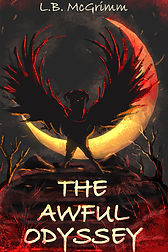
The Awful Odyssey follows young Burgeon, a half-canid, half-raptor pup caught between two worlds. The story opens with dreamy flights through Sleeping Locus and shifts fast into the grim reality of the Loyal Trench. What starts as a simple coming-of-age tale becomes a journey through class divides, harsh routines, emotional wounds, and the mysteries of realms beyond sight. Burgeon fights expectations at school, struggles under the weight of poverty, and clings to a fading bond with his mother. The book grows darker and stranger as secrets seep through the cracks of his life, and the tone swings between wonder and dread. It feels like a fable wrapped in a nightmare, stitched together with heart.
I was swept up in the contrast between light and dark. The author writes with an emotional honesty that I really enjoyed. The dream sequences are soft, fragrant, and warm. They lulled me in with that childlike belief that everything bright will stay bright. Then the trench scenes slapped me awake, though. The grime, the cold, the cruelty, the sense that the world has teeth. The writing leans into that contrast again and again. I was frustrated with Burgeon sometimes. At other times, I felt like I understood him and really cared about him. The pacing dips occasionally, yet even in the slower parts, I felt the tension humming. The story carries a sense of constant threat and constant longing that kept me engaged in the story.
The ideas the story explores were really intriguing. Identity. Shame. Desire. Responsibility. The book pushes all of those themes into a tight space and watches them rattle around inside Burgeon’s life. I kept thinking about how much he wants structure even as he fights it. How much he wants freedom even as it scares him. The scenes with the wizard surprised me the most. They were tender. They were strange. They reshaped everything I had assumed about the world he lives in. I loved that shift. It made the story feel bigger than its darkest moments and gave me something hopeful to hang onto. The writing never tries to sound clever, and that plainness works well. It lets the emotional weight sit right on the surface where you can’t ignore it.
I’d recommend this book to readers who enjoy character-driven fantasy that leans emotional, odd, and a little grim. If you like stories about broken places and resilient kids. If you like worlds that feel worn down yet still magical. If you like tales that sit with pain but don’t give up on wonder. Then this book is perfect for you.
Pages: 200
Hug Whispers Between Worlds
Hug Whispers Between Worlds follows Tim, a twenty–eight–year–old drifting between self-doubt, stalled ambition, and the quiet weight of family expectations. His life feels stuck until a strange encounter at his grandparents’ mountain lake house introduces him to Hug, a gnome who slips in and out of reality with riddles that cut deeper than they should. The book blends everyday frustration with magical realism, using Hug as a mirror that forces Tim to face the parts of himself he keeps avoiding. What begins as a hazy late-night hallucination grows into a journey of reflection, healing, and small but powerful shifts in how Tim moves through the world.
The scenes with Tim’s family have this raw authentic truth that made me wince a little because I’ve sat through those exact kinds of conversations, where every joke lands like a judgment and every question hides a comparison. The author doesn’t use heavy language. Instead, the emotions just show up in the pauses and the awkward laughs and the things nobody says. I liked how the magical parts didn’t drown out the real ones. Hug isn’t there to whisk Tim away. He nudges him and pokes at him and calls out the nonsense he tells himself. The mix of earthy humor and odd wisdom works really well, and I found myself rereading some of Hug’s lines because they felt simple on the surface but grew deeper the more I thought about them.
I also liked how the book handles drift and disappointment. There’s no tidy breakthrough. No big speech that fixes everything. Just a slow turning, like someone waking up after being half asleep for years. Tim’s struggles felt close to the bone. The scenes with Paula were especially tough in a good way. They’re trying to love each other while standing in different kinds of fog, and the author shows that with a gentle touch. The story could have leaned too sentimental or too mystical, but instead it keeps landing in this nice middle place where doubt and magic share the same breath. I appreciated that the book doesn’t pretend meaning arrives fully formed. It comes in pieces. It comes in small moments by a stream. It comes in noticing the person beside you before they fade from view.
I’d recommend Hug Whispers Between Worlds to readers who enjoy character-driven stories and gentle magical realism. It’s great for anyone who’s felt stuck, overwhelmed, or unsure what comes next. If you like stories that mix real-life messiness with a touch of wonder and just enough mystery to keep you curious, this one is worth your time.
Pages: 25



 LITERARY TITAN