Blog Archives
The Secretary


Deborah Lawrenson’s The Secretary is a richly layered spy novel set against the bleak yet fascinating backdrop of Cold War Moscow in the late 1950s. The story centers around Lois Vale, a British woman sent under deep cover to the British embassy in Moscow. By all outward appearances, she is a secretary, but beneath the surface lies a complex and dangerous mission to uncover a possible traitor within the embassy. Through diary entries, vivid scenes, and psychological depth, Lawrenson paints a tense world where truth is elusive, betrayal is always near, and even the most personal thoughts can become weapons.
From the very first page, I was pulled in. The writing has a graceful rhythm. It’s elegant without being flowery, sharp without being cruel. Lawrenson manages to say so much with so little. I found myself re-reading lines not because they were hard to follow, but because they hit a nerve. Her descriptions of Moscow are like watching a black-and-white film—gritty, cold, and oddly beautiful. What really stuck with me, though, was the emotional weight. Lois isn’t a James Bond figure. She’s real. She’s scared. She second-guesses herself. And I believed her every step of the way.
The book builds slowly, piece by piece. The tension comes from little things like a locked drawer, a look held too long, a diary that might be read. At times, I wanted more plot, more fireworks, but I came to appreciate the quiet dread more than the expected explosions. The sense of being watched, of being alone in a room full of people—it’s handled so well it gave me chills. There’s also a feminist undertone I didn’t expect. Lois is underestimated, even dismissed, but she holds more power than most of the men around her. That felt deeply satisfying.
I’d recommend The Secretary to anyone who loves Cold War fiction, but especially to readers who enjoy slower, more introspective spy stories. This isn’t an action-packed thriller. It’s a character study wrapped in espionage. If you liked Tinker, Tailor, Soldier, Spy but wished it had more emotional depth, or if you ever wondered what it would be like to spy without backup, this is your book. I closed it feeling both chilled and strangely moved.
Pages: 305 | ASIN : B0DSWG8J3C

The Pale Flesh of Wood


Elizabeth A. Tucker’s The Pale Flesh of Wood is a beautifully tangled family saga rooted in grief, memory, and the slow bend of time. Set across multiple generations, the novel follows the Hawkins family through snapshots of their lives spanning from the 1930s to the 1980s. Centered around a California oak tree, literal and metaphorical, it’s a story about growing up under heavy legacies, about love that wounds and heals in equal measure, and about the things we inherit even when no one speaks them aloud.
The writing is lush and poetic without being precious. Tucker knows how to set a mood and trap you in it. Her dad’s joking charm cracks in places, revealing a man stitched together by war, trauma, and ego. This isn’t just a story about a family. It’s about what’s left unsaid between parents and kids and how silence grows teeth.
The structure threw me at first, it jumps through decades and voices, but once I leaned into it, I was hooked. I liked that Tucker didn’t feel the need to hold my hand. In Chapter Two, young Charles, Lyla’s father as a boy, lies under that same tree, imagining himself fossilized after being slapped by his own mother. He watches a roly-poly bug curl up tight and wishes he could do the same. That image wrecked me. It’s a subtle but gutting way to show how generational pain rolls downhill, gaining speed like that tire Lyla’s dad sends her down in later chapters. And when she crashes, he just lights a cigarette and says, “Whoopsie poopsie.” I wanted to throw the book across the room.
Still, what surprised me most was how much tenderness lives in these characters. Even the broken ones. Especially the broken ones. Pops, the quiet grandfather, reads baseball stats to baby Daniel. Lyla’s grandmother, fierce and frigid at first, softens in fragments. And Lyla herself, oh man, I rooted for that girl with everything I had.
I’d recommend this book to readers who loved The Sound and the Fury or Marilynne Robinson’s Housekeeping, folks who appreciate moody, intimate stories that don’t rush their reveals. It’s not a quick read. It’s not meant to be. This is a sit-on-the-porch-and-let-it-sink-in kind of novel. One that lingers. One that matters.
Pages: 320 | ASIN : B0D6V72BL7

Restrictive Societies

Fallen is an immersive sci-fi tale following a young woman torn between duty and defiance, navigating political intrigue, alien traditions, and the weight of inherited secrets that could reshape her entire civilization. What were some sources that informed this novel’s development?
I have always been a huge fan of Frank Herbert’s Dune trilogy (as well as the books that fleshed out the series after his death). I can’t even remember how many times I read that first book. Each time, I found Paul Atreides’ journey inspiring and motivational, especially the way he took each apparent challenge and turned it to his advantage, making him stronger and more resilient. I hope that Alira’s journey in The Founder’s Seed would offer that same kind of feeling to readers.
What inspired Alira’s character arc from idealist to survivor, and how much of her journey reflects personal experiences or broader themes you wanted to explore?
A lot of Alira’s journey reflects my own, only without the sci-fi details. Like Alira, I’ve never felt like I “fit” with others around me, regardless of how I tried. Both Alira and I stood firm in our belief that things could be (can be) different. Better. Both of us feel like an island in a vast sea of opinions and views that don’t reflect our own or, if they do, their opposition is too strong to resist. I know Alira and I are not alone in that.
It’s hard—sometimes impossible—to stay silent in the face of clear violations of a perceived Truth. Alira learns the consequences of speaking out and, eventually (by the end of book 3, Driven), she finds strength, balance, and peace with herself and those around her, but on her own terms. This is what I hope for myself, and for everyone like me who finds it challenging to be true to who we are inside while operating in a world that sometimes feels alien to us. I wanted to offer Alira as an inspirational hero, one who can show us that it isn’t easy to be true to yourself, but in the end, it is absolutely worth it.
In Alira, I also wanted to explore what would happen when something catastrophic broke down the walls that held her back and gave her the opportunity to stretch into her authentic self. I think that part worked quite well, though her journey to find that authentic self is…circuitous. But that’s like real life, isn’t it?
What were some themes that were important for you to explore in this book?
I wanted to explore the concept of restrictive societies, where there’s no room for those who don’t blend in, and how it affects not just those who are exiled (or otherwise penalized), but those who manage to hide their differences. I also wanted to explore how those many individual prices cost the society overall.
The theme of personal growth under pressure was also important to me in this trilogy. Most of us have a “line in the sand,” boundaries we’ve defined for ourselves and those we allow into our lives. I wanted to explore crossing that line, and what might motivate someone to push past that point of no return. Sometimes, the best and strongest growth happens in adverse circumstances and while it might not be predictable or proceed in expected ways, it’s often rugged and enduring. One doesn’t have to be carrying signs or weapons to be a revolutionary. Sometimes all it takes is to step off the beaten path toward the perception of a “better way,” and refuse to go back to accepted standards. It isn’t an easy choice, but it can be a very powerful one.
I also wanted to explore, to a lesser degree (at least in this trilogy), the long-term effects of the reasons for humans’ Earth exodus—the environmental destruction and resulting wars—and what that result would look like in their colonial world structures. These details are mostly in the background, but they are definitely there, if you look closely.
(The backstory of all this is in the works and will eventually be published as part of the Founder’s Seed universe saga.)
The inherited memories in the story are fascinating—what influenced your decision to weave the past so tightly into the narrative?
Well, the present is always built on the foundations of the past. What happened then will always affect what happens now, sometimes in subtle unseen ways. I wanted to make that a bit more stark, more jarring. Hearing about the past is one thing; actually seeing it through the eyes of someone who was there brings a whole new understanding to the situation. Lurien serves as the unammi’s historian, which is one reason why hers is the first voice on the council.
I also wanted that aspect of the story to serve as a fragile thread of connection between the “before” and “after” for the unammi. Since Alira’s view of that history is fragmented, she can only bring a portion of that history forward. Imagine what would happen if the human race was nearly wiped out, and all our history erased. We would have to start over from scratch. Alira’s inherited memories, incomplete as they are, give her people at least a whisper of hope that some of their past could be remembered, if not recreated. And her memories inherited from others widen the unammi perspective, at least for her. This more comprehensive view offers the potential to rebuild unammi society with a broader base, and a more accepting perspective.
Author Links: GoodReads | Facebook | BlueSky | Website | Drema Deòraich | Amazon
Alira knows the pilots—including her brother—who live among the humans will be the next target for enemies of the unammi, unless someone flies to the nearest colony world to warn them of the threat. And since Alira Harvested the last pilot on Iridos, she’s the only one who can do it. If she leaves, she’ll be outcast. If she doesn’t, her brother and the other pilots will die. To Alira, there’s no choice. She’s never going to fit in anyway.
As a shapeshifter, looking human is easy. Acting human is far more difficult, especially once her Harvests start arguing in her head. But she has to succeed. If her species is to have any chance at survival, Alira must take the form of her nemesis, Harvest souls never intended for her, and shelter the remnants of her race where her enemies would never look, in a place only a lunatic would go.
Can she succeed without going insane?
A Story That Needed to be Told

Yankeeland follows a young woman from a stifling Irish village who escapes to the New World with her husband, seeking a life where they can realize their dreams. What was the inspiration for the setup of your story?
I have always been a champion of strong, powerful women and knew that this story needed to be told. Reading Brigid’s letters forever changed my thinking on secrets. The heartache from the secrets which society forced upon the female protagonists in Yankeeland haunted me deeply. Discovering and unraveling how their lives played out filled me with a profound sense of sadness, which stayed with me. The what-ifs and the desperate attempts at explaining away the various actions and outcomes all came back to the trauma caused by secrets. The basic human experience of compassion was lost to Brigid and Kate.
It seemed like you took your time in building the characters and the story to great emotional effect. How did you manage the pacing of the story while keeping readers engaged?
It was important for me to understand the challenges that were faced in Yankeeland, and my writing comes from a place of lived experience. I connected at a deep level with each character and their journey. I am a storyteller at heart and a lot of storytellers carry pain in their words, my objective is to turn suffering into something that we can learn from. The greatest compliment I received was that Yankeeland was not a ‘breezy’ read—I have tried not to detract from the reality of these experiences. In recreating Brigid’s story, I was able to recreate their path as emigrants understanding the society of the various locations. I was also able to reach into stories I had heard in my own childhood, particularly of Well’s House and the Doyne family that had lived there.
What were some themes that were important for you to explore in this book?
In a piece I wrote for my website ‘Secrets’ I looked at how lives that are lived in pain do not allow for awareness. Existing—the sole occupation of the sufferer. These pieces explore some of the themes in Yankeeland and my greatest wish is for the reader to reflect and give consideration from their own viewpoint and experienes. ‘Tis only and aul wink’ was written following a funeral I had attended in the West of Ireland. As I sat and listened to the priest give his sermon on how life passes so quickly, ‘aul wink of the eye,’ I felt a deep sense of emotion. I was frustrated thinking how Brigid and Kate had not been afforded this luxury. I also wanted to show how historically Women were often betrayed by society at the behest of a powerful patriarchal system. This did not bode well for any woman, never mind one who was strong and powerful such as Brigid was.
What is the next book that you’re working on and when can your fans expect it out?
I am working on a story about navigating modern day ‘Humbugs’. A girl’s journey through vulnerability, navigating the various modalities that are competing in today’s world, where spirituality meets commercialisation. It will follow a similar theme, looking at moral dilemmas. I would love for this to be with readers in 2026. The publishing journey requires adequate time to ensure quality of the output.
Author Links: GoodReads | X | Facebook | Website
Brigid and her cousin Molly, who is more like a sister, dream of a new life in the seemingly unlimited land of opportunity they call Yankeeland-America. Brigid gets her chance when she emigrates with her husband Ben and her brother James, while Molly stays in Ireland.
But when Brigid’s quest to have a child leads her to seek unconventional help, her mental stability is questioned. She is soon caught up in a patriarchal medical establishment she has little power to fight.
The new life in America Brigid dreamed about takes a drastic turn. Decades later Brigid’s grandniece discovers a sack full of letters between the two cousins. She unravels the story and vows to tell the tale of what really happened to Brigid in Yankeeland.
Yankeeland

Lacy Fewer’s Yankeeland is a sweeping tale of hope, resilience, and transformation that weaves through decades and continents. Centered on Brigid Kelly’s journey from a stifling Irish village to the promise-filled shores of America, the novel explores family dynamics, societal expectations, and personal ambition. Brigid’s dreams clash with her father’s traditions and her stepmother’s rigid control, culminating in her determined escape to the New World with her husband, Ben. What unfolds is a compelling narrative of immigrants grappling with love, identity, and survival in a land where opportunities are as abundant as the challenges.
Fewer’s writing captures the texture of Irish life in the early 20th century with remarkable detail. The quiet desperation of Brigid’s early years and her longing for freedom and beauty are palpable. I loved how Fewer used vivid imagery, like Brigid poring over forbidden magazines or sneaking into the store to gaze at glamorous pictures. These small acts of rebellion made Brigid feel alive and relatable. Yet, at times, the prose overindulged in descriptions that slowed the pace. While the lush details are immersive, there were moments I wanted the story to move faster, particularly in the sections set in Ireland. The narrative shines brightest when it dives into the immigrant experience. Brigid’s arrival in New York, her awe at the Manhattan skyline, and her disdain for the haughty first-class passengers who snub her felt raw and immediate. One scene, where Brigid defiantly stands up to an arrogant British couple aboard the ship, is potent. It underscored her tenacity and pride, traits that define her character throughout the book. However, the portrayal of Ben’s struggles with inferiority in America was equally compelling and balanced with Brigid’s ambitious optimism. Fewer skillfully juxtaposes their experiences, making their relationship dynamic and layered.
I felt the weight of Brigid’s choices—her sacrifices, her hopes for a better life. The novel’s themes of familial duty versus personal aspiration struck a chord. Fewer’s portrayal of immigrant life is both harsh and hopeful, never sugarcoating the realities but always highlighting the perseverance and ingenuity of her characters. The bittersweet yet triumphant ending left me reflecting on the cost of dreams and the resilience required to achieve them.
I’d recommend Yankeeland to readers who enjoy historical fiction with strong, complex female protagonists. Fans of Colm Tóibín’s Brooklyn or Christina Baker Kline’s Orphan Train will find much to admire in this heartfelt tale. While it’s not a breezy read, its rich storytelling and poignant themes make it a journey worth taking.
Pages: 258 | ASIN : B0DQWTPGRX
Special Challenge—and Pleasure

In The Cadieux Murders, an architect hired to renovate a mansion soon finds her work opens the door to a long-buried murder mystery. Where did the idea for this novel come from?
I edit a real estate newsletter and found out that if you own a landmark home, you have to call in a specially certified architect to make any changes. I thought, what a great idea—to have such an architect find mysteries in the historic homes she works on! And I’ve always loved old homes: My wife and I live in an 1850 farmhouse and love its quirks.
What was the hardest part about writing a mystery story; where you constantly have to give just enough to keep the mystery alive until the big reveal?
That’s the trick! You want to give readers enough information so they feel they can solve it. The ending should be a surprise but can’t be out of left field. That is, the reader must say “Aha! They were leading up to this!” Consider Murder on the Orient Express. No one combined hints with a final surprise better than Agatha Christie.
Which character in the novel do you feel you relate to more and why?
Wren Fontaine, my architect/sleuth, seems different from me in many ways: she’s a woman and I’m a man. She’s an architect and I have a weak visual sense. She is gay and I am straight. And yet, she’s the protagonist most like me. Wren and I share a difficulty relating to people. Our personalities and ways of coping are very similar. Bringing her to life was a special challenge—and pleasure.
Can we look forward to another installment in the Historic Homes Mystery series?
I’m working on one now with Wren returning to her difficult high school years—transforming a long-closed dormitory for modern use for foreign visiting students. Can she rebuild the dorm, solve a long-ago murder, and work with her former bully?
Author Links: GoodReads | Facebook | Website | Amazon
And the home itself comes with a dark past: In 1955, it was the site of the never-solved murder of its owner, Dennis Blaine. Cadieux himself was alleged to be having an affair with Dennis’s wife, the stunningly beautiful Rebecca. It seems like yesterday’s headlines, but then someone starts killing people with a connection to the house. The home’s new owner—bestselling novelist Bronwyn Merrick—may be using the house to launch a fictionalized account of the 1955 crime. But someone may not want her to. Just how far will Bronwyn’s armed bodyguard go to protect her?
As Wren untangles the threads, she finds they all lead back to the house. Rebecca apparently inspired the strange, yet alluring residence, and both the home and its mistress may have caused uncontrolled emotions that led to tragedy. Wren uses all her architectural skills to decipher the hidden message Cadieux cunningly wove into the home’s design. She must think back 20 years to when, as a little girl, she met Cadieux. Deeply impressed with Wren, he gave her a clue about the house—and his unusual friendship with Rebecca. With her girlfriend Hadley at her side, Wren eventually solves the mysteries of the home and the people who lived there, develops a grudging respect for modernist architecture—and learns something about the difference between love and obsession.
Trusting the Movement of the Spirit

In Home for the Bewildered, a female psychologist opens old wounds when she recognizes her pain in that of her patients. What was the inspiration for the setup of your story?
My work as a therapist was the inspiration for Home for the Bewildered. Over the years, I have been amazed how my clients and I can be dealing with the same issues. I could have a bout of anxiety then hear about anxiety all day. I would have a dream that led to reflection of an issue and then someone would show up and talk about the same thing. I’d go for a swim and a person’s name would float to the service and sure enough I’d hear from them, so I believe in paying attention and trusting the movement of the spirit (or intuition) in my life. The inspiration for the setup of the story was to convey that all people are interesting even those in the most hidden or unknown places. We have such an unhealthy fascination with celebrity in our culture—only some are considered important or of value. I wanted to give voice to the unheard, uncounted, “unimportant,” people. We all have a story to tell. I like to say that every story is unique, every theme is universal.
Was there anything from your own life that you put into the characters in your novel?
Home for the Bewildered would not have happened but for the suffering in my own iife. I picked 1974 before I researched it’s significance politically and socially because that was the year my brother died in a plane crash the night before Thanksgiving e.g, Thomas gets beat up multiple times on the night before Thanksgiving. Every character has a little piece of me in them. When I work with people I always try to find common ground and I did the same with Dorothy and her characters. And by the way, my mother’s name is Dorothy. She was a smart woman who was denied education but never lost her love of learning.
What is one pivotal moment in the story that you think best defines Dr. Dorothy Morrissey?
One pivotal moment that best defines Dorothy is when she says to George, “if your life can be ruined suddenly, why can’t it also be saved suddenly?” Dorothy was a purveyor of hope even when she felt hopeless.
What were some themes you felt important to address in Home for the Bewildered?
I believe, Home for the Bewildered is an antidote to the times we are living in right now. We need a lot more empathy in our culture. Every person has value. Every person has a unique story to tell that is worth hearing. Everyone wants to be heard. I was raised as a social justice Catholic. I’m dismayed social justice has been lost in the cultural narrative. This week in 1974 was the first time women could get a credit card or sign a mortgage without a man. And here we are again fighting the same fight. Home for the Bewildered is needed now more than ever. If every person especially those in power would reflect on their own suffering, take responsibility to get help when needed, and transform their pain into helping others, we’d be living in a much kinder world.
Author Links: Website | Instagram | TikTok | Threads | Facebook | Book Review
Dorothy’s patients mirror her emotional issues as they draw her into their often-chaotic lives. Thomas Perfect’s impulsiveness and attention-seeking behavior-both symptoms of his bipolar disorder-often prove dangerous as a gay man in 1970s Lansing, Michigan. His flair for drama makes Dorothy laugh as much as his trauma makes her want to cry. Dorothy wrestles with an inexplicable aversion to George who had been remanded to St. Lawrence after pleading Not Guilty by Reason of Insanity. Ruth’s post-partum psychiatric break threatens to draw Dorothy in with her, and Marcella, labeled as borderline frustrates Dorothy’s efforts to keep her from self-harm.
As good as Dorothy is at holding and interpreting her patients’ past traumas, she resists looking at her own, causing a strain on her relationship with Kenneth. It seems Dorothy has no problem saving her patients… but can she save herself?
A Noble Bargain
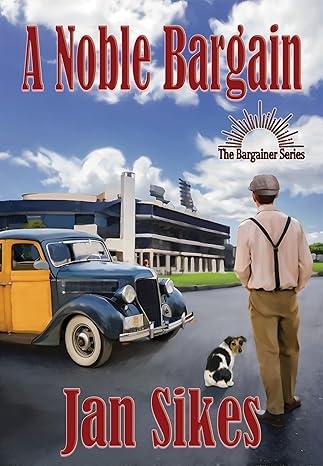
Jan Sikes’ A Noble Bargain transports readers to 1948, a time when post-war prosperity contrasted sharply with the struggles of small-town life. In Crossett, Arkansas, Oliver Quinn dreams of escaping his humble beginnings to become a professional baseball player. Across town, Rose Blaine endures a harsh reality under the thumb of her abusive, moonshine-brewing father. The two form an unlikely alliance: Rose promises to connect Oliver with her influential uncle in St. Louis if he agrees to take her and her brother away from their oppressive life. Their pact sets the stage for a poignant tale of ambition, resilience, and survival.
Sikes writes with a plainspoken elegance that perfectly suits the story’s setting and themes. Oliver and Rose, the central characters, embody a restless hope that propels the narrative. Their yearning for a better life highlights a central tension of the era: even amid national growth and optimism, achieving one’s dreams often remained an uphill battle for those born into hardship. The book’s portrayal of economic struggle and personal perseverance resonates deeply, making their journey all the more compelling. The story shifts gears when the protagonists arrive in St. Louis, expanding the narrative’s scope and raising the stakes. Sikes captures the wonder and challenges of city life with vivid descriptions and a keen sense of contrast, deftly illustrating how overwhelming the big city must feel to individuals from such modest beginnings. The new setting introduces a rich supporting cast that adds layers of intrigue and drama, pushing the characters to grow and adapt. Sikes keeps the plot moving with charged interactions and period-appropriate details, skillfully blending personal struggles with broader societal themes. Sikes avoids excessive sentimentality, instead grounding the story in the grit and determination of its protagonists. The conclusion feels earned and satisfying, a testament to the characters’ resilience and the strength of their bond.
Fans of character-driven fiction and historical narratives will find much to admire here. Young adults may connect with the story’s themes of ambition and self-discovery, while older readers will appreciate its rich period detail and timeless message. Reminiscent of Elmore Leonard’s The Moonshine War and the baseball-themed works of John R. Tunis, A Noble Bargain is an evocative, heartwarming novel that lingers long after the final page.
Pages: 301 | ASIN : B0DHQY46MJ



 LITERARY TITAN