Blog Archives
The Ruinous Curse: The Hunt for Alesta


The Hunt for Alesta kicks off Mark K. McClain’s “The Ruinous Curse” series with the story of Barrett, a prince caught between duty, prophecy, and personal longing. As his kingdom teeters on the edge of war, Barrett discovers not only that magic might live inside him, but also that he’s at the heart of a much larger destiny. Alongside loyal friends Zanora, Gaia, and Unger, he battles dark forces, navigates hidden tunnels and magic festivals, and must decide whether to wield ancient power or follow a simpler path. The book weaves friendship, fear, and growing up into a quest full of danger and mythic weight.
What stood out most to me was how deeply human Barrett felt. He’s not some perfect hero. He hesitates, he doubts, and he fumbles through his feelings for Zanora like any teenager would. That made his story so much more relatable. The magic and world-building had a classic fantasy feel, but the dialogue kept it fresh. There’s a bit of whimsy here, like talking doors, cheeky magical creatures, and floating gossip orbs, but it’s grounded by the looming threat of war and the emotional weight of loss. McClain isn’t afraid to slow down for a tender moment or dive into darker territory.
The setup took a while, and while I enjoyed the time with the characters, I found myself itching for the real stakes to kick in. Still, once the action started, especially with the chase through Ashton and the reveal of Barrett’s power, I was hooked. There’s also a lot of prophecy talk, which can get a little heavy-handed, but it didn’t stop me from caring about the choices Barrett had to make. McClain manages to keep the story from veering into cliché by injecting heart into every turn, even when the tropes feel familiar.
The Hunt for Alesta is a heartfelt and imaginative coming-of-age story wrapped in the trappings of high fantasy. I’d recommend it to younger readers who loved the early Percy Jackson books or fans of coming-of-age tales in magical worlds like Eragon or the Earthsea Cycle. It’s for those who want magic with emotion, action with meaning, and friendships that feel real. It spins a tale worth following, and I’m excited to see where Barrett’s story goes next.
Pages: 301 | ASIN : B0B4V5BMLG

Rhino


This gripping novel blends raw emotion with a high-stakes narrative centered around the illegal wildlife trade and the desperate search for a cure. At the heart of the story is Dr. Minh Tran, a respected Vietnamese oncologist secretly battling terminal cancer, and his daughter Linh, a determined research scientist who uncovers both her father’s illness and his entanglement with dangerous players in the illicit rhino horn trade. As the story unfolds across the chaotic streets of Hanoi and the sterile corridors of hospitals, it morphs into a race against time, where hope, love, ethics, and desperation collide.
I was surprised by the book’s emotional intensity. Smith writes with a quiet force, capturing the nuance of human vulnerability without overplaying the drama. I felt Linh’s panic, Dr. Tran’s despair, and the moral ambiguity pressing down on them like a physical weight. Their relationship was equal parts strained and tender. It felt authentic. The prose was direct and often lyrical, but never flowery. Scenes moved at a brisk pace, though Smith allowed just enough time for introspection. I appreciated that restraint. Nothing felt indulgent. Still, there were moments I wished for more exploration, more of Linh’s internal unraveling as she drifted from scientist to would-be conspirator.
That said, the ideas themselves were bold and uncomfortable in the best way. The book dares to ask: what would you sacrifice to save someone you love? Your career? Your values? Your freedom? It doesn’t preach. Instead, it presents complex choices and lets the reader wrestle with them. The rhino horn trade, with all its grotesque implications, is not only central to the plot but a metaphor for desperation itself. Smith clearly did his homework on conservation and corruption, and I came away both enlightened and unsettled. Still, I felt some shadowy characters lacked the same depth afforded to the protagonists, which slightly dulled the narrative’s realism.
RHINO is a powerful and emotionally charged story that will appeal to readers who crave moral tension, human drama, and international intrigue. It’s especially moving for those interested in medicine, environmentalism, and family dynamics. I’d recommend it to fans of medical thrillers and character-driven suspense alike. For me, it was a heartfelt and unforgettable ride.
Pages: 385 | ASIN : B0FCP11VB4
Horace in Space

Mary L. Schmidt’s latest children’s book follows young Horace, who is no ordinary pig. He’s a dreamer with his snout pointed firmly toward the stars. His greatest ambition? To venture into space. Yet, despite his lofty hopes, he quietly doubts that his dream will ever lift off. Until, unexpectedly, it does. A formal invitation arrives, and Horace is headed to the International Space Station.
Horace in Space is a delightful children’s book that effortlessly blends whimsical storytelling with factual space education. Tailored for children aged 1 to 8, this charming tale is brief in length, fitting for young attention spans, but rich in imagination and heart. The book’s vibrant illustrations serve as both emotional cues and narrative anchors, helping children see what Horace feels, thinks, and experiences.
Schmidt captures Horace’s sense of awe with genuine warmth. His naive excitement, so relatable for young readers, evolves into a more grounded understanding as his fantasy meets the real-world challenges of space. In doing so, Schmidt crafts a gentle lesson: reality might differ from dreams, but that doesn’t make it any less extraordinary.
The book strikes a thoughtful balance between imaginative adventure and educational value. Without ever sacrificing the fun, it introduces children to life in orbit, from the thrill of liftoff to the peculiarities of floating in microgravity. Facts are woven naturally into the narrative, ensuring that learning feels organic rather than instructional.
While Schmidt’s prose may not echo the playful cadences of Dr. Seuss or the clever wordplay of Shel Silverstein, Horace in Space still stands as a delightful addition to any young reader’s collection. Horace himself is an endearing protagonist, one whose journey feels ripe for expansion. It’s easy to envision this story as the launchpad for a larger series.
Horace in Space delivers more than just a tale about a pig in orbit; it offers young readers a chance to explore, imagine, and discover alongside a character who is every bit as curious and wide-eyed as they are.
Pages: 26 | ASIN : B0F9VX3XZ7
Striking the Right Balance
Flush Royale follows a Greek-Norwegian marine investigator who is pulled into a quest to investigate the Hirondelle, where he uncovers a secret that could change history. What was the inspiration for the setup of your story?
The idea for the story hit me during my first trip to Switzerland in 2022, while I was writing my debut novel. I was hanging out in a terraced vineyard in Lavaux, watching those Belle Époque steamships cruise across Lac Léman. Right then and there, I knew I wanted to set my next book in Switzerland. After that, I started exploring the lake’s maritime history and how I could connect it to Greece, which felt like a cool premise to build the plot around.
Nick Diamantis is a fascinating character. What scene was the most interesting to write for that character?
It’s hard to single out just one scene, but I find myself really drawn to writing the quieter and more introspective moments with Nick. That’s where his personality comes alive on the page, not always through action or dialogue but through subtle observations and reactions. Those moments reveal who he is beneath the surface, and I think that’s when readers are most likely to connect with him on a personal level.
I felt that the action scenes were expertly crafted. I find that this is an area that can be overdone in novels. How did you approach this subject to make sure it flowed evenly?
I think I’ve taken a lot from my own experience reading adventure novels, and I’ve always tried to keep that in mind when writing my own scenes. For me, it’s about striking the right balance. I want the scenes to be engaging and enjoyable to read, while still being clear enough for the reader to visualize without confusion.
What is the next book that you are working on, and when will it be available?
The next book I’m working on is the third novel in the Nick Diamantis series. It will feature all the classic elements people came to love in the first two. I can’t say too much about the plot or a release date, but this time, Nick’s next assignment will take him to Panama and South America.
Author Links: GoodReads | Amazon
Ritual, Horror, and Grief
In the Mountain’s Shadow follows an old woman who ventures into the unforgiving wilderness, where she navigates starvation, isolation, trauma, and violence, encountering both animalistic kindness in a wolf and horrifying brutality in other humans. What was the inspiration for the setup of your story?
The inspiration for In the Mountain’s Shadow came from many places. I was influenced by Japanese tales of ubasute, in which the elderly were allegedly left to die in the mountains; a haunting mythos that speaks to how societies often discard those they no longer find useful.
Most importantly, though, Park’s story is rooted, for me, in the image of the old witch in the woods – not as a villain, but as someone forged by abandonment, survival, and memory.
This blend of ritual, horror, and grief felt like something that needed to be written.
What are some things that you find interesting about the human condition that you think make for great fiction?
Humans are endlessly fascinating…because of our capacity for reason, belief, and perseverance; because of how often those things contradict each other. We can convince ourselves of almost anything, sometimes to survive, sometimes to justify, sometimes just because we need meaning.
But what I find most remarkable is our need to tell stories. Sometimes we do it to connect, sometimes to escape, and sometimes for no real reason at all…the endlessly complex impulse to create. That instinct, that emotional transmission through narrative, is what makes fiction so powerful. The written word allows us to explore what it means to be alive in a way that’s both intimate and limitless.
What were some themes that were important for you to explore in this book?
I was drawn to the absence of older women as central figures in fiction—especially as active agents of violence, resilience, or transformation. I wanted to explore the idea of the “female monster” and how societal neglect often shapes that archetype.
What is the next story that you’re writing, and when will it be published?
I’ve got two in the works right now, and I’m hoping to publish sometime next year. One is a story about invading aliens and the way we experience otherness—how we react to what doesn’t belong, and what that says about us. The other is a story that explores the dangers of falling in love when identity, memory, and desire are unstable.
I tend to write more than one at a time, it helps give me a much-needed break from some of the darker material I tend to gravitate toward; it also allows me the freedom to break through genre and write whatever I feel like, whether that’s sci-fi, horror, or something quieter.
My other two published works include Razorblade, a dystopian western about the consequences of taking what doesn’t belong to you, and Fragmentations, a short story collection that plays with form and iterates on the puzzle of the human condition.
Author Links: GoodReads | Website | Amazon
Quest for the Austral Amulet
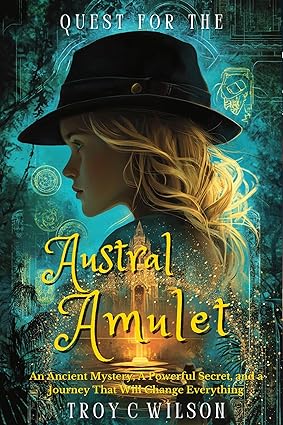
Quest for the Austral Amulet is a coming-of-age adventure wrapped in mystery, folklore, and a good dose of heart. The story follows thirteen-year-old Rebecca Harley, a quiet, introspective girl who inherits a mysterious diary from her late great-grandmother. The journal reveals long-buried family secrets and clues to the elusive Austral Amulet, which may be tied to a generational curse. Fueled by a yearning for purpose and belonging, Rebecca sets out on a secret journey alongside her estranged childhood friend Isaac and a curious historian, Dr. Bellamy. Their expedition becomes more than just a treasure hunt, it turns into a search for identity, courage, and healing, all while being pursued by those with darker motives.
Reading this book was like getting swept away into a dream. The writing has a quiet beauty to it. It’s soft, lyrical at times, and deeply emotional. Wilson’s portrayal of Rebecca is so intimate and raw that I found myself rooting for her from the very first page. She’s not a typical hero, and that’s what makes her story shine. Her loneliness, her yearning to matter, and her gradual blooming into someone brave enough to take on the unknown, it all felt so real and familiar. The way the story blends old family legends with modern-day adventure is clever and gripping, with just enough magic to keep you turning the pages late into the night.
But what I really liked were the relationships. The way Rebecca and Isaac slowly find their way back to each other was touching, filled with awkwardness and quiet trust. And Dr. Bellamy? She’s the adult every kid wishes they had in their corner: smart, open-minded, and willing to believe in something bigger. There’s a gentleness in how Wilson writes about belonging and loss, and a sense of wonder that pulses through every map, puzzle, and whispered secret. The threats never felt too dangerous, and the bad guy didn’t carry much weight emotionally. Still, the emotional arc more than made up for it.
This book reminded me of what it feels like to believe in something bigger than yourself. It tugged at the part of me that still wonders what secrets might be hiding in an old attic, or what stories my own family has buried in time. I’d recommend Quest for the Austral Amulet to readers young and old who love adventure stories with heart. It’s perfect for kids who’ve outgrown fairytales but still want a bit of magic, and for adults who want to feel like a kid again, even just for a while.
Page : 308 | ASIN : B0CVRMQWQ1
Man Against the Universe

The Call of Abaddon follows a gifted young scavenger on a crumbling, post-apocalyptic Earth who is attacked by an ancient alien obelisk, triggering a surge in his dormant psychic abilities. What was the inspiration for the setup of your story?
Thanks for the interview and for the thoughtful questions. The genesis of The Call of Abaddon goes back many years, through countless drafts and title changes.
The initial spark was Jason himself. I had a dream when I was younger about a guy (someone like me) using the power of his mind to fight something dark and terrifying. Obvious inspirations would be Luke Skywalker, Neo, Beowulf, and others. That darkness took many forms as the story evolved—from extradimensional demons (like in Doom or Warhammer) to biological zombie plagues—but eventually coalesced into the Abaddon Beacon obelisk. I did get my “zombie plague” in the form of the Nanophage, but it’s far more complex than a simple virus and will continue to (literally) evolve in future books, as Abaddon seeks revenge for Jason’s unexpected, hail-Mary-level victory at the end of Book 1.
The rest of the cast and world grew over years of development, both visually and on the page. In other interviews, I’ve mentioned some external inspirations—like a friend who started writing and a student teacher who gave me a massive sci-fi reading list in eighth grade—but the true origin of the story was always Jason. He began life as a bit of a power fantasy for me, but over time, Jason matured into something far more complex and mythic. Honestly, I think all my characters grew up as I did, which is why I’m glad I waited this long to publish. Great works take time to cook, and this one was no exception.
I find the world you created in this novel brimming with possibilities. Where did the inspiration for the setting come from, and how did it change as you were writing?
The setting changed a lot over time. Colossus Station, the orbital habitat referenced in Book 1 a few times, was originally supposed to be the primary setting. But as the lore and backstory deepened, I ended up pushing the journey to Colossus to future books. It’s kind of like going to Arrakis, stepping outside the Shire, or Odysseus leaving Troy—it marks the real beginning of the larger saga. That said, Book 1 is not a prologue or filler. New Toronto ended up becoming a much richer part of the story than I had expected, so the journey to Colossus had to wait.
Even New Toronto wasn’t originally envisioned as a sealed arcology. That came later, as the lore of the Confederacy and the Great War took shape. The idea of a dying Earth, ravaged by ecological collapse, ended up setting the perfect tone for readers—something like, “This world is old, broken, and a lot has happened here already… but you have no idea what horrors are coming next.”
Like any great SFF setting, the world grew, snowballed, got chopped down, and rebuilt several times. But once all the threads were tied together, it felt real. I think that’s what early readers and reviewers are responding to, regarding the setting in particular.
A lot of fictional worlds in SFF feel designed purely to serve the stories within them. A horror world, for instance, where things conveniently go wrong a little too easily. But I think that world of Abaddon strikes a stronger balance—it feels like it would still exist even if these characters weren’t in it. The events are wild, sure, but the world around them remains grounded. That’s something I worked hard to achieve.
What were some themes that were important for you to explore in this book?
In other interviews, I’ve talked about the themes of memory, identity, and mental health—all of which are central to the book. Tyranny, environmentalism, freedom—those are in there too. But the core theme, the one that threads through everything, is the power of the creative human soul—and how that power transcends anything external.
The Abaddon Beacon hijacks human society, addicting us to its nanotech like a drug. But none of that comes from our own ingenuity—it replaces it. The real question becomes: what happens when someone has all that taken away? No nanotech, no psychic powers. Just a man against the universe and its horrors. What does he do?
In Jason’s case, he channels something deeper—something that lets him subvert Abaddon’s godlike influence and strike a blow that no one else has. But the question remains: is the power he wields a twisted form of what the obelisk gave him, or is it something else entirely? Only future books will reveal the truth.
Where does the story go in the next book, and where do you see it heading in the future?
Great segue from the last question! As mentioned, future books will feature Colossus Station much more heavily. I won’t say how or why just yet—but the reason will probably shock readers.
The series is fully planned. Not down to line-by-line detail, but all the major arcs, twists, and character beats are mapped out—including the ending. Some things might shift along the way, but the key points are locked in. Readers are in for a saga with all the expected twists of epic sci-fi—but also some deeply personal character twists that I don’t think anyone will see coming.
Now that the world, characters, and conflict are in motion, readers get to grow with them, just like I did. I may be the creator, but I’m also part of the audience now, cheering them on… and hoping they all survive the hell I’m about to unleash.
Author Links: Goodreads | X (Twitter) | Facebook | Website | Amazon
New Toronto is a fractured city-arcology on a dying Earth, where hope is as scarce as clean air. For Jason, survival means scavenging the ruins beneath the city – where any day could be his last.
But everything changes when an ancient alien obelisk – the ABADDON BEACON – attacks Jason’s mind from afar, making his dormant psychic abilities spiral out of control. After barely surviving Abaddon’s psionic possession attempt, Jason and his companions are left with no choice but to find the obelisk before it consumes him.
Problem is, Abaddon has been sealed within a top-secret United Earth Federation research lab for over a century, silently worming its alien technologies into human society, presented as gifts with a far darker purpose. The Beacon doesn’t just speak; it infects, projecting its viral energies far beyond the walls of the lab.
And Jason isn’t the only one hearing Abaddon’s call. Across the Solar System, a ruthless Emperor will stop at nothing to seize the Beacon’s power for himself.
As the Imperial invasion of Earth looms, Jason’s quest to confront Abaddon will force him into a critical choice: master the strange power growing inside him … or succumb to the
Beacon’s godlike influence, ushering in mankind’s doom.
The Call of Abaddon is a gripping mythological tale of humanity’s struggle to overcome an unimaginable darkness, blending the political intrigue of Dune with the eldritch terror of Lovecraft, and the explosive world-building of The Expanse.
Environmental Destruction

The Last Ayer follows a spirited young numbat who discovers she is the last of a sacred line known as the Ayers, and must find the courage to fulfill her destiny and rid her homeland of evil. What was the inspiration for the setup of your story?
The inspiration is all around us at the present time. Human encroachment and global warming are affecting humans and animals around the globe. I wanted to shine a spotlight on the issue while providing a very enthralling adventure story. Inspiring young minds is at the forefront of my work.
I find the world you created in this novel brimming with possibilities. Where did the inspiration for the setting come from, and how did it change as you were writing?
As a child, I was fascinated by animals worldwide. I was especially interested in those found only in Australia. When I began writing, I researched children’s books and noticed a dearth regarding endangered animals and/or the animals of Australia. I was determined to write a story that took place in a fantastical world reminiscent of Australia. The Last Ayer is the third book created in the world called Sunderland.
What were some themes that were important for you to explore in this book?
The dominant theme of environmental destruction drives the story. However, I also wanted to express the need for accepting responsibility, facing up to those responsibilities, and having the courage to do so. The story emphasizes the importance of friendship despite the differences between friends.
Is this the first book in the series? If so, when is the next book coming out, and what can your fans expect in the next story?
No, this is not the first. My first book, The Sword of Demelza, also takes place in Sunderland and tells of the wonderful and powerful journey of two siblings who face the world of Sunderland alone to save their dying mother. It is a multi-award- winning middle-grade novel.
My second book, The Gift of Sunderland, plays off of the first book. A major theme in this book revolves around a reluctant hero who has hidden himself away after a traumatic experience. He saves a young numbat from drowning, and she helps him to realize that he must face up to who he is, namely the Guardian of the forest. She helps him accept that responsibility and return to Sunderland’s creatures who need him.
Author Links: GoodReads | Facebook | Pinterest | X (Twitter) | LinkedIn | Kohana Wolf | Amazon
Elsewhere, in the city of Dungarah, an evil perentie named Jago is driven by revenge for the death of his father at the paws of the numbat colony, and has stripped Sunderland of its natural resources. Jago’s need for power over the inhabitants of Sunderland is never ending. His efforts have resulted in the servitude of many woodland creatures.
But now, their slavery has brought them to the precipice of revolt. They only await the return of one called The Guardian of the Forest who they believe will bring nature’s balance back to Sunderland along with their own freedom.
At first, unaware she is the key to saving Sunderland, Keera and Echo travel to Dungarah, a long and dangerous journey. On their way, she discovers her true identity . . . and her destiny. Discover how Keera, the last of her kind, learns to face and overcome the evil perentie overlord, Jago, as the Last Ayer of Sunderland.



 LITERARY TITAN