Blog Archives
The Real Shock

The Lost Bitcoin is an exciting middle-grade adventure about four friends who travel to London on a billion-dollar treasure hunt to recover a lost Bitcoin hard drive while uncovering a mystery that adults have failed to solve. What is the most rewarding aspect of writing a series?
The most rewarding thing is probably getting to imagine how these adventures would play out like a movie in my head. When I first heard about James Howells trying to gain access to a landfill in Wales to find a hard drive containing the key to hundreds of millions of dollars in Bitcoin, I immediately thought, If my friends and I lived anywhere near there, we would figure out a way to find that thing!
That’s one of my favorite parts about writing a series. Whenever I hear about a real lost treasure or an unsolved mystery, I start imagining what would happen if my friends and I tried to find it. What would we need? Who else would be looking for it? What could go wrong?
How did you develop the personalities of the four friends and decide what each would contribute to the team?
You asked me this same question in the interview for my first book, and my answer is still the same. The four friends are really different parts of my own personality. I think everyone has different “voices” in their head depending on the situation, and I thought it would be fun to turn those into separate characters.
I’m writing the third book now, and one of the coolest parts of writing a series is seeing how their personalities have grown. Each character has become more complete and distinct, and sometimes I already know exactly what one of them would say or do before I even write the scene.
What research did you do to make the Bitcoin and cryptocurrency elements understandable to middle-grade readers?
First, I will say that there is nothing understandable about Bitcoin! I spent a lot of time researching cryptocurrency, private keys, digital wallets, and what happens if someone loses access to their Bitcoin.
The hardest part was figuring out how much readers actually needed to know. And that turned out to be pretty simple: there’s a hard drive, it contains keys to a fortune in Bitcoin, and no keys = no money.
The real shock was learning that Bitcoin is only valuable because a lot of people believe it’s valuable—kind of like cash—and that you basically own it because a huge network of computers agrees that you do. Once I understood that, I figured readers didn’t need a school lesson on Bitcoin. They just needed enough to understand the treasure hunt.
What do you hope young readers learn from the characters about ingenuity, responsibility, honesty, and teamwork?
I don’t really have a goal of teaching my audience anything. I just want them to be engaged, entertained, and to keep turning the page.
This question actually reminds me of a trip I took to a museum. The guide kept pointing out all the symbolism and hidden meanings in the paintings, and I remember wondering if the artists really intended all of that or if they were just painting something they liked.
I think about my books the same way. If adult readers see lessons about teamwork, honesty, or responsibility, that’s great. But when I’m writing, I’m mostly thinking, Is this story good enough to make someone put down their phone and keep reading?
Author Links: GoodReads | Instagram | TikTok | Website | Amazon
The Goonies meets Home Alone in a hilarious, high-stakes hunt for a billion-dollar fortune buried beneath a mountain of garbage.
Five years ago, a hard drive holding the keys to 15,000 Bitcoin was accidentally thrown away. Now, it’s lost somewhere inside a sprawling, heavily guarded garbage dump outside London.
Sam, Riley, Ava, and Jonah are going to find it.
Soon, the four friends are sneaking past security, deploying custom drones, dodging guard dogs, and racing an eccentric British politician who will stop at nothing to claim the fortune for his own royal ambitions.
They thought digging through trash was the hard part.
They were wrong.
When the treasure hunt follows them home, the kids have to turn their own turf into a fortress. Think glitter bombs. Paintballs. Homemade gadgets. And one very angry, humiliated would-be king.
Finding the treasure was only the beginning.
Now they have to keep it.
The hunt is back on. Are you ready to join them?
Where the Kaleidoscopes Turn


Where the Kaleidoscopes Turn, by Joan Enockson, follows Cody, an eleven-year-old boy who’s carrying the quiet sting of a rough school year, as he visits his grandpa in Pocahontas County, Iowa. What begins as a family trip becomes a tour of giant kaleidoscopes scattered through small-town parks, each one opening into a memory, a lesson, or a new way of seeing the world. With Grandpa Russell, Cody’s new puppy Molly, and the legacy of Leonard Olson guiding the story, the book becomes less about sightseeing and more about learning how beauty, community, and perspective can change a person from the inside out.
I really appreciated the heart of this book. I felt drawn to the way it treats Cody’s unhappiness without making it too heavy for young readers. He’s not written as a dramatic problem to solve. He’s a child who is hurt, withdrawn, and a little stuck, which felt honest to me. The relationship between Cody and his grandpa is the emotional center, and it’s handled with a gentle patience I found moving. Grandpa doesn’t lecture so much as notice, wait, tell stories, and lets Cody arrive at understanding in his own time. That felt true to childhood, and also true to good parenting.
The writing has a homespun, reflective quality that fits the rural setting well. The lessons are stated clearly, but I can see why that directness would work for younger readers. The ideas are lovely, especially the way each kaleidoscope becomes a metaphor for change, memory, courage, family, community, and choosing what we put into the world. I also thought the artwork gave the book much of its charm. The illustrations have a soft sketchbook feel with bursts of watercolor-like color, and that splashy brightness mirrors the kaleidoscope theme beautifully. The images of the small towns, parks, farm scenes, and Cody with Molly add warmth and texture, making the book feel both personal and rooted in a real place.
I found Where the Kaleidoscopes Turn to be a tender, thoughtful book with a strong sense of place and a sincere belief in the value of looking at life differently. It’s earnest and full of affection for grandparents, small towns, old memories, and children who need a little help finding their footing again. I’d recommend it for elementary and early middle-grade readers, especially kids who enjoy family stories, gentle life lessons, dogs, road trips, or books that leave them feeling steadier and more hopeful by the end.
Pages: 98 | ISBN : 978-1958023648

So You Want To Be A Diplomat

So You Want To Be A Diplomat is an engaging and eye-opening children’s educational book that introduces young readers to the fascinating world of diplomacy. Written for ages 10 to 14, the book explains what diplomats do, where they work, and why their quiet efforts matter so much. Rather than presenting diplomacy as dry politics, Soules turns it into an exciting behind-the-scenes journey through embassies, foreign ministries, international meetings, and the careful conversations that help countries solve problems without conflict.
One of the book’s greatest strengths is the way it combines real history with surprising and memorable stories. Readers learn about ping-pong diplomacy, diplomatic bags, pandas on diplomatic missions, and how a single mistranslated word influenced decades of the Cold War. These details make the subject lively and easy to remember, while also showing that diplomacy is full of unexpected moments. The book also introduces inspiring figures such as Eleanor Roosevelt, Ralph Bunche, Dag Hammarskjöld, and Kofi Annan, whose patience, courage, and dedication helped shape the modern world.
Soules writes with warmth and intelligence, treating young readers as thoughtful people capable of understanding serious ideas. The book clearly explains the skills a diplomat needs, including patience, discretion, curiosity, strong listening skills, a good memory, and respect for other cultures. I especially appreciated that it gives an honest view of the career, including both the exciting parts and the difficult parts. I learned a lot even as an adult reading this book, like how diplomats have to have a strong stomach because they’re going to be trying food in their host country, how they have to have a sense of humor for awkward moments, and how they have to have a good memory for names and faces (which I surely don’t).
So You Want To Be A Diplomat is an illuminating, inspiring, and highly readable introduction to an important career that many children may not have considered before. It is perfect for curious middle-grade readers, social studies classrooms, school libraries, Model UN clubs, and families who want to encourage global awareness. This book not only explains international relations in a clear and engaging way, but also shows young readers that peacebuilding is a skill they can begin practicing now. Highly recommended.
Pages: 38 | ISBN : 978-1972766378
So You Want To Be An Astronomer & Exoplanet Hunter

So You Want To Be An Astronomer & Exoplanet Hunter is a fascinating and beautifully presented nonfiction book for young readers who are curious about space, science, and what it really means to study the universe. Written for ages 10 to 14, this book goes beyond simple stargazing facts and gives readers an honest, exciting look at the real work astronomers do, especially those who search for planets beyond our solar system.
One of the book’s greatest strengths (as it is in the entire So You Want To Be… series) is the way it explains complex science in a clear and engaging way. Readers learn how astronomers detect exoplanets by studying tiny dips in starlight, measuring the wobble of distant stars, and using spectroscopy to understand the chemical makeup of alien atmospheres. These are big scientific ideas, but Soules presents them in a way that feels approachable without talking down to kids. The book trusts young readers with real vocabulary and real science, which makes the subject even more exciting.
The career-focused sections are especially strong. The book does an excellent job of showing that astronomy is not just about looking through telescopes. It involves math, physics, coding, patience, careful observation, data analysis, and problem-solving. And above all, it takes patience, as Linda puts it, “the timescales are humbling. An exoplanet… is found only by observing its star for at least one full orbit – which means years of patiently waiting.” The day-in-the-life section gives readers a realistic look at an astronomer’s work, from opening an observatory dome at sunset to dealing with weather problems and reviewing data the next morning. This realistic approach makes the career feel both challenging and inspiring.
The illustrations are another highlight. They are colorful and detailed, adding visual interest while also helping explain the science. The book also includes fun facts, a helpful glossary, historical profiles of important astronomers, and practical suggestions for kids who want to start learning more right away. Tips such as learning constellations, visiting a planetarium, trying a small telescope, exploring real datasets, and participating in citizen-science projects make the book feel empowering.
I also appreciated the strong representation of women in science. By highlighting female astronomers who made major contributions despite facing barriers, the book shows young readers, especially girls, that they belong in science too. This adds an important and inspiring layer to an already excellent educational book.
So You Want To Be An Astronomer & Exoplanet Hunter is an informative, engaging, and visually appealing guide for children interested in space or science careers. It’s short and accessible, but still packed with meaningful information. Young readers who dream of studying stars, galaxies, telescopes, or distant planets will find this book both exciting and useful. It’s a wonderful choice for upper elementary and middle-grade readers, classrooms, libraries, and families with kids who look up at the night sky and wonder what else might be out there.
Pages: 38 | ISBN : 978-1972766408
The Junkyard

Bryan Reilly’s The Junkyard, illustrated by Rich Denver, is one of those middle-grade stories that quietly slips past your defenses. At first glance, it is a story set in a junkyard. Beneath that gritty surface, however, is something far more tender. This is a story about choosing peace in a world shaped by violence. It is about finding family in the most unexpected places.
Ninja is a pit bull trapped in the brutal world of dog fighting, a bloodthirsty and morbid sport that strips animals of dignity, safety, and trust. She would rather lose than harm another living creature. She would rather suffer than become what others demand. After she deliberately throws a fight, her cruel owner, Mr. Fergusen, abandons her at the edge of a forest and leaves her for dead. Yet what seems like an ending becomes a beginning. A tribe of scrappy junkyard strays discovers her, renames her Maytag, nurses her back to health, and offers her something she has never truly known: love.
As a dog lover, I found myself caught between heartbreak and joy with every turn of the page. The horror of the fighting ring left me enraged and gutted. Then came the warmth of Maytag settling into her ragtag new family, and the story opened into something gentle, hopeful, and deeply moving. That peace does not last. When the aggressive Rottweiler Saab and a vengeful forest wolf named Canis set their sights on the northern junkyard, Maytag must face the question she has been running from: can a dog who refuses to fight bring herself to protect the ones she loves? It is a question with real emotional weight, and Reilly handles it with care, restraint, and courage.
What impressed me most was the writing. Reilly does not talk down to his readers. His prose is vivid, thoughtful, and emotionally intelligent. Each scene is painted with enough texture that the junkyard seems to rise from the page. You can almost feel the rusted steel, the cold ground, and the shared warmth of the pack huddled together. Rich Denver’s illustrations are sparse, yet effective. They appear at just the right moments, giving shape to characters the prose has already made unforgettable.
The message woven through this story is powerful without ever feeling preachy. Maytag’s journey, from a life of forced violence to one of chosen love, reminds young readers that gentleness is not weakness. Kindness, in this story, becomes its own form of bravery. For anyone who has ever loved a dog, The Junkyard will feel deeply personal. Readers will root for Maytag with their whole hearts. Moving, heartfelt, and beautifully written, Reilly’s novel is a must-read for young readers ready to dive into emotionally rich fiction. It is also an absolute gift for dog lovers of any age.
Pages: 198 | ASIN : B0GXSW13R2
The Crow’s Ring

The Crow’s Ring is a middle-grade adventure mystery that follows Brandon and his friends as they try to save Captain Hodges’s beloved old tugboat, the Maryanne, from being scrapped, only to get pulled into a long-buried robbery tied to Stony Creek, a missing ring, and Brandon’s sharp-eyed pet crow, Ralph. What starts as a summer restoration project turns into a kid-led investigation full of hidden clues, family history, and plenty of chaos, with the tugboat itself feeling almost as important as any person in the story.
I liked how readable and alive the book feels. The voice is direct, funny, and easy to settle into, and it keeps moving. I could feel the authors leaning into cliffhangers, comic timing, and the energy of a close-knit friend group, and for the most part it works. Brandon is a likable guide through all of it, and the supporting cast each gets a clear shape fast, especially bold Penny, unpredictable Josh, and of course Ralph, who is not just a cute detail but a real engine for the plot. I also liked the way the book lets Captain Hodges be more than a gruff old eccentric. His attachment to the Maryanne, and the way the tug carries his grief and memory of his wife, gives the story a warmer, deeper current under all the antics.
What stayed with me was the book’s sense of place and its belief that kids can matter. Riverside, the marina, the creek, the rooftop with Ralph’s stash, all of it gives the novel a lived-in feel that keeps the mystery grounded even when the plot gets wonderfully busy. I was especially drawn to the way restoration and investigation mirror each other. The kids are not just fixing up a wrecked boat. They are also piecing together a damaged story, and in doing that they help give Captain Hodges a future again, especially once the old case starts opening doors and the Maryanne’s survival begins to look possible. That idea lands well without getting preachy. The book sometimes piles on the coincidences and broad comic beats, still, the warmth carries it.
I’d recommend The Crow’s Ring most to readers who enjoy middle-grade fiction with adventure, humor, friendship, and a mystery that feels old-fashioned in a good way. It has the pull of a summer caper, the structure of a clue-driven detective story, and just enough heart to make the whole thing feel grounded. I think it will especially click with younger readers who like ensemble casts, lively pacing, and stories where community, loyalty, and curiosity do real work. It feels like the kind of book you hand to a kid who wants excitement, but also wants to care.
Pages: 334 | ASIN : B0GHZM4DMT
Different Solutions

The Grubby Feather Gang follows a boy plagued by bullying and fear who finds himself part of a small circle of friends who together find adventure and hope in a village otherwise torn by war and chaos. What was the inspiration for the setup of your story?
I’m really not sure, to be honest. I am very interested in the experiences of those who lived through either or both of the world wars because both wars plunged otherwise peaceful, ordinary people into extraordinary and horrific situations. But I love the idea that different people can have different solutions to the same problems; most young men of fighting age during WW1 wanted – or felt the need – to go overseas and join the fighting whereas some, such as George’s father in the story, believed in a totally different, peaceful approach. The amount of courage needed for either approach must have been immense, and thankfully, most of us today can only imagine what it must have been like to face that dilemma. I’m fascinated by the fact that these experiences, that seem, to us today, to exist only in the realms of fiction, really happened to real people.
What do you find is the most challenging aspect of writing for middle-grade readers?
Other than the usual challenges of writing for any audience, I’m not sure I find anything especially challenging about writing for middle-grade readers. It can be a challenge when you’ve been hired by a publishing company – rather than writing just because you yourself have decided to do so – because if the project is for a young audience the publishers give you a tight word-count which creates restrictions and challenges, ones which, I have to say, I really enjoy working within. However, I wrote The Grubby Feather Gang off my own bat, so I didn’t have those restrictions, even though I did want to keep the book short. But middle-grade is a wonderful age range. I don’t hold back on the complexity of the language I use or the depth of the issues the story tackles. The only thing I do differently when writing for children as opposed to adults is to make the main characters children.
Is there anything from your own life included in the characters in The Grubby Feather Gang?
I’m happy to say that the experiences of the children in this story are very different from mine. I don’t think you have to have experienced something to write about it in a believable way though. I hope I’m right about that! But there often elements of the writer’s personality in the characters they create. George is prone to anger and sulking, and as a child, I was a little like that. (I’ve grown out of it now though!) I would add that I am always warmed by people – real or fictional – who turn out to be more impressive in some way than you originally realised, like Mr Haxby. And in a way, the same can be said of each of the three main characters.
What is the next book you are working on, and when will it be available?
I’m currently working on a novel for adults. Unlike most of what I’ve written before, this is a fantasy novel, with elements of horror. It features werewolves and witches. There is so much literature about such things, so the challenge is to present them in a new way, avoiding stereotypes and tropes, and I think I’ve achieved that…
Author Links: Facebook | Website
Worse still, the school bully hangs George upside-down from the hayloft, and the next day, George gets the cane! So, with a bit of help from Emma, a curious newcomer to the village, he decides to take daring and drastic revenge on both the bully and his teacher. But he could never have predicted what happens next…
The Grubby Feather Gang is the story of four friends helping each other cope with their parents’ problems.
The BigShorts books are short, stand-alone novels for strong Key Stage 2 readers. Each novel is around 100 pages long. The content is rich and detailed, tackling discussion-worthy themes. Being shorter than most novels, BigShorts books are a great length for teachers to read to their class, or for use as guided-reading texts.
The Grubby Feather Gang
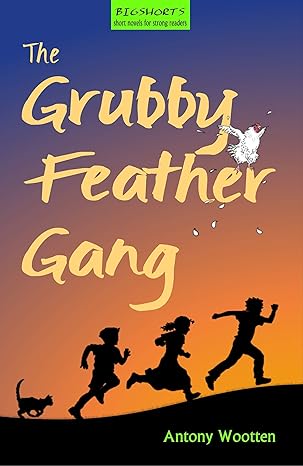
The Grubby Feather Gang follows George, a boy caught in the middle of a village torn up by war and judgment. He deals with bullying, fear, and the shame that others try to pin on his family because his father refuses to fight. As he meets Emma and Stan, the three of them slip into this oddly sweet little friendship that grows out of chaos. They stumble into adventures, trouble, and eventually form the Grubby Feather Gang, a tiny group held together by loyalty and a grubby feather that somehow becomes a symbol of hope instead of cowardice.
Reading it felt like sitting beside these kids as their lives spun between fear and laughter. I found myself rooting for George right away. His thoughts felt real in this quiet, aching way. Sometimes I wanted to shake him, other times I just wanted to hug the kid. The writing surprised me. It has this softness running through all the messy bits. Even the sad scenes didn’t feel heavy for long because there was always some little spark of warmth or humor waiting around the corner. And Emma cracked me up constantly. She felt like the friend who shows up loud and strange and instantly makes everything better.
What I liked most were the ideas behind the story. It’s a book about courage that doesn’t sound preachy. It tackles judgment and fear and the pressure to fit in. But it does it through the eyes of children who are trying to make sense of a world that doesn’t make sense at all. Some moments hit harder than I expected. Other scenes felt gentle and simple in a way that made me smile without thinking about it. I liked that the book didn’t pretend everything gets fixed, only that sticking together makes the hard stuff feel less impossible.
I’d recommend The Grubby Feather Gang to kids who enjoy stories with heart and a bit of grit, and to adults who like children’s books that don’t talk down to anyone. It’s great for readers who want friendship, trouble, and a little hope woven into history.
Pages: 113 | ASIN : B01FARFVUG


