Blog Archives
A Beautiful Sunrise


A Beautiful Sunrise by Bernadette Gage is a historical coming-of-age novel about Abi, a girl from Ipole whose hunger for education pushes against a culture that expects girls to marry, bear children, and stay quiet. The story follows her from childhood through schooling, marriage, motherhood, teaching, and later study abroad, tracing how one girl’s chance at education becomes a wider argument for dignity, independence, and opportunity for women.
I found the book most moving when it stayed close to the everyday texture of Abi’s world: the farms, schoolrooms, family compounds, village meetings, boarding school routines, food, chores, and the constant weighing of duty against desire. Gage writes with a steady, patient style. She isn’t in a hurry. Sometimes that makes the novel feel almost oral in its pacing, like someone is sitting beside you and telling a family history piece by piece. At times, I wanted a little more sharpness or compression, because some scenes explain what the reader already understands. But there is also something generous about that fullness. The book wants us to see the whole village, not just Abi.
What stayed with me most was the author’s choice to make education feel both personal and political. Abi’s story isn’t only about school certificates or ambition. It’s about permission. Who gets it. Who withholds it. Who has to fight twice as hard for it. I appreciated that the novel doesn’t make Abi perfect. She is stubborn, sometimes impatient, and often forced to carry more than she should. That made her feel real to me. The strongest idea in the book is simple but powerful: when a girl is given room to grow, the effect does not stop with her. It moves through her children, her students, and her community.
As a work of historical fiction and inspirational women’s fiction, A Beautiful Sunrise will appeal most to readers who like character-driven stories about resilience, family, education, and social change. I would especially recommend it to readers who enjoy reflective, culturally grounded novels with a hopeful arc. The story is like a slow sunrise, fittingly, and its warmth builds over time.
Pages: 178 | ASIN: B0GWB2ZL8Z

The Falcon and the Songbird


The Falcon and the Songbird, by Susan Kay Harris, follows April Winford, a perceptive girl coming of age in the Texas Hill Country during the early 1960s, as her private world of horses, family tensions, first love, and friendship is overtaken by the public tremors of Kennedy’s presidency, his assassination, racial injustice, land greed, and the fight to protect a fragile natural habitat. What begins as a young girl’s intimate remembrance widens into a story about conscience, how it wakes, how it wounds, and how it asks ordinary people to become braver than they planned.
I was drawn first to the novel’s strong sense of place. The Hill Country is not merely scenery here; it breathes, with its rain-starved grass, limestone ridges, ranch roads, birdsong, and the half-wild freedom of Moona, April’s horse. Harris writes April’s girlhood with a vivid inwardness, catching the awkwardness of adolescence without making it small. April is romantic, stubborn, naïve, observant, and sometimes painfully wrong, which makes her feel alive. The book is at its best when it lets innocence brush against danger before April fully understands what she has encountered.
I loved the way the novel braids personal awakening with historical disillusionment. Kennedy’s assassination does not sit in the background as decoration; it alters the moral weather of the book. The story can be sprawling, and at times its political conversations become more explicit than subtle, but I appreciated its ambition. It wants to connect a girl’s first difficult loyalties, to her mother, to Clay, to Ronnie, to the land itself, with the larger betrayals of a country entering a darker age. That gives the novel a raw, earnest charge, a kind of flint-struck sincerity.
I think this book is best suited for readers who enjoy reflective historical fiction, coming-of-age novels, Southern fiction, and stories about moral courage. Readers who admire the ethical awakening and regional atmosphere of To Kill a Mockingbird may find a familiar gravity here, though Harris’s novel is more openly political and more meditative in its treatment of land, memory, and loss. The Falcon and the Songbird is a heartfelt and searching novel about the hour when childhood ends, and conscience begins to sing.
Pages: 320 | ISBN : 978-2839949330
Outbreak (The Dark Days Series Book 1)

Outbreak: The Dark Days Book One follows Sonny, a young boy whose ordinary summer collapses into terror when a mysterious infection spreads across the world. What begins with family breakfasts, mall trips, and nervous rumors soon becomes a brutal fight for survival through quarantine zones, military violence, zombies, refugee camps, and fractured communities. The story is less about the outbreak itself than about what it steals: childhood, certainty, safety, and the simple belief that adults know how to fix things.
I was most affected by the novel’s insistence on filtering catastrophe through Sonny’s young perspective. His voice gives the horror a raw immediacy; he notices the strange details children notice, from favorite cartoons to birthday memories, even as the world around him is turning feral. That contrast gives the book its sting. The violence is often harsh, but the emotional damage lingers longer than the bloodshed. Sonny’s grief, fear, guilt, and stubborn loyalty become the real pulse of the story.
What really affected me, though, was the book’s bleak but persistent attention to human connection. Families are broken apart, friends are lost, and safe places keep proving temporary, yet the characters keep reaching for one another. The novel is at its strongest when it pauses amid chaos to let people comfort, argue, protect, or mourn. Some scenes are rough-edged and direct, but that bluntness suits the world author Christopher Cole is building: a place where tenderness has to fight for oxygen.
I think this book is best suited for readers who enjoy young adult dystopian fiction, zombie apocalypse horror, survival thriller, post-apocalyptic adventure, pandemic fiction, and coming-of-age horror. Fans of The Walking Dead will recognize the same grim question underneath the carnage: when civilization dies, what kind of person survives in its place? Outbreak is a fierce and grief-marked survival story about a boy forced to grow up while the world burns around him.
Pages: 245 | ASIN : B0G4GQ9J5N
The Summer of ’71
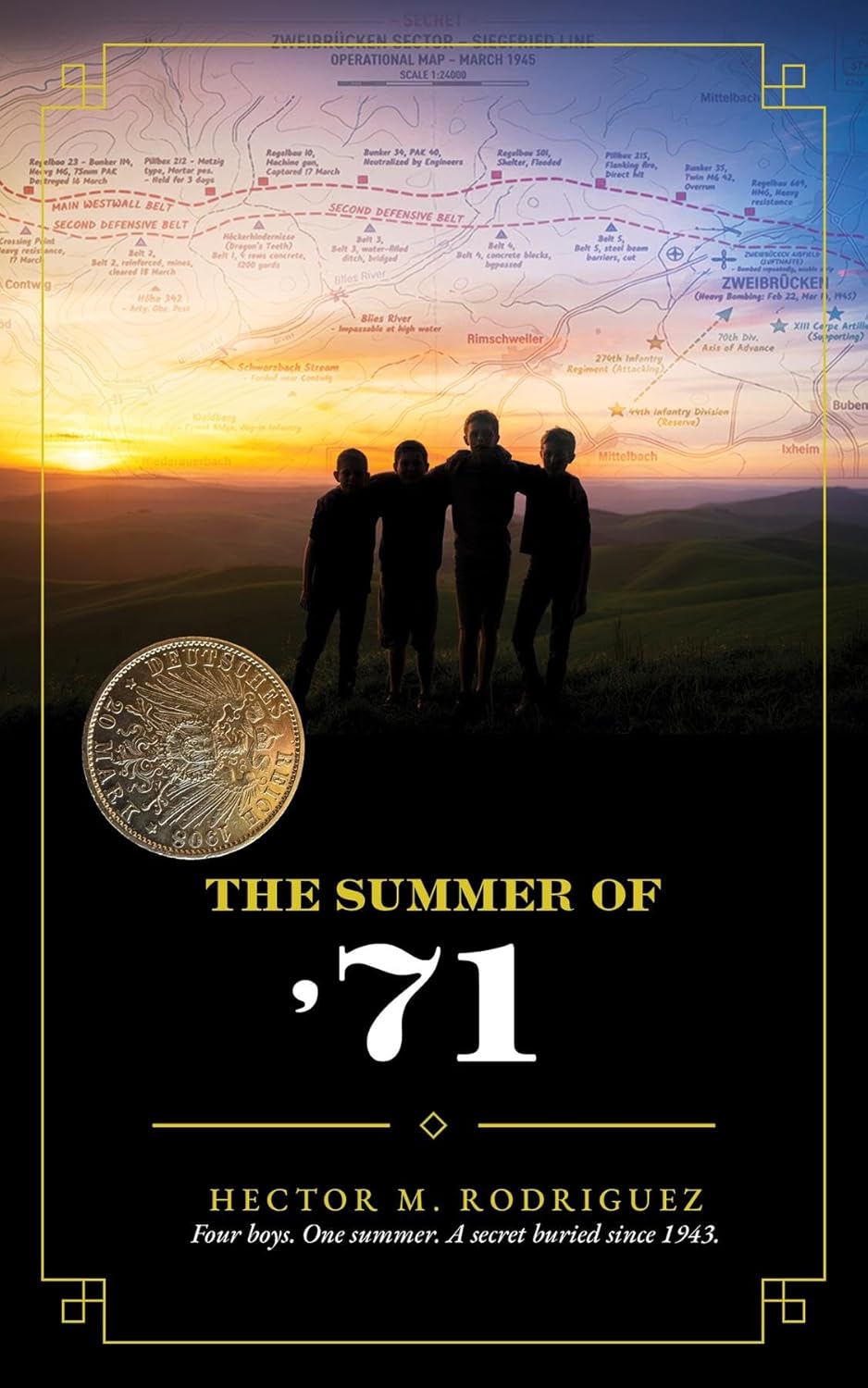
Hector M. Rodriguez’s The Summer of ’71 is a boyhood adventure told through the steady, reflective voice of a man who has spent most of his life trying to understand one summer in West Germany. Four military kids slip away from base, chase a rumor about a sealed World War II bunker, and find themselves carrying more than gold coins by the time they come home. It’s a story about friendship, military-brat life, old war wounds, and the strange way childhood can turn serious before anyone’s ready for it.
The book works because the boys feel specific. Galen watches and records, Bobby carries grief with quiet dignity, Rusty talks big but keeps going on a bad ankle, and Pascal moves through history like someone who already knows it has a pulse. Their banter feels natural, and their loyalty builds in small gestures rather than speeches. Bobby, especially, gives the story its emotional center. He’s the kind of kid who doesn’t announce that he cares. He just moves closer so he can catch someone if they fall.
Rodriguez gives the bunker scenes a strong, almost tactile atmosphere. The cold concrete, old tobacco smell, stopped clock, scratched walls, and buried ammo can make the past feel close enough to touch. The inscription “I was here. I loved her.” becomes one of the book’s quiet anchors, turning a wartime relic into something human and intimate. The gold coins matter, but the deeper treasure is the way the boys begin to understand that history is made of people who were scared, loyal, lonely, brave, and unfinished.
The novel also has a tender understanding of military families. It captures the odd mix of freedom and instability that comes with growing up on bases, where friendships form quickly because everyone knows time is limited. The boys’ secret becomes a bond they carry into adulthood, and the later chapters give that bond real weight. When the narrator looks back and says, “I wouldn’t change a single step,” it works because the story has earned that feeling.
The Summer of ’71 is warm, suspenseful, and deeply personal. It reads like a memory that’s been protected for decades before finally being set down on the page. Rodriguez turns a childhood expedition into a meditation on grief, duty, friendship, and the things people leave behind for others to find. It’s a heartfelt book with a strong sense of place and a sincere respect for the past.
Pages: 130 | ASIN: B0GX2X8NNZ
Atlas Falls to Earth
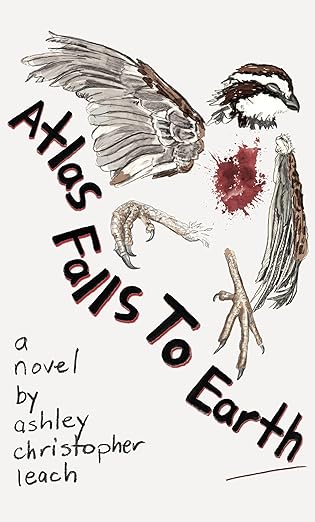
Atlas Falls to Earth, by Ashley Christopher Leach, is a literary coming-of-age novel with strong Southern Gothic and magical realist elements. It follows Atlas, a sensitive thirteen-year-old boy in rural North Carolina, as he struggles under the weight of his father Jason’s expectations, finds comfort in Alex’s quiet care, and escapes into a strange book-within-the-book called Misadventures in Being: The Strange Tale of Bunny and Munk. The novel moves between Atlas’s painful real world and the eerie, fable-like world of Bunny and Munk, using both stories to explore loneliness, identity, imagination, violence, and the aching need to be understood.
I liked how intensely Leach writes atmosphere. The book is full of damp fields, old wood, cold rooms, wounded birds, smoke, and silence. You can feel the farmhouse pressing in on Atlas. The prose often lingers, sometimes beautifully, sometimes heavily, and I found myself admiring its ambition. This isn’t a spare novel. It wants to be lush, strange, sad, and philosophical all at once. That choice gives the story a haunted quality, especially in the scenes where Atlas’s gentleness clashes with Jason’s rough idea of masculinity. Those moments hurt. As they should.
I was also fascinated by the author’s decision to fold Bunny and Munk’s fantasy tale into Atlas’s story so deeply. At first, it feels whimsical and odd, almost like a dark children’s book hidden inside adult literary fiction. But the longer I sat with it, the more it felt like a mirror Atlas uses to understand himself. Munk’s longing to be human and Bunny’s simple, instinctive joy play against Atlas’s own fear of being wrong in the body, family, and world he has been given. The inner story is dense, and the dialect is heavy. Still, there is real vision here.
I would recommend Atlas Falls to Earth to readers who like literary fiction that is dark, symbolic, and emotionally raw. It will especially appeal to people drawn to Southern Gothic family stories, magical realism, and novels about fragile young outsiders trying to survive a world that keeps asking them to become harder than they are. It has a strange tenderness that stayed with me after I finished the book.
Pages: 159 | ASIN : B0F2GSBN2V
A Light Had Gone Out

In Jake’s Shoes follows a grieving father who discovers his late son through a hidden notebook of childhood letters, uncovering the life, pain, and love he failed to see while his son was still alive. What was the inspiration for the setup of your story?
For a number of years I’d been writing picture books, middle-grade novels, and songs about, with, and for children.
In the early 1980’s, my mother died, rather suddenly from cancer. I felt like a light had gone out.
At the time, my wife, Judy, and I were team-teaching in early childhood, multi-age classrooms. I was seeing and working with young children…plus my own daughters, every day. As I watched them and spent time with them, I found myself wondering how they might cope with the same kind of struggle I was going through.
As I struggled to cope with the loss of my mother, and how to keep her light on, I needed some way to bring meaning to her death…something that would honor the “light inside” that made her such a special person in my life.
I decided I wanted to write about it. But didn’t feel like a personal journal or a memoir was my route. I decided I’d write about a young boy, who had just lost his grandmother, with whom he had developed a very special bond. Writing as a young boy (I named him Jake), he writes letters to her telling her how much he misses her, shares both his sad and happy days, his struggles at home and at a new school…letters that honor her by acknowledging the positive impact she had on his life. I decided the time frame would revolve around a difficult year in his life, as an eleven-year-old, whose family moved to a new town, new school, and new friends. Over the course of several years, I used these letters in several presentations I made to parent groups. It was only later, that I felt these simple letters might serve as a springboard for a story, which eventually became, IN JAKE’S SHOES.
Marshall is flawed but not villainized. Why was it important to write him with that complexity?
In Jake’s Shoes is a story about a normal family going through the normal struggles of learning to live each day together. I want readers to identify with Marshall, not vilify him and think about how their personal complexities project their own humanity…in how they deal with others, see the world…see themselves in it. The story should serve as a laboratory for reflection as the reader travels along on Marshall’s journey through loss, grief and the possibility for redemption.
The book explores emotional restraint, especially in men. Was that a conscious thematic focus from the beginning?
That theme, naturally, does weave itself throughout. I recall, when I began my career as a young teacher and as a parent, I would find myself responding to what I perceived as “misbehavior” as if it were a personal affront. But I found my response most effective when I could “take a breath,” and choose how I reacted to situations instead of, in essence, being at the mercy of impulse. I hope readers will consider how this theme might be reflected in their own lives as they ponder Marshall’s responses to his son, his wife, his other children.
The book leans into sincerity rather than irony. What do you hope readers feel when they finish the final pages?
I wanted to project Marshall as a normal father, whose internal conversations are genuine and real, as he struggles to understand his child. As I believe all of us do as parents, understanding what it means to be a parent while pursuing your own personal goals and identity is not a simple task.
I want the readers to feel that the story has taken them on a journey into their memories. That it has helped them to appreciate the complexity of family relationships, loss, grief, communication, and understanding.
An Army officer knocks on the door only a few days before Christmas-and a family’s world quietly unravels.
When Marshall Gatlin retreats to his dusty attic in search of solace, he stumbles upon an old notebook tucked inside a forgotten box. Written by his son Jake at the age of eleven, the letters inside are addressed to a deceased grandmother…but their words are very much alive.
As Marshall turns each fragile page, he’s drawn into the tender, whimsical, and often rebellious world of a boy wrestling with friendship, grief, and the quiet mysteries of growing up. With every letter, Marshall begins to uncover a side of Jake he never knew.
Both heartbreaking and inspirational, In Jake’s Shoes is a tale of discovery, loss, and the strange, mysterious ways that love leaves its mark. Prompting readers to reflect on their own family dynamics, it will spark conversations about love, loss, and the words left unspoken.
The Atmosphere of War

Sawadika American Girl follows an American teenager in Vietnam War-era Bangkok, as music, first love, and shared sorrow help her find a place for grief, longing, and belonging. What was the inspiration for the setup of your story?
Most people aren’t aware that during the Vietnam War, Thailand served as a major US military outpost, with over eight military bases scattered throughout the kingdom. In addition, thousands of American families lived in Bangkok with fathers who worked for the American Embassy, USAID, the CIA, the US Military, and as private contractors. All in direct or indirect support of the war effort. On top of that, in 1968, the year my novel takes place, nearly 5,000 GI’s were pouring into Bangkok each month on R&R, bringing their turmoil with them. This created a ‘little America’ that was complex and combustible and often at odds with Thai sensibilities and culture. Having grown up in Thailand, I understood these underlying tensions and knew it was fertile ground for a story. Making it a coming-of-age story with a 17-year-old female protagonist struck me as a powerful and unexpected way to shed light on this overlooked pocket of history.
Music feels central to Piper’s emotional life; how did you approach writing piano as both technique and feeling?
Music anchors Piper emotionally in a world that doesn’t make sense. The act of playing the piano becomes a private space where she works out her emotions. Her piano teacher is a Thai Prince who had studied with the great Chilean pianist Claudio Arrau. Arrau’s technique was legendary for centering the body for maximum emotional expression. This is what the Prince teaches Piper. Her efforts to master this technique symbolize her struggle to come to terms with what is going on in her life.
The character of the Thai Prince who studied with Arrau is based on a piano teacher I had. There was a vibrant classical music scene in Bangkok at this time. Renowned musicians had Bangkok on their concert tours. This made sense because the Thai King was a talented jazz musician and composed his own music. And as a young girl, the Queen studied classical piano in Paris. I love that thread of the story because no one expects it, but it is absolutely true.
Jack and Piper’s relationship is brief but deeply affecting. What did you want their connection to reveal about war, loneliness, and belonging?
Life is always precious. But war, even the atmosphere of war, perverts that value, making life more precious and less precious at the same time. Piper and Jack experience this intensity from different vantage points, but each is tuned in to the sense of loneliness and dislocation that proximity to war brings. Most of the story unfolds during a single week, about the length of a soldier’s R&R. Under such conditions, time stretches. Three, four, or even five days together mean everything. That perception of time is woven into the fabric of their relationship.
How did you balance the intimate story of Piper’s coming of age with the larger historical forces surrounding her?
The bulk of the novel unfolds over a single week in 1968. That is on purpose. The assassinations of MLK and Robert Kennedy had happened, the Tet Offensive had occurred, and the casualty rate for soldiers and civilians in Vietnam was at a high point. All of that darkened the mood for Americans working in Bangkok. There were tensions with the Thai government. As a dependent, this increased the pressure for Piper to behave a certain way and not put a foot wrong. That kind of control is at odds with an individual’s ability to come of age, which is by definition about asserting one’s independence in a way that produces some kind of personal and intimate transformation. This put Piper on a collision course with the forces around her.
Author Links: GoodReads | Instagram | Facebook | Website | Amazon
One night, Piper ditches the American Teen Club to party with an older crowd. Sparks fly when she meets Jack, a 19-year-old GI on R&R from Vietnam. Defying the Army’s non-fraternization policy, they pledge to spend his leave together. As the hypocrisy of the war closes in on them, Jack’s name surfaces in a drug investigation and Piper discovers a disturbing truth about her father, forcing both to decide what they are willing to risk for a few more days together.
Sawadika American Girl is the story of a young American woman coming-of-age on the periphery of a brutal, unjust war.
The Corridor


The Corridor, by William Klenk, follows Richard, a solitary grandfather whose knowledge of the Blue Ridge mountains is rooted in decades of bodily attention, and Eli, his withdrawn teenage grandson, who arrives carrying family trouble and a school assignment. What begins as a quiet stay in the mountains becomes a shared effort to document a wildlife corridor threatened by a resort development. Richard brings memory, fieldcraft, and lived intimacy with the land; Eli brings maps, cameras, data, and a stubborn belief that proof can still matter. Together, they learn that seeing is not always enough: sometimes the world needs evidence before it will listen.
I was drawn most to the book’s restraint. Its emotional engine is not built from melodrama but from small exchanges: a repaired hinge, a shared trail, a laptop turned across a kitchen table, a handshake that changes weight by the end. Richard’s interior life feels especially strong because the prose lets his certainty erode slowly, like weather on stone. The book understands that aging is not only a loss; it can also be a late apprenticeship in humility. Eli, meanwhile, never becomes a convenient symbol of youth or technology. He’s wounded, practical, observant, and quietly brave in the unflashy way of someone deciding to care again.
The book’s central tension between presence and documentation was entertaining. Richard knows the land because he has inhabited it; Eli protects it because he can translate it into a language that institutions recognize. It doesn’t worship data or romanticize intuition. It lets both be partial, both necessary. The environmental stakes give the plot shape, but the deeper subject is intergenerational repair: the fragile corridor between people, not just animals, and the work required to keep it open.
Readers who like environmental fiction, coming-of-age fiction, family drama, and nature writing will really enjoy this novel. And readers who like quiet, character-driven stories about land, kinship, and moral attention will find a lot to reflect on. I would place The Corridor near the gentler, contemplative side of Barbara Kingsolver, especially in its belief that ecology and family systems echo one another. It’s a brief book, but it has a patient pulse and a clean moral weather.
Pages: 25


