Blog Archives
The Night of the Animals


The Night of the Animals, by J.J. Pascal, follows René Navarro through a series of winding, strange, and often grim encounters after his mother’s death. The story begins with a bitter family truce and moves through bars, dusty basements, cramped apartments, and funeral parlors as René becomes entangled with a man named Pascal, a theater troupe, and an elusive family “treasure.” The narrative jumps between present action and memories, mingling bleak humor, oddball side characters, and moments of quiet despair. Death hovers everywhere, sometimes literally, sometimes just the decay of lives gone stale, and yet there’s always a sense that René is searching for something to give all of it meaning.
I found the writing to be wonderfully vivid and strange, the sort that can make a chipped coffee mug or a hole in the wall feel like a portal. Pascal doesn’t shy away from disturbing images or awkward moments, and I liked that honesty. There’s a dark comic undercurrent that kept me turning pages, bits of absurdity dropped into the middle of grief or poverty. At times, the style felt almost claustrophobic, piling sensory detail on top of emotional weight until I felt just as trapped as the characters. That density could be exhausting, but it also fit the mood perfectly.
Beneath all the odd errands and shifting conversations, there’s a constant pull toward identity. How much of who we are is built from family history, and how much is just chance? The book plays with doubles, echoes, and repetitions, as if lives can overlap without ever quite touching. Some moments hit hard: the little observations about aging, fear, and small cruelties landed more heavily than the plot twists. Other times, I wished the story would move faster, but I can’t deny that the slower pace gave room for its unique textures to sink in.
I’d recommend The Night of the Animals to readers who enjoy literary fiction that leans into the strange and the melancholy. If you like stories where humor and sadness share the same breath, where objects hold memories, and where characters feel like they’ve been living long before the first page, this one will reward your patience. It’s not a light read, but it’s the sort that stays with you, gnawing at the edges of your thoughts.
Pages: 129 | ASIN : B0F4Z78QXP

Inside Their Restricted Worlds

Night Hawks follows the lives of small-town drifters, dreamers, and the disillusioned who are all looking for something more, be that a fresh start, an escape, or just some understanding. What was the inspiration for the setup of your story?
The inspiration came to me from Edward Hopper’s famous 1942 painting Nighthawks. I always admired that painting and how it reveals a late-night café frequented by lonely souls. That’s what I always saw in it, anyway. The painting sparked an idea for a first chapter titled “The Last Train to Chicago,” which as a story, won a fiction contest award from The Vincent Brothers Review.
That first chapter ended with Hank appearing to lose his longtime server, Lois, and so I decided to write another chapter exploring where Lois went and what happened and once I felt it was becoming a book, I needed a couple more good characters to drop into the fishbowl already inhabited by Hank and Lois, and I put the four of them on constant collision courses.
Was there anything from your own life that you put into the characters in your novel?
I don’t think so. Both Hank and Tyler are military veterans and I’m not. I don’t believe any of the four main characters are based on anyone I know now or from the past. For each of the four characters, I first established their names, and from the names I got a starting point for building them into people. I worked, too, off their occupations: Hank as a diner owner and cook, Lois as a veteran server, Clara as a young server still living at home, and Tyler, a jittery veteran just home from Afghanistan.
So, when I started putting flesh on each one, I began with knowing their name and job and my imagination assembled them, and then with each new chapter, I learned more about them and how they would react. For me, writing is a daily process of discovery like it is for readers. I don’t do character arcs before I start writing. I want the daily surprise that comes day as I know the characters better and hear their voice and understand their desires and conflicts.
What were some themes that were important for you to explore in this book?
Family is perhaps the most important – and obvious – theme in Night Hawks. But not the usual concept of family. The four people in the book whose paths and lives are so intertwined, don’t really have traditional families anymore and so their journeys require them to bond and become their own little family. There are lots of people whose lives have become small and desperate, and they look to the people inside their restricted worlds to be family members.
Perhaps enduring and persevering are themes, too. Hank, Lois, Tyler, and Clara must all maintain hope for something better. They don’t have a lot to work with but must keep fighting to have satisfactory lives.
What is the next book that you are working on and when can your fans expect it to be out?
I am nearly done writing the draft of a novel titled The Gatsby Lover. It has a connection to The Great Gatsby, but I’ll keep that close to the vest for now. After I let it sit a few days and then make revisions, it goes over to my longtime personal editor, Carol Burbank, for her always useful reactions. Fingers crossed it finds a good publisher!
Author Links: GoodReads | Facebook | Amazon
Hank Spencer knows what goes on in his diner. He knows which days are best for business and whether the Blue Plate special is selling, and he makes note of the customers who come to drink and make small talk with his servers.
Lois is a hardworking waitress pushing fifty who hasn’t forgotten her big city dreams. When opportunity presents itself, she boards the train for Chicago, despite the risks and her boss’s attempts to warn her.
Working all the double shifts in the world won’t take care of Clara’s problem. She’s young, single, and knocked up. She feels trapped—at the diner, living with her god-fearing parents, and in the gossipy town full of watchful eyes.
Tyler is adjusting to civilian life after a stint in the army. At Hank’s Diner, he finds camaraderie and comfort, and sometimes, he can drown out visions of war over a plate of potatoes and meatloaf, and several, ice-cold beers.
These lonely souls converge under the fluorescent glow of the eatery, late at night and during long days, as the train speeds through, blaring its horn and signaling an alternate path. NIGHT HAWKS is a tender novella with a touch of noir about finding family in unlikely places, living through losses, and the connections that keep us showing up for another shift.
Night Hawks
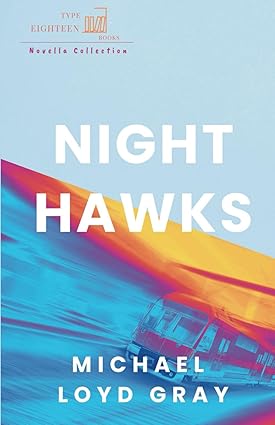
Michael Loyd Gray’s Night Hawks is a gritty, heartfelt novella that weaves together the lives of small-town drifters, dreamers, and the disillusioned. Told through interlinked short stories, the book captures the quiet struggles of characters who are yearning for something more—a fresh start, an escape, or just a little understanding. From the weary cook Hank Spencer to the hopeful but battered Lois, and the haunted veteran Tyler, each chapter peels back another layer of the town’s people, their regrets, and the fragile hope that still lingers in them.
What struck me most about Gray’s writing is its stark simplicity. He doesn’t waste words. Every line feels intentional, every conversation rings with unspoken truths. Take the scene in The Last Train to Chicago, where Lois and Hundley sit in a small-town diner, the weight of their decisions hanging between them like cigarette smoke. You can almost hear the loneliness in the clink of coffee cups and the hum of a jukebox playing old country songs. The writing doesn’t spell things out, it lets the silence do the talking. And that’s the kind of storytelling that hits me hard.
The book’s emotional depth really comes through in Objects in Mirror, where Tyler, a soldier trying to leave Afghanistan behind, takes a construction job demolishing an abandoned building only to realize he’s also tearing down pieces of his own past. Gray does an incredible job of showing the slow, painful process of healing without dramatizing it. The imagery here is unforgettable: the dust rising from broken bricks, the sweat, the ache in Tyler’s arms are all mirroring his internal battle.
Lois’s story arc was the most gripping for me. She leaves town with high hopes, chasing a better life in Chicago, only to be let down in the worst way. Her return in Wrong Turn is almost too painful to watch. When she knocks on Hank’s door, ashamed and exhausted, you feel the weight of every bad decision she’s ever made. But it’s Hank’s quiet understanding that makes this scene so powerful. He doesn’t lecture her. He doesn’t judge. He just lets her in. And sometimes, that’s all someone needs. While the book’s strength lies in its subdued, character-driven storytelling, there are instances, like in The Off Ramp to Nowhere, where I think the internal monologues could be tightened to maintain narrative momentum.
Gray doesn’t offer easy answers, and that’s what makes Night Hawks so compelling. It’s a book about real people making real mistakes, but it also offers moments of grace and redemption. The prose is unpretentious but deeply evocative, making it a perfect read for those who appreciate character-driven stories with a raw, honest edge. If you liked Kent Haruf’s Plainsong or Raymond Carver’s short stories, this one will stick with you.
Pages: 111 | ASIN : B0DKVGTZ21
Unspoken truths

A Little Something to Hide is a series of short stories following the passengers of the Briscola Coach Service, traveling from San Francisco to Albuquerque. What was the inspiration for the original and fascinating idea at the center of the book?
Many years ago, in a time before ‘pandemic’ had entered the common lexicon, I attended a concert in Oxford with my wife and some friends to see Wildwood Kin, a British folk-rock trio famed for their glorious harmonies. The support act that evening, a duo called Ferris & Sylvester, equally blessed with talent, sang their song, ‘Burning River,’ conjuring in me the image of a distant place. I found the muse powerful in the music and my mind began to wander. The seeds for A Little Something to Hide were planted somewhere during the four or so minutes of that song, with the book beginning its life with a working title of Nearing Albuquerque. From the outset, I envisaged an omniscient narrative perspective, giving the narrator the ability to express each character’s darkest secrets. It was a speculative notion that gnawed at me, with characters popping into my head with their stories loosely formed. The dog and I went for walks and held one-sided conversations about what might unfold and the book started to take shape. I’m so glad I listened to her.
What are some things that you find interesting about the human condition that you think make for great fiction?
There is so much about popular culture today that obsesses about celebrity. Any number of shows delve into the lives of others, providing glimpses of their lifestyles and their motivations, which often manifest as an overwhelming desire for fame and recognition. What frustrates me about these shows is the vacuity of the central characters. I’m not remotely convinced that the façade that they present on screen is a true representation of who they really are, and if it is, they rarely demonstrate any great depth of personality – beyond the make-up and the trappings of consumerism, there’s not a lot that’s redeeming.
I am much more interested in ‘real’ people, those who are not defined by their celebrity, but by their very real existence. The struggles that they face, their unspoken truths, the secrets that they hide – those things are of far more interest to me and why, in A Little Something To Hide, I wanted to explore those who live amongst us and largely go unnoticed, to illustrate that ordinary people often lead extraordinary lives.
What were some themes that were important for you to explore in this book?
I didn’t consciously set out to explore any themes in the book, and those that appear, are a fortuitous coincidence. In developing each character, certain themes emerged. It wasn’t so much that I adopted them, more that I clung to their coattails, attempting to stay faithful to what unfolded. If there’s one that I think that pervades the novel, it’s that of perseverance; the desire to pursue that which a character most wants. Whilst many of the characters in A Little Something To Hide demonstrated phenomenal determination, others did not, demonstrating a complete lack of resilience. It was this dichotomy that I most enjoyed discovering.
I also enjoyed exploring that which gets left unsaid. The book is jammed with characters who choose not to share too much with the world, and I loved being able to eke their secrets from them as their stories unfurled.
What is the next book that you are working on, and when will it be available?
I’m really excited about the next book, the first draft of which I began writing in 2003. It’s titled, Dignity and is another book that draws its inspiration from a song, in this case, a 90s song of the same name from a Scottish band, Deacon Blue. The song tells the tale of a bin man who quietly goes about saving his money to buy a boat, with plans to sail to somewhere better than the streets he cleans. I love the premise of the song, again, it’s about a character who is fiercely determined to pursue his dream and is yet another story of an ordinary man with an extraordinary tale – I just had to write it! I’ve moved the location from the gritty streets of Glasgow to the more gentile location of my hometown, Petone, in New Zealand. The story is told through the eyes of a twelve-year-old boy who befriends the protagonist, with more than a token nod to Ernest Hemingway’s The Old Man And The Sea. I’m still a couple of drafts away from sharing it and my hope is to have it out by the end of 2026.
Author Links: GoodReads | X (Twitter) | Facebook | Website | Bookbub | Threads | BlueSky | Books.by | Amazon
On the Briscola Coach Service to Albuquerque, that’s just not possible.
“All manner of people ride a Briscola coach. Some travel toward dreams, others are escaping horrors, each carries their secrets and the belief that they harbour truths known only to themselves”
Craig Brown’s debut novel, ‘A Little Something To Hide’, takes a peek into the lives of the passengers on the Briscola Coach Service from San Francisco to Albuquerque. Every traveller believes they’re harbouring a secret that none of the world can see. Some secrets are darker than others and none of them are truly hidden.
Climb aboard to learn more and remember, never trust the person you’re next to, no matter how sweet they look.
Seeking Closure: Someday, You Will Understand

Seeking Closure dives deep into the interconnected lives of its diverse cast of characters, blending personal growth, financial intrigue, and societal upheaval. Spanning decades from the 1990s to the pandemic-stricken 2020s, the book intertwines major historical events like 9/11 and the Great Recession with the intimate struggles of love, ambition, and self-discovery. The story’s heart lies in its exploration of universal questions: What defines love? How do we balance personal desires with societal expectations? It’s as much about financial investments as it is about emotional ones.
One thing that struck me immediately was the writing’s layered texture. The author breathes life into characters with rich, nuanced backstories. For instance, Adam, the protagonist, steps into the financial world with all the polished nerves of a freshly minted MBA, yet his journey is anything but linear. His first encounter with the enigmatic Charlie had me grinning and wincing in equal measure, reflecting on how chance meetings often define our paths. The way Adam’s nervousness on his first day mirrors his internal growth later in the book is rewarding. This character progression feels real and heartfelt.
I enjoyed the story but felt the prose occasionally reaches for more than it needs to, with some scenes feeling a bit overexplored. For instance, the meeting between Adam and Charlie in the early chapters, while engaging, sometimes lingers on details that could have been tightened. Even so, these moments also highlight the author’s enthusiasm for crafting vivid and immersive storytelling.
What I loved most, though, was how the book delves into its philosophical undertones. Each character seeks closure, whether through love, career, or family. The chapter on Jane’s sacrifices for her family versus her career ambitions resonated deeply. Her quiet strength is a sharp contrast to Charlie’s brash assertiveness and Adam’s introverted resilience. I found myself rooting for all of them, even when their flaws were painfully evident.
By the time I reached the closing chapters, I felt like I had lived decades alongside these characters. The final moments are bittersweet, leaving you pondering the very meaning of closure. Is it truly an end or just another beginning?
If you enjoy stories that weave personal dilemmas with historical contexts and explore themes of love, identity, and ambition, Seeking Closure is a must-read. It’s perfect for anyone who loves drama with a philosophical twist or wants to lose themselves in a tale that feels both sprawling and deeply personal.
Pages: 345 | ASIN : B0CW1BSJC5
Sketches from the Periphery


Michael Patrick Summers’s debut novel, Sketches From the Periphery, stands as a remarkable achievement in historical storytelling. It illuminates the human narratives behind world conflicts, offering a gripping and thought-provoking exploration of the Darfur conflict in Sudan. For anyone fascinated by history, this novel provides a poignant and empathetic window into the lives of those impacted by one of the 21st century’s most complex crises.
The story centers on Alexander Barr, a young American contractor working with the African Union’s peacekeeping mission in Darfur in 2006. Through Alex’s eyes, readers navigate the brutal realities of a war-torn region. The narrative delves into existential themes, grappling with the enduring legacies of colonialism and the often violent dynamics of human history.
Alongside Alex’s journey is the parallel tale of Tariq, a battle-hardened operative of the Darfur liberation movement, whose life has been indelibly shaped by conflict. Although their paths do not directly converge, the interwoven stories depict life on the margins of civilization, where idealism and survival clash in a haunting dance. Adding richness to the narrative is Cassandra, a fiercely independent European journalist whose presence brings a fresh dynamic to Alex’s search for meaning. Her depth and resilience make her a standout character. Summers deftly blends historical fiction with profound philosophical reflection, creating a layered and immersive experience.
The novel not only exposes the raw truths of the Darfur conflict but also challenges readers to confront broader questions about humanity’s capacity for both destruction and creation. The richly developed characters, each grappling with moral complexity, bring the story’s themes to life in vivid and unforgettable ways.
Sketches From the Periphery is an evocative and introspective work, appealing to history enthusiasts, fans of philosophical literature, and readers drawn to stories of resilience and moral struggle. Even for those who may not typically choose books about war, this novel offers an unparalleled journey into the depths of human conflict and the search for meaning amidst chaos. It’s a profound, moving, and deeply worthwhile read.
Pages: 197 | ASIN : B0DL6S7VHX
The Deaths at Jonestown

Paradise Undone is a powerful and deeply unsettling exploration of one of the most tragic events in modern history, the Jonestown massacre. Where did the idea for this novel come from?
In 2004, I gave a reading at the U. of N. Dakota Writers Conference to a crowd of 600, where I was a master teacher in residence. In the story, about the intersection of 9/11 and a Jewish family I knew back in New York, the parents go to a deprogrammer in an attempt to rescue their daughters (based on two friends) from a nameless cult in the Southwest. The programmer tells them he lost his daughter in Jonestown four years earlier. That was the sole mention of Jonestown in the story excerpt, which went on to win some prizes and be published in Sequestrum and Glimmer Train .
Afterward, a friend came up to me in tears, telling me of his colleagues who had lost family — siblings and nephew — in Jonestown. A powerful and unexpected response to my story. A month later, preparing for my sabbatical, in which I planned to write Hippie Ruins, a novel about the communes in Southern Colorado where I would spend the year ahead, I perused the shelves at Powell’s City of Books in Portland, OR, passing from COMMUNES to CULTS, where I discovered dozens of books about Jonestown. Thus, my bookstore aisle epiphany: remembering my friend in tears, I decided to write my book about Jonestown instead. The hippies could wait, while the story of an unscrupulous charismatic man leading altruistic souls to their demise felt urgent. Twenty years later, in this election year, my book just published, that urgency pulses with even greater danger.
Did you find anything in your research of this story that surprised you?
When I began researching, the most basic facts concerning the deaths at Jonestown — about which I knew little, like most Americans alive in 1978, when I was 18 — stunned me. The dead were 2/3 female, 80% African American, and 1/3 of those 900+ bodies were children. The media of the day, and even now, present those dead human beings as brainless, drugged-out zombies, led by a crazy man to “drink the Kool-Aid,” a salacious and sensationalized portrait so misleading. The dead of Peoples Temple were families, a third of them elderly, and the group as a whole comprising idiosyncratic individuals. It was not a mass suicide; it was murder, an example of coercive control gone ballistic.
What was one of the hardest parts of Paradise Undone for you to write?
I chose to narrate Nov. 18, 1978, from the first-person perspective of Marceline Baldwin Jones, Jim Jones’s wife of nearly 30 years, a founding member of the altruistic work of Peoples Temple in 1950s Indianapolis, who witnessed its decline in Jonestown’s final years, as her husband became an addict and monomaniac. The only fact we know about her demise that day is that she was one of the 900+ who died from poison. Two people died of gunshot wounds: Jim Jones and his nurse, Annie Moore. I wanted to give her a voice, a will, and a longing to stand up to her husband. However, she is human and weak and does not prevail. Living inside her consciousness for hours while the poison is dished out by others in cups and syringes in varying doses measured for infants, toddlers and adults, resonated with pain. She loves these hundreds of people who call her Mother. But there are armed guards surrounding her, guarding the vat of Flavor-Aid (not, in fact, Kool-Aid), and the crowd rises up against the one woman, Christine Miller, who argues with Jones not to go forward with his plan of so-called “Revolutionary Suicide.” Paralyzed with fear, Marceline does not act.
What is the next book that you are working on, and when will it be available?
My next book will be linking short stories about other members of Peoples Temple, including characters I wanted to write about in my novel but could not include due to narrative constraints. I plan to have it published on the 50th anniversary of the massacre in 2028. However, PARADISE UNDONE was ready for the 30th anniversary in 2008, with a NY agent who tried his best but, despite two close calls, returned it to me. Fifteen years later, despite hundreds and hundreds of rejections, in addition to being a finalist 17 times in various contests, I finally found a UK publisher, by chance, who eagerly snapped it up. Am hoping for a pub date closer to my goal this time around, with fewer years on my biological clock remaining!
Author Links: GoodReads | X (Twitter) | Facebook | Website | Instagram | Threads | Amazon
Imagine a community full of rainbow families where everyone comes together in the spirit of equality and fraternal love.
Shy pastor’s daughter Marceline and her new husband Jim Jones found Peoples Temple in the face of rampant hostility and aggression in 1950s segregated AmeriKKKa.
They give hope to the poor, the miserable, the alienated and disenfranchised of all colors, and build a commune in the jungle of British Guyana.
But this Eden too has its serpent. One who is also jealous of God, and where he goes, everyone must follow, even to the grave.
Paradise Undone: A Novel of Jonestown

In Paradise Undone, Annie Dawid takes readers on a haunting journey back to the 1950s, where Marceline, the daughter of a pastor, encounters a man who seems to embody all the characteristics she values. Charismatic, godly, and fiercely intelligent, Jim Jones attracts people like a flame in the darkness. However, the world would soon know his name for reasons far darker than Marceline could have ever imagined. The creation of Jonestown and the horrific massacre that ensued became global news, but no documentary could fully capture the human tragedy of what happened there. This novel does, and it does so with unflinching honesty.
Paradise Undone serves almost as a companion piece to the recent TV miniseries Cult Massacre: One Day in Jonestown. While the series provides archival footage and survivor interviews, Dawid’s novel delves deeper into the events that transpired in the Guyanese jungle and the years that led up to it. The Jonestown tragedy can be explored on many levels, each more disturbing than the last. It wasn’t just the loss of life that was so horrifying, but also the manipulation and perversion of the very idea of paradise on Earth that Jones preached. This novel focuses intensely on that perversion. Dawid’s vivid descriptions evoke a visceral reaction as we witness the transformation of Jones from a seemingly benevolent leader to a figure of pure malevolence, like the devil himself given human form. From the outset, Dawid expertly reveals the cracks in Jones’ Eden. As the story unfolds, readers become as captive as the residents of Jonestown, drawn into a web of tension that escalates to a fever pitch. Even for those familiar with the outcome, the inevitability of the violent crescendo does nothing to lessen its devastating impact. This is a harrowing tale, and Dawid leads us through it with the precision and skill of a seasoned storyteller, ensuring that every moment is as gripping as it is heartbreaking.
Paradise Undone is a powerful and deeply unsettling exploration of one of the most tragic events in modern history. Annie Dawid’s masterful storytelling brings the human aspect of the Jonestown massacre into sharp focus, revealing the psychological manipulation and the dark descent of a man who led so many to their doom. This novel not only provides a chilling reminder of the dangers of blind devotion but also serves as a poignant testament to the lives lost.
Pages: 304 | ASIN : B0CKHSZX7X


