Blog Archives
A Rich Tapestry

The Sword and the Hearth follows a young Brittonic boy thrust into leadership and survival as Saxon invaders threaten to crush his tribe and way of life, forcing him to mature quickly and navigate the complexities of war, leadership, and personal sacrifice.
What was your writing process to ensure you captured the essence of the characters?
My writing process for capturing the essence of the characters in “The Sword and the Hearth” was deeply iterative and rooted in a blend of imagination and focused development. It started with extensive brainstorming and profiling. Before I even wrote the first chapter, I created detailed character profiles for each main character, outlining not just their physical appearance but also their backstories, core beliefs, fears, desires, quirks, and even their favorite foods. This initial immersion helped me understand them as complete individuals, especially considering the varied backgrounds and social strata present in “The Sword and the Hearth.”
Then, during the actual writing, I employed method acting for authors. I’d often pause and ask myself, “How would this character react in this exact situation?” or “What would their internal monologue sound like right now?” This involved stepping into their shoes and genuinely trying to inhabit their perspective, particularly when exploring the nuanced relationships and internal conflicts central to the story. I paid close attention to their voice—ensuring that their dialogue, vocabulary, and even their thought patterns felt distinct and authentic to them, reflecting their individual journeys and development.
Finally, revision was crucial for refinement. I’d read scenes aloud, sometimes even acting out the dialogue, to catch any inconsistencies in character voice or motivation. I also relied on trusted beta readers who would provide feedback specifically on character believability, helping me to polish their nuances until they felt truly alive on the page, like companions in the reader’s own hearth.
What were some themes that were important for you to explore in this book?
Several themes were important for me to explore in “The Sword and the Hearth,” and they often interwove to create a richer tapestry:
The Enduring Strength of Family (Chosen and Blood): Whether it’s the bonds of biological family or the connections forged with individuals who become like family through shared trials, the strength and complexities of these relationships were central to the narrative. I wanted to show how these connections can be both a source of comfort and conflict, truly forming the ‘hearth’ aspect of the title.
The Nature of Identity and Belonging: Many characters grapple with who they are, where they fit in, and what truly defines them, especially when faced with challenging circumstances or new environments. This theme often explored the tension between individual desires and societal expectations, particularly within the feudal setting.
The Power and Peril of Secrets: Secrets, both personal and generational, play a significant role. I wanted to examine how secrets can shape relationships, influence decisions, and ultimately lead to either liberation or destruction, often with far-reaching consequences for the characters and the realm.
Redemption and Second Chances: I was keen to explore the idea that even after mistakes or difficult pasts, there’s often an opportunity for characters to find redemption, to change, and to build a better future for themselves and those around them, irrespective of their station or previous choices.
Will there be a follow-up novel to this story? If so, what aspects of the story will the next book cover?
While “The Sword and the Hearth” stands as a complete narrative in its own right, the literary journey for me, Ciaran MacLeod, has continued with “Echoes of the Ancient Isle,” which serves as the next significant novel in my bibliography.
“Echoes of the Ancient Isle” explores entirely new facets of the world and delves into different aspects of fantasy. It primarily focuses on the unearthing of forgotten histories and the resurgence of ancient magic. Readers will find themselves immersed in a world where the past literally resonates through the present, uncovering secrets tied to long-lost civilizations and powerful artifacts. The story examines themes of legacy, the enduring influence of ancestral spirits, and the profound consequences of disturbing dormant forces. While it features a new cast of characters and a distinct setting, it represents the continuation of my overarching storytelling themes of discovery, personal growth through adversity, and the intricate dance between human will and destiny. It expands the scope of my fictional universe, inviting readers to explore entirely different realms and challenges.
Author Links: GoodReads | Instagram | Website
Raised in the northern hills of Britannia, Cadric must navigate the complexities of war, leadership, and personal sacrifice as he becomes the unlikely leader of his tribe. Alongside him is Maev, a woman whose strength and determination challenge Cadric’s own sense of duty and love. Together, they must face not only the violent Saxon forces gathering at their borders but also the internal struggles that threaten to tear their community apart.
Amidst brutal battles, moments of heartbreak, and triumphs of courage, The Sword and the Hearth is a tale of resilience, the ties that bind people together, and the price of leadership. Will Cadric be able to unite his people and protect the hearth of his homeland, or will the Saxons prove too powerful to resist? This is a story of honor, loyalty, and the strength to protect what truly matters.
The Sword and the Hearth


The Sword and the Hearth follows Cadric, a young Brittonic boy thrust into leadership and survival as Saxon invaders threaten to crush his tribe and way of life. From the fog-choked forests of Eboracum to the blood-soaked hillforts of ancient Britain, this novel delivers an unflinching look at resistance, loyalty, and legacy. It is as much a coming-of-age story as it is a meditation on the costs of war, culture, and identity. As Cadric transforms from a frightened adolescent into a hardened leader, the reader is taken through heart-pounding battles, devastating losses, and the ever-tightening grip of fate.
I found the writing both gritty and poetic. The prose often reads like folklore, earthy, elemental, steeped in loss and myth. There are no wasted words here. Every paragraph drips with atmosphere. The mist, the blood, the grit in Cadric’s boots, it’s all vivid, almost cinematic. And the dialogue is sparse, sharp, and realistic. It respects the silence of trauma. What hit hardest for me were the quiet moments. Cadric watching smoke rise on the horizon or whispering a promise to his dying mother. The action scenes thrum with intensity, but it’s the quiet heartbreaks that linger.
The book is heavy, relentless even. There are stretches where the despair almost chokes the page, and the pacing slows as characters dig deeper into pain and politics. But maybe that’s the point. The story doesn’t pretend there are easy answers or heroic victories. It feels honest to the bone. Cadric’s growth isn’t triumphant; it’s painful, earned in blood and grief. The portrayal of the Saxons isn’t cartoonish either. There’s nuance here, a mutual alienation and brutality that makes the conflict feel tragically human.
The Sword and the Hearth shook me. It made me angry, sad, and strangely hopeful. It’s a story for readers who want their historical fiction raw and emotionally complex, who don’t need neat endings or pretty resolutions. I’d recommend this to fans of Bernard Cornwell or Mary Renault, basically anyone who appreciates richly textured worlds, stoic characters, and the ache of endurance. It’s not a casual read, but it’s a worthy one.
Pages: 368 | ASIN : B0DKPYGZDK

SOULFUL RETURN


Fidelis O. Mkparu’s Soulful Return is a poignant and deeply introspective novel that traces the journey of Dr. Afamefuna Nwaku, a Nigerian immigrant and successful physician in Boston, as he confronts the sacrifices he’s made—his family, his culture, his identity—for the promise of success in America. Through powerful narration, the story explores Afam’s growing disconnect from his homeland and loved ones, all culminating in a difficult decision between career ambition and cultural belonging. Woven through with the haunting presence of ancestral voices and dreams of Nigeria, this novel isn’t just about going home, it’s about reckoning with what it means to truly belong.
From the very first chapter, I felt this book hit close to home. That opening scene, Afam sitting on the banks of the Charles River, haunted by invisible drums calling him back to Nigeria, was more than poetic. It was spiritual. That deep ache of being split between two worlds, trying to find comfort in a place that doesn’t fully embrace you, is something I know well. Mkparu captures it all—the rhythm of longing, the quiet pain of assimilation, and the guilt of forgetting where you come from. And when Afam loosens his tie and lets the water lap over his bare feet, it felt like a baptism, like he was trying to wash off decades of silence.
But what really tore me up was the tension in Afam’s marriage. The scenes between him and Elisha hit like a gut punch. When she said, “I feel lonely lying next to you,” I had to put the book down for a minute. That kind of emotional neglect is too real. You can love someone and still be absent from them. Elisha was grieving the life she thought they were building together. And Afam, caught between trying to be a provider and losing sight of being a partner, is a complex portrait of a man who’s been chasing success so long he forgot what he left behind. Mkparu didn’t sugarcoat the cracks in that relationship. He let it bleed on the page.
Then there’s the whole weight of duty—both to his American life and his family back in Nigeria. It reminded me how often we, as Black men, carry burdens we didn’t ask for. We become bridges between two worlds. Expected to be everything to everyone—patriarchs, professionals, saviors. It’s exhausting. And when Afam stands in front of the hospital wall looking at the executive photo lineup, wondering if his face will be up there or lost in a place that never truly felt like his—man, I felt that.
Mkparu’s writing style is rich but never pretentious. He doesn’t dress his emotions up in fancy words. He lets them spill out. The way he uses flashbacks, dreams, and internal voices keeps the reader grounded in Afam’s inner world without feeling lost. I appreciated how he didn’t resolve things neatly. Life, especially for people caught between cultures, isn’t neat.
I’d recommend Soulful Return to anyone who’s ever felt the pull of two homes, two identities, or two versions of themselves. African Americans, especially, will feel the layers here—the echoes of diaspora, the questioning of what “home” even means. It’s a book for immigrants, yes, but also for anyone who’s chased a dream and then looked around and wondered what they left behind.
Pages: 322 | ASIN : B0F1DWCFT8

Ripple Effect

Heather’s Journey follows a 19-year-old girl living in a small town in Illinois during the 1930s who dreams of leaving, but tragedy strikes, changing everything about the course of her life. What was the inspiration for the setup of your story?
The year 1930 amazes me. For most of the year, everyone thought the stock market crash would breeze over and they could keep dancing like they did in the Roaring Twenties. They were so vulnerable, and our early Americans have grabbed my heart. Along with this, there was Prohibition, and racism that was considered normal. They were still recovering from World War I and the Titanic sinking. (Similarly, we’re still recovering from 9/11, which was over 20 years ago. Healing takes time.) Heather was a mirror of her father’s dreams in his younger days. He moved north; she wants to go south where the dreams started, but racism, like I said, was normal. I pondered on how unfair that had to have been for a young woman with enough issues to deal with. Racism had such a ripple effect on Heather’s entire life. It really umbrellaed her whole “journey.”
Were you able to achieve everything you wanted with the characters in the novel?
I took 18 months to write the novel. I fell in love with all my characters. I even have some compassion for Sylvia. It took time to develop her character. I withheld good qualities from her. I also discovered a struggle in creating Mae — a comical character who isn’t too annoying. Renato’s character was fun — I built him from younger photos of Marc Anthony. I picture Heather to look like Dorothy Danridge in her younger years. Hugh is a soft version of Denzel Washington. 🙂 I have gazed over the marsh in Savannah and thought, this is what the end of a happy story looks like. And so, . . . So, yes, I achieved everything I wanted to.
What were some themes that were important for you to explore in this book?
One important theme is conflict with independence and family — when are we being selfish, and how much of ourselves should we feel guilty about if we don’t give away? Sylvia suffered this conflict. So did Heather and Mae. Renato keeps the reader in conflict with this. He held back going to his family who could keep him safe to take care of Heather and Mae.
Chasing a dream that seems impossible is another theme. Must we have the skills and resources to walk towards where we want to be in life? Renato had a rough past, but he dreamed of respect.
The power of the ripple effect of racism is embedded before page 1.
What is the next book that you are working on and when can your fans expect it to be out?
I am working on another book set in 1930. The setting is a Chicago hotel. Once again, the protagonist is an unadmirable character in the American eye — an Irishman named Percival Dooley. I am hoping to be done with the story by the end of June of this year.
Author Links: GoodReads | X (Twitter) | Website | Amazon
Nineteen-year-old Heather Randolph longs to escape her small-town life in Sterling, Illinois, and uncover her family’s roots in Savannah, Georgia. But when tragedy strikes, she’s thrust into a world of danger, deception, and forbidden romance.
Caught between a charming Puerto Rican bootlegger, her sharp-tongued 12-year-old sister, and a mother whose cruelty knows no bounds, Heather must navigate the turbulent era of Prohibition, the shadows of World War I, and the harsh realities of racism and lawlessness. With the law closing in and her dreams slipping away, will she find the freedom she craves—or be trapped by the past she’s desperate to escape?
A gripping historical fiction novel set in 1930s America, perfect for fans of sweeping family sagas, unforgettable heroines, and forbidden love.
Heather’s Journey: Historical Romance of 1930
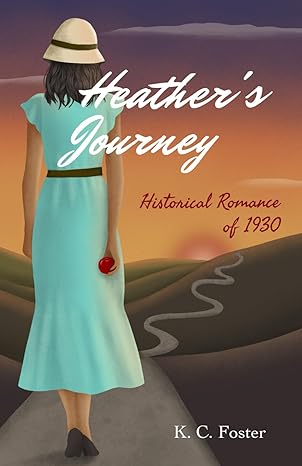
Heather’s Journey by K.C. Foster is an emotional, immersive novel that pulls the reader into a deeply atmospheric world of family struggles, love, loss, and the quest for identity. Set in the 1930s, the book follows Heather as she navigates a life tangled with mystery, survival, and self-discovery. From the first few pages, we are drawn into Heather’s tense reality, witnessing a secretive late-night burial in Chapter 1 that sets the tone for the book’s brooding undercurrents. As the story unfolds, we meet a complex cast of characters, each carrying their own burdens, yet all woven into Heather’s path toward understanding herself and the world around her.
Foster’s writing is rich and evocative, making every setting feel alive, from the small town of Sterling, Illinois, to the shadowed corners of Dodge Grocers. There’s a poetic rhythm to the prose, particularly in descriptions of the world Heather inhabits, whether it’s the wind whispering secrets across the fields or the hushed tension in a dimly lit kitchen. One of the book’s strongest points is its ability to create mood. In the opening scene, Heather is watching shadows move in the night while whispers of danger hang in the air, which immediately sets up an eerie intrigue. The dialogue, too, is crisp and filled with subtext, particularly in interactions between Heather and the enigmatic Renato, whose presence in her life is as steady as it is uncertain.
The heart of the book, though, is in its characters. Heather’s father, Hugh, is a quietly dignified figure, a man of resilience, whose fate is one of the novel’s most devastating blows. When tragedy strikes, Foster doesn’t hold back in letting us feel the rawness of Heather’s grief. The way she stumbles through her pain, desperately seeking solace in routine, in small moments, in the presence of Renato, it’s heartbreakingly real. And then there’s Sylvia, Heather’s absent mother, whose arrival is both anticipated and dreaded. When she finally steps onto the page, she’s not the warm, comforting figure Heather might have hoped for. Instead, she’s a force of vanity and detachment, more concerned with reclaiming control over the family store than reconnecting with her daughters. Foster masterfully builds Sylvia as a character we want to understand, yet can’t fully trust.
There are moments in this book that feel so intimate, they almost hurt to read. One of the most striking is when Heather, caught between grief and longing, kisses an unconscious Renato, a moment filled with quiet yearning, desperation, and a kind of naive hope. It’s these personal, human moments that make Heather’s Journey so compelling. The novel isn’t just about external struggles, it’s about the battles within, about the weight of choices, and about how even love can be tangled in regret and hesitation.
By the time I reached the final chapters, I was left with an ache in my chest. Heather’s Journey is not just a coming-of-age story; it’s a reckoning with past and present, with what we want and what we are forced to accept. It’s a book for those who love deeply drawn characters, slow-burning tension, and writing that lingers long after the last page is turned. If you enjoy historical fiction with a raw emotional core, this book is absolutely worth the journey.
Pages: 207 | ASIN : B0CWB5QRNX
Finding Rosie

Finding Rosie by W.B. Edwards takes us on a meandering journey through the mind of Paul Sutton, a young man fresh out of high school, trying to navigate his way through post-Vietnam War America. It’s a coming-of-age tale, laced with the tensions of escaping the draft, surfing along the Californian coast, and the bittersweet relationships he builds. The narrative ebbs and flows through different timelines, from carefree teenage escapades in Baja to a more mature struggle with love, memory, and a haunting past in the Philippines. The book uses surfing as a powerful metaphor for Paul’s emotional highs and lows while exploring the nostalgia and confusion of youth in a world shaped by war.
At times, Edwards paints scenes so vividly that I felt the warmth of the sun on my face or the cold sting of the Pacific water. His descriptions of California in the late ’60s and early ’70s brim with life, like the exhilarating, carefree drive Paul takes with Don Frank, his surfboard strapped to the roof, heading to Ocean Beach for one last adventure. Edwards captures the carefree, almost reckless spirit of youth beautifully, and the surfing sequences are thrilling, almost cinematic. But there are moments where the pacing stalls and the plot feels as aimless as Paul’s inner journey. I found myself yearning for a tighter narrative, especially in the chapters set in the present, where Paul’s struggle with direction often drags.
Edwards’ exploration of the theme of friendship struck an emotional chord. Paul’s bond with Don Frank is as deep as the ocean they surf together, a poignant connection forged through shared adventures and near-death experiences, like their harrowing escapade in Baja. Their dynamic feels authentic; the dialogue is peppered with humor, the slang of their time, and an unspoken understanding that goes beyond words. Yet, Paul’s relationships with women, particularly Mary and Rosie, are more complicated. There’s a raw vulnerability in how Paul reflects on his time in the Philippines, his guilt, and the sense of loss he feels in the wake of his fractured relationship with Mary. The titular character, Rosie, feels like a specter of lost innocence and an unresolved past that continues to haunt him. There’s a repetitive quality to Paul’s musings about his mistakes and his constant yearning for escape, which becomes tiresome. I felt trapped in his cycle of guilt and indecision, much like Paul himself. The conversations with Mary are emotionally charged yet ultimately feel stagnant, never quite resolving the tension. Mary’s poignant declaration about growing apart and moving on is one of the book’s more affecting moments. It’s delivered gracefully, and I empathized with her, even when Paul seemed determined to remain adrift. These moments of emotional honesty are where Edwards’ writing shines.
Finding Rosie is for readers who enjoy a slow, introspective read, one that dives deep into the psyche of a character trying to find meaning in a world that doesn’t make sense. It’s a melancholic, sun-soaked story, ideal for those who love novels about the Californian surf culture, the post-war generation’s disillusionment, or tales that don’t offer easy resolutions. While the book could have benefited from a brisker pace, it does succeed in capturing the essence of a restless soul. In the end, Edwards reminds us that some memories are impossible to out surf.
Pages: 178 | ASIN : B0773ZMGCH
El éxodo de los cátaros

El éxodo de los cátaros is a riveting historical fiction novel set in the early 13th century during the Albigensian Crusade. The story follows Ermessenda de Castellbó, a noblewoman with ties to the Cathar community, as she navigates the tumultuous political and religious landscape of medieval Languedoc. Her journey is fraught with danger, alliances, and the quest for survival amid the crusade’s brutality. The narrative seamlessly blends historical facts with creative liberties to fill in the gaps, offering a vivid portrayal of a time marked by conflict and faith.
One of the best things about this book is its exploration of the characters’ inner lives and motivations. Ermessenda is portrayed as a strong and compassionate woman, deeply committed to her people and faith. Her relationship with Robi is tenderly depicted, providing emotional depth to the narrative. The author skillfully illustrates the conflicts between personal loyalties and the harsh realities of war. For instance, Robi’s torment over the fate of Carcassonne and his desperate attempts to protect his loved ones highlight the human cost of the crusade.
Mariana Vernieri’s writing is both engaging and evocative, bringing the medieval setting to life with rich descriptions and intricate details. The opening scene in the camp of Toulouse, where soldiers rest uneasy with the threat of the Crusaders looming, sets a compelling tone. Vernieri captures the atmosphere perfectly, from the camaraderie among the soldiers to the palpable tension and the personal struggles of characters like Robi, Ermessenda’s beloved. The dialogue is natural and period-appropriate, which enhances the immersion into this historical era.
El éxodo de los cátaros is a compelling read that offers a nuanced view of a complex historical period. Mariana Vernieri’s meticulous research and vivid imagination bring the past to life, making it an enjoyable read for fans of historical fiction. This book is particularly suited for readers interested in medieval history, religious conflicts, and strong, character-driven narratives.
Pages: 798 | ASIN : B0D8H92D8L
Stolen Lives

Joyce Yarrow’s novel Stolen Lives, the second installment in the Zahara series, deftly combines historical intrigue with supernatural elements to create a compelling narrative. The protagonist, Alienor, is not only a journalist but also a psychic, gifted with the ability to witness past events through the eyes of her female ancestors. This unique ability embroils her in a dangerous quest to uncover the fate of family members lost under Spain’s Francoist regime and to reunite mothers with children forcibly taken at birth. As the story unfolds, Alienor’s connection to her ancestors deepens, leading her to the discovery of distant relatives and putting her in the crosshairs of unknown adversaries. Her psychic journey also uncovers a trove of stolen gold coins, bringing peril to those she holds dear. This raises a poignant question: Are some stories too perilous to pursue?
Stolen Lives is a masterful blend of suspense and drama, characterized by its fast pace and the seamless integration of multiple timelines and hidden secrets. Yarrow’s narrative prowess is evident in her creation of robust, stubborn characters who are willing to challenge limits to seek justice. While the use of foreign terms occasionally challenges the reader, it ultimately enriches the authenticity and depth of the setting. The novel culminates in a satisfying resolution, providing relief after a series of intense, disheartening events.
For readers drawn to historically rich thrillers that boast engaging dialogue and resilient characters, the Zahara series promises to be a rewarding experience. The author’s notable work captivates and educates, leaving a lasting impression with its intricate storytelling and vivid characterizations.
Joyce Yarrow’s Stolen Lives is a testament to the power of historical narratives woven with supernatural flair. Through its intricate plot and dynamic characters, the novel not only entertains but also invites readers to ponder the ethical implications of delving into painful pasts. This balance of thrill and thought makes the Zahara series a valuable addition to the shelves of those who appreciate thrillers enriched with history and heart.
Pages: 250 | ASIN : B0CXLR3DM3


