Blog Archives
The Teaching Guarantee: Making A Difference

Ken Darvall’s book offers a comprehensive and insightful guide to enhancing school culture, leadership, and educational standards. With a clear philosophical foundation and practical examples, Darvall lays out the core components necessary to create a transformative environment in schools and organizations alike. His deep expertise and authority in both leadership and education are evident throughout the book, as he shares real-life experiences that lend authenticity to his recommendations. Particularly, his use of Tema International School (TIS) as a case study enriches the content, showcasing his hands-on knowledge and illustrating the effectiveness of his ideas.
Darvall underscores the significance of a growth mindset and the pursuit of high standards, bringing his points to life with anecdotes from TIS that demonstrate these principles in action. By blending personal experiences with broader educational theories, he effectively bridges the gap between concept and practice. This approach not only affirms his abilities as an educator but also enables readers to grasp how theoretical ideas can manifest as impactful, practical strategies. His material is meticulously organized, with each chapter building logically on the last, making a strong case for the importance of a values-driven, mission-aligned school culture. The author’s writing style is both professional and approachable, maintaining clarity without sacrificing depth. He skillfully balances theoretical discussion with real-world application, ensuring complex concepts are presented in a straightforward manner. This makes the book accessible to a broad audience, allowing readers to stay focused on the key insights. Darvall’s reliance on practical examples further strengthens his arguments, such as his illustration of TIS’s rapid transition to online learning during COVID-19. This example highlights the power of preparedness and adaptability, reinforcing the practical relevance of the strategies outlined in the book. Perhaps the most valuable aspect of The Teaching Guarantee lies in its practicality. Darvall provides clear, actionable steps for school leaders to implement. He emphasizes the importance of fostering a standards-driven culture, offering concrete examples like TIS’s Annual Play and Founders’ Week, where the entire school community works toward surpassing previous achievements. This focus on continuous improvement and empowerment resonates throughout the book, making it a compelling resource for modern educators striving to elevate their institutions. Darvall also emphasizes the importance of collaboration, stressing that no one can achieve success in isolation. Working together and empowering others are essential components of effective leadership.
The Teaching Guarantee is a thoroughly well-crafted book. The thoughtfulness in its organization, the depth of its content, and the clarity of its writing all reflect the author’s intention to make a meaningful impact on education. It is an inspiring and practical guide for school leaders and educators seeking to cultivate a culture of excellence, responsibility, and ongoing improvement. Darvall equips readers with a clear understanding of the vital role that mindset, standards, and values play in achieving long-term success, and how to effectively implement these elements to drive meaningful change.
Pages: 226 | ISBN : 1923250108

Students Have a Voice

Transforming Into a Powerful Third, Fourth, or Fifth Grade Navigator of School Success is a practical guide for young students filled with over 100 strategies, tips, and exercises designed to help kids build strong habits and navigate upper elementary school. Why was this an important book for you to write?
It was an important book for me to write because I wanted students to be able to take charge of their education. School is a full-time job for students. They need strategies to help them to be responsible, well-prepared, and informed for school.
What were some ideas that were important for you to share in this book?
The ideas that were important for me to share were school success can be hard to navigate, preparation begins at home, and students have a voice. Becoming a successful third, fourth, or fifth-grade student does not come with step-by-step instructions.
What from your experience in education helped you write this book, and why did you want to focus on this age level?
I spent significant time visiting classrooms and providing positive and constructive feedback. I spoke to students. I observed that many of the strategies found in my book were not at the forefront of student educational success. I chose this age level to focus on because those students can be better at taking charge of their education, rather than when they were enrolled in kindergarten to second grade. The students in this age group are also getting closer to beginning middle school.
What is one thing that you hope readers take away from Transforming Into a Powerful Third, Fourth, or Fifth Grade Navigator of School Success?
If students are provided with strategies for school success including a purposeful rationale for each one, they can take charge of their education and achieve. Students can feel motivated, successful, and joyful.
Author Links: GoodReads | X (Twitter) | Facebook | Amazon
Would you like to transform into a Powerful Navigator of School Success? If your answer is Yes, you are ready to begin this exciting journey. You will meet your two friendly guides, Powerful Pencil, and Successful Stapler, who are also best friends and classmates. This handbook is packed with 100 easy-to-follow strategies. It will fully support you with what you can do at home and how to perform in the classroom.
Investigate how to:
Be prepared and organized.
Develop positive relationships with your teachers.
Be responsible and helpful.
Learn successfully.
Enjoy school.
By following Dr. Feltman’s strategies included in this book, you should become a successful student. Now is the time to begin reading and transforming into a Powerful Navigator of School Success! Have fun!
Friendship Takes Work and Time

Colin the Crab’s Friends follows a busy crab as he helps all his friends with repairs they need to have done and then throws a party for them all. What was the inspiration for the setup to your story?
Colin the Crab and his friends represent a village community or a small town to me. In such places, people of very different types often know each other well and work closely together.
In my childhood, I lived for a decade in a small country village and another decade in a small town. The residents of the rural village, especially, left a lot of human memories in my mind. That’s why the characters and events in Colin the Crab’s Friends are inspired by real life.
I must admit that observing activities and interactions within different communities is exciting. The types of people, the networks of connections, and the behavioral patterns between persons repeat themselves surprisingly. If we change the focus from the village to the workplace or the environment of hobbies, we can observe remarkable similarities in roles and behavior.
In many respects, I am a real-life Colin the Crab, so I write Colin stories based on my personal experiences and observations. I hope the reader finds them relatable and honest that way.
Aside from Colin, what character in the series do you have the most fun writing about?
Several of Colin’s friends are amusing, although I occasionally feel pity for them. It’s because I know them “better” from what I have already written about them in the Colin the Crab Series with books for older readers. In that original series about Colin, darker shades related to each character’s funny image are more visible.
Regarding the fun of writing, I immediately think of Sally the Starfish, whose vain mood swings are fun to write about. She is earnest about her needs and ideas, which often seem meaningless to outsiders.
Another fun guy is Eddie the Eel, a tech freak who often appears in the Colin the Crab books but doesn’t play a significant role in this book in the Mini-Crab series. I know several technology-enthusiastic people closely in real life. Their optimistic infatuation with all new devices sometimes leads to comical situations. Fortunately, these people resembling Eddie have seen the humor in this eel’s character when reading my Colin the Crab stories.
Although we are now talking about the Mini-Crab Books, I am very tempted to highlight the deeper features of the characters, which are more versatile and complete in that other series—with four books already—intended for older readers.
As the children grow up and gain more reading experience, they quickly move from the Mini-Crab Books to the more demanding Colin the Crab Series, which still presents the familiar world of the riverside and water with its characters. And the fun continues!
What does friendship mean to you, and how do you show your friends you care?
Friendship is a unique relationship between people. I have a few true friends with whom I have shared life for a long time. A friendship must last so that it can develop deeply.
I’m very cautious about friendship because I’m afraid losing it would hurt too much. After disappointments, starting a new friendship is even more difficult. I’ve had to learn this life lesson as well. Talking behind the other person’s back can break even a long-term relationship. After disappointment, it isn’t easy to build new trust. Also, misusing the other person’s help and efforts is selfish and unacceptable. I always try to give more than I take—I hope to succeed. I am good at keeping secrets, too, I guess.
True friendship gives both parties the safe feeling that a reliable person exists by your side on both good and bad days. You don’t have to pretend anything to your friend. It’s enough to be honest and genuinely you. I try to be a true friend to people close to me. They know I’m there even if we haven’t seen each other for a while. The bond between us is solid and lasting.
My friendships include conversation and listening, shared experiences in nature, family parties, joint concerts, and good food. If I have enough time, I like to bake and set a good coffee table for my friends. Sharing coffee time together is one common thing in Finnish friendship!
Have you ever thought about expanding the underwater series with a book about one of the sub-characters, maybe Ms. Catfish of Sally?
Some of my avid readers have repeatedly asked me the same thing! I have noticed that Sally the Starfish has many admirers who would like to read even more about her adventures. Sally is an inspiring, great person who might deserve her particular underwater book series. Her character has also inspired me in the Colin the Crab Series for older readers I mentioned. There, we get to know her equally vain and handsome boyfriend, for example. We follow how her wishes and desires emerge and influence in connection to Colin the Crab’s wedding arrangements. Sally’s personality tends to see everything from her perspective.
I’d be glad to write a whole series of Ms. Catfish, too. She is particularly well suited to topics where different generations’ opinions and experiences differ. Her various friends at the river bay help the loneliness of the old catfish living alone in the big house. Of course, Colin the Crab has an extraordinary role as a practical help in building maintenance.
In the other series aimed at more advanced readers, we can already follow Ms. Catfish’s thoughts and opinions in more detail. Her way of life and thinking reflect the past world. This topic is close to everyone who faces generational differences in their lives. Such a separate series about Ms. Catfish could be pretty interesting for grandparents and grandchildren to read together.
Finally, let me tell you about one big dream of mine. Colin the Crab Series and Mini-Crab Books would work perfectly as animated films. They feature a fascinating underwater world with interesting characters representing different and believable types. In addition, there are exciting adventures with continuity. Now that I’ve written about this secret dream, it’s no longer a secret! —If only it would come true one day!
Author Links: Facebook | Website
Norma the Newt and Sally the Starfish constantly need Colin’s help too. On top of that, a hungry fish family hopes the crab will share his delicious soup with them.
After a busy week, a happy group of friends gets together at Colin’s blue garden pavilion.
Organize the Learning Process

The Self-Education Manual is a guide for readers looking to take control of their learning journey utilizing a clear structure, engaging real-world examples, and focus on building confidence and personalized learning. What was the inspiration for writing this book?
As a geologist, I thought of an invention to help find oil. To pursue the invention, I needed to learn more science and math. So, I enrolled at a regional university 100 miles away to take classes toward an advanced degree in physics. Two weeks into my classes a torn retina in one eye got me a doctor’s excuse to not travel to attend classes for a month. Nearing the end of the month, I had another tear in a different place on the retina of the same eye. This resulted in another doctor’s note to not attend classes for another month. Therefore, I began investigating how to teach myself. Now, I want to share with others what I learned about how people can teach themselves.
How did you develop your step-by-step approach to learning and mastering skill sets?
The three tools of my book, the Study Methods Chart, the Decision Tree, and the Flowchart came to my mind as inspirations while I pondered how to organize the learning process in a practical manner.
Did you find anything in your research of this story that surprised you?
One thing I found surprising was that one study method is not sufficient. It usually takes about a half dozen or more study methods to learn one object. Another surprise was that, in the Mental Imagery study method, research showed that memorizing an actual, physical picture proved to cause mistakes and detract from success. The picture must be a purely “mental” image for the technique to show measurable effectiveness.
What is one thing that you hope readers take away from The Self-Education Manual?
You can break free from dependence upon instructors or from having to fight your own attitude limitations. Learning, similar to swimming, is an acquired skill.
Author Links: GoodReads | Website | Amazon
Friends and Rivals
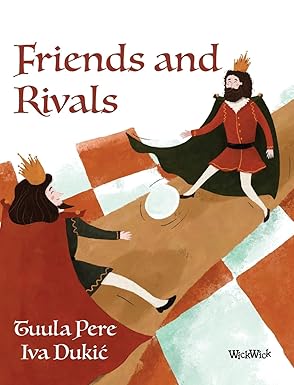
In Friends and Rivals, Tuula Pere delves into the complex dynamics of sibling rivalry through a captivating children’s narrative. Set in a kingdom where two princes, once inseparable friends, become adversaries in their quest for the throne, the story unfolds a poignant tale of lost familial bonds. The novel charts the journey of one brother’s ascendancy to power and the subsequent imprisonment of the other, culminating decades later in a heartwarming turn of events orchestrated by a young boy.
The book, embellished with the evocative illustrations of Iva Dukić, stands out for its compelling imagery and a distinct Old World allure. Dukić’s use of a limited color palette skillfully draws attention to the characters’ expressive faces and the setting’s unique charm. Otto, the prince confined to obscurity, emerges as a character that resonates deeply with readers. At the same time, Victor, his ruling brother, embodies the realization that wealth and power are no substitutes for happiness—a crucial message for young minds.
Pere and Dukić’s collaboration results in a book that is a delightful read and a source of valuable life lessons. Friends and Rivals transcends mere storytelling by weaving in a fundamental lesson about the power of forgiveness and reconciliation. Pere’s narrative, through the actions of a kind-hearted child, not only reunites the estranged brothers but also rekindles their lost friendship. This aspect of the tale, along with the gentle infusion of magical elements, makes the book particularly appealing to children. Meanwhile, educators and parents will find ample material within the story for meaningful discussions with young readers.
Pages: 42 | ISBN : 9528200133
Literary Titan Gold Book Award – Nonfiction

The Literary Titan Book Award recognizes outstanding nonfiction books that demonstrate exceptional quality in writing, research, and presentation. This award is dedicated to authors who excel in creating informative, enlightening, and engaging works that offer valuable insights. Recipients of this award are commended for their ability to transform complex topics into accessible and compelling narratives that captivate readers and enhance our understanding.
Award Recipients













Visit the Literary Titan Book Awards page to see award information.
Adopting a Learner-Centric Approach

ELEARNING GOLD shows readers the direction that education is taking and why they need to embrace eLearning and not just “live with it” because it is the future and is evolving every day. Why was this an important book for you to write?
Writing ELEARNING GOLD was crucial for me because it encapsulated my journey and learnings from over two decades in the eLearning field. When I began, there were no roadmaps for online education. My experience pioneering virtual learning schools, despite facing standards designed for traditional classrooms, highlighted elearning’s immense potential and challenges. This book is a culmination of those experiences aimed at empowering educators to navigate and excel in the evolving landscape of online education, which has become even more critical in the post-pandemic world.
What were some ideas that were important for you to share in this book?
I wanted to convey the significance of adopting a learner-centric approach, the power of engaging content, and the strategic selection and use of technology in elearning. Sharing insights on navigating regulatory landscapes, effectively leveraging the features in Learning Management Systems, and fostering a culture of continuous innovation was paramount. It was essential for me to provide educators with a toolbox they could use regardless of their familiarity with technology and guide them through some of the best practices for developing and managing successful virtual learning environments.
What is a common misconception you feel people have about eLearning?
A common misconception is that elearning is merely a temporary or lesser substitute for traditional education. From my early days as a young teacher to launching virtual schools, I’ve seen firsthand the transformative potential of elearning. It’s not just an alternative; it’s a complementary mode of education that offers flexibility, accessibility, and personalized learning opportunities that traditional classrooms cannot always provide.
Where do you see the future of eLearning going, and how do you think the next generation will adapt to this technology?
The future of elearning is incredibly bright, with advancements in AI, VR, and AR making learning more immersive and personalized. My experiences, from pioneering in the early 2000s to observing the rapid deployment during the pandemic, have shown me the resilience and adaptability of both educators and learners. I believe the next generation will not only adapt but thrive, using these technologies to create innovative learning pathways that were unimaginable when I first started. This evolution inspires me to continue contributing to the field, ensuring professional learning is available to educators to help them create successful and connected virtual learning communities.
Author links: GoodReads | Twitter | Facebook | Website Book | Website Author
In Annette Levesque’s new guide Elearning Gold: The Ultimate Guide for Leaders, she facilitates leaders and educators as they navigate the challenging world of distance education and training programs. Levesque, an experienced leader and education expert, offers practical insights and strategies to help you catapult your learning programs to the next level. From building and launching a virtual learning environment to creating effective policies and strategies for operational excellence, this guide is your key to success.
The Elearning Gold roadmap takes its readers on a journey of knowledge, focusing on:
*Virtual Learning Success Criteria
*Digital Age Learning Models, Including Blended Learning
*How to Increase Course Completion Rates and Learner Engagement
*Building Your Learning Community
*What Leaders Need to Know About Learning Management Systems
*Managing Academic Misconduct in your Virtual Learning Program
*How to Plan Your Virtual World Launch or Update
*The Future of AI and Chatbots in Education
Relinquish what you thought you knew as an education expert or trainer and embrace this new ideology on how to reach all learners—especially online. These strategies and techniques will help you create elearning systems and content that meet the needs of learners today and also prepares them for tomorrow.



 LITERARY TITAN