Blog Archives
Little Ships: A Novel


Little Ships, by Sandra J. Scofield, offers a poignant exploration of grief, loss, and the delicate process of rediscovering joy in life. This novel is artfully composed, treating its characters with a tender yet determined touch that echoes Lynne Bryant’s The Mother Gene. Set in Oregon, the narrative centers on the Beckers and the Sunderssons, two families linked by the marriage of Nick Becker and Karin Sundersson. Nick, Karin, and their daughters, Juni and Tilde, form a close-knit unit. However, Karin’s sudden death uproots them to the Becker household—home to Nick’s parents, Eleanor and Walter, his sister Alison, and her daughter Fiona.
The story unfolds through their adjustments and accommodations, from reallocating space in the house to managing personal keepsakes like Karin’s jewelry and planning the girls’ weekends with their grandmother Helve. Eleanor, at 59, anticipates retirement but instead finds herself at the center of her family’s needs, embodying a quiet determination to nurture her granddaughters and support her son. Her efforts to reconcile with past resentments and cope with emerging family secrets add depth to her character and the family dynamics. Scofield’s narrative style combines clarity with evocative brevity, effectively painting vivid scenes and emotions without overwrought descriptions. The early chapters, laden with pathos, gradually transition to reveal the complex relationships within the family, offering insights into how everyday life can both challenge and heal those in mourning.
Little Ships stands out for its balanced portrayal of tragedy and the essential role of a supportive family network in fostering hope and resilience. This novel skillfully captures the myriad ways life’s everyday flow can both erode and soothe the sharp edges of grief.
Pages: 339 | ASIN : B0CT47B3K1

The Power of PR Parenting

Marjie Hadad’s book, The Power of PR Parenting, ingeniously applies the tactics of public relations to the challenging art of parenting. Drawing from her extensive experience in the PR field, Hadad equips parents with tools to handle crises, encourage confidence, and prepare their children for the future using strategies typically reserved for managing media and public perception. This innovative approach is grounded in the belief that parenting, much like PR, often involves managing, mentoring, and motivating with a strategic mindset.
Hadad’s work is refreshingly unique in its perspective, blending the structured, strategy-driven world of PR with the intuitive, often chaotic realm of parenting. The idea that public relations skills can effectively manage family dynamics and children’s development is both intriguing and compelling. Through detailed anecdotes and accessible writing, she brings PR principles to life, making them relevant to daily parenting scenarios, from crisis management to building self-reliance in children.
One of the most interesting aspects is its novel use of public relations strategies to navigate and mitigate family crises, akin to managing brand or corporate crises. This approach advocates for structured communication and strategic problem-solving, typically employed in PR, to create a calm and controlled environment that promotes resilience in children. The application of these professional techniques to personal family dynamics is innovative and offers parents new tools for fostering understanding and cooperation.
Hadad doesn’t just theorize but illustrates how each strategy can be implemented, providing a practical roadmap for parents. This hands-on approach, combined with her conversational tone, makes the book not only informative but also engaging.
The Power of PR Parenting is a must-read for parents looking for a new approach to raising confident and resilient children. Hadad’s innovative take offers a valuable resource for any parent seeking to enhance their parenting toolkit with fresh, proven methods from the world of public relations.
Pages: 222 | ASIN : B0BVGR5X25
Becoming Forever Families
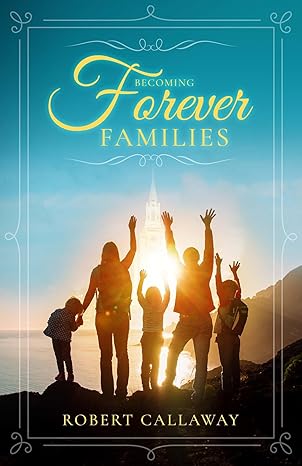

Becoming Forever Families, by Robert Callaway, is a compelling and emotive exploration of faith, resilience, and the bonds of family, set against the backdrop of Latter-day Saint beliefs. Callaway adeptly weaves a narrative that is both personal and universal, delving deep into the lives of the Wilkinson family as they navigate the complexities of modern life while clinging steadfastly to their faith.
At the heart of this narrative is Sarah Wilkinson’s journey, a poignant portrayal of a mother’s strength and vulnerability. Her story of finding love with Wayne Spencer and their subsequent decision to marry in the LDS temple is told with a sincerity that resonates with anyone who has experienced love later in life. The author’s depiction of their spiritual connection and shared values adds depth to their relationship, making it a central pillar of the story.
The character of Ethan Wilkinson, who grapples with Asperger’s Syndrome, is particularly noteworthy. His growth throughout the story is both inspiring and heartening, illustrating the power of familial support and personal determination. The way Callaway addresses Ethan’s challenges and achievements is sensitive yet realistic, avoiding the pitfalls of oversimplification.
Another compelling aspect of the book is its exploration of mortality through the character of David, Sarah’s father. His declining health and eventual passing are handled with a delicate balance of realism and faith. The impact of his life and death on his family poignantly underscores the novel’s central theme of eternal families in the LDS faith. While the book is deeply rooted in Latter-day Saint theology, its themes of love, loss, and familial bonds are universal. However, readers not familiar with LDS beliefs might find some theological discussions and specific practices less relatable. Despite this, the emotional core of the story remains accessible. Callaway’s narrative style is straightforward and heartfelt. His approach to storytelling is unpretentious, which makes the book a comforting read. The dialogues, I feel, sometimes read as a bit didactic, especially when expounding on religious beliefs, but they also provide valuable insights into the LDS perspective.
Becoming Forever Families is a touching and thought-provoking novel that offers readers both within and outside the Latter-day Saint community a window into the joys and trials of adhering to one’s faith in the contemporary world. It’s a testament to the enduring power of family and faith, no matter the challenges life presents.
Pages: 231 | ASIN : B0CHD8RD19
You Can Find Humor Everywhere

In Queen Molly and the Summer Palace, a German Shepherd and her owner venture northward to enjoy the cooler temperatures and embark on new summer adventures. Where did the idea for this story come from?
I have lived part of the year in PA and part of the year in FL for several years; a reverse snowbird, I guess. Of course, that means two road trips a year with my various dogs. Two years ago, I made the trip with Molly for the first time, and her responses to all the new experiences fascinated me. I thought a book written from her perspective might be kind of fun to write and read.
Is there anything from your own life that you put into Molly’s adventures?
All of Molly’s adventures have a basis in reality. I guess I am more observant than I am creative.
I enjoyed the humor woven throughout your book. How important is it for you to create lighthearted moments in your children’s books?
I have come to the conclusion that my greatest contribution to this world, behind my wonderful daughters, is adding a little humor to it. So many people seem to be taking everything so, so seriously! I believe humor helps put everything in perspective. I have always been able to laugh at myself and, fortunately, have helped my kids adopt that attitude, and they’re happier for it. If I can let other kids know that the world can be a fun place and you can find humor everywhere if you look for it, that’s a good thing.
Can readers look forward to a third book in the Molly series? If so, when will it be available?
Yes, I will be writing one more book in this series. When Molly and I returned from the Winter Palace, Meghan was pregnant. Readers will be able to see that pregnancy through Molly’s eyes. As to timing, I hope for late Spring. I need to scrape up enough money to pay for my Illustrator! I am definitely not in this for the money.
Author Links: Amazon | Twitter
Emotional Isolation Within Families

Running As Fast As I Can follows a teenage boy living in an abusive home who runs away trying to find someplace safe, and people he can call family. What was the inspiration for the setup of your story?
Obviously, all good fiction starts in some reality. When I founded Good Samaritan Home 22 years ago, my intent was to help men and women coming back from prison restart their lives. But the one constant theme I heard was they all came from broken and often abusive homes.
Although not as intense, my experiences growing up were similar to theirs. I think Daniel said it best, “I shared space with people called family. We had the same address, ate at the same table, even had the same last name, but we were strangers. We all lived alone together.” I believe this emotional isolation within families can be as destructive as any physical abuse—and I wrote Daniel’s story through that lens. That’s why I call this “everyone’s story.” I believe there are many people who come from the same haunted background as me. We just hide it better than my Good Samaritan Home residents.
The bottom line is everyone is looking for a second chance. It was that theme that I tried to convey through all the characters in my book.
Your novel brings the characters to life, all the pain and hurt, as well as the moments of joy. What was your writing process to ensure you captured the essence of the characters?
I started with a very rough outline 10 years ago, but the actual story evolved and grew as I wrote it. Or more accurately, as the characters revealed themselves. Initially, the primary characters such as Daniel, Elizabeth, and Kate, were two-dimensional, flat, without any real personality. Beta readers couldn’t feel them, and therefore, they couldn’t identify with them. Part of the problem was my background. My academic training, and especially my years as a journalist, taught me to present the facts—who, what, when, where, and how. Never introduce emotion into a story. That’s fine for a research paper, but it doesn’t read well as a novel. Finally, my editor suggested—more like demanded—that I allow my emotions to come out in the characters—to show them as real people who struggled with insecurities, doubts, and fears through their actions. That made a significant difference in the emotional intensity of the story. But it was when I applied that same approach to all the supporting characters, like Doc Samuels, Ruthie, Sister Rose, James and Elijah, Daniel’s three kids, and especially Charles, that’s when the story really came alive. But that was no easy process. It took seven years and more than twenty drafts, adding 50,000 words to the manuscript, I might add.
What were some themes that were important for you to explore in this book?
Initially, it was a story of a boy growing up in a dysfunctional family, but that soon evolved into sexual abuse as the church sex scandals came to light. The common thread seemed to be vulnerable kids in broken families looking for adult attention. They were easy prey—just like Daniel. But what we never knew was what happened to these kids afterward. How do they function normally as adults when they have been so damaged as children? I call it “broken from birth.”
It’s like Somerset Maugham’s character Philip Carey in Of Human Bondage. He was born with a club foot, and he spent the rest of his life struggling to be normal—physically and emotionally. And that was Daniel. He was born with an emotional club foot, from a mother and father who ignored him and a pastor who abused him. He limped through the rest of his life, and the insecurities, and especially the false sense of shame and guilt that always accompanies child sexual abuse, affected every relationship, every choice he made.
That internal struggle led Daniel into a world he never imagined possible, like destructive relationships, depression, poverty, homelessness, and addiction. However, the key theme that arises out of all this is second chances. But not some simplistic just-say-no, come-to-Jesus solution that seems made for television. Real life is messy, with a lot of mistakes, and lots of do-overs. Too many of us have started so far behind, and with so few tools, we don’t know how to start over. All we know to do is to go back to the same destructive relationships, making the same wrong choices over and over. But the key theme here is that we keep trying, keep starting over, and never quit running.
That said, the one subtle theme that emerged was that our salvation often comes from unexpected sources. All the people who helped Daniel learn to walk normally were broken in their own way—like Doc Samuels, Elijah, James, Sunshine and Mellow, even Father Webber. And the one person who was most instrumental in helping Daniel through his greatest crisis was Charles. Daniel said it best. “I had degrees in both psychology and theology, but this guy who could barely read, and who’s been in prison all his life, knew more about forgiveness than me.” I remind myself of this periodically with the men and women I deal with at Good Samaritan Home. No matter how damaged they may be, no matter what crime they may have committed, they are still part of God’s fallen creation, and I can still learn something from them. Maybe that’s why I sometimes tell people I feel safer in prison with these guys than I ever did in a church board meeting when I was a pastor. In prison, everyone admits they are a sinner. In church, we just hide it better.
What is the next book you’re working on, and when can your fans expect it out?
It’s called Requiem. It means a Mass of remembrance for the dead. In Running As Fast As I Can, there is a 30-year gap between the last chapter and the epilogue. Requiem is the story about what happens to all the remaining characters. Spoiler alert—a main character dies tragically at the end of Running. How do the remaining characters adapt—or not adapt—to that death? But this time I am looking at bringing in a political thriller element as Daniel finds evidence that this death may not have been accidental. And that leads him all the way to Washington for his answers. But I still want to maintain the same intense emotional storyline of Running As Fast As I Can. This time, however, I don’t plan on spending ten years writing it. I hope to have it completed in a year.
Author Links: Goodreads | Twitter | TikTok | Facebook | Instagram | Website | Good Samaritan Home | Amazon
1st PLACE FIREBIRD BOOK AWARDS 2024
FINALIST FEATHERED QUILL BOOK AWARDS 2024
FINALIST AMERICAN WRITING AWARDS INSPIRATIONAL FICTION 2024
Growing up in the mill slums surrounding Pittsburgh, all that Daniel Robinson ever wanted was a family who loved him. Instead, he was ignored by a mother who hid in her room praying to an unseen God, and a drunk for a father who used everyone as a punching bag.
He thought he found love in college with Elizabeth. But she dropped him as soon as someone “with better prospects” came along. Daniel spends the next ten years wandering the country throughout the turbulent 1960’s, desperate to find someone who didn’t care about money and would love him as he is. While traveling he gets caught up in the hippie drug invasion in San Francisco, racial violence in Cleveland and Detroit, and especially a deadly anti-war protest at Kent State.
Ultimately, he does find that love in Ruthie, a salt-of-the earth Ohio farm girl and her family who welcome him as one of their own. Marriage is expected—until Elizabeth resurfaces and seduces Daniel with false promises of love.
Daniel loses Ruthie, his job, and nearly loses his mind over what he has done to Ruthie. He again goes on the road, but he is only going through the motions—what he calls “a dead man walking.” Daniel loses hope he will ever be happy—until he meets Kate Fitzgerald, who was running from her own demons. Together they get a second chance at love and the family they both want.
Daniel is now determined, with Kate’s love and support, that his new family will be different than the abusive home he came from, but can he ever run far enough to leave behind his haunted past? Because of his experiences with street people, he is offered a job helping men coming from prison. When asked to find housing for Charles Vickers, a black man who spent twenty years in prison for a rape Daniel is convinced he never committed, he and Kate open their own home to him. This enrages the community, especially when a local girl disappears. Violence erupts—with Daniel as the focus of their rage. Should he stay and fight for Charles—and put his family at risk, or run away again?
Daniel’s story, with its harrowing social themes, conveyed through an intense personal odyssey, bridges the gap between literary and commercial fiction. It would be enjoyed by readers who were moved by the heartbreaking, yet hopeful narratives of Forrest Gump and Where the Crawdads Sing. RUNNING AS FAST AS I CAN vividly portrays a traumatic period in our history, while grappling with intense emotional and social issues we still face today.
It is an epic journey for love and forgiveness. Most important, it is a page-turner story that readers will identify with because it is, on some level, everyone’s story.
A Growth Mindset Is the Key

I Love How introduces children and their caregivers to the growth mindset praise principle, and how this method benefits and helps children to thrive. Why was this an important topic to write on?
I Love How is the first book in a collection. It was important for this book to be the first as it lays the foundation for a growth mindset, which is a cornerstone for the subsequent books. A growth mindset is the key to unlocking the potential to learn and master the skills presented in the rest of the collection. For benefits from the concepts in my books to be optimized, the parents will also need to be involved and model the behavior. A growth mindset empowers parents and children to embrace the idea that they can continually learn, evolve, and enhance their lives, influencing how they perceive and interact with the world.
How much research did you undertake for this book, and how much time did it take to put it all together?
Well, that depends on what you mean by research and where you draw the starting line. I spent over 6 years conducting a study on the relationships between grit, success, and retention. Part of that was reviewing the existing literature on those three variables. My Ph.D. specialization is in performance psychology, and my M.Ed is in counseling. I have also spent over 15 years as a therapist, behavioral specialist, school counselor, and coach. So I have been studying, researching, and putting these concepts into practice for close to two decades.
I Love How is the first book in a collection that originated from a training/lecture of mine on psychological skills to help adults thrive. These skills are a collection of well-researched concepts that when practiced regularly, have potent benefits. I adapted some of the key concepts of the training into a collection of short baby books. The books are designed to appeal to very young children and to make parents aware of the benefits of incorporating these concepts into their lives.
So the short answer is the research and preparation were done over a long period and synthesized into a lecture. The books themselves were completed pretty quickly because I already had the concepts ironed out in my head.
As for the design and publishing, that was also pretty fast. My wife is very quick and savvy with design software. She was able to help generate the design that I was going for as well as teach me how to navigate the software. I have also been through the very rigorous process of publishing peer-reviewed academic research which made this process seem much less intimidating. Once I put an idea into action I can usually complete the manuscript and cover files in about a week. I have young children myself so I typically work on projects in the evening after everyone goes to bed.
What is one thing that you hope readers take away from I Love How?
My hope is for all of my books to be a valuable resource for both parents and children. While the formats of these books are tailored towards babies, the underlying concepts hold significant benefits for adults. In I Love How, I invite readers to recognize that abilities and intelligence are not fixed attributes; rather, they can be cultivated and enhanced over time through dedicated effort, continuous learning, and perseverance. I hope that readers grasp the impact that fostering a growth mindset can have on their child’s learning journey, realizing the compounding effect it can bring to their overall development. On a more simple level, the books are short and contain images of other young children, this was intentional to appeal to both the reader and the baby. I hope this makes my books a favorite go-to at storytime.
What topic will the next book in that series cover, and when will it be published?
Since the release of I Love How, three additional books in the Growing Minds collection have been published. The second book is titled I’m Grateful, which is about establishing a regular practice of gratitude. The third book is titled Another Great Day, which is about the practice of noticing and savoring the positive things in one’s life. The fourth book is called Reframe, and it is about the skill of taking potential negative situations and shifting one’s perspective into a positive and constructive outlook.
Author Links: Goodreads | Instagram | TikTok | Amazon
The visuals in this book have been intentionally designed to appeal to very young children but it can be enjoyed by older children as well.
About the Author
Dr. Isaiah Varisano is a highly skilled educator, therapist, coach, athlete, and parent. With over 15 years of experience working with thousands of children and students, as well as hundreds of collegiate and professional athletes, Dr. Varisano brings his expertise in performance psychology to help parents and caregivers establish healthy mindsets and communication styles to support children’s thriving development.
Queen Molly and the Summer Palace

Queen Molly and the Summer Palace, by Gary John, is a charming narrative told through the eyes of a spirited German Shepherd named Queen Molly. Residing in her beloved Winter Palace in Florida, she is doted upon by her human companions, Gary and Megan. The story paints a vivid picture of her daily escapades – from engaging in conversations with neighborhood pets to her enthusiastic squirrel chases, and even taking Gary on walks, which adds a humorous twist to the pet-owner relationship.
As the setting shifts with an unexpected change in weather, Queen Molly embarks on a journey of discovery in a new environment. The story adeptly captures her adventures and new friendships, highlighting her adaptability and zest for life. The inclusion of a special frozen treat adds a delightful touch to her summer escapades. Told predominantly from Molly’s perspective, the book employs a playful tone, especially in how Molly perceives Gary as “her human,” humorously reversing the typical pet-owner dynamic. This perspective is not only engaging but also sparks several laugh-out-loud moments, contributing to the book’s overall charm. Samantha Deir’s illustrations complement the narrative beautifully, adding vibrancy and a sense of warmth that resonates with the story’s joyful essence. The conclusion of the story is satisfying, neatly wrapping up the current adventure while also hinting at future escapades. This leaves readers anticipating more delightful stories about Queen Molly.
Appropriate for a wide range of readers, this book stands out for its storytelling and humor. It is an excellent choice for shared reading experiences, particularly during storytime. Queen Molly and the Summer Palace is a captivating and heartwarming story that promises to be a hit with families and readers who appreciate a light-hearted, animal-centric narrative.
Pages: 36 | ASIN : B0CPMTMHHX
To Give the Victim a Voice

Dear Gosei: A young man confronting his past follows a young man who was sexually abused as a teenager as he goes on a journey of self-discovery and a search for answers from those who did nothing to protect him. What was the inspiration for the setup of your story?
The novel is based on a true fact that was revealed to me by accident, and I had to keep it a secret. I couldn’t comfort the victim, who was an acquaintance of mine so I grew a bit obsessed with the event. Also, it was during the worst part of Covid, and I spent many hours alone at home in isolation. I ended up writing about this to calm my anxiety. I wrote the story as a way to process my thoughts and feelings about the incident. It was my way of trying to make sense of what had happened and to give the victim a voice that they couldn’t give themselves. I hope my novel will be a source of comfort for those who have been through similar experiences.
Was there anything from your own life that you put into the characters in your novel?
There is no direct reference in my debut novel to anything that happened in my life but definitely, I share many points of view with the protagonist. Family dynamics, the college years away from home, the teenage dreams to become an independent, dependable person, the path to self-discovery are also aspects with which I identify myself. Some of the characters in the novel are composites of my past and present, and their stories come from my own life experiences.
What were some themes that were important for you to explore in this book?
In order to properly describe the harrowing experience of suffering sexual abuse I read a lot about it, trying always to understand why it happens and what are the consequences. I found, to my astonishment, that sexual abuse is not a thing of the past. On the contrary, it is an ever-present damage in modern societies, affecting all over the world. It is a heartbreaking reality that has serious consequences for those who suffer it. We must take urgent steps to prevent and combat it and to provide the necessary support to survivors. This is the only way to make our society a safer place for all. It is also a delicate issue, particularly when it happens among families, and there is no real magic solution to it. Many sexual abuse crimes go unreported precisely for that reason because it can destroy the future of the victim, the abuser, and the entire family.
I read a lot, too, about Asian immigration to the USA during the last century, particularly Japanese immigration. That is how I learned about WWII internment camps for Japanese families on the West Coast, such as Manzanar in California. It was so shocking to me that I decided to put it in the story. It was a powerful reminder of the racism and injustice that was faced by Japanese-Americans during the war, and of the strength and courage of those who survived the camps. I wanted to include it to show that even in the darkest of times, we can still find hope and resilience.
What is the next book you are working on, and when will it be available?
I am working on the prequel which will give a perspective on the traumatic events happening in DEAR GOSEI. It goes back four generations of the Forrester Hattori family. The prequel will explore the family’s history and how they came to be where they are today. It will also provide more insight into the characters and their motivations. Finally, it will provide the necessary context to understand DEAR GOSEI. It is at a very early stage, so I can’t say when it will be finished.
Author Links: GoodReads | Facebook | Instagram | Website | Amazon
After a tragic teenage trauma, a young man fights to respect himself and embarks on a journey of self-discovery, facing his family to get the answers he has been searching for for the last 12 years.
John, a good-looking, and athletic 14-year-old from an affluent family in the suburbs of Los Angeles, is a victim of sexual abuse at the hands of his uncle. Family interests will prevail above all else. The mother decides to keep the incident secret to avoid scandal and the bad reputation of the family. The boy’s life is forever changed by this tragic experience which destroys his hopes of becoming a competitive swimmer and leaves him feeling helpless and alone.
Over time, however, thanks to his resilient and tenacious spirit, he overcomes his obstacles and returns to his former academic and athletic success. John and his girlfriend Val, who seem to have a rock-solid relationship, become the most popular couple at school. In reality, he doesn’t live like his friends because of his tragic past, insecurity, sexual confusion, and toxic family. Although everything appears normal, neither the family behaves naturally nor does John shake off the weight of his past.
His uncle considers John his favorite nephew but ignores the harm inflicted on the boy. His mother wishes to keep the secret. His father and brother, devoutly religious, make him feel like an outsider at all times, dictating family life with an iron fist and a handful of obsolete rules.
To reclaim his self-respect, he will confront his past, demanding explanations from his uncle and mother, each guilty of having a great impact on his harrowing youth. In this journey of self-discovery, he will explore his priorities, career, friendships, and dysfunctional family. John knows that he must face the future head-on to be at peace with himself.
DEAR GOSEI is the debut novel of Jorge Bosch, born and educated in Barcelona, Spain, now a resident of Los Angeles, California. The book hopes to captivate the reader with its well-grounded and vividly portrayed characters, and participants in a story that will keep you interested until the end. The story takes place at two points in the protagonist’s life: firstly when John is molested as a young boy and then again when he finally decides to take charge of his life and confront his family 12 years later. Two central themes steer the narrative: sexual abuse, as real as life itself, and a controversial subject treated with sensitivity and empathy, and John’s personal development, as he seeks to deal with the truth about what happened to him. He struggles to find his place in the world by accepting his homosexuality and the person he loves. DEAR GOSEI, a romantic drama with touches of a psychological novel, fast-paced and minimalist, is set in the capital of Southern California and takes a critical view of the traditional and old-fashioned family it portrays.



 LITERARY TITAN