Blog Archives
Moral Compromise
Rhino follows a research scientist who discovers her father has terminal cancer and is entangled with poachers and smugglers, leaving her in a race against time to find a way out for him and a cure. What was the inspiration for the setup of your story?
The inspiration for the setup came from wanting to explore the collision of two very different worlds: the clinical, evidence-based world of modern medicine and the desperate, high-stakes world of the international wildlife trade. I was fascinated by the question of what could push a fundamentally good, logical person to cross a line they never thought they would.
I made Linh a research scientist for a specific reason. Her entire life is governed by data, ethics, and reason. By putting her in a situation where science and medicine seem to be failing the person she loves most—her father, an oncologist, which adds a layer of tragic irony—her foundation is shattered. This is what opens the door for a desperate, irrational choice.
The rhino horn itself is a powerful symbol. It represents this clash between ancient belief and modern conservation, between a daughter’s desperate hope and a global ecological crisis. It’s not just a simple illegal act; it’s a moral labyrinth. For Linh to even consider it, she has to betray her own scientific principles and become entangled with the very darkness that characters like Inspector Le and Nguyen Vu are fighting.
So, the setup—the scientist, the dying oncologist father, and the criminal underworld—was designed to create the ultimate moral pressure cooker. It’s a story born from the question: How far does love compel us to go, and can we find our way back once we’ve
crossed into the dark?
Linh is a woman with strength and determination. What do you think makes her a valuable and worthy heroine?
Thank you, I’m glad her strength and determination come through. For me, what makes Linh a valuable and worthy heroine isn’t that she’s perfect or always makes the right choice, but precisely because she doesn’t.
Her heroism is rooted in something incredibly human and relatable: the fierce, unconditional love for a parent. She isn’t a trained operative or a hardened detective; she’s a scientist thrown into a world she doesn’t understand, armed only with her intelligence and a desperate need to save her father. Her initial strength isn’t about physical power, but about her refusal to accept defeat, even when all logical paths are closed to her. But what truly makes her worthy, in my eyes, is her fallibility. She makes terrible, morally compromising decisions. She lies, she steals, and she gets involved with a ruthless criminal. This is where her real journey begins. A perfect heroine doesn’t have to grow. Linh is forced to confront the darkest parts of herself and the devastating consequences of her choices.
Her true strength isn’t just the determination to save her father at any cost, but the courage to face what she has done and actively work toward redemption. By the end of the novel, when she joins Nguyen Vu’s conservation efforts, she isn’t just running from her past; she’s trying to build a better future, both for herself and for the cause she once harmed.
So, Linh is a heroine for our complex times. She’s not an idealized figure on a pedestal. She’s a real person who gets lost in the dark and has to fight her way back to the light. Her worthiness comes from that struggle—from her capacity for both terrible mistakes
and profound redemption.
What were some themes that were important for you to explore in this book?
That’s a great question, as the themes were really the foundation of the story. There were a few that were very important for me to explore.
First and foremost is the theme of moral compromise born from desperation. I wanted to put a good person, Linh, in an impossible situation. She’s a scientist, someone who believes in logic and ethics, but she’s faced with the absolute, emotional terror of losing her father. The central question I wanted to explore was: How far will love push you past your own moral boundaries? It’s about that slippery slope—how one desperate decision can lead you into a world of darkness you never imagined.
Building on that, another crucial theme is systemic corruption. The antagonist isn’t just the ruthless gangster, Khanh Pham. He’s a symptom of a much larger disease. The corruption infects the hospital through Dr. Duc, it threatens law enforcement, and as we eventually learn with Wong Min, it reaches the highest levels of international power. It was important for me to show that this kind of evil isn’t just the work of a few bad men; it’s a network that thrives in the shadows of our institutions, making it incredibly difficult for individuals like Inspector Le and Nguyen Vu to fight.
Finally, despite all the darkness, a key theme is the possibility of redemption. Linh’s journey doesn’t end when the main conflict is resolved. She has to live with her choices. Her decision to join the conservation efforts is her way of atoning, of trying to heal some of the damage she contributed to. It suggests that even when we make terrible mistakes, the path forward isn’t about erasing the past, but about using our experiences to build a better future. It’s a difficult and painful hope, but it’s hope nonetheless.
What is the next book that you are working on, and when can your fans expect it to be out?
I’m so glad you asked! It’s an incredibly exciting time, and I have a lot of new stories I can’t wait to share with readers across different age groups.
For my younger readers, I’m thrilled to announce that my publisher, Fabled and Bound, is releasing my new Zoo Collection. The first book, Bat Rocket Boogie, which is for ages 6-8, will be out in the very near future. And that’s just the beginning! We’re expanding that universe with two spin-off series starring more anthropomorphic animals. The first is Forest Friends Mysteries for ages 6-9, which we hope to release around September or October of this year. Following that will be Myths & Legends, a historical fiction
series for kids 8 and up.
And for my adult readers, I’m so excited to be working on a historical fiction novel, tentatively titled The Women of Ravensbrück. It’s set to be published in the UK by Legend Press in the spring of 2026, so there is definitely a lot coming down the pipe!
People sometimes ask how I’m able to work on so many different projects. As many of my readers know, I’m a retired ICU RN, and I live with PTSD from my time on the front lines. For me, writing every day isn’t just a job; it’s a form of therapy. It’s been profoundly healing and has become a vital part of my life. It allows me to build new worlds and channel my experiences into stories, and I’m so grateful to be able to share them.
So, all these stories are brought to you by a very busy, very proud, and very left-handed Canadian!”
Author Links: GoodReads | X (Twitter) | Facebook | Website | Amazon
Her search ensnares her in a bloody web of poachers, smugglers, and killers who traffic in extinction. As bodies pile up and evidence vanishes, a relentless inspector and a passionate conservationist close in from opposite sides.
Stalked by shadowy figures and haunted by impossible choices, Linh discovers a terrifying truth: saving her father may cost her soul—or both their lives.
In this high-stakes game where everyone is both hunter and hunted, survival demands crossing lines that can never be uncrossed.
Freedom Highway

Priscilla Speaks follows a young girl living in poverty who is cast out of her home at sixteen, leaving her to set out on the Appalachian Trail, where she meets diverse people who help her learn about life and relationships along the way. What was the inspiration for the setup of your story?
The answer is broader than you might have anticipated. I have thru-hiked the Appalachian Trail four times, and have found each journey to be life-changing or life-affirming. As a consequence, it is an element in much (although not all) of my fiction. I find the trail to be regenerative. Most who successfully thru-hike it or even hike long sections of it feel the same. It is the total immersion that does it, having one’s ego worn down by sweat and hunger and bugs until the real you is exposed. A long weekend on the trail won’t quite get one there.
Relating to the Speaks Saga as a whole, and Priscilla in particular for the moment, during Hike 3 in 2018 I hiked into a town for resupply, a town brought closer by a trail relocation and a town I’d never been to before, in an area where rednecks were known to harass hikers, and where I’ve personally witnessed hillbillies doing some pretty bizarre things. I was struck by the despair of the place before I’d even entered the town, considering the drug paraphernalia I spotted littering the curb. Once in the town, I encountered people almost unintelligible in their speech who volunteered the most offensive racist comments to a total stranger, and many of whom sported the missing teeth and cleft lips of heavy meth addiction. I couldn’t hike out of that town quickly enough.
I pondered as I continued my hike, wondering how one could wrest oneself out of that environment, then realized that the Appalachian Trail, an actual freedom highway, lay right at their doorstep. I conceived the first novel, Timewall Speaks, within the next hundred miles, and have used the Appalachian Trail as a means of escape for every character since.
Priscilla is born into a world of poverty, addiction, and abuse, but refuses to let that define who she is or who she will become. What was your process to bring her character to life?
I knew from the beginning that Priscilla might be the most complicated character in the Saga, and I had to reimagine her a few times before I felt I’d gotten her right. The epiphany came as I was writing Chapter Two, the fight scene, her brother injured, and I knew right then who I wanted Priscilla to be. I raced back, did a lot of re-writing, made Pris autistic and fearless, had her cut off her braid (probably spoilers in this), and evolved her into an outsider in her own family. Unknown to Pris, she is more like her mother at that age than she would ever want to accept, strong, unyielding, fierce, and in her own emotionally-numbed way, proud.
What were some themes that were important for you to explore in this book?
As always, that transformation from dysfunctional to emotional health, and that people are not defined by their circumstances, but defined by themselves. I wanted to demonstrate that it is possible to escape, despite the burdens that Pris carried. I have known people in similar circumstances who have rescued themselves, so Priscilla’s journey is not a stretch.
Will this series continue in another book, or are you working on a different story?
There will be one more novel in the Saga, The Family Speaks, in which a story arc covering fifty years will be brought full circle. I intended to end it there, although I have been encouraged by many to expand the Saga to incorporate some of the secondary characters. That might happen in the future, novels in a Speaks Universe if you will, but immediately after The Family Speaks (and a fifth Appalachian Trail thru-hike), I will begin work on some unrelated novels that have been nagging me for a few years now.
Author Links: Goodreads | Website | Amazon
In Book Four of The Speaks Saga, Blaize’s second daughter, Priscilla, born during the worst of her mother’s addiction, begins at an early age to count the years until she can escape the drudgery and boredom of her dismal, impoverished life, all the while watching as her older siblings leave one by one.
Cast out on her own at the age of sixteen, Priscilla ventures forth in search of an uncertain future while grappling with her sexuality and the phenomenal capacity of her mind. Using the Appalachian Trail as a means of escape, distracted from her obsessive nature by the day-to-day trials of the wilderness, her journey thrusts her into the company of diverse people who steer her toward a fuller understanding of the complexities of life and relationships. Through confounding emotions, heartache, and moments of grace, she is forced to confront mortality, love, and loss, all pointing her toward a staggering awareness of space and time.
With deliberate cunning, Priscilla does battle on her own terms, calling forth the hardened legacy of her family as she fights against the abuses she encounters in society.
Parental Love and Support

Orphans of the Living tells the story of a family’s complicated history spanning from 1920s Mississippi through decades of poverty and social change. What inspired you to write this novel?
The novel is based on my mother’s own family, of which I knew little. But things in the past have a habit of invading us today, and the more I researched, the more I realized my mother’s lived experiences influenced my life, and my children’s lives, in ways I had not understood. Yes, this is a novel, but the skeleton, the bones of the story, are real. It is a hell of a story, and I wanted to dig deeper into it.
Can you share with us a little about the research that went into putting this book together?
I really had three sources. Here’s how they came into play, for instance, in my grandfather’s sojourn in Mexico. I had the bits and pieces my mother gave to me in her life, between bouts of addiction and mental illness, such as “My father went to Mexico to grow bananas.” I explored the vast trove of information and connection at Ancestry.com and Newspapers.com, such as records of my grandfather’s trip to San Francisco, where he took a steamer to Mexico, and a manifest for a ship that brought him and his bananas to Galveston. And the third piece was how I followed what I learned from Ancestry.com and Newspapers.com. For example, I spent a lot of time learning how bananas were grown and raised in the tropics, and how United Fruit, then one of the largest corporations in the world — owned by men from the American South — employed Jim Crow tactics to control their labor force in Central and South America. Weaving all these sources together was an act of imagination and conjecture, and that’s why it’s a novel, not non-fiction.
What were some themes that were important for you to explore in this book?
So much about this era, and these people felt so current to me: the multi-generational impact of poverty, racism, inequality, sexism; the experiences of people who were at the margins, lacking education, perhaps confused about their gender or sexual orientation, long before there was any general knowledge of these issues; the impact of Western expansion and “manifest destiny” on how average Americans in the west thought about land and success; the importance of parental love and support.
What is the next book that you are working on, and when will it be available?
I have completed a memoir that is in many ways a sequel to Orphans of the Living. She Writes Press will publish it in spring 2027. And I’m way deep into writing a third book, another novel, a near-future political thriller.
Author Links: GoodReads | Threads | Instagram | Facebook | Website | Amazon
In the shadow of the Great Depression and Jim Crow south of the 1930s, an impoverished white family escapes—with the help of Black sharecroppers—from a vengeful Mississippi plantation overseer intent on lynching them. Arriving in California to start a new life, Barney and Lula Stovall are haunted by the past, the children they’ve left behind, and the daughter they cannot love or protect.
Orphans of the Living follows the peripatetic life of the Stovall family, woven from four parallel stories: Barney and Lula Stovall, and two of their nine children, Glen and Nora Mae.
Their California sojourn—from their hardscrabble dairy farm, to the brig at the San Francisco Presidio, to the building of the Golden Gate Bridge—lead them on paths toward each other and forgiveness. But redemption doesn’t come to them all.
Pigs Really Can Fly!

Horace in Space follows a little pig with big dreams who wants nothing more than to venture into the great beyond. Where did the idea for this book come from?
I’ve written children’s books for about a decade now. I always wanted to write a book for kids and the ISS. Then it hit me – Pigs really can fly! And that started the entire idea.
Is there anything from your own childhood included in your characters’ traits and dialogue?
Not so much. We had a telescope when I was little, and we looked at the moon and stars. But the ISS fascinates me. I’ve timed and researched when the ISS will fly over my area on a particular night. I get away from city lights and, clear as day, one can watch it orbit from one point in the sky until out of view. I’ve taken pictures and videos. One can easily find out when it will next be over their locale. It is visible in the daytime as well.
Why was it important for you to include facts woven throughout Horace’s narrative?
Facts are facts. My children wanted to know facts from the books I read to them, and that means I want to give out some facts for children to think about, ask more questions, expand their minds to move forward.
Can young readers look forward to more adventures from Horace? What are you currently working on?
Horace may have more adventures, or I will choose another baby animal. Horace In Space is book number sixty-one for me, so I’m also slowing down a bit. Next up is a children’s book or adult sci-fi.
Author Links: GoodReads | X (Twitter) | Facebook | Website | Amazon
Splenditude
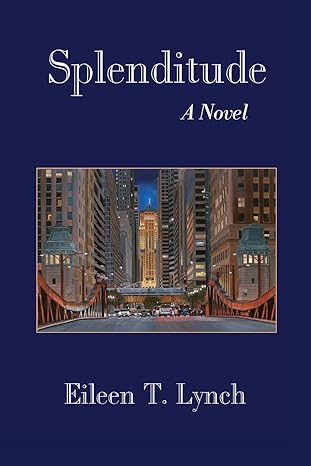

Eileen T. Lynch’s Splenditude tells the story of Deirdre Collins, a sensitive, literary-minded woman navigating love, mental illness, and the longing for a fuller life in 1990s Chicago. The novel traces her downward spiral into mania and depression, her struggle to find meaning, and her slow, painful climb back toward stability and purpose. Anchored by her deep interior life and longing to be a writer, Deirdre’s story unfolds against a vivid Chicago backdrop, with its smoky bars, biting winds, and old neighborhoods filled with ghosts and grit.
Lynch’s prose is rich and layered without being heavy. Her writing dances between lyrical and blunt, often in the same paragraph. I was struck by how intimately she renders Deirdre’s mind. Its sharpness, its fragility, its longing. The emotional rhythm felt honest. There are no neat bows here, no characters who say just the right thing. People disappoint and disappear. Love drips in awkward silences and backhanded compliments. I loved that. I also loved the humor tucked into the darkness, the literary references like secret handshakes, and the way Lynch pulls Chicago off the page like steam from a manhole.
There were a few moments when I found myself hoping for a slightly quicker pace or a smoother shift between scenes. The ending felt more like a gentle exhale than a grand finale, which may have been exactly the intention; life rarely ties itself up neatly. Still, that’s a small note in a book that, overall, truly stayed with me and moved me in ways I didn’t see coming. I found myself underlining sentences, re-reading passages, and pausing just to sit with what Lynch had unearthed.
Splenditude is a book for anyone who’s ever felt too much, thought too deeply, or tried to crawl their way out of a dark place with only stories and hope as their tools. It’s for readers who savor emotional honesty, who can live without tidy arcs, and who believe beauty and brokenness often walk hand in hand.
Pages: 234 | ISBN : 978-1962931199

Azazel’s Scriptures

Azazel’s Scriptures, by S.F. Parkhurst, is a richly textured novel that blends historical mystery with magical realism, immersing readers in a vibrant medieval setting laced with supernatural elements. It follows a trio of friends, Simon, Hugh, and Newt, as they become entangled in dark folklore involving the demonic grimoire of Azazel, the ancient Druids, and mysterious beings known as the Daegons. As secrets unfold and tensions rise, they find themselves confronting forces that blur the lines between reality and myth, testing their courage and friendships in unexpected ways.
I found myself completely absorbed by Parkhurst’s lyrical yet accessible prose. The vivid imagery and atmospheric storytelling evoked genuine emotional responses, sometimes fascination, sometimes unease. The author effortlessly drew me into a world where the mystical seems entirely plausible, making even the more fantastical scenes feel believable. Particularly impressive is the way Parkhurst crafts dialogue: each character speaks with a distinctive voice that genuinely matches their persona, providing a sense of depth and realism. Though the writing flows well overall, at times it felt slightly dense, requiring deliberate attention to fully grasp the subtleties of the narrative.
The ideas Parkhurst explores are captivating and unsettling. Themes such as immortality, friendship, and the dangerous allure of forbidden knowledge run deeply throughout the story. Parkhurst does not shy away from portraying complex moral dilemmas, which often left me pondering the ethical gray areas presented in the book. While I appreciated the layers of intrigue and symbolism, the volume of interconnected plots and historical references sometimes made me lose track. That said, the confusion was fleeting and never severe enough to detract significantly from my overall enjoyment.
Azazel’s Scriptures is not a casual read. It demands a willingness to engage deeply with its historical mysteries and magical undercurrents. I recommend it to readers who enjoy thoughtful storytelling blended with dark folklore, especially those who appreciate narratives that explore the boundaries between reality and legend. This book would resonate particularly well with readers drawn to medieval settings and characters whose humanity shines brightest against the backdrop of supernatural darkness.
Pages: 375 | ASIN : B0FGGVHJYV



 LITERARY TITAN