Blog Archives
Love and Other Cures for the Recently Undead


At its core, Love & Other Cures for the Recently Undead is a gritty, emotional, and strangely tender post-apocalyptic coming-of-age tale. We follow CeCe, a teenage girl who wakes up from a two-year blackout only to discover she was among the Infected, essentially the undead, during the downfall of civilization. As she tries to rebuild a life in a world that has changed beyond recognition, she confronts loss, trauma, guilt, and, unexpectedly, the guy who bit her. It’s not just a zombie survival story, it’s about identity, healing, and navigating the ugly mess of grief and rebirth.
I wasn’t prepared for how raw this book would hit. The opening chapters aren’t action-packed in the usual undead thriller way, but they are claustrophobic and gut-wrenching. CeCe waking up in darkness, confused and crushed under bodies, is horrifying, not because of gore but because it’s so human and real. Ramsay doesn’t rush the emotional recovery, and I appreciated that. You really feel CeCe’s pain when she realizes her mother didn’t make it, that her best friend and boyfriend are missing, that she’s been gone for two years and everything she loved (tennis, high school, her future) is shattered. That kind of slow-burn horror hits harder than any jump scare.
The writing style is simple but effective. Ramsay keeps things clean and fast-moving, even when the plot slows down. There’s a lot of introspection, especially in scenes where CeCe returns to her old school as part of the Rehabilitation Program. Those moments of being surrounded by other damaged kids with missing limbs, haunted eyes, and weird silence hit me like a punch to the chest. And the subtle tension with Olivia, the hostile Survivor, is quietly terrifying. But where the book really surprised me was Derrick. The boy who infected CeCe? It turns out he’s been cured, too. And somehow, this book manages to make you feel something when they meet again. Confused anger. Loathing. Maybe even curiosity. I didn’t want to root for him, but I found myself leaning in.
What really stood out was the emotional weirdness of returning to something familiar that’s now unrecognizable. Ramsay captures that eerie feeling of trying to go back to normal when “normal” is gone forever. When CeCe walks through her school, sees her old tennis team photo, or opens her ex-boyfriend’s locker. Those moments are small, but they carry so much weight. And it’s honestly heartbreaking how she’s just expected to rejoin society, do her homework, eat her weird canned spaghetti, and pretend everything’s fine. It’s not. It never will be. And that tension between survival and actual living is what keeps the book from falling into cliché.
Love and Other Cures for the Recently Undead is for anyone who’s ever felt like a stranger in their own life, or tried to rebuild something that doesn’t quite fit anymore. It’s not a light read, but it’s oddly hopeful in its own way. There’s still love. There’s still friendship. And there’s still that weird human ability to keep going, even when everything’s broken. I didn’t expect to care this much about a girl with a zombie bite. I’m glad I read it.
Pages: 235 | ISBN-10 : 1957295821

SOULFUL RETURN

Fidelis O. Mkparu’s Soulful Return is a poignant and deeply introspective novel that traces the journey of Dr. Afamefuna Nwaku, a Nigerian immigrant and successful physician in Boston, as he confronts the sacrifices he’s made—his family, his culture, his identity—for the promise of success in America. Through powerful narration, the story explores Afam’s growing disconnect from his homeland and loved ones, all culminating in a difficult decision between career ambition and cultural belonging. Woven through with the haunting presence of ancestral voices and dreams of Nigeria, this novel isn’t just about going home, it’s about reckoning with what it means to truly belong.
From the very first chapter, I felt this book hit close to home. That opening scene, Afam sitting on the banks of the Charles River, haunted by invisible drums calling him back to Nigeria, was more than poetic. It was spiritual. That deep ache of being split between two worlds, trying to find comfort in a place that doesn’t fully embrace you, is something I know well. Mkparu captures it all—the rhythm of longing, the quiet pain of assimilation, and the guilt of forgetting where you come from. And when Afam loosens his tie and lets the water lap over his bare feet, it felt like a baptism, like he was trying to wash off decades of silence.
But what really tore me up was the tension in Afam’s marriage. The scenes between him and Elisha hit like a gut punch. When she said, “I feel lonely lying next to you,” I had to put the book down for a minute. That kind of emotional neglect is too real. You can love someone and still be absent from them. Elisha was grieving the life she thought they were building together. And Afam, caught between trying to be a provider and losing sight of being a partner, is a complex portrait of a man who’s been chasing success so long he forgot what he left behind. Mkparu didn’t sugarcoat the cracks in that relationship. He let it bleed on the page.
Then there’s the whole weight of duty—both to his American life and his family back in Nigeria. It reminded me how often we, as Black men, carry burdens we didn’t ask for. We become bridges between two worlds. Expected to be everything to everyone—patriarchs, professionals, saviors. It’s exhausting. And when Afam stands in front of the hospital wall looking at the executive photo lineup, wondering if his face will be up there or lost in a place that never truly felt like his—man, I felt that.
Mkparu’s writing style is rich but never pretentious. He doesn’t dress his emotions up in fancy words. He lets them spill out. The way he uses flashbacks, dreams, and internal voices keeps the reader grounded in Afam’s inner world without feeling lost. I appreciated how he didn’t resolve things neatly. Life, especially for people caught between cultures, isn’t neat.
I’d recommend Soulful Return to anyone who’s ever felt the pull of two homes, two identities, or two versions of themselves. African Americans, especially, will feel the layers here—the echoes of diaspora, the questioning of what “home” even means. It’s a book for immigrants, yes, but also for anyone who’s chased a dream and then looked around and wondered what they left behind.
Pages: 322 | ASIN : B0F1DWCFT8
Becoming the Villain

Wrath of the Storm Lord follows an outcast turned warrior-myth, rising from condemned slave to challenging the empire that destroyed his people. What inspired this setup?
Well, originally Jerith was supposed to be the villain in another series of mine called Chronicles of the Bard King. Coming from a comics background, I’ve always been inspired by writers like Rick Remender, Jonathan Hickman, and Ed Brubaker. These guys create incredible morally gray characters and anti-heroes, and one thing they always nail is making villains relatable. So, that was my goal—I wanted to explore Jerith’s journey, find out what pushed him down this dark path, and why he became the most feared man in Eodarrin. But honestly, I didn’t expect to become so attached to him. Pretty soon, it was clear a simple prologue just wouldn’t do his story justice.
The world you’ve created feels so alive and full of possibilities. Where did your inspiration come from, and did the setting change as you wrote?
Ah, the frozen land of Ver’Sut! This place has been living in my head for nearly thirty years. As a kid, I was fascinated by Viking and Norse culture, especially this idea of people shaped by their harsh environment and struggles. Growing up in the Deep South, snow was rare and almost magical to me. Dog sledding and snowy landscapes always grabbed my imagination—thanks partly to Jack London’s books like The Call of the Wild and White Fang. The concept of an eternal winter just has this mystic charm I couldn’t resist.
Jerith Al’Sut faces deep inner conflict, fighting not to become the monster he battles against. What inspired his character’s journey?
My initial idea for the Sutian people combined elements of Norse culture and Indigenous heritage—reflecting my own background. Both cultures have powerful myths about inner struggle. One is the tale of two wolves inside us, constantly battling for our souls. Another is the Norse myth of Freki and Geri—Odin’s wolves representing greed and hunger. I wanted to dive into this question: if you could save everyone you love by becoming the villain, could you do it? That’s really at the core of Jerith’s struggle, this intense battle within himself.
Can you tease what’s next for the story and where you see it heading in the future?
The heart of the story revolves around the Axe of Eldran—the artifact granting Jerith the power of the Storm God, Eldran. But here’s the twist: during an ancient battle with an evil Arch Fey, the Fey’s defeated spirit attached itself to the axe, slowly corrupting Jerith. In Wrath, we see the beginning of this corruption as he struggles to control his rage. Moving forward, we’ll watch Jerith spiral deeper into obsession as he’s plagued by dark visions convincing him only he can stop an approaching evil—no matter how devastating his actions become. It’s all about exploring how far he’ll go, and whether he can find redemption or lose himself entirely.
Author Links: GoodReads | Amazon
The mines were supposed to kill him. Instead, they unleashed something far worse.
Jerith Al’Sut was sentenced to die nameless, broken, and forgotten. Instead, he rose from the depths with lightning in his veins and vengeance burning in his heart. Now, the condemned slave is the Storm Lord—a force of nature who can shatter armies and tear fortresses apart with a single strike, determined to break the chains of an empire built on blood.
But power without control is a blade that cuts both ways. As rebellion ignites against King Ulthean’s ruthless reign, Jerith’s fury threatens to consume everything—including himself. Every battle pushes him closer to victory—and closer to becoming the tyrant he swore to destroy.
Yet the Storm Lord does not stand alone.
At his side is Valeria—exiled princess, master strategist, and the only person Jerith would die for. She once had everything: nobility, status, a future. Then she betrayed her father, King Ulthean, for the love of a branded Unsought—lower than a slave, unworthy even of a name. Her defiance cost her a crown, her family, and her homeland. Now, she fights not for a throne, but for the heart of the man she refuses to lose, no matter the cost.
Yet King Ulthean’s armies close in, ruthless and relentless. War is merciless, and love alone does not shield against fate. As Jerith’s storm grows, so do the whispers: Not all tyrants wear crowns. Not all monsters can be stopped. And if the price of vengeance is his soul, will anyone be strong enough to save Jerith from himself?
Lightning exposes the darkest truths:
Sometimes, the greatest battle isn’t against our enemies—but the monster we risk becoming.
And always, his fallen brother’s final, blood-stained words haunt his every choice:
“Remember Who You Are!”
A Glimpse of Hope

You Can’t Stop Me follows a diverse group of young girls who transform their so-called weaknesses into strengths, proving that determination, self-belief, and authenticity can break any barrier. What was the inspiration for the setup of your story?
I remember the day I decided I was going to write and publish You Can’t Stop Me. I was holding my then 4-month-old daughter, watching women’s rights being stripped away. Angry, sad, scared—I was trying to understand the world my daughter is going to grow up in. How could I make a difference? How could I make sure young girls and women keep fighting and not let the everyday battle knock them down? How do I explain it to my daughter?
I began writing down ideas immediately. Almost 2 years later, You Can’t Stop Me was born.
How did you develop the different characters, and was there one character you felt most connected to?
A small part of me can connect and relate to each girl portrayed in You Can’t Stop Me—and unfortunately, I think most girls and women will feel the same. I wanted to showcase as many types of girls as possible. I wanted the young girls reading it to think, “Oh, she looks like me and she’s in space!” or “I’m in a wheelchair too, that doesn’t mean I can’t be president!”
But if I had to choose one character I relate to the most, I would say it’s the author!
The book challenges societal expectations placed on young girls. What impact do you hope it has on readers?
My main goal has always been to give a glimpse of hope and power to little girls that don’t get told they’re enough, they’re smart, they’re brave, that they’re unstoppable. I hope You Can’t Stop Me gets in their hands and they realize that can do or be anything they set their mind to.
What is the next book that you are working on, and when will it be available?
I’m currently working on an apocalypse-style YA novel. It’s in the early stages, so no dates yet. This is a project I’ll be taking my time with as it’s written in memory of my brother, who will be one of the main characters.
Author Links: GoodReads | Facebook | Website | Amazon
You’re too bossy? Sounds like you know how to get stuff done.
You’re too weak? Well, that’s not possible. You’re the toughest person I know.
You’re too nice? That’s not even a thing.
Being too “you” is not a bad thing. You are the best you I’ve ever seen!
You should embrace who you are, and use it to make your dreams happen.
Girls can do anything, and no one can stop us!
Born of Bombs and Bullets: An Aaron Thornton Thriller

David A. Dummer’s Born of Bombs and Bullets is a sharply written, emotionally charged political thriller that pulls no punches. It follows Dr. Aaron Thornton, a prison psychologist whose life is upended after a brutal murder at the penitentiary where he works. Seeking a reset, he relocates with his wife Claire to Belfast—only to be thrust into a volatile world of old grudges, hidden identities, and a brewing storm of violence tied to the legacy of the IRA. Through layered narratives, the book digs into the personal and political costs of trauma, loyalty, and vengeance, all against the backdrop of Northern Ireland’s troubled history.
What grabbed me first was the way Dummer weaves high-stakes action with genuinely human moments. The opening scene inside USP Hazelton is pure tension. One second, you’re in a therapy session; the next, you’re watching the chaos unfold, ending in a devastating double murder. I felt the chill in the room, the tension in Thornton’s indecision, the horrifying weight of inaction. That moment—when Thornton can’t bring himself to strike with the baton—lingers through the rest of the book. It’s a quiet, haunting flaw that makes him real. Dummer doesn’t just serve up trauma; he lets it stew, then uses it to shape the characters.
The Belfast chapters dig deeper into identity and trauma, especially through Liam O’Malley and Tommy Magee. Liam’s backstory—particularly the vivid, heart-shattering scene where his sister Deidre is killed by a British armored vehicle—is one of the most powerful in the book. It felt cinematic and visceral. That single event justifies Liam’s rage and radicalization. At the same time, Dummer avoids painting him as a monster. Liam’s weariness, his doubts about renewed violence, his reflections on a life lived in shadows—they’re painfully honest.
On the flip side, we’ve got Tommy. He’s the emotional powder keg—an orphan, a trauma case, caught in a cycle of poverty and rage. His journey from suicidal despair on Ballycastle Beach to reluctant accomplice in a murder is wild. His flashbacks, especially the aftermath of the Sheehan’s furniture store bombing, are raw and haunting. What impressed me was how Dummer shows Tommy slipping into violence. He’s not evil. He’s broken. And in that brokenness, he becomes someone else’s weapon.
The pacing is tight, the writing is sharp, and the dialogue has just the right edge of grit and realism. It does get pretty heavy, especially with all the political history and acronyms. But Dummer does a solid job of keeping it digestible. He throws you into a world of factions and vendettas, sure—but never without anchoring it in people who bleed, mourn, and remember. The balance between plot and pathos is what makes this more than just a thriller. It’s a character study in the ruins of ideology.
I really liked this book. It’s not a breezy read—it’s emotionally heavy, politically messy, and morally gray. But it’s also compelling as hell. If you’re into thrillers with a conscience, stories that tackle trauma, redemption, and the gritty realism of sectarian violence, you’ll want to check this out. Fans of The Troubles-era fiction, political thrillers like The Ghost or The Constant Gardener will find plenty to chew on here.
Pages: 458 | ASIN : B0DY6MS7F8
Making Vespuccia Great Again
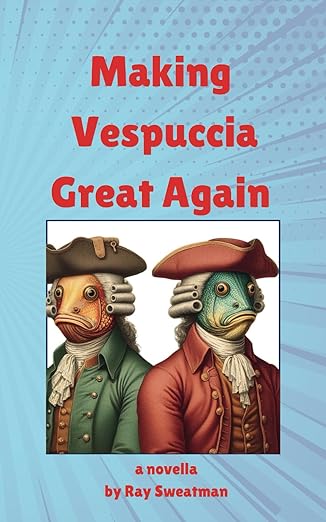
Ray Sweatman’s Making Vespuccia Great Again is a sharp, fearless, and at times laugh-out-loud political satire that imagines a dystopian America rebranded as “Vespuccia.” Set in a twisted mirror of our current socio-political climate, the novella follows the rise (again) of President O.J.C. McDonald, a grotesque caricature of a certain orange-hued reality TV personality. Through absurd characters, biting dialogue, and a surreal plot that includes everything from sentient fish Founding Fathers to LGBTQ revolutionaries called “The Pronouns,” Sweatman delivers a fiery send-up of authoritarianism, fake news, and cultural division in America.
From the very first chapter, Sweatman goes full throttle, skewering the January 6th insurrection with the same kind of commentary you’d expect from The Onion if it took acid and watched Idiocracy on repeat. The fake news anchors Donna Dumay and Don Drapery narrating the Capitol attack like a sports event? Genius. “Oh my, this is better than Getflix!” Donna chirps as democracy crumbles. I was equal parts horrified and laughing out loud. Sweatman walks that tightrope masterfully, never letting the humor soften the blow of the real critique.
One of my favorite arcs was Reverend Swindlemore and his daughter-turned-nonbinary-hacktivist Bucky (aka They/Them). The Reverend is a grotesque blend of fire-and-brimstone televangelists with just the right dose of unhinged righteousness. His hell-obsessed sermons feel ripped from real-life absurdities, and when Bucky forms a rebel group of queer hackers, I was all in. It’s outrageous, it’s camp, but there’s heart. You get the sense that Sweatman deeply respects those fighting for justice, even while cranking the satire up to eleven.
And then there’s the Founding Fathers. Literal fish-people who rise from the sea, transform into Jefferson and Hamilton, and get swept into a costume shop where they breakdance to Rick James’ “Super Freak.” It sounds insane because it is, but somehow it works. These absurd moments don’t just entertain, they hammer home Sweatman’s larger point: when truth dies, history becomes theater, and we’re all stuck on stage, flailing. Watching Jefferson defend his slave-owning past while Hamilton snarks and George Washington threatens to shoot him with a shotgun? That’s satire doing its job, shining light through the madness.
Making Vespuccia Great Again isn’t for everyone. It’s blunt, crude at times, politically fiery, and proudly liberal. But if you’re the kind of reader who enjoys Dr. Strangelove, South Park, or Vonnegut on a rampage, you’ll eat this up. Making Vespuccia Great Again is for the disillusioned, the politically exhausted, the angry, and the hopeful. It’s for anyone who still believes words have power, humor can cut deep, and that fighting back might look a little ridiculous but is still necessary. I laughed, I cringed, I shook my head. And I’d read it again in a heartbeat.
Pages: 252 | ASIN : B0DY4T96PV
Story of Renewal
Crossing Lake Pontchartrain follows a forty-year-old unemployed man with a collapsing marriage who moves to New Orleans, where he winds up on a journey to discover who he is and who he is not. What was the inspiration for the setup of your story?
Middle age supposedly is where life finds full flower with marriage and family, career, and a deepened sense of self, but reality often disappoints. Larry rekindles old creative dreams and discovers transformative personal relationships in New Orleans after the failures of his life remind him he hasn’t yet lived up to his potential. The creative throb of New Orleans renewing after Hurricane Katrina was the perfect place for this story of renewal, and after the isolation of COVID-19, it seemed to me the world was ready to shake off its stalled ways and move ahead. Finding the right people and an inspiring right place to build the second half of his life, Larry accepts that people can help him become the person he’s always wanted to be.
What things do you find interesting about the human condition that make for great fiction?
Great fiction for me is literary fiction, an approach examining broad human emotional experience through the narrow lens of character, setting, and language. By focusing on particular circumstances viewed through the inner theater of individual characters, the panorama of all humanity can be glimpsed in all its nuance of pain, love, treachery, and growth. Great fiction is at one time an awareness of what it is to be human and alone and yet to be one with all humanity threaded together by the common emotions and challenges we each know to be the human experience.
What themes were important for you to explore in this book?
Pontchartrain is a story of renewal, the shaking of a stagnant emotional collection of relationships, careers, expectations, and creative dreams. In this novel, the protagonist’s mid-life crisis of belief in himself and even in possibility itself catalyzes into growth under the influence of potent new friendships awakening him from his 40-year-old malaise. Each new person releases within him fresh thinking about his future (and past) in slightly nuanced ways. With time and work, Larry learns to assess who he is and who he isn’t. Set in post-Katrina New Orleans itself renewing after hardship, Larry Winstead models the theme of continuous renewal fueled by the social energy of human contact. Here, the inner character experience and the interplay of characters in action indulge the conversation to paint a picture of the artist as a good old boy receiving life and not trying to force it. Chop Wood Carry Water proves to be a lesson all people can benefit from when taught by people who care.
What is the next book that you are working on, and when can your fans expect it to be out?
My next book will be, Arlie: Leaf River Days. I’ve written about half the novel and expect publication in 2026. I began writing Southern literary fiction after I retired from my technology career in 2006 and Arlie will complete my envisioned trilogy of the Deep South where three separate families experience the panoply of human experience each in a different stage of life. The first novel published in 2017, What the River Wants, explored a multi-generational family confronting the vagaries of time and focuses on old age, coming of age, and middle age. An old man retreats into isolation on the river before his teenage grandson journeys to rescue him from his drift into desperation. The grandfather, his forty-year-old daughter, and two teenage grandchildren each reveal their separate challenges of doubt, dreams, and treachery. The grandfather’s family story about his mom draws out from each character a fresh understanding of who they are and helps reset who they want to become. The end is a bit shocking but revelatory, and even today 8 years later it leaves me with a sensation of freshly tilled life where old becomes new and the past both returns underground and feeds the future. These character remain friends of mine I miss every day.
My second novel, Crossing Lake Pontchartrain, told in first person, traces the journey of a 40-year-old through his mid-life mess. Through the loyalty of a devoted mother and the impetus of artsy worldly new friends, this protagonist explores how time has left him emptied in modern life until inspired to revive his creative dream of writing a novel. In discovering a mutually creative relationship with a single-mother yoga instructor and resolving an old mystery of a father’s disappearance, the old life is sloughed off and replaced with loving, creative relationships.
My current writing project, Arlie, is a child in the South who has a tough time fitting in but at last discovers the inner person he might like. This novel completes the trilogy of life stages. Beginning when Arlie is six-years-old with a birthmark that undermines his confidence and development, the book follows his growth year by year and in the process examines the disturbing Southern themes of segregation in the light of Arlie’s lifelong feelings of not belonging. This trilogy avoids many of the tropes of Southern stereotypes so this novel can examine its inevitable presence through the lens of youth. For 40 years I’ve lived in New Jersey and consider myself a Southern Yankee, someone committed to decomposing the bias of both my Northern and Southern homes where oversimplified impressions fuel cultural bias rather than insight. I’ve tried to show all these characters as human rather than labeled types.
Author Links: GoodReads | Facebook | Linkedin | Amazon
A father’s mysterious disappearance and a tossed writing dream still trouble Larry even after twenty years. But in the creative renewal of a big city pulse, a hobbyist clairvoyant and an iron sculpture expose his uncertainties while a philosophical maintenance worker teaches him to Chop Wood, Carry Water. Yet, Emma, an inspiring clear-eyed yoga instructor grasps what Larry has overlooked in his search for the fulfilled life he yearns for yet has denied himself.
A serendipitous discovery will scramble the fates of Larry’s new web of friends. But sometimes when things fall apart, they fall together again.
Seeing Beyond Appearances

Pretty in Purple follows a young girl on her 7th birthday who meets her spirit guide, and she is given a special gift: the ability to see auras. What was the inspiration for your story?
I’ve always been fascinated by energy, intuition, and the unseen connections between people. As a mother, I wanted to create a story that teaches children about inner beauty, kindness, and the energy we share with the world. Pretty in Purple was inspired by my daughters and the lessons I hope to pass down to them; lessons about self-worth, empathy, and seeing beyond appearances. The idea for Sophie’s story first came to me in 2014, after my first daughter was born, but it wasn’t until my second daughter arrived in 2024 that I truly felt the push to bring it to life.
What educational aspects were important for you to include in this children’s book?
I wanted to introduce young readers to the concept of auras in a way that feels both magical and relatable. While auras are often seen as a spiritual concept, I present them as a visual representation of emotions; helping kids understand that our energy, attitude, and kindness affect how others feel around us. The story also explores important social-emotional lessons, like making friends, dealing with unkind behaviour, and learning that true beauty shines from within.
The art in this book is fantastic. What was the collaboration process like with illustrator Katya Mo?
Working with Katya Mo was an incredible experience. I had a very clear vision for the book. I wanted it to be vibrant, whimsical, and full of energy to reflect the story’s themes. Katya beautifully brought Sophie’s world to life, especially in the way she portrayed the auras with soft, glowing colors. We worked closely to ensure each illustration complemented the emotions of the scene, from Sophie’s excitement to her moments of doubt. The end result exceeded my expectations, and I couldn’t be happier with how it turned out!
What next book are you working on, and when will it be available?
I’m currently working on the sequel to Pretty in Purple! In this next adventure, Sophie meets a boy named Alex, who spends most of his time indoors on his tablet and is afraid of the outside world. With Zoe’s guidance, Sophie helps Alex reconnect with nature, and he begins to heal; both emotionally and physically. This story highlights the power of nature, movement, and play in our well-being. I’m also adapting Pretty in Purple into a 24-page board book with rhyming text for younger readers, focusing even more on the concept of auras. I hope to release both books within the next year!
Author Links: GoodReads | LinkTree | Instagram | Facebook | Website | Amazon



 LITERARY TITAN