Blog Archives
Your Problems Solved: Cold Clues
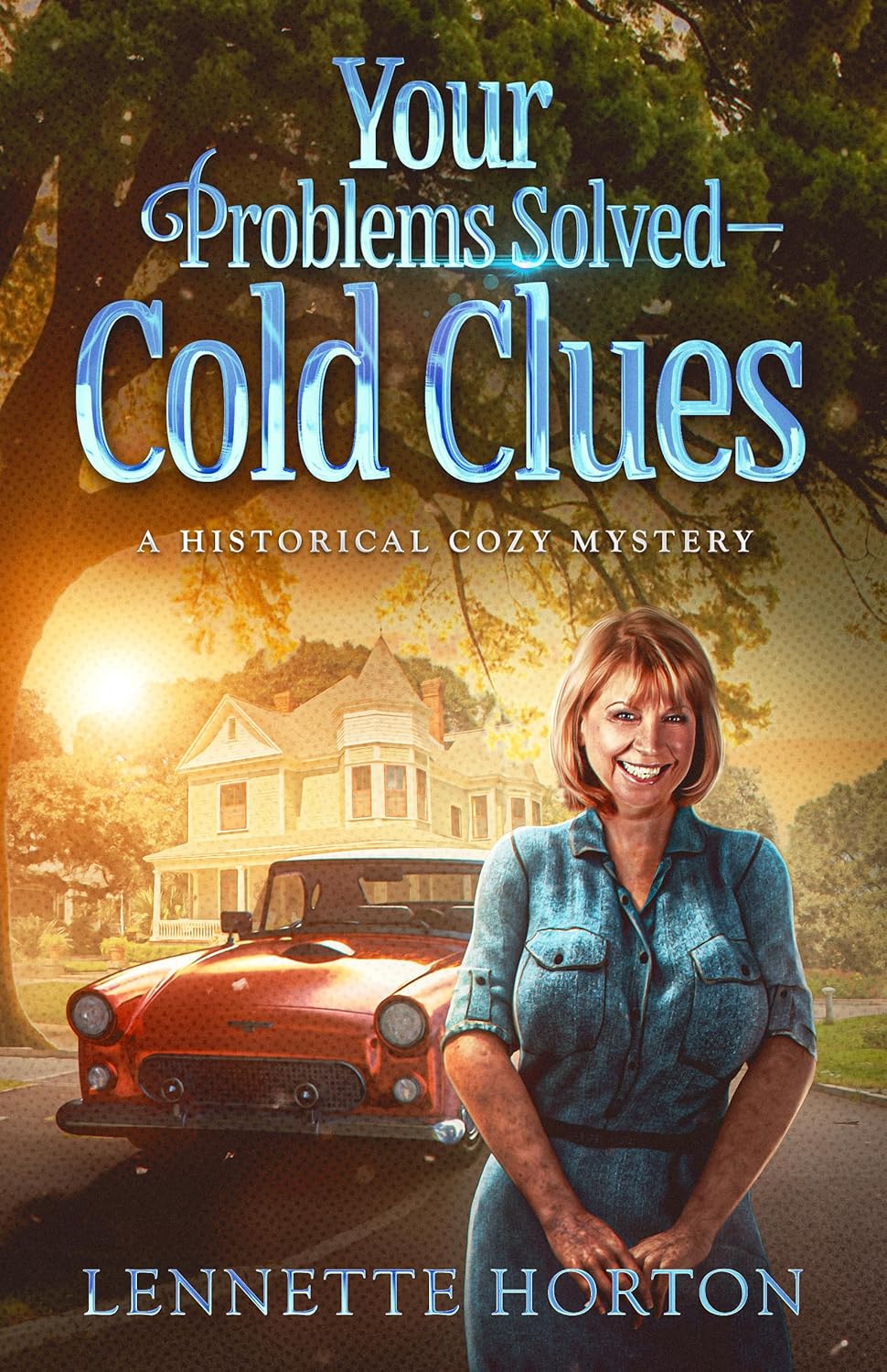

Your Problems Solved: Cold Clues hooked me right from the first scene, where retired librarian Dory Frame steps onto her porch and finds a troubled young woman asking for help. That moment kicks off a mystery rooted in a small California town in 1955, full of heat, old secrets, sharp characters, and the quiet grit of a woman who never expected to become a sleuth. The story winds through murder, corruption, community ties, and one woman’s stubborn insistence on truth. It moves with a gentle rhythm that feels like a stroll through a neighborhood, then tightens when things turn dark. I found myself caring far more than I expected to.
As I read, I kept smiling at the voice of Dory. She is steady and thoughtful, yet she surprises you with a streak of bravery that sneaks up on you. The writing made me feel like I was sitting beside her at the kitchen table, sipping iced tea while she sorted through clues and her own memories. Author Lennette Horton paints small-town life with such affection that even the gossip feels warm. There were moments that hit harder, though, like the quiet grief wrapped around Dory’s widowhood or the unease of a veteran struggling with trauma. Those scenes caught in my chest. They added weight to a book that could have stayed light but chose something richer.
I also appreciated the layers tucked inside the plot. What starts as a simple request from a desperate daughter slowly becomes a tangle of civic corruption, hidden relationships, and buried ledgers. Horton balances this with soft humor and everyday detail. One moment I was caught in the tension of a new clue, and the next I was listening to neighbors talk tomatoes and grandbabies. Oddly enough, that blend worked. It grounded the danger in something very real. I felt like I knew these people. I wanted them safe. I wanted justice to land where it should.
By the final pages, I closed the book feeling satisfied. This story would be wonderful for readers who love cozy mysteries with heart, fans of historical settings, and anyone who enjoys a heroine who solves problems with brains, kindness, and a little stubbornness. If you like mysteries that feel authentic rather than flashy, this one is a great pick. I’m looking forward to reading more of Dory’s adventures.
Pages: 342 | ASIN : B0FNTBNHY3

Justice and Loyalty
Part of the Solution: A Mystery follows a New York professor who experiences a chance meeting that pulls her back into the 70s and brings her closer to a death that shook the community she once called home. What was the inspiration for the setup of your story?
Setting Part of the Solution in 1978 was an easy choice because the very first version of the book was written in 1978! I had just finished a dissertation in English literature, and I’d survived graduate school by sneaking off to read murder mysteries when I couldn’t bear one more page of “serious” literature. A few years ago, I reread my original manuscript and decided to rewrite it as a period piece. I thought it would be interesting to go back to that time and wrestle with who we “Boomers” were back in the day – idealistic, earnest, and hopeful but also very young and sometimes very silly. The book is completely different now. In some ways, it’s a comedy of manners as much as it is a mystery.
Yet comedy of manners though it is, I don’t want to overemphasize the humor in the book. In the process of rewriting, the mysterious death at the core of the original plot took on a deeper meaning. Now my main character, Jenifer, has had forty years in which she has had to live with what happened. The decisions she made at the time as the “amateur detective” have shaped her life in ways that she – and even I – could never have imagined at the time.
What is it that draws you to the mystery genre?
I have a complicated relationship with the mystery genre. I love the structure and discipline of the classic whodunit in which all the clues and red herrings line up in a way that plays fair with the reader. I love the puzzle at the heart of the genre and, to quote the title of my book, the `solution’ that is revealed at the end. But I am also troubled by how much fun such mysteries are because death, even in fiction, shouldn’t be fun. I worry that devouring mysteries the way a lot of us do ends up dulling our responses and thus numbing an important piece of what makes us human. I don’t want the characters, or even the reader, to get off scot-free.
In Part of the Solution, I tried to tell a story in which the characters don’t get off scot-free because they are changed forever by what has happened to them. I wanted them to have to wrestle on a deeply personal level with the issues that are raised. What does justice mean? What does loyalty mean? How do different people understand those terms, and what difference does that make? Jennifer and Ford – the amateur detective and the official detective – have very different relationships to questions of justice and loyalty, and those questions matter to them both. The very different answers they come up with have never stopped haunting them.
How did the mystery develop for this story? Did you plan it before writing, or did it develop organically?
The mystery plot was there from the beginning. I had a wonderful time inventing a set of wonky characters in an imaginary little hippie town in the Berkshires, with the challenge of trying to figure out who among these various peace activists, artisans and poets, leftwing intellectuals, and spiritual seekers would murder someone, and why. Once I had the mystery structured, I could relax into writing the dialogue and the scenes. What were they listening to on the stereo? What were they arguing about? Laughing about? What were all of them wearing? How did they understand the world around them, and how were they trying to change it for the better?
What is the next book that you are working on, and when will it be available?
I want to bring Jennifer and Ford back together in the present day. They are both in their late ‘sixties now, and they meet up again at a conference during which someone dies mysteriously. I have the plot lined up as well as most of the characters. I haven’t gotten very far in the writing yet, but I’ve booked myself some time away this winter just to write, and I’m planning to have it done by the end of this coming year.
Concern for her community prompts Jennifer to investigate the murder with the sometimes-reluctant help of Ford McDermott, a young police officer. Little does she know that the solution lies in the hidden past.
Part of the Solution blends snappy dialogue, unconventional settings, and a classic oldies soundtrack, capturing the essence of a traditional whodunnit in the era of sex, drugs, and rock-and-roll.
Part of the Solution: A Mystery
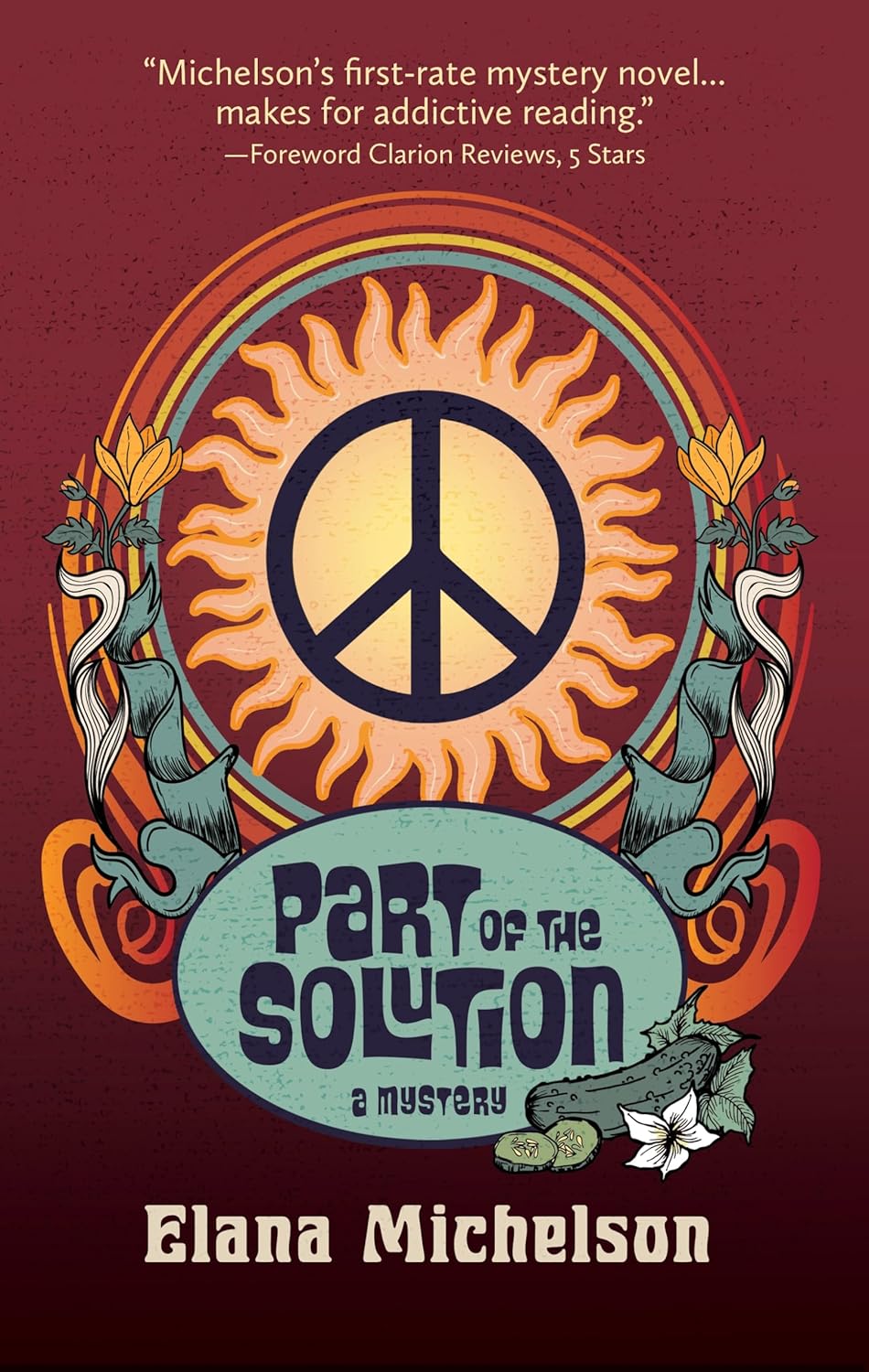
Part of the Solution follows Jennifer Morgan, a New York professor who returns to Boston for a conference and suddenly collides with her past. A chance meeting pulls her back into the late seventies, when she lived in a tiny Massachusetts town full of hippies, activists, dreamers, and drifters. The book moves between the present and that earlier world, and the story slowly circles a death that shattered the odd little community she once called home. The narrative blends memory, mystery, romance, and political reflection in a way that feels alive and warm and a little bittersweet.
Reading it felt like stepping into a room that smells like coffee and incense and old books. The writing has a cozy quality. It rambles in a good way, like someone talking while cooking dinner, and I found myself leaning in. I had moments of real affection for the characters. They fight. They love. They hold grudges that make no sense and cling to ideals that make no sense either. The dialogue has a lively spark that kept surprising me. Sometimes it hopped around. Sometimes it took its time. I liked that. And even when the tone shifted into darker territory, the heart of the book kept beating steady.
The ideas underneath the story resonated with me more than I expected. Michelson captures the messy idealism of the counterculture era with charm and also with a sharp pinch. I kept nodding because the book understands something about how people try to build a better world and then stumble right over their good intentions. The spiritual seekers. The radicals. The shy intellectuals who think too much and then think even more. I felt the book’s tenderness toward them, and I felt its frustration too. The tension between hope and disillusionment had real weight. It made me sit back and think about my own younger self and the beliefs I thought would never bend.
I would recommend Part of the Solution to readers who enjoy character-driven mysteries, stories about found communities, and novels steeped in the moods of the sixties and seventies. If you like fiction that mixes warmth with tension and lets people be flawed in recognizable ways, you’ll enjoy this book.
Pages: 298 | ASIN : B0FL4MH5WY
Palpable Tension

The Matriarch Messiah follows two women who come from different cultural and religious backgrounds yet find themselves bound by an ancient prophecy and mission to save humanity. What was the inspiration for the setup of your story?
First and foremost, the conflicts over the ages between people of both Zara’s and Rachel’s faiths and cultures inspired the story of how peace needs to be found so humanity could survive and thrive. The more recent conflicts highlight the need for peaceful solutions as violence only begets violence – which both Zara, a former Kurdish soldier, and Rachel, an Israeli Torah historian and archeologist, find out by the ending chapters of The Matriarch Messiah. Perhaps these notions are naïve, but we all must have faith that we can find peace among us all.
The legend of the cavern of the blue light stemmed from a sense of gender equality in mythology. The Matriarch Matrix is based on an ancient story passed patriarchally from grandfather to grandson. Much of ancient literature including faith text is patriarchal. The Matriarch Messiah shows a parallel but even more secretive women’s legend passed matriarchally from grandmother to granddaughter. So, even though Zara and Rachel have their initial conceptual and contextual differences, both their matriarchal ancestors ask they follow the prophecy handed down by their grandmothers. In this, they must find a solution by working together. A parable for our times.
What was your inspiration for their characters’ interactions and backstories?
In The Matriarch Messiah, the reviews so far call out the “raw and realistic” interactions between Zara and Rachel. As I credit in the book’s acknowledgments, their spats are based on years of watching my two daughters, who ultimately love each other, go at it for, as we say in French, “n’importe quoi” or whatever or nothing at all. At their core, Zara and Rachel are more similar than different motivated by the same end-game of finding the cavern of the blue light. But as in real life, the external optics of upbringing and sense of what is culturally or religiously correct trip them up.
And the love triangle that some reviewers have praised? That was inspired by Romance Writers of America craft sessions. A romance story must find the romance characters stumbling over obstacle after obstacle until they finally resolve their differences. Setting up Rachel as someone who Zara would despise, especially if Peter ends up in her bed, fueled the palpable tension felt through the back half of the book.
What were some themes that were important for you to explore in this book?
In both The Matriarch Matrix and the sequel, The Matriarch Messiah, I wanted readers to confront their own prejudices and stereotyping formed by our modern world’s premium on “fast take” and “move on” social media. From the reviews, one can discern those who formed judgment very early and did not accept the later challenges to their preconceived notions. Then one can see other reviewers who embraced the “thought-provoking” nature of the reading experience. Much of the social injustice we see today, the intolerance of different cultures and faiths, comes from biases formed from misinformation and/or misunderstanding. My premise is we need to be open to understanding further before we pronounce judgement.
Second, I created the book’s ancients storyline to show a hypothesis of how the seemingly divergent customs we see in the Abrahamic faiths may have started from one source before the days humanity could codify their faith in writing. Myths and religion were passed down orally from one generation to another. Then around 3000 BCE these stories–history was encoded into durable stone and clay. Hence we see a common “flood story” across faiths. The original matriarch, Nanshe, and her descendants hypothetically formed many of the cultural traditions we see in these Western religions. My intent is to show we are more alike than different by showing both the good in what we see today and the horrible acts of war have roots all the way back beyond the first temple at Göbekli Tepe in 9600 BCE.
Will there be a follow-up novel to this story? If so, what aspects of the story will the next book cover?
Nearing first draft completion is the prequel, The Matriarch Mission. Set eighty years prior to the current two books, it takes place in post-civil war Russia. The story provides the background for Rachel’s pursuit of the truth behind Asherah and how her family became intimate with the legend of the cavern of the blue light as shown in The Matriarch Messiah prologue. The protagonist is Oksana, the mother of Rachel’s great-grandmother, Ariella.
As well, we will learn why Alexander Murometz, the ominous puppet master Russian oligarch in The Matriarch Matrix and The Matriarch Messiah, is driven to find the legendary black object at all costs. His grandfather, Zoran Murometz, plays a role in Oksana’s destiny with Asherah and the mysterious Agartthans, who were in real life sought after by Russian and French occultists.
While The Matriarch Mission goes to beta readers in April, I will outline The Matriarch Mandate while on the shores of Mallorca, which will follow the stories of the first two book’s characters eighteen years later. What is worse than fighting oppressors in deadly combat? Raising teenagers!
Author Links: GoodReads | Facebook | Website | Amazon
The Matriarch Messiah is a thrilling science fiction adventure that will leave you breathless. This sequel to The Matriarch Matrix picks up the story six months later, plunging you deeper into a world of conspiracies, forbidden love, and the fight for humanity’s future.
Zara Khatum, a woman haunted by ancient visions, finds herself drawn deeper into the heart of a perilous quest. Guided by a mysterious voice, she seeks to fulfill an ancient prophecy and find the cavern of blue light – a sanctuary rumored to hold the key to saving humanity. But the path to salvation is fraught with danger, and Zara is torn between her destiny and her heart.
A shadowy organization, known as NiQihs, seeks to exploit the power of the legendary black object, the source of Zara’s visions, for their own sinister ends. They are not alone. The world’s superpowers, driven by greed and ambition, race to control the artifact, threatening to unleash unimaginable devastation.
Joining Zara in this dangerous pursuit is Rachel Capsali, a brilliant Israeli archaeologist driven by a personal quest to uncover evidence of Asherah, a forgotten goddess who held a pivotal place in ancient Israelite faith. Unbeknownst to them, both women are bound by a shared destiny – a prophecy foretelling the cavern of blue light and a final, heartbreaking truth: two women will fight to the death, and only one will save us all.
Adding to the complexity, a passionate triangle forms as Rachel vies for Peter Gollinger‘s affection, a man deeply entangled in the ancient mystery. Zara, torn between fulfilling her destiny and her own feelings for Peter, finds herself caught in a web of conflicting desires.
As Zara and Rachel navigate a treacherous landscape of hidden agendas, betrayal, and relentless pursuit, their rivalry for Peter’s affections intensifies. Can love survive the forces that threaten to tear them apart? Will the quest for salvation lead to a heart-wrenching sacrifice?
Dive into a world where:Ancient prophecies clash with modern technology: Discover a world where ancient legends are woven into the fabric of a technologically advanced future.
Intrigue and betrayal threaten to shatter everything: Uncover a web of conspiracies, hidden agendas, and deadly secrets.
A passionate rivalry for love unfolds: Zara and Rachel’s destinies are intertwined, leading them to a final confrontation where only one will survive, but their struggle for Peter’s love adds another layer of complexity and tension.
The stakes are higher than ever before: With the world teetering on the brink of nuclear war, Zara and Rachel must find the cavern of blue light, uncover the truth behind the black object, and face the ultimate sacrifice to save humanity.
The Matriarch Messiah is a must-read for fans of science fiction thrillers with a touch of romance and a dash of the mystical. Prepare to be swept away by a journey where ancient secrets, forbidden love, and the fate of humanity hang in the balance.
O’SHAUGHNESSY INVESTIGATIONS INC. Bangtails, Grifters, and a Liar’s Kiss

A.G. Russo’s O’SHAUGHNESSY INVESTIGATIONS INC. Bangtails, Grifters, and a Liar’s Kiss whisks readers away to the gritty streets of 1940s Brooklyn, where Maeve O’Shaughnessy and her detective agency balance precariously between personal trials and societal upheaval during World War II. With a layered narrative of mystery, gangland threats, and the home-front struggles against a wartime backdrop, Russo pulls us into a world heavy with palpable tension. Vic Marino, Maeve’s partner, adds a rugged, protective presence to the team, and Jimmy, Maeve’s brother, represents the weight of family duty as the war looms over their lives. It’s a story woven tightly with suspense, crime, and the emotional strains of war-torn America.
Russo’s writing style is nothing short of riveting. From the start, the author paints a vivid picture of Brooklyn in 1943. I loved the scene-setting, especially the vivid descriptions of Maeve and Vic bracing against the elements of a harsh New York summer while being trailed by gangster types. The era feels authentic, and the author does a fine job threading in historical detail, like FDR’s fireside chats, which give us a sense of urgency. Maeve’s stoic resilience stands out, yet she isn’t immune to grief, evident in her moments of emotional vulnerability, like when she zones out thinking of her lost friends and worries about her brothers. Vic’s attempts to lift her spirits are genuine, though he, too, grapples with trauma from his past relationships. These emotional layers make the characters believable, but at times, the slow build made me wish for quicker pacing. The banter between Maeve and Vic feels organic, almost like listening to old-time radio detectives, and moments like their hilarious disguises to avoid the mob’s gaze had me grinning. The shadow of the mob boss Fat Fingers loomed large and added a sense of dread whenever Vic navigated their world.
O’SHAUGHNESSY INVESTIGATIONS INC. Bangtails, Grifters, and a Liar’s Kiss is a thrilling read, brimming with atmosphere and heart. Russo has a gift for bringing the 1940s to life, immersing readers in the moral dilemmas, period slang, and struggles of everyday people. If you’re a fan of historical crime fiction with a detective noir flavor and plenty of emotion, this book is well worth your time. It’s for anyone who enjoys strong female leads, tales of loyalty and loss, and a twisty plot that keeps you guessing. Dive in and let Maeve and Vic take you on a wild ride.
Pages: 317 | ASIN : B0DHHL3WHB
The Personal Touch

The Composer’s Legacy follows a music professor from California who discovers he is the beneficiary of a composer he has never met, sending him on a journey to discover more about his mysterious benefactor. What was the inspiration for the setup of your story?
Oh boy, well, long before I attempted to write in earnest, I scribbled down a few story ideas that I would have liked to have seen in a book. The first one operated under the premise, what would happen if a present-day, hearing-impaired college student had his hearing miraculously restored, only to discover all the odd “sounds” going on in his head were the compositions of Beethoven? Not only that, he could perform them on the piano as well as improvise just like Beethoven did. However, the niche of readers for this idea would be too narrow to be a relatable story.
The other idea, more generic, was this: What would have happened if no one had ever heard of Brahms, and then suddenly, we discover his music? And, as a composer, myself, and to add the personal touch, I could write pieces that would become part of the story. These simple ideas, along with sharing some actual history of the East Coast, morphed into The Composer’s Legacy.
David is an interesting and well-developed character that readers are drawn to and want to get to know. Are there any emotions or memories from your own life that you put into your characters’ life?
I am a 24-year-veteran of the U.S. Air Force and I deployed to many places in my career, including the Kingdom of Saudi Arabia. The scene contained in West’s journal that recounts his deployment to a “makeshift base” near Riyadh in September 1991, actually happened to me during my 1996-97 tour of duty there. The only change was, the keyboard I used was an electric Yamaha keyboard.
Can you tell readers more about the original music that you composed for this book?
The inclusion of my original music with this story was actually my niece, Shannon’s idea. Knowing of my penchant for composing, she suggested I use some of my own works (the score to the third movement of my string quintet is on the cover of the novel) along with the music playing a central role in the plot. I repurposed several compositions as well as composed the rest of the eight original pieces specifically for the book. There were other, full-orchestra pieces and a piano trio I conceived where only an introduction and a main theme were fully developed. As I wrote the descriptions of the scores Carla and David were “discovering” I began to feel unequal to the task of daring to come close to the genius of these mighty composers. Even today, I am reluctant to approach these pieces in an attempt to complete them.
All eight pieces are available free at my website under the “Books” page for The Composer’s Legacy, so readers could enjoy listening to them while reading the story. If you enjoy these musical offerings, I’ll pass that along to Mr. West. If you don’t, you can blame me.
What is the next book that you are working on, and when will it be available?
As The Composer’s Legacy was my debut novel, I wasn’t sure if I would ever write another book again. I toyed with the idea of a sequel, but that plot proved too problematic. I did, however, publish The Old Corsair this past year (Aug 2023). Although the story is from the same world and year (2013), the two stories are completely independent of each other with an entirely different cast of characters. Contained in each is an Easter egg about the other, where there’s a cursory involvement with a character from the other story.
I am currently working on a sequel to The Old Corsair that shall continue the present-day character’s story arc called, The Crimson Corsair. I’m also toying with the idea of going back to the historic captain’s time in order to tell his story. This would be a bona-fide series; the initial work would establish the characters, with subsequent novellas (150-200 pages) to recount the adventures of the enigmatic Captain Vernon Cavendish Tunney.
Author Links: GoodReads | X (Twitter) | Instagram | Website | Amazon
Esteemed California music professor David Whealy is drawn to the other side of the country to investigate the circumstances behind his unexpected inheritance. As David probes deeper into the secrets of his benefactor, James Burton West, he finds more than just a wealth of unpublished music on the order of the great composers.
David’s benefactor knew precious little about his own estate that had been in continuous family hands since 1724. He knew nothing about him.
The Experiences of One Man

Indian Billy Ice shares the true story of your great-great-great-grandfather and how he survived being taken by a nomadic Native American tribe in the 18th century. Why was this an important book for you to write?
As the last member of the Ice family line, I felt a profound responsibility to share the incredible life story of my ancestor, Billy Ice. My book was initially a screenplay that garnered significant acclaim, winning 28 writing contests worldwide, including two in Russia. Despite Hollywood’s recognition of my writing talent, the screenplay never made it to the big screen. However, the book has allowed me to reach a wider audience and help people understand the challenges faced by 18th-century frontiersmen.
What were some ideas that were important for you to share in this book?
In recent years, the colonial period has been scrutinized more critically, often through the lens of political correctness and historical revisionism. While it’s undeniable that atrocities occurred on both sides, my book offers a unique perspective by focusing on the experiences of one man, Billy Ice.
Did you find anything in your research of this story that surprised you?
I was astonished by how an eight-year-old boy could endure 11 years of unimaginable hardship without his spirit being broken. Billy was an extraordinary individual who survived indescribable horrors.
What is one thing that you hope readers take away from Indian Billy Ice?
I often remind friends and acquaintances to “honor your ancestors because history matters.” My hope is that history will once again become a key component of the educational process.
Author Links: GoodReads | Amazon
As he matures, the young man becomes a formidable force on the frontier, dispensing his own brand of justice to those who cross his path. Along the way, he finds himself embroiled in the conflicts of the time, serving in every war that marks his era. Despite the turmoil of battle, he never forgets his ultimate goal: to reunite with his family and carve out a life of his own.
Eventually, fate leads him back to his kin, and with them, he establishes a wilderness community, a sanctuary in the untamed lands he has come to call home. Through hardship and triumph, he remains steadfast in his commitment to protect his loved ones and uphold the values of his rugged existence.
This is the true story of my great-great-great-grandfather, William Galloway “Indian Billy” Ice.
Murder At Monterey
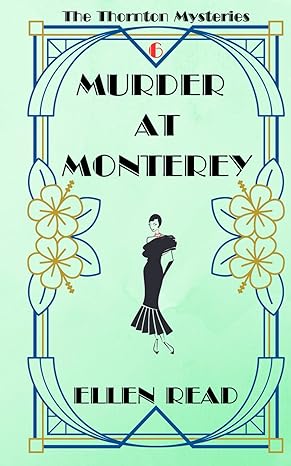
Ellen Read’s Murder at Monterey is a quintessential traditional murder mystery that transports readers into a world reminiscent of Agatha Christie’s iconic tales. The story revolves around two devoted sisters, Alexandra and Edith, who are invited to a grand party by Prudence, the enigmatic hostess. Their initial reluctance to attend, due to past encounters with the guest of honor, is overridden by the allure of a weekend getaway. Upon arrival, the sisters and their entourage mingle with the eclectic mix of guests, setting the stage for a suspenseful and tragic turn of events.
The narrative takes a dark twist when a guest is found dead, and another is discovered standing over the body, leading to a classic “whodunit” scenario. This homage to Christie’s masterpieces, such as the Hercule Poirot and Miss Marple series, grips the reader from the opening line, “Alexandra felt the loss…” The story is laced with foreshadowing, as exemplified by the line, “I, for one, hope we don’t have any murders while we’re there,” which expertly builds tension leading up to the murderous climax. Ellen Read’s adept use of dialogue enhances the suspense and character development, although the story takes its time to dive into the core action. This deliberate pacing allows readers to become intimately acquainted with the characters and their possible motives, enriching the overall narrative. As the sixth book in the series, Murder at Monterey showcases Read’s ability to create compelling characters and intricate plots.
Murder at Monterey by Ellen Read is a masterfully crafted murder mystery that pays homage to the classic works of Agatha Christie. Through meticulous character development and a well-paced narrative, Read weaves a tale of suspense and intrigue that keeps readers on the edge of their seats. Whether you’re a long-time fan of traditional murder mysteries or new to the genre, this book is a must-read that promises a thoroughly engaging experience. I eagerly await the next adventure in this series.
Pages: 217 | ASIN : B0D48RQQFL



 LITERARY TITAN