Blog Archives
Listen and Learn


Come, Find Space With God is a guide to Christian spiritual formation designed for readers moving into adulthood and spiritual self-awareness. Why was this an important book for you to write?
We both recall our own mistakes along our journeys and realize how beneficial it would have been to receive wise, empathetic counsel early on. Come, Find Space with God offers wisdom and formation through stories, reflection, sacred reading, and practices that we wish we had access to during our times of transition. We could have benefited from experiencing more reflective spaces to slow down and listen to the still small voice of wisdom
What spiritual challenges do you think young adults face today that previous generations may have experienced differently?
Today’s young adults seem much busier, distracted, overwhelmed, stressed, confused, lonely, and depressed than previous generations. They hear a variety of conflicting opinions on social media; connections may be superficial and shallow, and may not be in person. The culture around them is moving at far too fast a pace to even process issues and make wise choices. They need to listen and learn from ancient spiritual ways of finding balance, peace, and freedom.
Was there a story in the book that was especially difficult to write about?
The story in Evaluating my thoughts and plans was the most challenging to write. I prefer people to think of me (Leoma) as a competent, self-assured person. Most of us want to project that persona. So, to describe the many ways in which I feel insecure, incompetent, and “less-than” in a public forum is daunting. However, I’ve learned over the decades that God’s opinion of me is the most important thing, not what anyone else thinks.
How can readers create a rule of life that feels realistic rather than overwhelming?
The book provides questions and structures in order to create the reader’s own rule of life that fits with his or her stage, schedule, vision, and purpose in life. The idea is really to take time with this and not rush the reflective process. Ultimately, a rule of life should bring balance, provide focus and clarity, offer spiritual growth, and free the reader up from being overwhelmed with life. A good rule of life should include SPACES in days for stillness to reconnect spiritually, and often, less is more. Mainly, this process needs to be about observing your daily habits and activities first and considering if they are still a good fit or if some things could be eliminated, especially time sucks like scrolling the internet or watching too much news. This needs to be intentional, or we will fill our time up and wonder why we have no peace. Not all the questions in the book need to be answered in one sitting; keep it simple.
Author Links: GoodReads | Facebook | Website | Amazon
Come Find Space with God offers spiritual practices and reflections to help individuals navigate life’s challenges and deepen their relationship with God.
Come, Find Space With God


Come, Find Space With God, by Leoma Gilley and Carol Mullen, is a contemplative guide to Christian spiritual formation, written especially for readers moving into adulthood, responsibility, uncertainty, and spiritual self-awareness. The book walks through practices such as stillness, Scripture meditation, prayer, examen, discernment, surrender, sacred community, service, and a rule of life, pairing biblical reflection with personal stories and practical exercises. Its central invitation is simple but searching: make room for God not as another obligation, but as the One who can reshape fear, hurry, wounded thinking, and restless striving into a steadier life of trust.
What I found most affecting was the book’s refusal to treat spiritual growth as tidy or abstract. Leoma’s stories give the material weight: her prayer counseling in England, where a first-grade memory still carried the sting of shame; her long argument with God about Africa; her years caring for her mother; her decision to welcome Ben, Sara, and John into her home even when hospitality became costly and inconvenient. These moments keep the book from floating into devotional softness. The ideas here are deeply pastoral. “Space” is not presented as a pretty metaphor. It becomes a house opened to someone in need, a schedule interrupted, an ambition surrendered, a harsh inner voice confronted, a grief carried honestly before God.
The writing is warm, direct, and companionable, with a rhythm that feels suited to reflection. I appreciated how the authors blend story, Scripture, music, journaling prompts, and spiritual practices without making the reader feel rushed or managed. The structure can feel instructional, especially when the chapters move from story into exercises and group questions, but that same structure is also part of the book’s usefulness. I was especially drawn to the chapters on discernment, negative self-talk, and service because they press into the places where faith becomes concrete: what we do with fear, how we interpret our own failures, and whether we can serve without needing to fix people.
Come, Find Space With God speaks with the calm authority of people who have been formed by long obedience, real disappointment, and repeated redirection. The concluding emphasis on a rule of life gives the book a fitting sense of movement, as though all the earlier practices are gathering into a sustainable pattern rather than a burst of temporary inspiration. I’d recommend this book to Christians in seasons of transition, especially young adults, small groups, spiritual direction groups, and readers who feel crowded by anxiety, decision fatigue, or spiritual noise and want a grounded way to begin listening again.
Pages: 129 | ASIN : B0GX2XNR2T

I Feel I’m Writing History

In Life in a Tumble Dryer, you share with readers your experiences living in Khartoum, Sudan structured around letters to your cousin detailing friendships, survival tactics, and the bureaucracy. Why was this an important book for you to write?
There never seemed to be a good time to share my stories about life in Sudan with my family or friends. Also, life is so different there that it is impossible to explain in a short time. One story may be interesting, but without the context, the deeper implications are lost. I love the Sudanese and want others to get to know them and appreciate the wealth of insight and wisdom they have to offer. With the horrible events going on at this time in the country, I feel I’m writing history as many of these people and places are no longer there. I was blessed to be there from the 1980s to the early 2000s.
I appreciated the candid nature with which you told your story. Is there anything from your time in Khartoum that you now wish you had included in your memoir?
Actually, there are many more stories that will be included in the next book in the Not How I Planned it series. In 1996, I joined the University of Khartoum as an Assistant Professor, and there are many stories soon to come.
How did you decide on the title for your memoir?
Khartoum is very hot with temperatures over 115°F much of the year. Initially, the roads were very bumpy, but also the political climate was not favorable towards the work we were doing. There was a great deal of uncertainty and we found it best to have multiple plans in place. I never quite knew what to expect on any given day.
What is one thing you hope readers take away from your experiences?
Sudan gets a lot of bad press, much of it deserved. But there is another side to the story that includes the hospitality, generosity, kindness, and strength of the Sudanese people. They care deeply about their families, their language and culture, and they are gracious to overlook the missteps and blunders of people like me who seek to offer technical assistance and genuine friendship.
Author Links: GoodReads | Facebook | Website | Instagram
Life in a Tumble Dryer: Living and Working in Khartoum, the World’s Hottest Capital (Not How I Planned It)
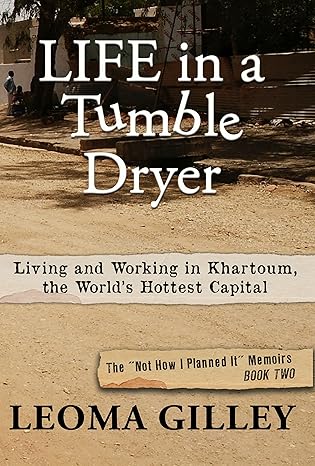

Life in a Tumble Dryer is Leoma Gilley’s vivid and deeply personal memoir of her years living and working in Khartoum, Sudan, specifically the sweltering, dust-choked, unpredictable chaos of everyday life in the world’s hottest capital. The book is structured around letters to her cousin Harriet and weaves together tales of linguistic research, cultural missteps, bureaucratic wrangling, unexpected friendships, and survival tactics in a place where the electricity vanishes with the heat and dust storms sneak up like petty thieves.
What really stuck with me from the start was how sharply Leoma captures the absurdity and humor of adapting to a totally different way of life. Her story about arriving in Khartoum with 256 kilograms of luggage, complete with solar panels, books, and fans, only to be delayed by a flat tire on the tarmac at 3 a.m. is a peak travel nightmare. But she tells it with a wink and grit that made me laugh out loud. Even funnier, she ends up in the wrong airport queue behind Orthodox Jews boarding an El Al flight, while she’s bound for Sudan, one of those “what even is my life” moments you just can’t make up.
But the memoir isn’t all quirky misadventures. What’s most powerful is the subtle unraveling of her own assumptions. Leoma is honest about her initial sense of control and expertise, especially when it comes to linguistics. But then, in a scene that humbled even me as a reader, she recalls how a colleague gently reminded her that it’s not her job to decide for people what their language or culture should look like. “It is their language and thus their decision,” she’s told. That moment comes back again and again, and it’s the soul of the book. She’s not there to fix anything; she’s there to walk alongside. That shift in mindset is deeply moving, especially when so many “aid” narratives fall into the trap of saviorism.
The book is more a series of letters and anecdotes than a tightly plotted memoir, so it’s best to read it slowly, maybe a chapter at a time. Still, that format is part of its charm. The chapter where she writes a parody song called “The Yellar Dust of Khartoum” had me wheezing, especially the line: “Your oily skin is daily dried by that abrasive touch, but one good thing about it, it doesn’t cost that much.” There’s something about surviving in a brutal climate with nothing but a fan, peanut butter on sour crepes, and a sense of humor that made me love this book all the more.
By the end, I felt like I knew Khartoum, its smells, its setbacks, its kindnesses, and I admired Leoma not just for what she did there, but how she let herself be changed by the place. Life in a Tumble Dryer is perfect for readers who love honest travel writing, especially memoirs with heart, humor, and a dose of humility. If you’ve ever tried to make a home somewhere wildly unfamiliar or wondered what it would take, this book is for you.
Pages: 319 | ASIN : B0DSLP2V12


