Blog Archives
A Life in Too Many Margins


S. E. Thomson’s A Life in Too Many Margins: Laughing Through the Labels is a whip-smart and emotionally stirring memoir that opens in a hospital room, David, chronically ill and exhausted, finally believed after months of dismissal, staring at the “beige hospital blanket” and coping with gallows humor as doctors confirm an omental infarction tied to Ehlers-Danlos Syndrome. From there, the book moves through a childhood and adulthood spent ricocheting between forced gender roles, neurodivergent masking, disability and medical trauma, and the slow, hard-earned assembly of a self, one chapter at a time, like a life rebuilt from receipts and radiology reports.
I liked the voice in this book. It’s not “funny” as decoration; it’s funny as a crowbar. In the prologue alone, the humor keeps snapping the seal on the airless jar of medical neglect: the hospital gown “afraid of commitment,” the Jell-O christened Gary, the pain described as a “damp grocery bag full of bees.” That comedic metabolism doesn’t dilute the suffering; it metabolizes it, turning indignity into something you can hold up to the light without going blind. I found myself laughing, then immediately feeling implicated, because the joke keeps pointing back to the systems and people who require disabled folks to audition for basic credibility.
I also didn’t expect the book to be so precise about the small origin-moments that become a lifelong weather pattern. The early sections about gender feel like being trapped in a brightly colored room where everything is a script you didn’t agree to learn; the “pink” isn’t just décor, it’s enforcement. And when the narrative arrives at pronouns later, quietly, almost offhand, in a classroom roll call, it lands with the force of a key finally fitting a lock: “Uh, I don’t care?” becomes the hinge that swings the door open. The moment David names it, I am transgender… I am a man, it’s rendered not as a glossy reveal, but as an “ohhhhhhh” that rearranges decades of memory in one night. That ordinariness is the point. Self-recognition isn’t always fireworks; sometimes it’s just the first time someone asks the right question in a room that doesn’t punish honesty.
This is for readers who gravitate toward memoir, humor, disability, neurodiversity, LGBTQ+, and trauma recovery narratives, especially anyone who’s ever been treated like a “case” instead of a person, or who wants a story that makes space rather than demanding palatability. If you like the sharp, self-protective candor of Jenny Lawson (or the laughter-through-the-bruises essay energy of Samantha Irby), Thomson’s voice will feel familiar. And when the book closes by insisting, without sentimentality, that if your body is falling apart and no one believes you, you should write it down because it might save someone else’s life, it doesn’t read like a slogan; it reads like a field note from a survivor.
Pages: 229 | ASIN : B0FL6XG768

Loss Fuels a Life

Loss Fuels a Life is a queer erotic crime novel that follows Ivan Dorn, a globe-trotting classical music critic, whose life is ripped apart when his best friend Rye, a Toronto tech whiz and sex worker, is found dead in what looks like a kinky suicide gone wrong. As Ivan digs into Rye’s emails, videos, and clients, he discovers footage that points to murder and to “Upstairs Daddy,” a wealthy older benefactor named Harold, whose world stretches from a Palm Springs gay resort to a sleazy film set in Los Angeles. Around them orbit hustler turned actor Andreas, Harry’s bitter daughter Melissa, and a whole ecosystem of critics, festival insiders, and sex partners, all tangled up in money, desire, and lies. The book moves between Toronto apartments, desert pools, and casting couches, and builds toward a bloody, messy finale where attempts at revenge leave more than one body on the floor and no one walks away clean.
I was pulled along by the sheer energy of the writing. The style is lurid, breathless, and very visual. Scenes of sex, murder, and concert halls all get the same close-up treatment, and that gives the book a strange, nervy power. I liked how S. James Wegg uses the structure of emails, reviews, and camera footage to shift point of view and to keep dropping new information. The explicit scenes come early and often, and a few times I caught myself wanting more space to sit with what the characters are feeling in the aftermath. When the book slows down and lets Ivan grieve or scheme instead of just react, it really lands for me. Those quieter stretches in Toronto or in an empty hotel room hit harder than yet another trip to the lube drawer.
What I liked most were the ideas behind all the sweat and violence. The novel digs into power and dependency in queer relationships in a way that feels blunt and uncomfortable. Rye trades submission for rent and a sense of safety, Harry trades money for youth and denial, Andreas trades his body for access and leverage, and Melissa treats everyone around her as a threat to her inheritance. Loss sits in the middle of all that, not just Rye’s death but also Melissa’s dead mother, Harry’s health, Ivan’s illusions about his own sexuality and about his best friend. The title feels dead on. Grief becomes fuel for art, and also for obsession, bad choices, and finally murder. I liked that the book refuses to give me a neat moral. Ivan’s revenge is clumsy and cruel, and the story does not pretend that righteous anger automatically leads to justice.
I see Loss Fuels a Life as a bold, messy, very specific ride. The pages are full of graphic sex, BDSM, sexual violence, homophobia, substance abuse, and a detailed suffocation scene, so readers who are sensitive to those topics will want to steer clear. If you enjoy dark, character-driven stories about queer lives that sit at the crossroads of art, money, and desire, and you are comfortable with explicit content that never really lets up, this novel will probably get its hooks into you.
Pages: 248 | ASIN : B0G341Y3PX
TELL ME THAT YOU LOVE ME


In Tell Me That You Love Me, Connie Roberts narrates a restless, decade-tinged search for tenderness that keeps slipping into sex, friendship, and misread need, moving between New York City, Charleston, Fire Island, and Key West as the story escalates from raw erotic entanglements to genuine catastrophe. What begins as Connie’s attempt to reinvent herself and be chosen becomes a harsher education in how people use each other, how shame masks longing, and how “love” can be mistaken for the simple relief of being wanted.
This book doesn’t flirt with discomfort, it really commits. The eroticism is frequently charged, sometimes tender, and sometimes poisoned by power games and crossed boundaries; there’s an argument over “who did what to whom” that lands with a sour aftertaste because it’s played like banter while still naming rape outright. That tonal whiplash, sensuality set beside psychic bruising, feels deliberate, a reminder that harm often arrives in familiar voices, even in rooms that look safe.
And then the plot turns viciously public. On Fire Island, the story’s social sparkle (tea dances, beaches, the magnetic churn of summer bodies) is split by sudden violence: Connie learns that her friend Darin has been shot and is dead, rumors detonating faster than facts, police looming at the edges of the party. The murder isn’t used as a gimmick; it changes the temperature of everything, exposing how quickly a chosen family can become a crime scene, how fear rearranges loyalties, how the self tries to sprint away from grief. By the time the book reaches its late stretch, it’s no longer asking “Will she be loved?” so much as “What kind of love can survive the world she’s already lived?”
Readers who want erotic romance, dark romance, and emotional romantic suspense, especially stories that braid sex with queer-adjacent nightlife, messy friendship, and genuinely disturbing turns, are the best fit here (with a clear content-warning mindset for sexual violence and murder). If you’ve enjoyed the big-feelings sweep and relationship labyrinths of Taylor Jenkins Reid’s The Seven Husbands of Evelyn Hugo, this delivers a grittier, less polished cousin: more bruises, fewer soft-focus edges. The last pages in Key West widen into something like grace: a sail into the sunset, a rare “green flash” called a lucky omen, and Connie, finally, naming her love as improbable but real, choosing to believe she and Bill were “destined to be together.” Tell Me That You Love Me is a jagged, sensual novel that earns its ending by refusing to pretend the dark parts didn’t happen.
Pages: 411 | ASIN : B0FBY5KNSH

Mortal Vengeance: A Grim Tale

Mortal Vengeance: A Grim Tale, by Alejandro Torres De la Rocha, is a psychological thriller that works like an origin story: it follows a 17-year-old senior at the Jesuit-run Excelsior Academy, as the school’s cruelty, silence, and “character-building” discipline quietly shape the conditions for the future Grim Cojuelo killings. It’s framed as the “howdunit” prequel to another book in the same universe, tracing how institutional rot and personal guilt turn a Dominican folklore figure, the limping devil reimagined as a hunter, into something inevitable.
I really enjoyed the cinematic writing. The book opens with a staged, almost spoken-word setup, with a narrator and the killer stepping in like voices in a dark theater, and it keeps that heightened, performative feel even in ordinary moments. The school itself is described with a kind of glossy dread: stained glass, marble, crucifixes everywhere, and beauty that feels like a trap. Sometimes the language is intense, almost daring you to look away. It works, especially when it’s tied to sensory detail and not just mood. Other times, it can feel a little crowded with emphasis, like the book underlining its own points. Still, the voice commits. It wants you inside Julián’s head, where guilt is not abstract; it’s a pressure in the chest.
The author’s big choice, and I mean this in a good way, is to make the horror feel system-made. The most frightening scenes are not supernatural. They’re social. A teacher humiliates a student in public, classmates freeze, phones come out, and nobody with power stops it. Then you get a philosophy class where a priest asks, calmly, if it’s ever okay to lie, and suddenly the book is talking about survival, complicity, and the cost of telling the truth in a place that punishes it. That’s where the psychological thriller genre really clicks for me: it’s less about jump scares and more about watching a closed world tighten its rules until someone breaks. If you like school-set dread where the building itself feels like a character, it reminded me at times of the slow-burn pressure and moral rot in Donna Tartt’s The Secret History, and the “this place is shaping you” inevitability you get in Stephen King’s novel Carrie, even though the voice and cultural lens here are very much its own.
I’d recommend A Grim Tale to readers who want their thriller to have teeth, especially people interested in stories about institutions, religious power, and how silence gets enforced. One note, it does not tiptoe around heavy material, including trauma and grooming, so you really have to be in the right headspace. But if you’re drawn to psychological thrillers where the scariest thing is watching a system teach people to look away, you’ll appreciate what this book is doing, and how patiently it builds the sense that the monster is being assembled in plain sight.
Pages: 571 | ASIN : B0FPBB3ZDL
Mortal Vengeance


Mortal Vengeance, by Alejandro Torres De la Rocha, is a young adult supernatural thriller that follows a tight-knit but deeply troubled group of teens whose attempt to get revenge on a cruel teacher spirals into something far darker than any of them imagined. What starts as a grim school drama quickly escalates into a chain of betrayals, fear, and ultimately the appearance of a mythic, reaper-like being that shatters their lives. The book blends coming-of-age turmoil with horror and psychological suspense, and the shift from everyday cruelty to supernatural violence comes through sharp and sudden.
I was pulled into the heat and pressure of those classrooms and courtyards. The writing often leans intense, almost cinematic, with scenes described in a way that makes the emotions feel oversized, raw, and volatile. I caught myself thinking, these kids are carrying way more weight than they know how to hold. Marcos’s explosive anger, Mario’s guilt and fragility, Alex’s manipulative charm and insecurities, Melissa’s heartbreak, Enrique’s need to please everyone… every character is drawn with a kind of heightened emotional color. Sometimes it felt melodramatic, but in a way that matched the story’s pulse. The author’s choice to push sensations and metaphors to their limits gives the book a feverish energy, like the world is always one bad decision away from breaking.
What surprised me most was how quickly the story shifts from grounded teen conflict to something mythic and terrifying. One moment we’re dealing with bullying and revenge in a school hallway, and the next we’re staring down the Grim Cojuelo on a moonlit pier. That jump could have felt jarring, but for me, it worked because the emotional stakes were already running so high. The supernatural element feels like an extension of everything boiling inside these characters. Still, I found myself wishing for a few quieter beats where the emotions had room to breathe. When everything is dialed up, it can be hard to sit with the subtler moments. But there’s something gripping about how unafraid the author is to dive into intensity, whether it’s love, jealousy, fear, or guilt.
Mortal Vengeance is a story about how small cruelties grow into big consequences, and how revenge rarely lands where you expect. If you like young adult stories that mix school drama with supernatural horror, and you don’t mind a narrative that swings for big emotions instead of quiet restraint, this will be the perfect book for you. It’s a dramatic, dark, and sometimes chaotic ride, but it is delightfully entertaining.
Pages: 306 | ASIN : B0FDT6JYSQ
Our Lives Mattered

In Stateless in Paradise, you share your family history, personal struggles, and your fight for recognition. Why was this an important book for you to write?
Stateless in Paradise was important for me to write because for most of my life, my existence was defined by paperwork I didn’t have, borders I couldn’t cross freely, and decisions made about me without my voice. When you are stateless, your story is often reduced to a case number, a detention file, or a legal problem. Writing this book was my way of reclaiming my humanity.
I wanted to document my family history and personal struggles, not out of self-pity, but out of responsibility. Statelessness is usually invisible. Millions live it, yet very few stories are told from the inside—from the fear of detention, the humiliation of deportation, the loneliness of exile, and the quiet resilience it takes just to survive. By telling my story, I wanted to put a human face on a condition that is too often discussed only in legal or political terms.
The book was also a way to honor the people who shaped and saved me: my mother, who raised me with dignity despite displacement; the strangers who showed compassion when governments did not; and the few mentors and loved ones who believed in me when the system erased me. Their presence in the book is my way of saying that survival is never a solo act.
Finally, Stateless in Paradise was an act of resistance. Writing it was my fight for recognition—not just for myself, but for others who live in legal limbo. I wanted to leave a record that says: we were here, our lives mattered, and our stories deserve to be heard.
I appreciate the candid nature with which you share your experiences. What was the most difficult thing for you to share?
The most difficult thing for me to share was not a single event, but the emotional truth behind them—the shame, fear, and sense of invisibility that came with being stateless.
It was hardest to write about the moments when I felt completely powerless: sitting in detention knowing my fate depended on signatures and stamps, being deported without dignity, or living in exile in American Samoa, where time felt suspended, and my life reduced to waiting. Those experiences stripped me not only of freedom, but of identity. Admitting how deeply that broke me—how close I came at times to losing hope—was far more painful than describing the physical circumstances.
Equally difficult was exposing the quiet loneliness. Statelessness isolates you in ways that are hard to explain: you cannot plan a future, you hesitate to form attachments, and you learn to survive emotionally by numbing yourself. Writing about that emotional survival mechanism meant confronting parts of myself I had long buried just to keep going.
I also struggled with writing about my family, especially my mother. Her strength, sacrifice, and the weight of what she endured as a refugee still carry deep emotional gravity for me. Putting that on the page meant reopening wounds that never fully healed.
But I chose to include these truths because anything less would have been dishonest. If the book was going to matter, it had to reflect not only what happened to me, but what it did to me. And in sharing that vulnerability, I hoped readers might better understand the real human cost of statelessness—not as an abstract issue, but as a lived reality.
What is one piece of advice someone gave you that changed your life?
What stayed with me—and ultimately became my guiding principle—was very simple advice: stand for yourself. Fight for yourself, because in the end, no one else is going to do it for you. When you are stateless, you learn very quickly that you are on your own. Sympathy is rare, and systems don’t protect people without status.
There was also a sentence someone once said— I don’t even remember who—that became my personal motto: try to take everything from this life, whether it’s good or bad, because one day you’ll turn around and realize the game is over. That thought struck me deeply. It forced me to stay awake, to stay present, even in the worst conditions.
That mindset carried me through six months in a detention center in Houston, through one year and five months of exile in American Samoa, and through nearly twenty years of being stateless in the United States. When everything is taken from you—your documents, your freedom, your future—the only thing left is your will to keep going.
So the advice I lived by was not romantic or comforting. It was survival advice: fight, don’t give up, and keep moving forward, even when you’re exhausted, even when the system is against you. Because stopping means disappearing—and I refused to disappear.
What is one thing you hope your readers take away from Stateless in Paradise?
If there is one thing I hope readers take away from Stateless in Paradise, it is this: a person’s worth is not defined by their legal status.
I want readers to understand that behind every label—stateless, undocumented, refugee, detainee—there is a full human being with dreams, love, intelligence, and dignity. Statelessness is not a failure of character; it is a failure of systems. And yet, even inside those broken systems, people continue to endure, resist, and find meaning.
I also hope readers walk away with a sense of responsibility. Not guilt, but awareness. Awareness that freedom, mobility, and belonging are privileges many take for granted—and that these can be taken away overnight. When readers recognize that, compassion stops being abstract and becomes personal.
Finally, I want the book to leave people with courage. If someone who was erased by borders, detained, deported, and exiled could keep fighting and keep moving forward, then maybe readers facing their own battles—visible or invisible—will feel less alone. If the book does that, then telling this story was worth it.
Author Links: GoodReads | X (Twitter) | Facebook | Website | Instagram | Amazon
Stateless in Paradise is the deeply human journey of a man living between borders. From the South Pacific to West Africa, from Eastern Europe to the United States, Mikhail’s life is shaped by movement, uncertainty, and the constant negotiations required of someone without a recognized nation.
Forced into detentions, threatened with deportations, and stranded for months in American Samoa, he confronts the global systems that decide who belongs — and who does not. Yet this memoir is also filled with connection: the kindness of strangers, the discovery of chosen family, the beauty of cultures encountered, and the love story that becomes his safe harbor.
Bridges and Connections

In The Book of Oded, Chapter 2, you share with readers your most personal moments from love and loss to spiritual acceptance. Why was this an important book for you to write?
Why was this an important book to write, or why did I need to share my story? Well, when I first started writing this story, I didn’t actually feel a need to share it. I was working as an animator in a big Hollywood studio, and I felt like something was missing. After a few weekly meetings with a life coach, who was also my friend, I realized that what was missing from my life was ‘creativity.’ Being creative. I was working 12-hour days with a 2-hour commute each day, so when I’d get home, I was already too tired to do anything. My coach suggested writing. I had written a little when I was younger, but nothing serious, and so when I sat down to write, I still really didn’t know what to write about. I had a notebook and a pen, and I sat by my desk and stared at the blank page. A few moments passed, and suddenly, I picked up the pen and started writing. I wrote one sentence and stopped. I had no idea where that came from, but I knew EXACTLY what I was writing about. In the next few months, as I was writing the story, I was sure I was writing it for myself and myself only. I didn’t even share it with my husband of, then, 20 years.
Cut to about 4 years later. At the request of my acting teacher, I brought my unfinished story to class, and I was ready to read about 5 minutes of it and discuss the topic of one-actor-shows.
I was convinced that what I wrote wouldn’t resonate with anyone in class. Not just because there were very few openly gay students there, but also because, as my thoughts were telling me, “Who’s gonna want to hear about your troubles and issues? They probably have some of their own…” But I did it anyway. I stepped up to the stage, sat down, and started reading. I read and read until I finished all that I had written so far. I looked up. The class was still, and someone shouted: “And then? What happened next?” Apparently, I was reading for about 20 minutes, and I had everyone closely following me, and they, obviously, were finding my writing interesting.
This was my first discovery that what I wrote, as a personal and unique story, was indeed touching and resonating with others.
Cut again to about 2 years later. My husband and I produced my one-man-show with the story that, by then, was finished and polished into performable material. The show ran in a small theater in Hollywood for 9 weeks, had great reviews, and above all, showed me, again and again, how universal and relatable it was, even with a diverse and eclectic audience.
I understood that my story, more than changing me, has the power to help and improve the lives of others. I also realized that I cannot keep performing it because, emotionally, it was too hard. Time passed, and about 10 years after the show was over, the idea of making a book out of it came up. Somewhat ironic, since the name of the show is “The Book of Oded”…
So why did I need to share my story? Because I know that learning about what others have been through, what they were thinking, and how they got over the challenges in their lives, helps them with their own difficult life situations. As the viewers or readers resonate with the story, bridges and connections are being created, communities become more powerful, and the feeling that we are all closer, more than we think, becomes stronger.
I appreciated the candid nature with which you share your story. What was the most difficult part for you to write?
The difficult part of writing the book, since I was writing about real-life experiences and challenges that I went through, was reliving some of these events. Some that I, unknowingly, hid deep inside, trying not to have to deal with again. As I was writing and remembering or sometimes realizing new facts about what and why I acted the way I did, it was challenging to face that. At the same time, I found it cathartic, and I felt relieved that I could come to terms with those emotions.
What advice would you give someone who is considering writing their own memoir?
When I was writing what eventually became my book, I was not aiming to write a book, or a memoir, or anything specific. I was just following an inner urge to write. To spill onto the page a story that wanted to be revealed. I listened to that urge, and I answered it. Since then, I do my best to write in the same way. I don’t want to push anything, to force anything. I write with a flow that comes naturally. Recently, I started writing fiction, and I am not saying, “I’m writing a book.” I’m just writing. I’m giving myself the space and the ease of not knowing until I know. That is my advice. Write with ease. Enjoy the process.
Be kind to yourself.
What is one thing you hope your readers take away from The Book of Oded, Chapter 2?
I hope something they read in my book touches their heart. What I mean by that is simple: something that makes them feel. It can be anger, sorrow, hope, any kind of feeling. I believe that our feelings are like a compass, helping us navigate through life. If anything makes us feel, and we pay attention to it, we get to take some steps on our life path and get more clarity about our life goals and life purpose.
Author Links: GoodReads | Website | Amazon
This real-life memoir follows Oded Kassirer’s journey through love in its many forms—love that comforts, love that tests us, and love that stays even when people are gone. With honesty and openness, Oded shares moments from his own life, weaving together memory, relationships, and the everyday search for meaning.
Each part begins with an image, creating a rhythm of words and photos that invite the reader to pause, reflect, and connect. The book moves gently between joy and loss, humor and sorrow, offering a window into how love shapes us over time.
The Book of Oded, Chapter 2 is both deeply personal and universal—a reminder that behind every story of one life, there is also the story of love itself.
The Book of Oded, Chapter 2
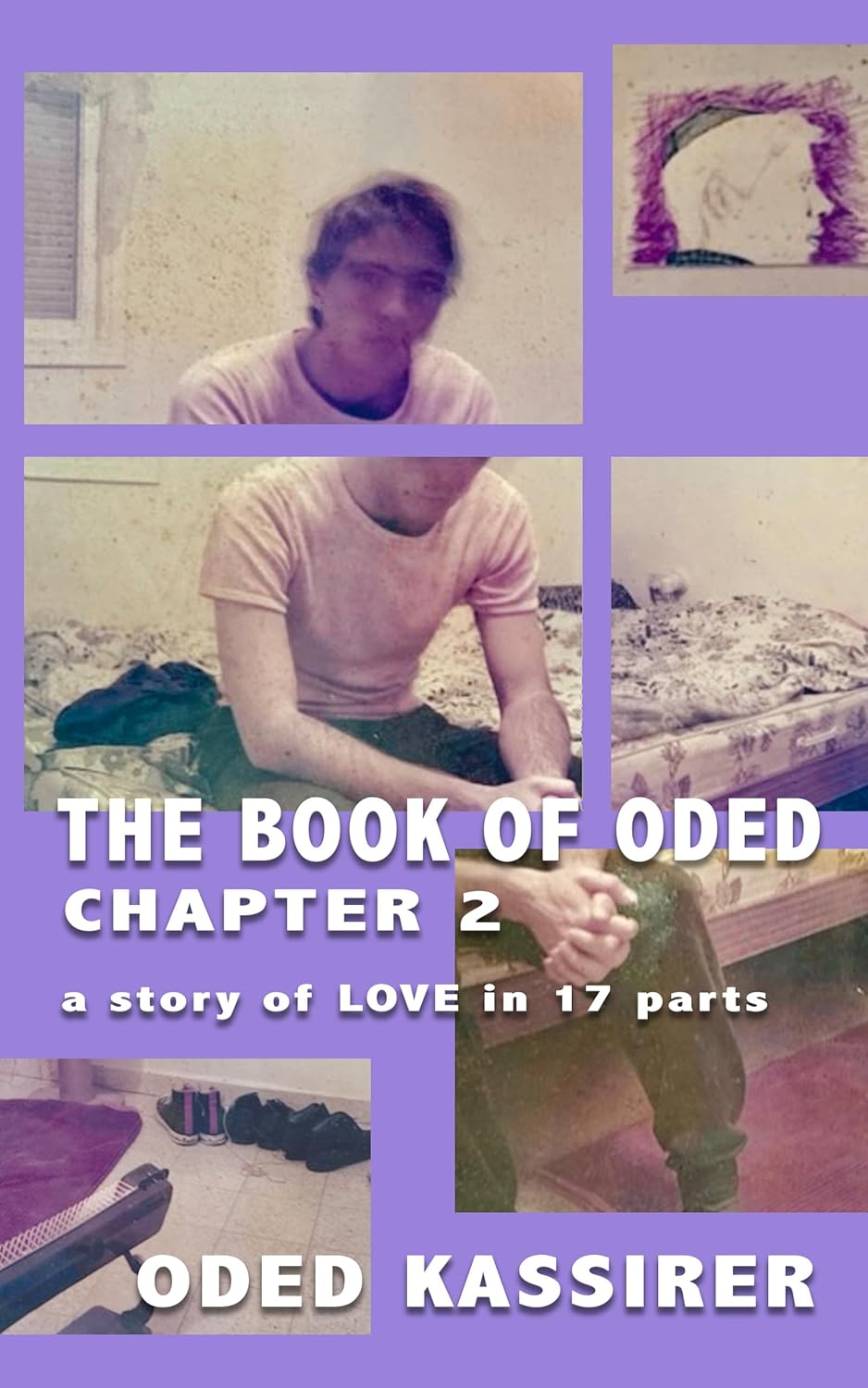
The Book of Oded, Chapter 2 tells the story of a young Israeli man whose life spins through love, identity, migration, and loss. It begins with Oded racing through Tel Aviv to share his green card news with his boyfriend, Gil, and then expands into a rich, heartfelt memoir about how their relationship began, how it grew, and how it changed when HIV entered their lives. The book follows Oded from his army days to his first years in Los Angeles, through joy, heartbreak, separation, friendship, and finally grief and spiritual acceptance. It becomes a story about love that keeps changing shape yet never quite disappears.
The writing feels relaxed and honest, like a friend sitting across from me telling me their story. I loved the humor tucked inside the pain. I laughed at the stories about Na’alei Kvasim slippers and the matching striped shirts at Shabbat dinner, little moments that make the book feel alive. Then the tone shifts and sinks when needed, especially in the phone call that delivers Gil’s diagnosis. I felt myself slow down as the story did, almost holding my breath at times. The simplicity of the writing makes the emotions stand out even more. There is no attempt to impress. It just speaks plainly, and that makes it powerful.
I also found myself moved by how the book tracks what love can become over the years. Oded does not hide the messy parts. He admits the silence, the drifting, the resentment, the guilt. That honesty made me trust him as a narrator. I could feel how love for Gil kept expanding even as their lives pulled apart, and how caring for someone can be both an anchor and a weight. The dream near the end, where Gil appears in white and disappears in a hug, was very emotional. It felt like closure that grew from feeling rather than logic, and I found myself sitting quietly after reading it.
This book feels perfect for anyone who likes real stories told without pretense. If you enjoy memoirs about love, identity, or resilience, you will probably connect with this one. It is also a meaningful read for anyone who has lost someone and is still figuring out what to do with the love that remains. I would happily recommend it.
Pages: 61 | ASIN : B0FVD1N895


